
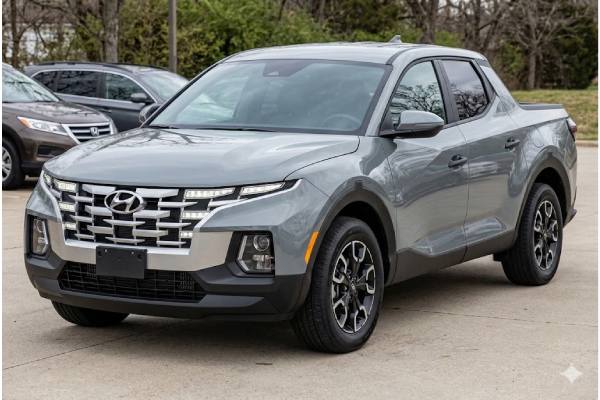
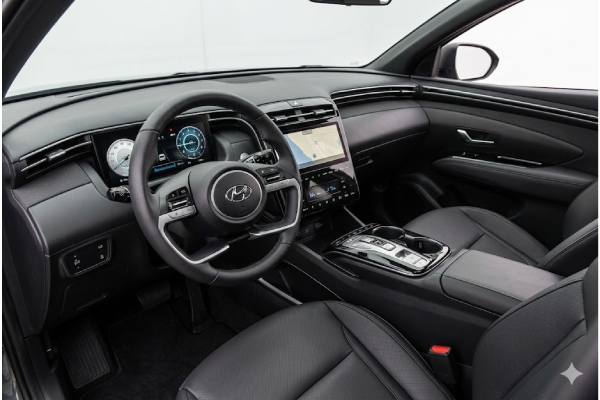
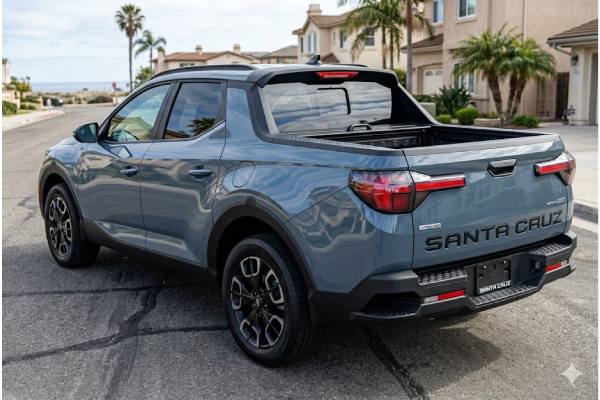
The Hyundai Santa Cruz with HTRAC AWD and the naturally aspirated Smartstream G2.5 GDI + MPI engine is the calmer, simpler version of Hyundai’s compact unibody pickup. It does not have the strong mid-range thrust or 5,000 lb tow rating of the turbocharged model, but it offers a more conventional 8-speed torque-converter automatic, lower mechanical complexity, and a useful mix of crossover comfort and open-bed practicality.
Although the Santa Cruz appeared in 2021 as a launch/production vehicle, the North American retail model years begin with 2022. The 191 hp 2.5-liter AWD version is most relevant to buyers comparing compact pickups, crossover-based utility vehicles, and used Santa Cruz SE/SEL-style trims. Its strengths are everyday drivability, manageable size, available all-weather traction, and good safety equipment; its main limitations are modest acceleration, a short bed, and the need to verify recalls and service history carefully.
Owner Snapshot
- The 2.5 GDI/MPI engine is smoother and simpler than the turbo version, with 191 hp and a conventional 8-speed automatic.
- HTRAC AWD improves wet-road, snow, gravel, and light-trail traction without turning the Santa Cruz into a body-on-frame truck.
- The 52.1 in bed, underfloor storage, and compact footprint make it useful for daily driving and light hauling.
- Check VIN-specific recalls, especially roof molding, tow-hitch harness, and 2024 power-steering campaigns.
- Normal engine-oil service is typically around 8,000 miles or 12 months; severe use is closer to 5,000 miles or 6 months.
Table of Contents
- Santa Cruz HTRAC AWD Context
- Santa Cruz G2.5 Technical Specs
- Santa Cruz Trims and Safety Tech
- Reliability, Recalls and Known Issues
- Maintenance Schedule and Buying Checks
- Driving Character and Real Economy
- Santa Cruz Against Compact Rivals
Santa Cruz HTRAC AWD Context
The Santa Cruz is Hyundai’s compact “sport adventure vehicle,” but in practical terms it is a Tucson-based unibody pickup with a four-door crew cab, five seats, and a short but genuinely useful cargo bed. The NX4A/NX4-OB wording is connected to Hyundai’s fourth-generation Tucson/Santa Cruz family documentation, while some U.S. service and recall material identifies the Santa Cruz separately from the Tucson. For owners and buyers, the important point is that this is not a traditional ladder-frame truck. It is a crossover-derived pickup designed for mixed commuting, weather confidence, weekend cargo, bicycles, gardening supplies, small trailers, and outdoor gear.
The 2.5-liter Smartstream G2.5 GDI + MPI engine is the base gasoline engine in the early Santa Cruz lineup. It uses both gasoline direct injection and multi-port injection, a useful combination because port injection can help keep intake-valve deposits less troublesome than on older direct-injection-only engines. Output is 191 hp at 6,100 rpm and 181 lb-ft at 4,000 rpm, which is adequate but not muscular once the vehicle is loaded or climbing grades.
HTRAC AWD is an on-demand all-wheel-drive system. In normal driving, it behaves like a front-biased system and sends torque rearward when the control unit sees traction demand, throttle input, steering angle, wheel slip, or selected drive modes. It is helpful in rain, snow, gravel, wet grass, and steep driveways, but it does not include low range, locking axles, or the heavy-duty cooling and frame hardware of a midsize truck.
The best fit for this exact version is a buyer who wants the Santa Cruz shape and bed utility but does not need the turbo model’s stronger acceleration or maximum towing rating. It is also appealing for used shoppers who prefer the more conventional 8-speed automatic over the turbo model’s wet dual-clutch transmission. The trade-off is clear: the 2.5 HTRAC AWD is easiergoing and potentially less complex, but it asks for patience during passing, merging, and towing.
As a used purchase, the Santa Cruz deserves the same checks as a compact crossover plus a few truck-specific checks: bed wear, tow-hitch wiring, rear suspension condition, AWD fluid seepage, underbody impacts, and recall completion. A clean, serviced example can be a versatile daily vehicle, but a neglected one can quickly become expensive if AWD, electronics, or body-related campaigns have been ignored.
Santa Cruz G2.5 Technical Specs
The following specifications focus on the naturally aspirated 2.5-liter GDI/MPI AWD version. Some values vary by market, model year, trim, tire package, accessory load, and VIN. Service capacities that are not reliably published as universal values should always be checked against the under-hood label, service information, or dealer VIN lookup.
Powertrain, Driveline and Efficiency
| Item | Hyundai Santa Cruz HTRAC AWD 2.5 GDI/MPI |
|---|---|
| Engine code | Smartstream G2.5, commonly G4KN family |
| Layout | Front transverse inline-4, 4 cylinders, DOHC, 4 valves/cylinder |
| Bore × stroke | 88.5 × 101.5 mm; some extracted spec sheets show a likely bore typo, so verify by service data |
| Displacement | 2.5 L; 2,497 cc |
| Induction | Naturally aspirated |
| Fuel system | GDI + MPI dual injection |
| Compression ratio | 13.0:1 |
| Maximum power | 191 hp; 142 kW at 6,100 rpm |
| Maximum torque | 245 Nm; 181 lb-ft at 4,000 rpm |
| Timing drive | Timing chain; no routine belt replacement interval |
| Transmission | 8-speed torque-converter automatic with SHIFTRONIC; exact unit code should be verified by VIN |
| Drive type | HTRAC AWD, front-biased on-demand system |
| Differentials | Open axle differentials with electronic traction control; no mechanical locker |
| EPA efficiency, AWD | 21 city / 25 highway / 23 combined mpg US; about 11.2 / 9.4 / 10.2 L/100 km |
| Real highway at 120 km/h | Typically about 9.5–11.0 L/100 km depending on tires, wind, load, roof accessories, and terrain |
Chassis, Dimensions and Capacities
| Item | Specification |
|---|---|
| Front suspension | MacPherson strut, independent |
| Rear suspension | Multi-link independent |
| Steering | Electric rack-and-pinion; approx. 14.2:1 ratio, about 2.6 turns lock-to-lock |
| Brakes | Front ventilated discs 325 × 30 mm; rear solid discs about 325 × 12 mm |
| Common tire size | 245/60 R18 on many SE/SEL 2.5 models; 245/50 R20 on some higher trims and packages |
| Ground clearance | 218 mm; 8.6 in |
| Approach / departure / breakover | Approx. 17.5° / 23.2° / 18.6° |
| Length / width / height | 4,971 / 1,905 / 1,694 mm; 195.7 / 75.0 / 66.7 in |
| Wheelbase | 3,005 mm; 118.3 in |
| Turning circle | Approx. 12.1 m; 39.6 ft |
| Curb weight | Approx. 1,750–1,785 kg; 3,860–3,930 lb for 2.5 AWD, depending on trim and equipment |
| GVWR | Approx. 2,390–2,545 kg; 5,270–5,610 lb depending on trim |
| Fuel tank | 67 L; 17.7 US gal; 14.7 UK gal |
| Bed length | 52.1 in; about 1,323 mm |
| Bed volume | Approx. 764–765 L; 27.0 ft³, SAE-style pickup-bed volume |
| Towing capacity | Up to 1,588 kg; 3,500 lb with the naturally aspirated 2.5 engine where properly equipped |
| Payload | Often around 640 kg; 1,411 lb, but door-jamb payload label is the authority |
Fluids, Service Data and Safety
| System | Specification or note |
|---|---|
| Engine oil | SAE 0W-20 full synthetic, API SN PLUS/SP or ILSAC GF-6; capacity about 5.8 L / 6.1 US qt with filter |
| Oil drain plug torque | Approx. 39 Nm; 29 lb-ft; replace sealing washer |
| Coolant | Hyundai-approved ethylene-glycol coolant for aluminum engines; 50/50 mix is typical; capacity should be confirmed by VIN |
| Automatic transmission fluid | Hyundai Genuine ATF SP4M-1 or approved equivalent; service fill level is procedure-based |
| Transfer case / rear differential | Use Hyundai-specified hypoid gear oil; commonly GL-5 75W-85 class, but verify by VIN and component tag |
| A/C refrigerant | Usually R-1234yf on this generation; exact charge is on the under-hood A/C label |
| Wheel nut torque | Approx. 137–157 Nm; 101–116 lb-ft |
| NHTSA safety rating | 2024 model commonly listed with 5-star overall rating; rollover rating 4 stars |
| IIHS safety rating | 2024 Santa Cruz: Top Safety Pick; Good small overlap, Good updated side, Good headlights, Marginal updated moderate overlap |
| Euro NCAP | No mainstream Euro NCAP Santa Cruz rating; the model was mainly a North American-market vehicle |
Santa Cruz Trims and Safety Tech
For the 2021–2024 launch-generation Santa Cruz, trim names and equipment vary by country. In the U.S., the naturally aspirated 2.5-liter engine is mainly associated with lower and mid trims such as SE and SEL. The turbocharged 2.5T models, including higher trims such as Night, XRT, and Limited in later years, are mechanically different enough that they should not be treated as the same vehicle for towing, acceleration, transmission behavior, or recall relevance.
The 2.5 GDI/MPI AWD version is the practical middle ground. It gives buyers the bed, available HTRAC traction, and most of the core safety systems without the extra powertrain complexity of the turbo/DCT combination. The most obvious identifiers are the absence of “2.5T” performance equipment, an 8-speed automatic rather than the wet dual-clutch transmission, and usually 18-inch wheels on base/mid trims. A window sticker, build sheet, or VIN decode is the safest way to confirm engine, transmission, AWD, tow package, and factory options.
Key year notes are useful for used buyers. The 2022 model year launched the Santa Cruz in North America. The 2023 lineup carried forward the basic formula and added or adjusted appearance and package content depending on market. For 2024, Hyundai made meaningful equipment changes, including broader LED headlight availability and the introduction of the more rugged-looking XRT trim, although XRT belongs to the turbo side of the lineup in the U.S. The naturally aspirated AWD versions remained focused on everyday value rather than maximum performance.
Safety equipment is one of the Santa Cruz’s stronger points. Standard and available systems include forward collision-avoidance assist, lane keeping assist, lane following assist, driver attention warning, blind-spot collision-avoidance assist, rear cross-traffic collision-avoidance assist, rearview camera, safe exit warning, stability control, traction control, hill-start assist, and multiple airbags. Higher trims and packages can add adaptive cruise control, surround-view camera, blind-spot view monitor, navigation-based features, and more advanced convenience equipment.
The IIHS picture is positive but not perfectly uniform across years and test versions. Early models did well in original crashworthiness tests, while the stricter updated tests introduced more nuance. The 2024 model’s Top Safety Pick status is helped by stronger headlight performance and updated side-impact results, but the updated moderate-overlap result remains worth noting. Buyers carrying rear-seat passengers often should pay attention to production date and test applicability, not just the headline award.
Child-seat support is conventional for the class, with rear LATCH/ISOFIX-style lower anchors and top tethers. The rear bench is usable, but rear legroom is not generous compared with larger pickups or midsize SUVs. Families should test actual child seats before buying, especially rear-facing seats behind taller front occupants.
ADAS calibration matters after body repair, windshield replacement, radar work, suspension repair, wheel alignment, or front-end collision repair. A Santa Cruz that has had bumper, grille, windshield, steering, or suspension work should have documentation showing proper calibration where required. Poor calibration can cause false warnings, weak lane support, or unavailable driver-assistance functions.
Reliability, Recalls and Known Issues
The naturally aspirated 2.5-liter Santa Cruz has one important reliability advantage over the turbo model: it avoids the turbocharger hardware and the 8-speed wet dual-clutch transmission used in higher-output versions. That does not make it problem-free, but it narrows the list of expensive powertrain concerns. Most ownership risk is tied to recalls, electronics, body trim, AWD service neglect, and normal wear rather than one widely proven catastrophic weakness.
| Issue area | Prevalence | Severity | Symptoms and practical remedy |
|---|---|---|---|
| Open recalls | Common enough to check every vehicle | Medium to high | VIN shows incomplete campaign; have a Hyundai dealer complete recall work before purchase or soon after |
| Roof molding retention | Known campaign on certain 2022–2023 vehicles | Medium | Loose or lifted roof trim; dealer inspection, securing, or replacement under recall where applicable |
| Tow-hitch harness water intrusion | Relevant when equipped with affected accessory harness | High because of fire risk | Accessory tow wiring present; verify recall completion and updated fuse/wiring remedy |
| 2024 MDPS electric power pack | Limited affected build range | High | Warning light or loss of steering assist; dealer replaces motor-driven power steering electric power pack |
| GDI deposits | Occasional over higher mileage | Low to medium | Rough idle, misfires, hesitation; dual injection helps, but poor fuel, short trips, and neglected maintenance still matter |
| Oil consumption or leaks | Not a dominant pattern, but should be checked | Medium | Low dipstick level, burning smell, seepage; document oil use and inspect valve cover, pan, filter housing, and drain plug |
| AWD transfer/rear differential wear | Occasional, more likely with towing, water, or neglected fluid | Medium | Whine, binding, seepage, vibration; inspect mounts, seals, prop shaft, rear coupler, and fluid condition |
| Suspension and tire wear | Common as mileage rises | Low to medium | Uneven tire wear, clunks, wandering; check alignment, bushings, struts, rear links, and wheel bearings |
The major recall distinction is that some headline Santa Cruz powertrain recalls apply mainly to turbo/DCT models, not the 191 hp 2.5 automatic. The 8-speed DCT recall is important when comparing the broader Santa Cruz lineup, but it is not the same transmission used in this naturally aspirated version. The turbo oil-feed-pipe recall likewise belongs to turbocharged vehicles. A buyer should still check all campaigns by VIN because model-year and equipment boundaries are not always obvious from trim badges alone.
Software updates can also matter. Transmission, engine, infotainment, camera, ADAS, and body-control updates may address shift feel, warning messages, connectivity faults, or driver-assistance behavior. A service history showing dealer visits and campaign completion is more valuable than a seller’s verbal reassurance.
Pre-purchase checks should include a cold start, a hot restart, a long road test, full-throttle merge, slow parking-lot turns, brake stops from highway speed, and a scan for stored or pending diagnostic codes. On AWD models, listen for rear driveline noise and check for binding during tight turns. Inspect the bed floor, under-bed storage, tailgate, tonneau rails if fitted, hitch wiring, rear bumper area, and underside for towing damage or corrosion.
Corrosion is usually less about frame rot, because this is a unibody vehicle, and more about exposed underbody hardware, suspension fasteners, brake components, seams, chips, and vehicles used on salted roads. Any Santa Cruz from a snow-belt area should be inspected on a lift.
Maintenance Schedule and Buying Checks
Maintenance on the 2.5 HTRAC AWD Santa Cruz is straightforward if the vehicle is used like a crossover. It becomes more demanding when used for frequent short trips, heavy traffic, dusty roads, mountain driving, towing, roof loads, salted winter roads, or repeated cargo hauling. Hyundai’s normal schedule is a good baseline, but many owners fall into severe-service use more often than they think.
| Item | Practical interval | Notes |
|---|---|---|
| Engine oil and filter | About 8,000 miles / 12 months normal; about 5,000 miles / 6 months severe | Use 0W-20 full synthetic meeting Hyundai/API/ILSAC requirements; verify level between services |
| Tire rotation | About 8,000 miles / 12 months | Important for AWD tire diameter consistency; inspect brakes during rotation |
| Cabin air filter | About 16,000 miles / 24 months, or yearly in dusty areas | A clogged filter reduces HVAC performance and defogging |
| Engine air filter | Inspect regularly; replace around 24,000 miles or sooner in dust | A dirty filter can affect economy and throttle response |
| Brake fluid | Inspect regularly; replace around 48,000 miles / 48 months or sooner if moisture is high | Use the correct DOT-rated brake fluid and bleed ABS-compatible systems properly |
| Spark plugs | Around 96,000 miles / 156,000 km on the naturally aspirated 2.5, unless symptoms occur earlier | Use OEM-equivalent iridium plugs and correct torque |
| Coolant | First replacement around 120,000 miles / 120 months; then shorter follow-up intervals | Use Hyundai-approved coolant; do not mix random coolant chemistry |
| Automatic transmission fluid | Often no routine service under normal use; inspect or service earlier under severe use | Towing, heat, and city use justify more conservative fluid planning |
| Rear differential and transfer case | Inspect periodically; replace if contaminated, submerged, towing often, or noisy | Use the VIN-correct Hyundai gear oil specification |
| Timing chain | No scheduled replacement | Investigate rattle, timing-correlation codes, poor oil history, or tensioner/guide noise |
| Serpentine belt and hoses | Inspect from about 60,000 miles onward | Replace for cracks, glazing, swelling, seepage, or noise |
| 12 V battery | Test yearly after 3 years; many last 4–6 years | Weak batteries can cause electronic faults and start/stop issues where equipped |
A good used Santa Cruz should have oil-change receipts, recall proof, tire history, brake service records, and evidence that the AWD system has not been ignored. Because payload and towing are common reasons to buy a Santa Cruz, inspect rear tires, rear dampers, hitch hardware, wiring, and bed condition closely.
The best years to seek depend on budget. A 2024 example has stronger equipment content and safety-rating advantages, but it can still need VIN-specific recall checks. A 2022 or 2023 can be a good value if roof molding and tow-hitch campaigns are completed and the vehicle has not been abused. For buyers who do not need maximum power, the naturally aspirated 2.5 AWD is often the more sensible long-term choice than the turbo model, especially when purchase price and repair complexity matter.
Avoid vehicles with missing maintenance history, mismatched tires, unexplained warning lights, aftermarket tow wiring, water in the under-bed storage, heavy underbody impacts, or signs of poorly repaired collision damage. Also be cautious with examples that have been used for commercial delivery, repeated short-hop city work, or regular towing without more frequent fluid care.
Long-term durability should be good if the vehicle is serviced on time and used within its limits. The Santa Cruz is happiest as a lifestyle utility vehicle, not as a substitute for a midsize truck doing hard towing or job-site work every day.
Driving Character and Real Economy
The 2.5 HTRAC AWD Santa Cruz drives more like a compact crossover than a truck. That is mostly a compliment. The unibody structure, independent rear suspension, and manageable dimensions make it easier to park, steer, and place on narrow roads than a body-on-frame pickup. It feels stable on the highway, rides with more compliance than many traditional pickups, and has a cabin that is quieter and more car-like than its open-bed shape suggests.
The steering is light to moderate in effort, with accurate response rather than rich feedback. Around town, the Santa Cruz is easy to thread through traffic. On faster roads, it settles into a predictable front-biased balance. Push hard into corners and it behaves like a tall crossover with a bed: secure, mild, and traction-control aware. The AWD system helps apply power cleanly on wet pavement and loose surfaces, but tires make a major difference. The 245/60 R18 setup generally gives a better ride and more sidewall protection than 20-inch packages.
The naturally aspirated engine is smooth but not urgent. It needs revs to make its best power, and peak torque arrives at 4,000 rpm. In light commuting, the 8-speed automatic shifts smoothly and keeps revs low. When merging, climbing, or passing, it downshifts readily, but the engine can sound busy because it must work harder than the turbo version. This is normal for the 191 hp model and should not be confused with a fault unless accompanied by misfires, hesitation, warning lights, or slipping.
Typical 0–60 mph performance is roughly in the 9-second range depending on test conditions, tires, fuel, load, and drivetrain losses. That is acceptable for daily use but modest for a modern vehicle of this weight. A loaded bed, passengers, roof accessories, or a trailer will make the difference more obvious. Braking performance is generally reassuring for the class, but repeated heavy stops while towing or descending grades demand care because the Santa Cruz is still a compact unibody vehicle.
Real-world fuel economy depends strongly on speed. At relaxed highway speeds, the 2.5 AWD can approach its EPA highway rating. At 120 km/h or 75 mph, wind resistance, AWD hardware, roof bars, and tire choice usually push consumption into the high-9 to low-11 L/100 km range. In city use, expect roughly 10.5–12.5 L/100 km in normal conditions and more in cold weather or short-trip driving. Mixed use often lands close to the official combined figure if the vehicle is stock and maintained.
Towing is where expectations must be realistic. The naturally aspirated AWD Santa Cruz is rated up to 3,500 lb where properly equipped, but it is better suited to small utility trailers, light campers, personal watercraft, motorcycles, and modest loads than to frequent mountain towing near the limit. Trailer brakes, correct tongue weight, tire pressure, cooling-system condition, and conservative speed matter. Fuel use can rise by 20–40 percent or more with a boxy trailer or heavy load.
The core advantage is versatility. The Santa Cruz is less clumsy than a midsize truck, more weather-capable than a front-drive compact pickup, more useful for dirty cargo than a normal crossover, and more comfortable than many older pickups. Its limitation is that it cannot fully replace a truck for heavy towing, deep off-road work, or large-bed cargo.
Santa Cruz Against Compact Rivals
The Santa Cruz sits in a small but interesting group of vehicles. Its closest direct rival is the Ford Maverick, while the Honda Ridgeline is larger and more expensive but similar in unibody philosophy. Some buyers also compare compact SUVs, Subaru crossovers, and used midsize pickups because the Santa Cruz blends traits from several categories.
| Model | Where it beats the Santa Cruz 2.5 AWD | Where the Santa Cruz has an edge |
|---|---|---|
| Ford Maverick 2.0 EcoBoost AWD | Stronger acceleration, broader pickup image, excellent packaging | More refined cabin feel in many trims, distinctive design, smooth conventional 8-speed behavior in the 2.5 NA version |
| Ford Maverick Hybrid | Much better fuel economy, lower running costs | HTRAC AWD availability on this Santa Cruz version; more upscale interior impression depending on trim |
| Honda Ridgeline | Larger bed, stronger V6, higher comfort for passengers, more truck capacity | Smaller footprint, easier parking, usually lower used pricing, better fit for urban use |
| Toyota Tacoma / Nissan Frontier | Body-on-frame toughness, better off-road and work-truck credibility | Smoother ride, easier daily driving, better crossover-like comfort |
| Hyundai Tucson AWD | Enclosed cargo space, more family-SUV practicality | Open bed, washable cargo flexibility, more distinctive utility role |
| Subaru Outback / Forester | Better wagon/SUV practicality and often better bad-weather reputation | Open-bed hauling, stronger lifestyle-pickup appeal, higher tow utility than many compact crossovers |
The Santa Cruz 2.5 HTRAC AWD makes the most sense for buyers who want a comfortable daily vehicle first and a light-duty pickup second. It is not the most efficient option, not the quickest option, and not the most rugged option. Its appeal is in combining enough of each quality into one compact, easy-to-live-with package.
Compared with the turbo Santa Cruz, the 2.5 AWD gives up a lot of performance. The turbo feels far stronger in passing and towing, and its higher tow rating is meaningful. However, the naturally aspirated model’s simpler hardware and conventional automatic can be attractive to used buyers who plan to keep the vehicle beyond warranty.
Compared with the Maverick, the Santa Cruz feels more crossover-like and design-led. The Maverick is often the more rational small truck, especially in hybrid form, but the Santa Cruz has a more premium-feeling cabin in many configurations and a more planted, SUV-like character. Choosing between them depends on whether fuel economy and bed utility matter more than interior feel, ride character, and Hyundai’s equipment mix.
The final verdict is balanced. The Hyundai Santa Cruz HTRAC AWD 2.5 GDI/MPI is a smart choice when bought for the right job: commuting, winter confidence, light towing, modest hauling, and occasional outdoor use. It is less convincing for buyers expecting truck-grade payload toughness, strong acceleration, or class-leading fuel economy. With a clean VIN history, completed recalls, matched tires, and documented maintenance, it can be one of the more useful compact lifestyle vehicles from its period.
References
- 2024 Santa Cruz Specifications 2024 (Manufacturer Specifications)
- 2024 Hyundai Santa Cruz 2024 (Safety Rating)
- Vehicle Detail Search – 2024 Hyundai Santa Cruz | NHTSA 2024 (Recall Database)
- Consumer Alert: Additional Hyundai and Kia Vehicles Recalled for Fire Risk 2023 (Recall Notice)
- 2024 Owner’s Handbook & Warranty Information 2024 (Owner’s Handbook)
Disclaimer
This article is for informational purposes only and is not a substitute for professional diagnosis, repair, inspection, or service advice. Specifications, torque values, service intervals, fluids, procedures, safety equipment, and recall applicability can vary by VIN, market, production date, trim, and installed equipment. Always verify critical information against the official owner’s manual, service documentation, under-hood labels, VIN-specific dealer data, and current recall records before buying, servicing, towing, or repairing the vehicle.
If this information was useful, please consider sharing it on Facebook, X/Twitter, or another platform to support our work.