

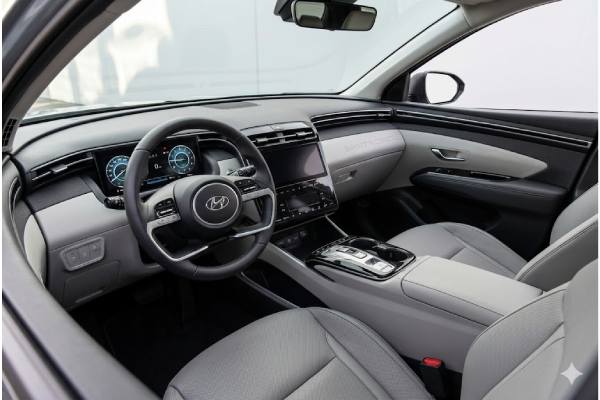
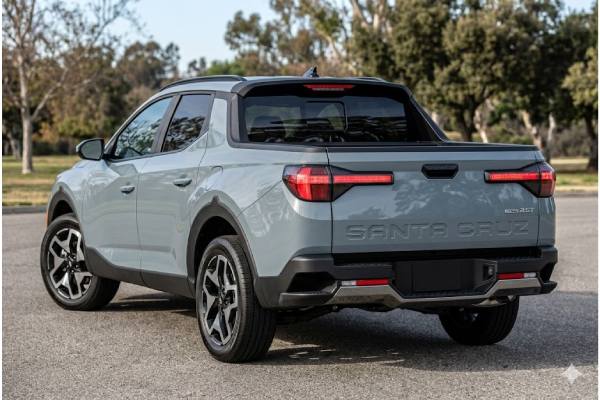
The turbocharged Hyundai Santa Cruz is best understood as a compact unibody pickup with crossover manners, a short open bed, and far more performance than its size suggests. In 2.5T form, it uses Hyundai’s Smartstream turbocharged four-cylinder with combined direct and multi-point injection, paired with an 8-speed wet dual-clutch transmission. The result is quick acceleration, useful towing capability, and a driving feel closer to a sporty SUV than a traditional body-on-frame truck.
There is one important scope note: Hyundai specification material lists the 2.5T drivetrain with FWD and available HTRAC AWD, but many North American retail turbo trims were commonly sold as AWD-only depending on market, model year, and trim. For buying or servicing, always verify the VIN, door-jamb label, window sticker, and build sheet before assuming a specific tow rating, curb weight, tire package, or driver-assistance fitment.
Owner Snapshot
- Strong 281 hp output and 422 Nm of torque make the 2.5T Santa Cruz much quicker than base-engine compact pickups.
- Unibody construction, independent rear suspension, and compact length make it easier to live with than most midsize trucks.
- The useful bed, underfloor storage, and available tow equipment suit bikes, tools, garden runs, and weekend gear better than heavy construction use.
- The 8-speed wet DCT needs correct fluid, software updates, and careful inspection for recall completion or shift-quality issues.
- Normal oil service is typically every 8,000 miles / 12 months, while severe-use service drops to 5,000 miles / 6 months in many schedules.
Table of Contents
- Santa Cruz NX4A Real-World Role
- Santa Cruz NX4A Technical Specs
- Santa Cruz NX4A Trims Safety
- Reliability Issues and Recalls
- Maintenance and Used Buying
- Driving Performance and Efficiency
- Santa Cruz Against Key Rivals
Santa Cruz NX4A Real-World Role
The Santa Cruz NX4A is not a conventional pickup in the old-school sense. It is built on a crossover-style unibody platform related in concept to Hyundai’s SUV architecture, with a crew cab, independent suspension, transverse engine layout, and a short integrated cargo bed. That makes it most useful for people who want pickup flexibility without the size, fuel use, ride firmness, or parking burden of a midsize truck.
In 2.5T form, the character changes noticeably from the standard 2.5-liter naturally aspirated version. The turbo engine’s 281 hp and broad torque output give the Santa Cruz strong passing power, easier highway merging, and much better confidence when loaded. The wet dual-clutch transmission also gives it a more direct, mechanically connected feel than a typical torque-converter automatic, although it behaves differently at parking speeds and in stop-and-go driving.
The FWD scope in the title should be treated carefully. Front-wheel drive reduces weight and mechanical drag compared with AWD, and it can be completely adequate for warm climates, paved roads, and light-duty hauling. It is also simpler because there is no rear differential, transfer case, propeller shaft, or AWD coupling to service. However, turbocharged torque through the front axle can make tire quality, alignment, and throttle smoothness more important, especially on wet pavement.
For shoppers comparing used examples, the main advantage is versatility. The Santa Cruz can carry messy or bulky cargo outside the cabin, yet it drives with the refinement and steering response of a compact SUV. The bed is short, so it is not ideal for full-size sheets of building material without the tailgate down, but it is excellent for mountain bikes, home-improvement supplies, camping gear, muddy sports equipment, small appliances, and light work tools.
The main compromise is that it lives between categories. It is more useful than a Tucson-style SUV for dirty cargo, but less capable than a body-on-frame truck for heavy towing, off-road work, and rugged job-site use. Rear-seat space is acceptable rather than generous, and the 2.5T’s fuel economy is only moderate for the segment.
For most owners, the best use case is mixed daily driving with regular weekend utility. The 2.5T engine gives the Santa Cruz its most convincing personality: quick, compact, comfortable, and practical, but still dependent on proper maintenance and correct recall completion.
Santa Cruz NX4A Technical Specs
The following figures apply to the 2021 production launch through 2023 model-period Santa Cruz NX4A/NX4 OB 2.5T where equipped with the Smartstream G2.5 T-GDI + MPI engine. Some figures vary by market, trim, tire package, and whether the vehicle is FWD or HTRAC AWD.
| Category | Specification |
|---|---|
| Vehicle | Hyundai Santa Cruz, NX4A / NX4 OB, crew-cab compact unibody pickup |
| Engine | Smartstream G2.5 T-GDI + MPI, commonly listed in the G4KP engine family |
| Layout | Inline-4, aluminum block/head, DOHC, 16 valves, 4 valves per cylinder |
| Displacement | 2.5 L / 2,497 cc |
| Bore × stroke | 88.5 × 101.5 mm / 3.48 × 4.00 in |
| Induction | Turbocharged with intercooling |
| Fuel system | Direct injection + multi-point injection |
| Compression ratio | 10.5:1 |
| Maximum power | 281 hp / 210 kW at 5,800 rpm |
| Maximum torque | 422 Nm / 311 lb-ft from about 1,700–4,000 rpm |
| Timing drive | Chain |
| Fuel | Regular unleaded gasoline; market octane labeling varies |
| Rated efficiency, turbo | About 10.7 L/100 km combined / 22 mpg US / 26.4 mpg UK for many AWD 2.5T ratings |
| Real-world highway at 120 km/h / 75 mph | Commonly about 8.5–10.0 L/100 km / 24–28 mpg US, depending on tires, wind, load, grade, and speed discipline |
| Driveline and chassis item | Specification |
|---|---|
| Transmission | 8-speed wet dual-clutch automatic; Hyundai 8WDCT family |
| Drive type | FWD in this scope; HTRAC AWD fitted or optional in many markets/trims |
| Differential | Open front differential; brake-based traction control |
| Front suspension | MacPherson strut |
| Rear suspension | Multi-link independent |
| Steering | Motor-driven electric power steering; approx. 2.5–2.6 turns lock-to-lock depending on market data |
| Brakes | Four-wheel discs; commonly about 325 mm / 12.8 in front and rear rotors |
| Popular tire sizes | 245/60 R18 on 18 × 7.5J wheels; 245/50 R20 on 20 × 7.5J wheels |
| Tire pressure | Commonly 240 kPa / 35 psi cold for normal load |
| Wheel nut torque | 107–127 Nm / 79–94 lb-ft |
| Ground clearance | About 218 mm / 8.6 in |
| Approach / departure / breakover | Approx. 18° / 23° / 19° |
| Turning circle | About 12.0 m / 39.6 ft curb-to-curb |
| Dimensions and weights | Specification |
|---|---|
| Length | 4,970 mm / 195.7 in |
| Width | 1,905 mm / 75.0 in |
| Height | 1,695 mm / 66.7 in |
| Wheelbase | 3,005 mm / 118.3 in |
| Curb weight | Approx. 1,800–1,890 kg / 3,970–4,170 lb depending on trim and driveline |
| GVWR | Approx. 2,530–2,600 kg / 5,578–5,732 lb depending on trim and driveline |
| Fuel tank | 67 L / 17.7 US gal / 14.7 UK gal |
| Seating | 5 |
| Cargo bed length | Approx. 1.32 m / 52.1 in at floor |
| Bed volume | About 764 L / 27.0 ft³ by SAE-style pickup-bed volume reporting |
| Performance and capability | Specification |
|---|---|
| 0–100 km/h / 0–62 mph | Approx. 6.3–6.8 seconds depending on driveline, tire, surface, and test method |
| Top speed | Approx. 210–225 km/h / 130–140 mph where unrestricted by market calibration |
| 100–0 km/h braking | Often around 38–42 m / 125–138 ft with good tires |
| Towing capacity, FWD scope | Up to about 1,588 kg / 3,500 lb where rated and properly equipped |
| Towing capacity, AWD turbo | Up to about 2,268 kg / 5,000 lb where rated and properly equipped |
| Payload | Approx. 690–730 kg / 1,520–1,610 lb depending on trim and label |
| Tongue weight guidance | Typically 10% of trailer weight unless local documentation states otherwise |
| Fluids and service capacities | Specification |
|---|---|
| Engine oil | 0W-30 full synthetic, API SN PLUS/SP or ILSAC GF-6; 5.8 L / 6.13 US qt drain and refill |
| Engine coolant | Ethylene glycol based coolant for aluminum engines; about 8.63 L / 9.12 US qt |
| Coolant mix | Usually 50/50 coolant and deionized/distilled water unless climate requires a different approved mix |
| DCT gear oil | GS WDCTF HD G / WDGO-1; about 3.3–3.4 L / 3.49–3.59 US qt |
| DCT control oil | GS WDCTF HD H / WDHO-1; about 2.45–2.50 L / 2.59–2.64 US qt |
| Brake fluid | DOT 4 |
| A/C refrigerant | R-1234yf; about 600 g / 21.16 oz ± 25 g |
| A/C compressor oil | PAG; about 100 g / 3.53 oz ± 10 g |
| Transfer case / rear differential | AWD only; not applicable to FWD vehicles |
| Critical torque value | Wheel nuts 107–127 Nm / 79–94 lb-ft; oil-drain torque varies by service data and should be VIN-verified |
| Safety and assistance | Specification |
|---|---|
| IIHS crashworthiness, 2022 tested generation | Good ratings in major crashworthiness categories under the applicable test versions |
| IIHS award | Top Safety Pick for 2022 when equipped with specific headlights |
| Headlights | LED projector units on higher trims rated Good; halogen projector/reflector setup on lower trims rated Poor in 2022 IIHS testing |
| Front crash prevention | Forward Collision-Avoidance Assist rated Superior in applicable IIHS vehicle and pedestrian evaluations |
| Child-seat anchors | Two rear seating positions with complete LATCH hardware plus a center tether provision |
| ADAS availability | Forward collision assist, lane keeping, lane following, driver attention warning, high-beam assist; blind-spot, rear cross-traffic, adaptive cruise, surround camera, and highway assist depend on trim/year |
Santa Cruz NX4A Trims Safety
For 2021–2023 production and 2022–2023 North American model-year coverage, the Santa Cruz trim walk was shaped around two engines. Lower trims typically used the 191 hp naturally aspirated 2.5-liter engine with an 8-speed torque-converter automatic. The 281 hp 2.5T was attached to higher trims and the 8-speed wet dual-clutch transmission.
In the U.S. market, common early trims included SE, SEL, SEL Premium, Night, and Limited, though exact availability shifted by model year. Canada used a different grade structure and often emphasized the turbo/AWD combination more heavily. Because the title scope is FWD 2.5T, the safest way to inspect a real vehicle is to identify the powertrain first, then confirm the driveline from the VIN, underside layout, rear differential presence, and window sticker.
Useful trim identifiers include:
- Turbo engine: “2.5T” powertrain listing, wet DCT, paddle shifters on many examples, stronger tow rating where equipped, and higher-output calibration.
- AWD equipment: rear differential, propeller shaft, HTRAC badging or drive-mode/terrain-control references depending on trim.
- Higher lighting package: LED projector headlights, usually associated with upper trims and the better IIHS headlight result.
- Limited-level cabin: leather-trimmed seating, larger digital displays, premium audio, ventilated front seats, surround-view camera, and more complete driver-assistance equipment.
- Activity or appearance packages: roof rails, tonneau-related equipment, trim-specific wheels, darker exterior accents, or bed utility items depending on year and market.
Safety equipment is a major strength for this class. All versions include the expected fundamentals: multiple airbags, anti-lock braking, electronic stability control, traction control, tire-pressure monitoring, a rearview camera, and child-seat anchor provisions. Standard and optional Hyundai SmartSense systems add active support, but the exact level matters. Forward Collision-Avoidance Assist and lane support were broadly available, while blind-spot assistance, rear cross-traffic assistance, adaptive cruise, Highway Driving Assist, and surround-view features were usually tied to higher trims.
The IIHS result is also trim-sensitive because headlights matter. The Santa Cruz earned strong crashworthiness results, but the Top Safety Pick recognition depended on specific headlight equipment. A used buyer should not assume that every 2022 or 2023 example has the same nighttime visibility performance. The LED projector setup on upper trims is preferable if rural night driving is common.
ADAS calibration should not be ignored after body repairs, windshield replacement, grille removal, alignment work, suspension repairs, or front-end collision repair. Radar, camera, and lane-support systems depend on correct sensor position and calibration. If the vehicle has accident history, ask for documentation showing that camera and radar calibration was performed after repairs.
Year-to-year equipment changes for these early model years were modest rather than transformational. The larger practical differences are usually trim, lighting, wheel package, driveline, towing preparation, and driver-assistance level. For a used purchase, a clean service record and completed recall status often matter more than chasing a single model year.
Reliability Issues and Recalls
The 2.5T Santa Cruz is still relatively young as a used vehicle, so long-term durability patterns are less mature than for older Hyundai trucks and SUVs. The basic engine design is modern and strong, but it is also a high-output turbocharged direct/port-injected four-cylinder paired with a complex wet dual-clutch transmission. That combination rewards correct fluids, software updates, and disciplined maintenance.
| Issue or system | Prevalence | Severity / cost | Typical signs | Recommended action |
|---|---|---|---|---|
| 8-speed wet DCT oil-pump / loss-of-drive recall | Known recall on affected 2022 2.5T vehicles | High | Warning lights, limp mode, loss of motive power risk | Verify recall completion by VIN; confirm TCU update and any follow-up transmission work |
| Turbo oil feed pipe recall | Affected early 2022 vehicles | High | Oil smell, visible oil leak, smoke, fire-risk concern | Verify campaign completion; inspect oil-feed area and underbody for residue |
| Trailer tow hitch harness recall | Affected 2022–2023 vehicles with certain harnesses | High | Water intrusion, electrical short, fire-risk advisory | Verify recall completion before towing or parking near structures if unrepaired |
| Roof molding detachment recall | Some 2022–2023 vehicles | Medium | Loose roof trim, wind noise, detached molding | Confirm recall status and inspect trim retention |
| DCT low-speed behavior | Occasional, partly characteristic | Medium | Jerky creep, hesitation, clutch smell after repeated creeping | Check software updates; avoid riding throttle on hills; inspect if harsh or worsening |
| Direct-injection carbon deposits | Possible with age/mileage | Medium | Rough idle, misfire, reduced economy | Use quality fuel; inspect intake deposits if symptoms appear |
| Turbo/cooling stress | Occasional with neglect or heavy towing | Medium/high | Coolant loss, oil consumption, overheating, turbo noise | Maintain oil/coolant intervals; check leaks and cooling performance |
| Suspension, tires, alignment | Common wear item | Low/medium | Edge wear, vibration, pull, clunks | Rotate tires, align when wear appears, inspect bushings and ball joints |
| Infotainment/ADAS glitches | Occasional | Low/medium | Camera warnings, screen freezes, sensor messages | Check software updates, battery health, and calibration history |
The DCT deserves the closest attention. Hyundai’s wet dual-clutch unit is designed for higher torque than a dry-clutch DCT, and it can shift quickly and efficiently. It is not, however, the same as a torque-converter automatic. Repeated low-speed creeping, holding the vehicle on a hill with throttle, maneuvering heavy trailers slowly, or crawling in traffic can create heat and clutch wear. Good examples shift crisply once moving, with only mild low-speed clutch engagement feel. Harsh banging, repeated warnings, slipping, delayed engagement, or a burning smell should be treated as inspection triggers.
Engine concerns are more conventional. The Smartstream 2.5T uses a timing chain, not a scheduled timing belt. There is no normal belt-replacement interval for the chain, but noise at cold start, cam/crank correlation faults, poor running, or metal debris during oil service should lead to inspection of chain stretch, guides, tensioners, and oil pressure. Because this is a turbo engine, oil quality is especially important. Long oil intervals under short-trip or hot-climate use are not ideal.
Cooling-system checks matter because turbo engines generate more heat. Inspect coolant level, radiator and heater hoses, clamps, water pump area, thermostat housing, and intercooler plumbing. Any repeated coolant top-up, overheating message, or sweet smell after shutdown deserves attention.
Pre-purchase inspection should include a full recall/VIN check, service records, DCT behavior from cold and hot, turbo oil-line inspection, underbody leak check, tire-wear reading, brake condition, ADAS warning scan, and evidence of regular oil changes with the correct 0W-30 full-synthetic specification. For AWD examples, add transfer case, rear differential, propeller shaft, and rear coupling checks.
Maintenance and Used Buying
A good Santa Cruz 2.5T should not be difficult to own, but it should not be treated like a simple old naturally aspirated pickup. The turbocharger, wet DCT, electronic driver-assistance systems, and compact packaging all make correct service important.
| Item | Normal interval | Severe-use guidance | Notes |
|---|---|---|---|
| Engine oil and filter | About 8,000 miles / 12 months or 13,000 km / 12 months in many schedules | About 5,000 miles / 6 months or 8,000 km / 6 months | Use 0W-30 full synthetic meeting API SN PLUS/SP or ILSAC GF-6 |
| Engine oil level | Check regularly, especially between services | Check more often during break-in, towing, heat, or short trips | Oil consumption can vary with driving style and temperature |
| Tire rotation | About 8,000 miles / 12 months or 13,000–15,000 km / 12 months | More often if edge wear appears | Include pressure and tread-depth check |
| Engine air filter | Inspect regularly; replace about every 24,000 miles / 36 months in many schedules | Replace sooner in dust | Dirty filters hurt turbo response and economy |
| Cabin air filter | About every 16,000–24,000 miles or 24 months depending schedule | More often in dusty or polluted areas | Easy comfort item often neglected |
| Spark plugs | About 72,000 miles / 120,000 km on some schedules | Earlier if misfire, towing, or poor fuel history | Use correct heat range and torque |
| Coolant | First around 120,000 miles / 120 months; then 24,000 miles / 24 months | Inspect annually | Use approved ethylene glycol coolant and proper water quality |
| Brake fluid | Replace around 48,000 miles / 48 months in many schedules | Shorter interval in humid or mountain use | Use DOT 4 |
| Brake pads and rotors | Inspect every service | Inspect more often with towing or winter road salt | Rear brakes can corrode if lightly used |
| DCT fluid | Inspect about every 32,000 miles / 48 months or 52,000 km / 48 months | Inspect sooner if towing, heat, or harsh use | Use only specified DCT gear/control oils |
| Serpentine belt and hoses | Inspect periodically; replace if cracked, swollen, noisy, or tension is reduced | Inspect more often in hot climates | No fixed timing-chain service interval |
| 12 V battery | Test annually after 3 years | Replace when reserve capacity drops | Weak batteries can trigger electronic faults |
| Alignment | Check with tire wear, impacts, or steering pull | More often on rough roads | Important for front-drive torque and tire life |
When buying used, start with the paperwork. A Santa Cruz with documented oil changes, completed recalls, and no repeated warning-light history is a much safer choice than a cheaper example with gaps. The wet DCT should be tested in several conditions: cold start, gentle takeoff, reverse engagement, parking-lot maneuvering, moderate throttle, highway kickdown, and hot restart after a drive. A small amount of clutch-like engagement feel at crawl speeds can be normal; pronounced shudder, slipping, or warnings are not.
Look closely at the tires. Uneven front tire wear can point to alignment issues, aggressive driving, worn suspension parts, or high torque through the front axle. Check that all four tires match in size, speed rating, and load rating. On AWD examples, mismatched rolling diameter can create driveline strain; on FWD examples, mismatched front tires can worsen traction and torque steer.
Inspect the bed and tailgate. The Santa Cruz bed is useful, but many examples are bought for outdoor hobbies. Look for damaged tie-downs, water intrusion in underbed storage, broken tonneau hardware, scraped bed trim, and signs of overloaded cargo. Payload is respectable for the size, but the door-jamb label is the final authority for a specific truck.
Recommended used picks are well-documented upper trims with LED projector headlights, completed recalls, and no DCT complaints. Avoid vehicles with unresolved recall status, unexplained transmission replacement history, repeated low-oil operation, accident repairs without ADAS calibration records, or evidence of towing beyond the rated limit.
Long-term durability should be good with correct care, but the Santa Cruz 2.5T is not the cheapest configuration to neglect. It is the best-performing Santa Cruz of the early years, and it should be maintained like a modern turbocharged performance crossover with a pickup bed.
Driving Performance and Efficiency
The 2.5T Santa Cruz feels much quicker than its compact-pickup shape suggests. The engine makes strong torque low in the rev range, so the vehicle does not need to be worked hard in normal driving. Around town, it moves with light throttle, and on the highway it has enough reserve to pass without the long downshift wait common in lower-powered trucks.
The wet DCT is a major part of the character. Once rolling, shifts are quick and clean. Under harder acceleration, the transmission gives the Santa Cruz a sporty feel that suits the turbo engine well. At very low speed, it can feel less fluid than a torque-converter automatic because clutch engagement is part of the design. Smooth drivers adapt quickly, but buyers coming from traditional automatics should test it in traffic and parking maneuvers before deciding.
Ride quality is one of the Santa Cruz’s strengths. The unibody structure and independent rear suspension help it feel stable and settled over broken pavement. It does not have the rear-end hop that many empty body-on-frame pickups show. Steering is light but accurate, and the compact footprint makes it easy to place in urban traffic. With 20-inch wheels, impacts can feel sharper and tire noise can be more noticeable; 18-inch tires are usually the comfort-oriented choice.
Braking feel is generally confident for daily use. Repeated heavy braking while loaded or towing will expose its compact-truck limits, but for normal commuting, mountain roads, and occasional hauling it feels controlled. Tire quality makes a visible difference in wet braking, traction, and cabin noise.
Fuel economy depends heavily on speed. In city driving, expect roughly 11.5–13.5 L/100 km / 17–20 mpg US / 20–24 mpg UK from many turbo examples, with worse results in short-trip winter use. Mixed driving often lands around 10.0–11.5 L/100 km / 20–24 mpg US / 24–29 mpg UK. At steady highway speeds, careful drivers may see 8.5–10.0 L/100 km / 24–28 mpg US / 29–34 mpg UK, but high speed, roof accessories, headwinds, winter tires, and cargo quickly reduce that.
Cold weather can bring a meaningful drop because warm-up time, denser air, winter fuel, heated accessories, and tire rolling resistance all work against economy. A 10–20% winter penalty is realistic in colder regions.
Towing should be approached realistically. A FWD-rated Santa Cruz is suitable for light trailers, small utility loads, personal watercraft, or compact camping setups within its rating. For the highest tow rating, AWD turbo examples are typically the better fit. Even then, the Santa Cruz is still a compact unibody vehicle. Trailer brakes, correct tongue weight, conservative speed, and extra transmission/cooling awareness matter. Expect fuel consumption to rise sharply when towing; a 25–45% penalty is common with moderate trailer loads depending on aero drag and terrain.
Santa Cruz Against Key Rivals
The Santa Cruz 2.5T competes in a small but interesting space. It is closest in concept to the Ford Maverick and Honda Ridgeline, but it also overlaps with compact SUVs and entry-level midsize trucks. Its main advantage is that it feels more premium and quicker than many practical rivals, while its main limitation is that it gives up bed length, rear-seat room, and heavy-duty capability.
| Rival | Santa Cruz 2.5T advantage | Rival advantage | Best choice if… |
|---|---|---|---|
| Ford Maverick EcoBoost | More power, more upscale cabin feel in upper trims, stronger sporty character | Better price, longer bed usability, simpler automatic, strong aftermarket | You want lower cost and maximum compact-truck practicality |
| Ford Maverick Hybrid | Much stronger Santa Cruz performance and towing feel | Far better fuel economy, lower running cost | Economy matters more than acceleration |
| Honda Ridgeline | Smaller footprint, sharper response, more distinctive styling | Larger cabin and bed, smoother V6, excellent everyday truck usability | You want a larger and more relaxed unibody pickup |
| Toyota Tacoma | Better ride comfort, easier parking, stronger daily refinement | More rugged frame, off-road ability, resale reputation | You need trail use or traditional truck durability |
| Nissan Frontier | More refined urban handling and cabin tech | Body-on-frame toughness and V6 truck character | You tow/haul more often and want conventional truck design |
| Hyundai Tucson 2.5T-related SUVs | Open bed utility and stronger lifestyle-cargo flexibility | Enclosed cargo security and better rear cargo weather protection | You need an SUV more than an open-bed vehicle |
Against the Maverick EcoBoost, the Santa Cruz feels more polished and more expensive. It has a higher-output engine and a sportier transmission, but the Maverick’s conventional 8-speed automatic, boxier bed, and lower entry cost are compelling. A buyer who wants a worklike compact pickup may prefer the Maverick. A buyer who wants a refined crossover with a bed may prefer the Santa Cruz.
Against the Ridgeline, the Santa Cruz is smaller and more agile, but the Honda is the more mature all-around unibody truck. The Ridgeline has a larger bed, more rear-seat comfort, and a smoother V6 powertrain. The Hyundai counters with stronger turbo punch, easier urban sizing, and a more modern cabin feel in higher trims.
Against body-on-frame trucks, the Santa Cruz wins on comfort, steering, efficiency, and daily livability. It loses on serious off-road durability, aftermarket suspension support, and heavy-use towing confidence. That does not make it worse; it means it serves a different owner.
The best argument for the 2.5T Santa Cruz is that it makes small-pickup ownership feel quick and easy. It is not the cheapest, largest, or toughest option, but it is one of the most enjoyable to drive. For buyers who need occasional truck utility and daily crossover comfort, a well-maintained 2.5T example remains a smart and appealing choice.
References
- 2023 Santa Cruz Specifications 2023 (Specifications)
- 2. Vehicle Information and Reporting Safety Defects 2022 (Owner’s Manual)
- 9. Maintenance 2022 (Owner’s Manual)
- 2022 Hyundai Santa Cruz 2022 (Safety Rating)
- Check for Recalls: Vehicle, Car Seat, Tire, Equipment | NHTSA 2026 (Recall Database)
Disclaimer
This article is for informational purposes only and is not a substitute for professional diagnosis, repair, or official service procedures. Specifications, torque values, maintenance intervals, recalls, fluids, and procedures can vary by VIN, market, trim, equipment, build date, and service campaign status. Always verify details against the official owner’s manual, workshop information, VIN recall lookup, and dealer service records for the specific vehicle.
If this information was useful, please consider sharing it on Facebook, X/Twitter, or another platform to support our work.