
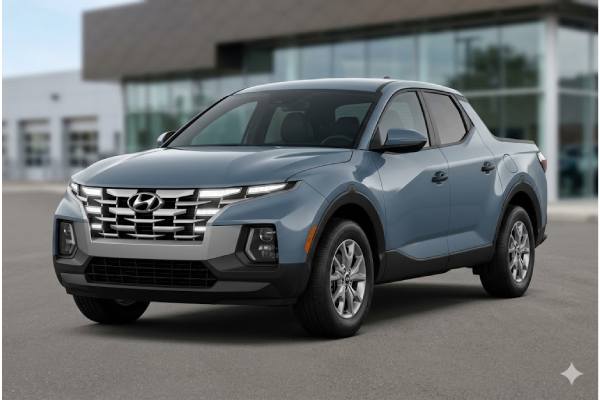
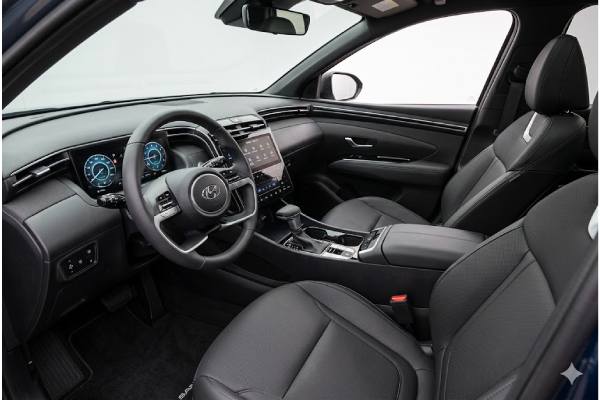

The Hyundai Santa Cruz with the naturally aspirated Smartstream 2.5 GDI + MPI engine is the simplest version of Hyundai’s compact unibody pickup. It combines a Tucson-derived platform, a four-door cabin, a short composite bed, front-wheel drive, and an eight-speed torque-converter automatic transmission.
Although production began in 2021, the Santa Cruz entered the U.S. market as a 2022 model. For 2021–2024 coverage, the practical scope is the early NX4A OB generation built from the launch period through the 2024 model year. The FWD 191 hp version is aimed less at heavy truck work and more at drivers who want crossover comfort, open-bed flexibility, useful towing capacity, and lower complexity than the turbocharged AWD models.
Quick Overview
- The 2.5 GDI + MPI engine is less powerful than the turbo but simpler, smoother, and better suited to normal commuting.
- FWD models are lighter, easier to service, and usually less expensive to buy than AWD turbo trims.
- The Santa Cruz’s unibody platform gives it a composed ride and secure handling, but it is not a traditional body-on-frame work truck.
- Watch for recall completion, trailer-hitch harness history, 12 V battery condition, bed water management, and software updates.
- Normal-service oil and filter changes are scheduled every 8,000 miles or 12 months when the correct full-synthetic oil is used.
Table of Contents
- Santa Cruz FWD 2021–2024 Guide
- Santa Cruz FWD Technical Specs
- Santa Cruz FWD Trims and Safety
- Reliability, Issues and Recalls
- Maintenance and Used Buying
- Driving Feel and Performance
- Rivals and Market Fit
Santa Cruz FWD 2021–2024 Guide
The Santa Cruz is not a conventional pickup with a separate frame, low-range gearing, and a long cargo box. It is a compact unibody pickup based on Hyundai’s modern crossover architecture, sharing much of its basic layout with the Tucson. That matters because it explains both its strengths and its limits. It rides more like a crossover than a truck, fits more easily in urban spaces, and feels stable at highway speed, but it is not designed for severe payload abuse, rough-jobsite punishment, or heavy towing.
The FWD 2.5 GDI + MPI model is the entry powertrain in the U.S.-market Santa Cruz range. It uses a naturally aspirated 2.5-liter inline-four with both direct and port fuel injection. Output is 191 hp and 181 lb-ft, sent through an eight-speed automatic transmission to the front wheels. This configuration appeared mainly in lower and mid-level trims, while many upper trims used the 2.5-liter turbocharged engine and, depending on year and trim, AWD.
In daily use, the naturally aspirated FWD Santa Cruz is best understood as a practical lifestyle vehicle. It suits homeowners, commuters, cyclists, gardeners, small-business users, and outdoor drivers who need an exposed bed but do not need the size, thirst, or truck-like ride of a midsize pickup. The composite bed, underfloor storage, side storage areas, tie-down points, and available tonneau cover make it more useful than a compact SUV for messy or bulky cargo.
The main trade-off is performance. The 191 hp engine moves the Santa Cruz adequately, but it does not give the quick response or strong midrange pull of the 2.5 turbo. When loaded, climbing grades, or merging into fast traffic, the naturally aspirated engine needs revs. The eight-speed automatic helps by keeping the engine in its useful range, but drivers expecting effortless passing power may prefer the turbo AWD version.
For ownership, the FWD 2.5 has several advantages. It avoids the dual-clutch transmission used on early turbo models, avoids rear differential and transfer-case service, weighs less, and generally costs less to buy. It also has enough capability for light towing, with a 3,500 lb braked tow rating in U.S. specification when properly equipped. That makes it a useful compromise for people who want pickup convenience without committing to a larger truck.
The key used-buying point is to verify the exact trim, equipment, model year, recall status, and service record. Santa Cruz equipment changed during the early years, and some features that look similar from outside can differ significantly inside, especially infotainment, driver assistance, bed equipment, wheel packages, and towing accessories.
Santa Cruz FWD Technical Specs
The following specifications focus on the North American FWD Smartstream G2.5 GDI + MPI version. Some values vary by trim, wheel package, market, build date, and equipment. VIN-level service data should be used for repair decisions.
| Item | Hyundai Santa Cruz FWD 2.5 GDI + MPI |
|---|---|
| Vehicle code | NX4A OB; early-generation Santa Cruz, North American specification |
| Engine | Smartstream G2.5 GDI + MPI gasoline inline-four |
| Layout and valvetrain | I-4, DOHC, 4 valves per cylinder, dual continuously variable valve timing |
| Bore × stroke | 85.5 × 101.5 mm (3.37 × 4.00 in) |
| Displacement | 2.5 L (2,497 cc) |
| Induction | Naturally aspirated |
| Fuel system | Combined gasoline direct injection and multi-point/port injection |
| Compression ratio | 13.0:1 |
| Maximum power | 191 hp (142 kW) at 6,100 rpm |
| Maximum torque | 245 Nm (181 lb-ft) at 4,000 rpm |
| Timing drive | Timing chain |
| Fuel | Regular unleaded gasoline, 87 AKI minimum in U.S. specification |
| Rated efficiency, 2024 FWD | 10.2 L/100 km combined; 10.7 city / 9.0 highway L/100 km (23 combined; 22 city / 26 highway mpg US; about 27.6 combined mpg UK) |
| Real-world highway at 120 km/h | Typically about 9.0–10.5 L/100 km (22–26 mpg US / 26–31 mpg UK), depending on wind, load, tires, terrain, and speed discipline |
| Item | Specification |
|---|---|
| Transmission | 8-speed torque-converter automatic, Hyundai A8F27 family |
| Drive type | Front-wheel drive |
| Differential | Open front differential with brake-based traction/stability control |
| Front / rear suspension | MacPherson strut front; multi-link independent rear |
| Steering | Motor-driven electric power steering; rack-and-pinion |
| Brakes | Four-wheel discs; commonly listed as 325 mm (12.8 in) front and rear rotors |
| Common tire sizes | 245/60 R18 standard on many lower trims; 245/50 R20 on selected packages/trims |
| Ground clearance | 218 mm (8.6 in) |
| Approach / departure / breakover | 17.5° / 23.2° / about 18.6° |
| Length / width / height | 4,971 / 1,905 / 1,694 mm (195.7 / 75.0 / 66.7 in) |
| Wheelbase | 3,005 mm (118.3 in) |
| Turning circle | About 12.1 m (39.6 ft), curb-to-curb |
| Curb weight | About 1,700–1,780 kg (3,750–3,930 lb), depending on trim and equipment |
| GVWR | 2,475 kg (5,456 lb) for 2WD 2.5 GDI in the 2024 owner data |
| Fuel tank | 67 L (17.69 US gal / 14.7 UK gal) |
| Cargo volume | Pickup bed about 764 L (27 ft³); rear lower seat cushions flip up for in-cabin storage, but this is not an SUV-style seats-down cargo rating |
| Towing capacity | Up to 1,588 kg (3,500 lb) braked when properly equipped; unbraked trailer limits depend on market and documentation |
| Payload | Typically around 635–700 kg (1,400–1,550 lb) by published trim/equipment ratings; verify door-label payload for the exact vehicle |
| Item | Typical figure or service data |
|---|---|
| 0–100 km/h (0–62 mph) | Approximately 8.8–9.6 seconds depending on test conditions and load |
| Top speed | Not a key factory selling point; typically around 190 km/h (118 mph), market and limiter dependent |
| 100–0 km/h braking | Commonly in the 39–43 m range (about 128–141 ft from 62 mph), depending heavily on tires and surface |
| Engine oil | SAE 0W-20 full synthetic meeting API SN PLUS/SP or ILSAC GF-6; 5.8 L (6.13 US qt) drain and refill |
| Coolant | Ethylene-glycol coolant for aluminum radiators; about 9.46 L (10.00 US qt) for G2.5 GDI |
| Automatic transmission fluid | Hyundai Genuine ATF SP4M-1 or equivalent listed fluids; about 6.5 L (6.87 US qt) |
| Differential / transfer case | Not applicable to FWD models |
| A/C refrigerant | R-1234yf; 600 g ± 25 g (21.16 oz ± 0.88 oz) |
| A/C compressor oil | PAG lubricant; approximately 100 g / about 3.5 oz equivalent, verify service equipment units |
| Wheel nut torque | 107–127 Nm (79–94 lb-ft) |
The most important technical distinction is that this FWD version uses the conventional automatic rather than the dual-clutch transmission fitted to many turbo models. For long-term owners, that is a meaningful simplification. It reduces low-speed clutch-wear concerns and makes the vehicle easier to recommend for stop-and-go commuting.
Santa Cruz FWD Trims and Safety
In the early U.S. lineup, the naturally aspirated 2.5 FWD configuration was concentrated in the lower trims. SE and SEL are the main trims to look for when shopping for a 191 hp FWD Santa Cruz. Higher trims often moved to the turbocharged engine and, depending on year, standard or available AWD.
The trim walk is important because two Santa Cruz trucks can look similar but differ in comfort, technology, driver assistance, wheels, bed hardware, and towing preparation.
| Area | What to expect on 2.5 FWD models |
|---|---|
| SE | Usually the cleanest, simplest version: cloth seats, 18-inch wheels, 8-inch display audio, core safety systems, composite bed, rearview camera, and basic convenience equipment. |
| SEL | Adds comfort and convenience features depending on year, often including heated front seats, power driver seat, proximity key, added interior trim, and optional activity-style equipment packages. |
| Activity / convenience packages | Can add roof rails, larger screen/navigation features, bed accessories, tonneau cover, wireless charging, digital cluster features, or upgraded cabin equipment depending on model year. |
| Night, XRT, Limited | Typically associated with the turbo powertrain and AWD in many early lineups, so they are usually outside the exact FWD 191 hp scope. |
| Quick identifiers | Look for SE or SEL badging/build sheet, 2.5L non-turbo VIN data, absence of HTRAC AWD badging, 18-inch 245/60 R18 tires on many examples, and conventional automatic behavior. |
Safety equipment is strong for the class, especially because Hyundai made several driver-assistance features standard rather than reserving them only for expensive trims. Typical features include Forward Collision-Avoidance Assist, Lane Keeping Assist, Lane Following Assist, Driver Attention Warning, High Beam Assist, blind-spot monitoring or avoidance assistance, rear cross-traffic assistance, stability control, traction control, ABS, and a rearview camera. Adaptive cruise control and higher-grade navigation-linked functions depend on trim and year.
Airbag coverage includes front airbags, front side-impact airbags, side curtain airbags for front and rear occupants, rear side airbags on listed specifications, and rollover-sensor integration for the curtain airbags. Rear child-seat provisions include two full LATCH positions and a center tether-only position, which is useful but not as flexible as three fully equipped rear seating positions.
The IIHS rating picture is favorable but needs careful wording because test versions changed. For 2024, the Santa Cruz received a Top Safety Pick designation. It achieved Good ratings in small overlap front, original moderate overlap front, updated side impact, and headlights. The updated moderate overlap test was rated Marginal, while front crash prevention was rated Marginal in the vehicle-to-vehicle 2.0 evaluation and Acceptable in the pedestrian evaluation. This means it performs well structurally in many areas, but the newest IIHS tests are more demanding than the original tests used when the vehicle launched.
For repair work, ADAS calibration matters. Windshield replacement, front-end repair, bumper removal, alignment work, suspension repair, and radar/camera disturbance can require calibration or inspection. A used Santa Cruz with accident history should be checked for proper panel fit, correct sensor mounting, no warning lights, and documented calibration after repair.
Reliability, Issues and Recalls
The FWD 2.5 GDI + MPI Santa Cruz has a generally favorable mechanical layout compared with the more powerful turbo AWD versions. It avoids turbocharger heat, high boost loads, AWD service points, and the early dual-clutch transmission used on many turbo models. That does not make it maintenance-free, but it does make it the lower-risk powertrain for drivers who value simplicity over speed.
| Prevalence | System | Symptoms | Likely cause and remedy | Cost tier |
|---|---|---|---|---|
| Common | Tires and alignment | Uneven shoulder wear, pull, vibration | Alignment drift, pothole impact, tire rotation neglect; align, rotate, balance, and inspect suspension | Low to medium |
| Common | Brake wear and corrosion | Pulsation, scraping after rain, rear brake rust | Urban use, road salt, infrequent cleaning; service pads/slides/rotors as needed | Low to medium |
| Occasional | Bed and tonneau hardware | Water entry, rattles, stiff cover movement | Drain blockage, seal adjustment, cover wear; clean drains and adjust/repair hardware | Low to medium |
| Occasional | Infotainment and driver assistance | Screen lag, phone pairing issues, warning messages | Software version, sensor obstruction, calibration need; update software and inspect sensors | Low to medium |
| Occasional | 12 V battery | Slow crank, warning lights, random electronic faults | Short trips, age, parasitic loads; test battery and charging system | Low |
| Rare but important | Engine oil level or engine fault lights | Low oil warning, rough running, MIL | Oil consumption, maintenance neglect, sensor/fuel/ignition issue; document oil use and diagnose promptly | Medium to high |
The 2.5 GDI + MPI engine uses both direct and port injection, which helps reduce the intake-valve deposit concern associated with direct-injection-only engines. It still benefits from quality fuel, correct oil, regular oil-level checks, and avoiding long oil intervals under severe use. The timing chain is not a scheduled replacement item, but chain noise, cam/crank correlation faults, rough starts, or persistent timing codes should be investigated rather than ignored.
The conventional eight-speed automatic is generally smooth in this application. Harsh shifts, delayed engagement, flare, or repeated hunting should prompt a scan for software updates, adaptive values, fluid condition, and mount condition. Because this FWD version does not use a rear differential or transfer case, driveline service is simpler than AWD variants.
Recall and service-action history should be checked by VIN, not by model year alone. Two important early Santa Cruz recall areas are worth noting. Certain 2022–2023 Santa Cruz vehicles with affected trailer tow hitch harness equipment were included in a fire-risk recall involving possible water intrusion and electrical shorting in the tow-hitch harness module. Certain 2024 Santa Cruz vehicles were included in a recall for the motor-driven power steering electric power pack, where a short circuit could lead to loss of power steering assist.
Software and calibration updates are also part of modern ownership. Infotainment updates can address device compatibility and navigation behavior. Powertrain control updates may refine drivability. ADAS-related updates or calibrations may be needed after collision repair, windshield work, wheel alignment, bumper work, or sensor replacement. A good pre-purchase inspection should include a full module scan, not just a check-engine-light glance.
Before buying, request service records, recall completion proof, tire and brake history, accident repair documentation, and any records for bed accessories or tow-hitch installation. If the vehicle was used for towing, inspect the hitch, wiring, rear structure, cooling system condition, transmission behavior, and brake wear closely.
Maintenance and Used Buying
The Santa Cruz 2.5 FWD rewards straightforward maintenance. Its most important needs are regular oil changes with the correct full-synthetic oil, tire rotation, brake inspections, coolant service on schedule, brake-fluid replacement, air-filter replacement, and software/recall completion.
| Item | Typical interval | Notes for the 2.5 FWD Santa Cruz |
|---|---|---|
| Engine oil and filter | Every 8,000 miles / 13,000 km or 12 months under normal service | Use SAE 0W-20 full synthetic meeting API SN PLUS/SP or ILSAC GF-6; shorten interval for severe use. |
| Engine oil level | Check monthly and before long trips | New engines may use more oil during break-in; low oil can trigger protection behavior. |
| Tire rotation | About every 8,000 miles / 13,000 km | Rotate with oil service; maintain 35 psi cold for standard full-size tires unless the door placard states otherwise. |
| Engine air filter | Inspect regularly; replace about every 24,000 miles / 39,000 km or as needed | Dusty roads, construction areas, and wildfire smoke justify earlier replacement. |
| Cabin air filter | Usually every 12,000–16,000 miles or yearly | Replace sooner if airflow drops or odors appear. |
| Spark plugs | GDI version: replace at 96,000 miles / 156,000 km | Use the correct Hyundai-specified plug type and torque. |
| Drive belt | First inspect at 48,000 miles / 78,000 km or 72 months; then every 8,000 miles / 13,000 km or 12 months | Replace if cracked, glazed, noisy, contaminated, or loose. |
| Coolant | First replacement at 120,000 miles / 200,000 km or 120 months; then every 24,000 miles / 39,000 km or 24 months | Use compatible ethylene-glycol coolant for aluminum engines/radiators. |
| Brake fluid | Inspect every 8,000 miles / 13,000 km or 12 months; replace every 48,000 miles / 78,000 km or 48 months | Use DOT-4 LV / FMVSS 116 DOT-4 / ISO4925 Class 6 fluid as specified. |
| Automatic transmission fluid | No casual dipstick service; inspect under severe use and service when required | Use only ATF SP4M-1 equivalent listed fluid. Earlier service is sensible for towing, heat, or severe urban use. |
| Timing chain | No routine replacement interval | Inspect if there is start-up rattle, timing-correlation fault, chain noise, or poor oil-maintenance history. |
| 12 V battery | Test annually after year three | Short trips and accessory use can shorten battery life. |
For used buyers, the best Santa Cruz FWD examples are not necessarily the lowest-mileage ones. A well-maintained SEL with clean records, completed recalls, even tire wear, no accident history, and properly functioning driver-assistance systems can be a better buy than a neglected low-mile vehicle.
Inspect the bed carefully. Check the underfloor storage area, drain channels, tonneau tracks if fitted, bed lighting, tailgate operation, side storage, and evidence of heavy impacts. A Santa Cruz used for bikes, camping gear, and household cargo is usually less concerning than one used for repeated heavy hauling without maintenance records.
Under the hood, look for oil leaks, coolant residue, belt condition, rodent damage, and signs of poor oil-change discipline. During the road test, the engine should start cleanly, idle smoothly, rev without hesitation, and shift predictably. Any warning lights, ADAS faults, steering warnings, or repeated infotainment glitches should be diagnosed before purchase, not after.
The most desirable FWD 2.5 version for many buyers is an SEL with useful comfort equipment but without unnecessary complexity. The SE is appealing for budget buyers who value simplicity. Avoid any example with unresolved recalls, mismatched tires, accident repairs without calibration records, chronic water intrusion, poor transmission behavior, or signs of neglected oil service.
Driving Feel and Performance
The Santa Cruz FWD 2.5 drives more like a compact crossover with a pickup bed than a small truck. That is mostly an advantage in everyday use. The steering is light but accurate, the body structure feels settled, and the independent rear suspension gives the rear axle better composure than many leaf-sprung pickups when the bed is empty.
Ride quality is one of the model’s strongest points. On 18-inch tires, the Santa Cruz absorbs broken pavement well and feels more refined than a traditional midsize pickup over sharp city impacts. Models with 20-inch wheels can look sharper but transmit more tire noise and impact harshness. For a used buyer who values comfort and tire cost, the 18-inch package is usually the more practical choice.
The 191 hp engine is smooth and predictable rather than energetic. Around town, throttle response is clean, and the automatic transmission usually shifts early to save fuel. When more acceleration is needed, the gearbox downshifts and the engine becomes more vocal. This is normal for a naturally aspirated four-cylinder moving a vehicle of this size. The engine’s torque peak arrives at 4,000 rpm, so it does not have the effortless low-rpm shove of the turbo.
At highway speed, the Santa Cruz tracks well and feels secure in crosswinds, though the open bed and upright rear shape can add aerodynamic noise. Road noise depends strongly on tires. Fuel economy is best at moderate speeds; sustained 75 mph / 120 km/h running, roof cargo, headwinds, all-terrain tires, or heavy bed loads can push consumption noticeably above the official highway figure.
Braking feel is reassuring for daily use. The pedal is progressive, and the four-wheel discs are adequate for the vehicle’s intended duty. Heavy towing, mountain descents, and repeated high-speed stops require more restraint. As with any compact pickup, load distribution matters: keep heavy items low and forward in the bed, stay within payload, and allow extra braking distance.
For towing, the FWD 2.5 is suitable for light trailers, small utility trailers, small personal-watercraft trailers, and modest camping loads within rating. It is not the right version for frequent heavy towing. The 3,500 lb rating is useful, but power, front-drive traction, braking margin, and heat management should all be respected. A moderate trailer can also reduce fuel economy sharply, often by 20–40 percent depending on frontal area, speed, terrain, and wind.
The FWD layout is fine for rain and normal winter roads with the right tires, but it cannot match AWD traction on steep snowy starts, muddy campsites, wet grass, or boat ramps. Good tires matter more than the badge: a FWD Santa Cruz on quality all-weather or winter tires will often feel more secure than an AWD model on worn all-seasons.
Rivals and Market Fit
The Santa Cruz FWD 2.5 sits in a narrow but useful space. It is smaller and easier to live with than a midsize pickup, more cargo-flexible than a compact SUV, and more comfortable than many traditional trucks. Its closest conceptual rival is the Ford Maverick, but shoppers may also compare it with the Honda Ridgeline, Nissan Frontier, Toyota Tacoma, Chevrolet Colorado, and Hyundai Tucson.
| Rival | Santa Cruz advantage | Rival advantage |
|---|---|---|
| Ford Maverick | More refined cabin feel, strong safety equipment, composed crossover-like ride | Better fuel-economy options, especially hybrid versions; more traditional compact-truck value appeal |
| Honda Ridgeline | Smaller footprint, lower entry cost, easier urban parking | More powerful V6, larger bed, standard AWD in later years, higher all-around truck utility |
| Nissan Frontier | More comfortable daily ride, easier handling, better city maneuverability | Body-on-frame toughness, stronger towing/work-truck character, more off-road suitability |
| Toyota Tacoma | More refined road manners and lower step-in feel | Stronger truck reputation, wider off-road range, higher traditional pickup capability |
| Hyundai Tucson | Open bed, better for dirty or awkward cargo, light towing flexibility | Enclosed cargo area, quieter rear storage, often better fuel economy and easier family packaging |
The Santa Cruz makes the most sense for buyers who need an open bed occasionally but spend most of their time commuting, parking in cities, running errands, and taking weekend trips. It is a smart alternative to a compact SUV when bikes, tools, mulch, wet gear, or camping equipment are regular cargo.
Its weakest point against the Maverick is efficiency and price. Ford’s hybrid Maverick is much thriftier in city driving, while the Santa Cruz answers with a more refined cabin, a distinctive design, and a more crossover-like road feel. Against midsize trucks, the Santa Cruz cannot match serious truck capability, but it is easier to drive every day.
For the specific FWD 191 hp version, the verdict is clear: buy it for comfort, versatility, low complexity, and light-duty practicality. Do not buy it expecting strong acceleration, off-road traction, or heavy towing confidence. The best examples are well-maintained SE or SEL models with complete recall records, clean electronics, good tires, and no signs of hard commercial use.
References
- 2024 Santa Cruz Specifications 2023 (Manufacturer Specifications)
- Manuals & Warranties | Hyundai Resources 2024 (Owner’s Manual Portal)
- 2024 Fuel Economy Guide 2024 (Official Fuel Economy Data)
- 2024 Hyundai Santa Cruz 2024 (Safety Rating)
- Vehicle Detail Search – 2024 Hyundai Santa Cruz | NHTSA 2024 (Recall Database)
Disclaimer
This article is for informational purposes only and is not a substitute for professional diagnosis, repair, inspection, or manufacturer service information. Specifications, torque values, fluid capacities, service intervals, software updates, recall eligibility, and repair procedures can vary by VIN, market, build date, trim, equipment, and service history. Always verify details against the official owner’s manual, service manual, emissions label, door placard, dealer records, and current manufacturer or regulatory VIN checks before making maintenance, repair, towing, or purchase decisions.
If this overview helped you, please consider sharing it on Facebook, X/Twitter, or another platform to support our work.