

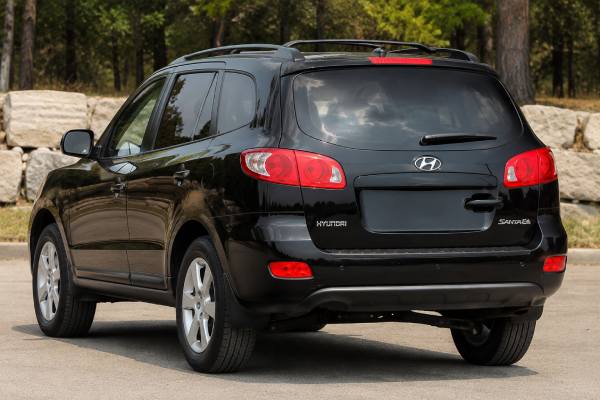

The 2007–2009 Hyundai Santa Fe AWD with the 3.3-liter V6 is one of the more practical versions of the second-generation CM Santa Fe. It pairs a naturally aspirated Lambda V6 with a five-speed automatic transmission and an on-demand all-wheel-drive system, giving it stronger acceleration, better towing suitability, and more all-weather confidence than the base 2.7-liter models.
This version is best understood as a family-sized midsize crossover rather than a rugged off-roader. Its strengths are cabin space, simple V6 power, standard stability control, available seven-passenger seating, and generally sensible ownership costs. Its weak points are age-related: neglected fluids, suspension wear, rust, brake-switch and airbag recalls, and the need to verify AWD condition carefully before purchase.
Quick Overview
- Strong 242 hp 3.3 V6 gives the CM Santa Fe useful passing power and better towing confidence than the 2.7 V6.
- Standard stability control, side-curtain airbags, and strong IIHS results make it a solid safety pick for its era.
- Spacious cargo area, optional third row, and 3,500 lb towing rating with trailer-prep equipment add real versatility.
- Age matters more than mileage alone: check recalls, rust, rear brakes, suspension, AWD fluids, and automatic-transmission behavior.
- A practical service rhythm is engine oil every 5,000–7,500 miles or 6–12 months, with shorter intervals for severe use.
Table of Contents
- Santa Fe CM AWD Snapshot
- Santa Fe CM 3.3 Technical Specs
- Santa Fe CM Trims and Safety
- Reliability Issues and Recalls
- Maintenance and Used Buying
- Road Performance and Efficiency
- How Santa Fe CM Compares
Santa Fe CM AWD Snapshot
The CM-generation Hyundai Santa Fe arrived for the 2007 model year as a larger, more refined crossover than the first-generation Santa Fe. In North American form, the 3.3 V6 AWD version sat above the base 2.7 V6 models and was commonly found in SE and Limited trims. It used unibody construction, four-wheel independent suspension, a transverse front-mounted V6, and an electronically controlled AWD system rather than a truck-style 4×4 layout.
The engine is the 3.3-liter Lambda V6, usually identified as G6DB in parts and service contexts. It is an all-aluminum, 24-valve DOHC V6 with continuously variable valve timing and multi-point fuel injection. Output is 242 hp at 6,000 rpm and 226 lb-ft of torque at 4,500 rpm. That made it competitive for the period: not especially sporty by modern turbocharged-SUV standards, but strong enough for confident highway merging, family use, and moderate towing when correctly equipped.
All 3.3 V6 Santa Fe models used a five-speed SHIFTRONIC automatic transmission. The AWD system is an on-demand setup that normally behaves like a front-biased crossover drivetrain, sending torque rearward when slip or conditions require it. The driver-selectable AWD lock can request a fixed front/rear split at lower speeds, which helps on snow, wet grass, gravel, and steep driveways. It is not a substitute for low-range gearing, underbody protection, or dedicated off-road hardware.
In everyday use, the 3.3 AWD Santa Fe is appealing because it avoids many complications found in newer vehicles. There is no turbocharger, no direct-injection carbon-buildup issue, no dual-clutch transmission, and no hybrid battery. The timing system is chain-driven, so there is no scheduled timing-belt replacement. That simplicity helps the Santa Fe age well when oil, coolant, ATF, and AWD fluids are maintained.
There are still important caveats. These vehicles are now old enough that ownership condition is more important than brochure specification. A clean, well-serviced example can be a useful and affordable family crossover. A neglected one can need transmission work, suspension repairs, brake calipers, wheel bearings, airbag recall completion, rust repair, and several fluid services at once. For a used buyer, the best Santa Fe CM AWD is not necessarily the lowest-mileage one; it is the one with the most complete service history, dry underbody, smooth-shifting transmission, and documented recall work.
Santa Fe CM 3.3 Technical Specs
The figures below reflect the 2007–2009 North American Hyundai Santa Fe CM 3.3 V6 AWD with the five-speed automatic. Some specifications vary by country, trim, wheel package, third-row seating, tow-prep equipment, and build date, so VIN-specific service information should always be used before ordering parts or fluids.
| Item | 2007–2009 Santa Fe AWD 3.3 V6 |
|---|---|
| Engine code | Lambda / G6DB |
| Layout | Transverse 60-degree V6, aluminum block and heads |
| Valvetrain | DOHC, 4 valves per cylinder, 24 valves total, CVVT |
| Bore × stroke | 92.0 × 83.8 mm (3.62 × 3.30 in) |
| Displacement | 3.3 L (3,342 cc) |
| Induction | Naturally aspirated |
| Fuel system | Multi-point port fuel injection |
| Compression ratio | 10.4:1 |
| Maximum power | 242 hp (about 180 kW) @ 6,000 rpm |
| Maximum torque | 306 Nm (226 lb-ft) @ 4,500 rpm |
| Timing drive | Chain |
| EPA-rated efficiency | About 12.4 L/100 km combined (19 mpg US / 23 mpg UK); 17 mpg US city and 24 mpg US highway |
| Real-world highway at 120 km/h | Typically about 10.0–11.5 L/100 km (20–24 mpg US), depending on tires, wind, load, and terrain |
| Item | Specification |
|---|---|
| Transmission | Five-speed SHIFTRONIC automatic; A5HF1 family |
| Drive type | Electronically controlled on-demand AWD |
| Differentials | Open differentials; electronically controlled rear coupling, no low range |
| Front suspension | MacPherson strut with stabilizer bar |
| Rear suspension | Multi-link independent with stabilizer bar |
| Steering | Power-assisted rack and pinion; about 16.5:1 ratio |
| Brakes | Four-wheel discs; common 3.3 fitments are about 298 mm vented front and 302 mm solid rear, but verify by VIN |
| Common tire size | P235/60R18 on many SE and Limited models; other trims may use 16- or 17-inch wheels |
| Ground clearance | About 203 mm (8.0 in) |
| Approach / departure angles | Approximately 25.6° / 22.9° in markets where published |
| Length / width / height | About 4,675–4,676 / 1,890 / 1,795–1,796 mm (184.1 / 74.4 / 70.7 in, market-dependent) |
| Wheelbase | 2,700 mm (106.3 in) |
| Turning circle | About 10.9 m (35.8 ft), kerb-to-kerb |
| Curb weight | About 1,824 kg (4,021–4,022 lb) for many AWD 3.3 five-seat trims |
| GVWR | Commonly about 2,500–2,550 kg (5,512–5,622 lb), depending on market and seating |
| Fuel tank | About 75 L (19.8 US gal / 16.5 UK gal) |
| Cargo volume | About 968 L (34.2 ft³) seats up; about 2,214 L (78.2 ft³) seats folded, SAE-style published figures |
| Item | Typical figure or guidance |
|---|---|
| 0–100 km/h | About 8.8–9.5 seconds, depending on trim, load, tires, and test method |
| Top speed | Approximately 185–195 km/h (115–121 mph), market-dependent |
| 100–0 km/h braking | No single official figure; healthy examples with quality tires are typically in the midsize-crossover range for the era |
| Towing capacity | Up to 1,588 kg (3,500 lb) with trailer-prep equipment; lower ratings may apply without correct equipment |
| Payload | Usually about 500–650 kg (1,100–1,430 lb), depending on curb weight, GVWR, passengers, and equipment |
| Engine oil | API SJ/SL or newer; 5W-20 or 5W-30 commonly specified by temperature; about 5.2–5.5 L (5.5–5.8 US qt) with filter, verify by dipstick |
| Coolant | Ethylene-glycol coolant for aluminum engines; 50/50 mix; system capacity roughly 9 L (9.5 US qt), verify by VIN |
| Automatic-transmission fluid | Hyundai/Kia ATF SP-III specification for this generation; drain-and-fill quantity is less than total system capacity |
| Transfer case and rear differential | Hypoid gear oil, API GL-5, commonly SAE 75W-90; fill quantities are small and must be checked at the fill plug |
| Brake fluid | DOT 3 or DOT 4 |
| A/C refrigerant | R-134a; charge varies with front-only or front/rear A/C, so use the underhood label |
| Key torque examples | Wheel lug nuts about 107–127 Nm (79–94 lb-ft); oil drain plug about 39 Nm (29 lb-ft), verify official service data |
| Item | 2007–2009 Santa Fe CM context |
|---|---|
| IIHS crashworthiness | Good in moderate-overlap front, side, and head-restraint tests; 2007 Top Safety Pick, with side rating applying to vehicles built after March 2007 |
| NHTSA | Five-star front and side impact results under the older test protocol were promoted for this generation |
| Euro NCAP | European CM ratings used older star-system methods and may not match North American 3.3 AWD equipment; do not compare directly with current percentage ratings |
| Headlight rating | Not rated under the later IIHS headlight-rating program |
| ADAS | No modern AEB, ACC, lane keeping, blind-spot monitoring, or traffic-sign assist; focus is passive safety, ESC, ABS, EBD, Brake Assist, TPMS, and airbags |
Santa Fe CM Trims and Safety
For North America, the Santa Fe CM lineup was generally built around GLS, SE, and Limited trims. The exact trim walk changed by model year and market, but the 3.3 V6 was most strongly associated with SE and Limited models, while the GLS was commonly tied to the 2.7 V6. In Canada and some markets, 3.3-liter GL or GLS designations may appear, so the badge alone is not enough to confirm equipment.
The easiest mechanical identifier is the powertrain combination. A 3.3 AWD model should have the Lambda V6, five-speed automatic, and AWD hardware under the rear floor and suspension area. The AWD lock button inside the cabin is another useful clue, but it should not be treated as proof that the system is healthy. A pre-purchase inspection should still confirm the prop shaft, rear differential, coupling, axle seals, and matching tire sizes.
Typical equipment differences are more important than small styling changes. SE models usually brought the 3.3 V6, 18-inch alloy wheels, fog lights, upgraded cabin trim, roof-rack hardware, and stronger towing suitability when trailer-prep equipment was fitted. Limited models added the luxury features most used buyers notice first: leather seating, heated front seats, power driver seat, dual-zone automatic climate control, upgraded audio, sunroof on many examples, and available navigation or rear-seat entertainment depending on year.
The optional third row is useful for occasional children or short trips, but it is not as roomy as a minivan or larger three-row SUV. Buyers who need regular adult third-row use should look carefully at seating position, rear climate controls, cargo space with all seats raised, and access. For many owners, the five-seat version is the better choice because it keeps the same cargo-friendly body without the compromises of a small third row.
Safety equipment was a major selling point for the CM Santa Fe. All trims came with electronic stability control, anti-lock brakes, electronic brake-force distribution, Brake Assist, front airbags, front side airbags, side-curtain airbags, active front head restraints, three-point seat belts, and tire-pressure monitoring. LATCH child-seat anchors are fitted for the rear seating positions, but the exact location and tether routing should be checked in the owner’s manual because third-row-equipped vehicles can differ.
The IIHS results are strong for the period, but there is one important detail: the side-impact rating applies to 2007–2012 models built after March 2007, after side-curtain airbag changes. Early-build 2007 vehicles should be checked carefully if crash-test equivalence matters to the buyer. Modern safety expectations should also be kept realistic. The Santa Fe CM does not have automatic emergency braking, adaptive cruise control, lane keeping, cyclist detection, rear cross-traffic alert, or modern camera-based driver assistance.
Year-to-year changes were mostly equipment-related. For 2008, the Limited gained more standard luxury features, and navigation became available on some versions. For 2009, Hyundai added USB/iPod auxiliary inputs, changed option packages, and made trailer-prep equipment standard on SE and Limited trims in the U.S. market. These changes do not transform the vehicle mechanically, but they matter when comparing used examples because a well-optioned 2009 Limited can feel noticeably more complete than an earlier lower-trim model.
Reliability Issues and Recalls
The 3.3 V6 Santa Fe is generally considered one of the more durable versions of the CM generation, especially compared with later turbocharged or more complex powertrains. The Lambda V6 is smooth, chain-driven, and not known for the same large-scale engine-failure reputation that affected some later Hyundai/Kia four-cylinder families. Still, durability depends heavily on oil quality, cooling-system health, and age-related maintenance.
| Issue | Prevalence | Severity | Symptoms and remedy |
|---|---|---|---|
| Valve-cover or timing-cover oil leaks | Common with age | Medium | Oil smell, smoke from hot surfaces, low oil level, alternator contamination. Replace gaskets or reseal affected covers. |
| Ignition coils and spark plugs | Occasional | Low to medium | Misfire, rough idle, flashing check-engine light. Replace plugs and failed coils; rear bank takes more labor. |
| Automatic-transmission harsh shifts | Occasional | Medium to high | Delayed engagement, flare, clunk, or shudder. Check fluid condition, software updates, mounts, solenoids, and internal wear. |
| AWD coupling or driveline wear | Occasional | Medium | Binding in tight turns, rear noise, vibration, warning lights, fluid leaks. Inspect tires, prop shaft, coupling, transfer case, and rear diff. |
| Rear brake calipers and parking brake | Common in rust climates | Low to medium | Dragging brake, hot wheel, uneven pad wear, weak parking brake. Rebuild or replace calipers and service hardware. |
| Suspension bushings, links, struts | Common with mileage | Low to medium | Clunks, wandering, uneven tire wear. Replace worn sway links, control-arm bushings, struts, mounts, and align. |
| Rust and underbody corrosion | Common in salt regions | Medium to high | Rust at subframes, suspension mounts, brake lines, fuel lines, rocker areas, wheel arches, exhaust. Inspect before purchase. |
The timing chain is an advantage because there is no routine belt interval, but it is not maintenance-free in a neglected engine. Rattle at cold start, cam/crank correlation faults, or persistent timing-related codes require proper diagnosis. Clean oil at reasonable intervals is the best prevention. If the chain system is noisy or out of specification, the repair can become expensive because access is labor-intensive.
Cooling-system condition is another major age marker. Look for crusting at hose joints, seeping radiator end tanks, weak heater output, water-pump noise, thermostat faults, and any history of overheating. The aluminum V6 does not tolerate repeated overheating well. A buyer should treat unexplained coolant loss or evidence of stop-leak as a warning sign.
Several recalls and service actions are important. Common headline areas include stop-lamp switch failures, occupant classification system recalibration, driver-airbag clock spring issues, and an ABS-module fire-risk recall affecting certain early 2007 Santa Fe vehicles. The stop-lamp switch problem can affect brake-light operation, cruise control cancellation, shift interlock behavior, ESC/ABS interaction, and warning lights. Airbag-related recalls should not be ignored because they affect whether restraint systems operate as intended.
Recall completion must be verified by VIN through an official recall lookup and dealership records. A seller’s statement that “all recalls were done” is useful only if it is backed by paperwork or a dealer printout. On older vehicles, some recall repairs may have been performed years ago, while others may remain open because ownership changed or mail notices never reached the current owner.
A strong pre-purchase inspection should include a cold start, a long enough road test to warm the transmission, tight parking-lot turns to check AWD binding, a scan for stored and pending codes, a lift inspection for leaks and corrosion, and a check of all electrical features. The best examples feel ordinary in the right way: smooth idle, clean shifts, no driveline shudder, no warning lights, no burnt fluid smell, and no heavy rust underneath.
Maintenance and Used Buying
A Santa Fe CM 3.3 AWD can be inexpensive to own if maintenance is kept ahead of age-related failures. The mistake is treating it like a disposable old SUV. Fluid condition, tire matching, brake service, and corrosion prevention matter because small neglected items can damage larger systems.
| Item | Practical interval | Notes |
|---|---|---|
| Engine oil and filter | 5,000–7,500 miles or 6–12 months | Use the correct viscosity for climate. Short trips, towing, heat, and winter use justify shorter intervals. |
| Engine air filter | Inspect 15,000 miles; replace 30,000 miles or sooner | Replace earlier in dusty areas. |
| Cabin air filter | 12–24 months | A clogged filter reduces HVAC performance and defogging. |
| Spark plugs | About 90,000–100,000 miles | Use correct plugs; rear-bank labor is higher, so inspect coils and gaskets at the same time. |
| Coolant | Initial long interval, then about every 30,000 miles or 2–3 years | Use aluminum-safe ethylene-glycol coolant and correct mix. |
| Automatic-transmission fluid | 45,000–60,000 miles for long life | Use SP-III specification fluid; avoid universal fluid unless it explicitly meets the required specification. |
| Transfer case and rear differential | 30,000–60,000 miles | Shorter intervals for towing, snow, steep terrain, or water exposure. |
| Brake fluid | Every 2–3 years | Moisture-contaminated fluid accelerates internal corrosion and poor pedal feel. |
| Brake pads, rotors, calipers | Inspect every service | Rear calipers and sliders deserve extra attention in salt climates. |
| Serpentine belt, hoses, mounts | Inspect every service; replace when cracked, swollen, noisy, or loose | Old rubber can fail regardless of mileage. |
| Tires and alignment | Rotate every 5,000–7,500 miles; align as needed | AWD vehicles need closely matched tire size, tread depth, and pressure. |
| 12 V battery | Test annually after 3 years | Many batteries need replacement around 4–6 years, sooner in extreme climates. |
For fluids, the critical points are specification and verification. Engine oil capacity varies slightly by source and drain time, so the dipstick is the final check after filling and running the engine. The five-speed automatic should use Hyundai/Kia SP-III-type fluid, not a random “multi-vehicle” ATF unless the label clearly states compatibility. Transfer case and rear differential fluid capacity is small, so level must be checked at the fill opening with the vehicle level.
When buying, start under the vehicle. Check the front subframe, rear suspension cradle, brake lines, fuel lines, rocker seams, rear wheel arches, exhaust flanges, and tow-hitch area. Rust in cosmetic areas is negotiable; structural rust near suspension or brake-line routing can turn a cheap SUV into a poor buy.
Then inspect the powertrain. The V6 should start cleanly, settle into a smooth idle, and pull without misfire. A small amount of injector noise is normal, but chain rattle, knocking, heavy oil smell, or visible smoke is not. The automatic should engage Drive and Reverse promptly, shift smoothly at light throttle, and kick down without flare. A hard 2–3 shift, delayed reverse, or burnt fluid smell deserves further diagnosis.
For AWD, all four tires should match in brand, size, and similar tread depth. Mismatched tires can stress the driveline and create false symptoms. During a slow figure-eight turn, listen for binding, clunks, or groans. On a lift, check the transfer case, prop shaft, rear differential, axle seals, and rear coupling area for leaks or impact damage.
The best trims to seek are usually well-kept SE or Limited AWD examples with documented fluid service and recall completion. A Limited can be attractive for comfort, but repairs to sunroof drains, navigation units, premium audio, seat heaters, and rear entertainment equipment can add age-related complexity. A simpler SE with trailer-prep equipment and excellent maintenance may be a better long-term buy than a neglected Limited.
Road Performance and Efficiency
The Santa Fe 3.3 AWD drives like a mature midsize crossover from the late 2000s. It is not sharp in the way a sport-oriented SUV is, but it feels stable, quiet enough for family use, and more confident than the earlier Santa Fe generation. The wheelbase and independent rear suspension give it a settled highway ride, while the body structure feels reasonably solid over rough pavement when the suspension is healthy.
The 3.3 V6 is the main reason to choose this version. It has smooth power delivery, a relaxed sound, and enough torque to move the Santa Fe without constant high-rpm effort. It is more satisfying than the 2.7 V6 when loaded with passengers or climbing grades. Passing performance from 80–120 km/h is adequate rather than urgent, but the five-speed automatic usually finds the right gear without excessive hesitation if the transmission is in good condition.
The automatic transmission is tuned for smoothness, not aggressive response. It can feel a little lazy by modern standards, especially compared with newer eight-speed automatics or turbocharged engines with more low-rpm torque. However, that character is also part of its appeal. There is no dual-clutch low-speed jerkiness and no turbo lag. A harsh or flaring shift is not normal and should be treated as a maintenance or wear issue.
Steering is light and predictable. It lacks much road feel, but parking is easy and the 35.8-foot turning circle is useful for a vehicle of this size. Body roll is present in corners, particularly on soft tires or tired struts, yet the chassis is stable when driven within normal family-SUV limits. Good tires transform the vehicle more than many owners expect; worn, mismatched, or low-quality tires make the Santa Fe feel slower to stop, noisier, and less secure in rain or snow.
Braking performance is adequate when the system is fresh. The pedal should feel firm and progressive. Soft pedal feel, vibration, dragging rear brakes, or a hot wheel after a short drive points to caliper, rotor, hose, or fluid problems. Because many examples now live in the used-car market, brake condition varies widely.
Fuel economy is reasonable for a naturally aspirated V6 AWD crossover of this age, but it is not modern. Expect about 13.8–15.7 L/100 km in city use (15–17 mpg US), about 9.8–10.7 L/100 km on steady highway drives (22–24 mpg US), and about 11.8–13.1 L/100 km mixed (18–20 mpg US). Short winter trips, roof racks, underinflated tires, heavy cargo, and aggressive driving can push consumption noticeably higher.
The AWD system is helpful in poor weather. It improves traction when starting on snow, gravel, mud, wet leaves, or steep driveways, but it does not overcome poor tires or careless speed. There is no low range, no locking rear differential, and no serious trail hardware. For light unpaved roads, ski trips, and winter commuting, it is useful. For repeated deep mud, rocks, or heavy off-road use, it is the wrong tool.
With trailer-prep equipment, the Santa Fe 3.3 AWD can tow up to 3,500 lb. That rating should be treated with respect rather than as an invitation to tow at the limit constantly. Transmission temperature, trailer brakes, tongue weight, tire condition, and cooling-system health all matter. Moderate towing is within the vehicle’s character; repeated heavy towing with old ATF, weak rear shocks, or neglected brakes is not.
How Santa Fe CM Compares
The 2007–2009 Santa Fe 3.3 AWD sits in a crowded used-crossover field. Its closest rivals include the Toyota Highlander V6, Honda Pilot, Ford Edge, Subaru Tribeca, Mitsubishi Outlander, and Kia Sorento. It is usually not the most refined, most fuel-efficient, or most prestigious choice, but it often makes sense because it combines strong safety equipment for its era, useful V6 power, good cargo room, and lower used-market pricing.
| Rival | Where it may be better | Where the Santa Fe 3.3 AWD holds up |
|---|---|---|
| Toyota Highlander V6 | Refinement, resale value, long-term reputation | Often cheaper to buy with similar space and useful V6 power |
| Honda Pilot | Third-row usability, boxier cargo layout, family practicality | More car-like size and feel, often lower purchase cost |
| Ford Edge AWD | Modern-feeling cabin in some trims, strong 3.5 V6 | Available third row in Santa Fe and simpler, more compact packaging |
| Subaru Tribeca | Standard AWD character, distinctive interior | Better parts familiarity and often easier ownership value |
| Mitsubishi Outlander V6 | Available compact third row, nimble size | Santa Fe feels more substantial and generally more comfortable |
| Kia Sorento | More traditional SUV appeal in some years | Santa Fe has a more crossover-like ride and interior layout |
Compared with a Highlander, the Santa Fe usually loses on brand reputation and resale value but wins on purchase price. Compared with a Pilot, it is less spacious in the third row but easier to maneuver and often more affordable. Compared with an Edge, it feels less stylish inside, yet the Hyundai’s optional third-row layout and strong standard safety package can make it more versatile.
The Santa Fe’s biggest advantage today is value when condition is good. A well-maintained 3.3 AWD can deliver a lot of vehicle for the money: V6 power, AWD, real cargo room, strong crash-test history for its time, and a comfortable cabin. Its biggest disadvantage is that poor examples can hide expensive catch-up maintenance. A cheap Santa Fe with rust, harsh shifts, mismatched tires, open recalls, leaking covers, and worn rear brakes is rarely a bargain.
The 2007–2009 3.3 AWD is worth considering for buyers who want a simple, naturally aspirated used crossover and do not need modern driver-assistance features or excellent fuel economy. It is especially appealing for light towing, winter commuting, and family cargo duty. The smartest buy is a clean SE or Limited with service records, matching tires, smooth transmission behavior, dry AWD components, and completed recall work.
References
- AWARD WINNING 2009 SANTA FE ADDS FEATURES 2009 (Manufacturer Publication)
- Gas Mileage of 2007 Hyundai Santa Fe 2026 (Official Fuel Economy Data) ([Fuel Economy][1])
- 2007 Hyundai Santa Fe 2026 (Safety Rating) ([IIHS][2])
- Vehicle Detail Search – 2007 HYUNDAI SANTA_FE 2026 (Recall Database) ([NHTSA][3])
- Part 573 Safety Recall Report 20V-061 2020 (Recall Report)
Disclaimer
This article is for informational purposes only and is not a substitute for professional diagnosis, repair, or inspection. Specifications, torque values, service intervals, fluid capacities, safety equipment, recalls, and repair procedures can vary by VIN, market, production date, trim, and installed equipment. Always verify critical information against the official owner’s manual, service documentation, underhood labels, VIN-specific parts data, and qualified repair guidance before servicing or purchasing a vehicle.
If this information was useful, consider sharing it on Facebook, X/Twitter, or your preferred platform to help others researching the Hyundai Santa Fe CM.