

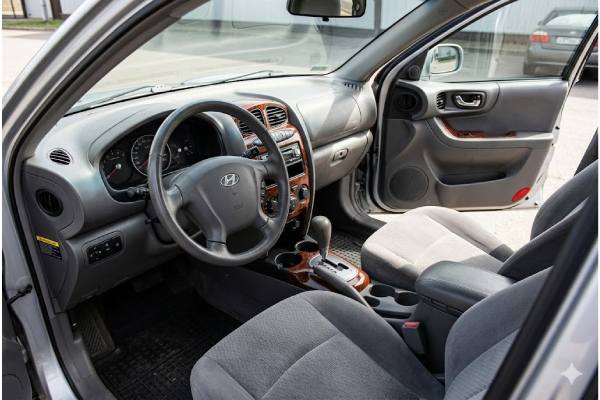
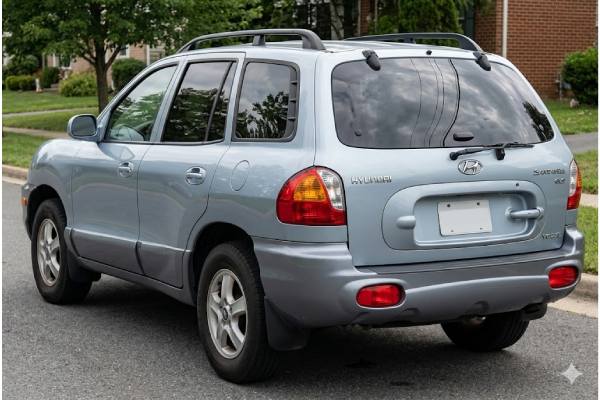
The first-generation Hyundai Santa Fe arrived at a time when compact and midsize SUVs were becoming family cars rather than purely utility vehicles. In 2.4 MPI Fulltime 4WD form, the SM-generation Santa Fe is not a fast or especially refined modern crossover, but it offers honest mechanical simplicity, useful cabin space, and a more substantial feel than many small SUVs of the early 2000s.
For a used buyer, the important question is not only whether the 2.4-liter petrol engine has enough power. It is whether the timing belt has been replaced on time, whether the full-time 4WD system has been serviced, and whether corrosion recalls or structural inspections have been completed. Market specifications vary, so VIN-specific documentation matters, but the ownership priorities are consistent: maintenance history, rust condition, cooling system health, and drivetrain smoothness.
Owner Snapshot
- Spacious five-seat cabin, high driving position, and practical cargo area for its age.
- Simple naturally aspirated 2.4 MPI engine is easier to service than later turbo or direct-injection engines.
- Fulltime 4WD improves poor-weather traction but adds weight, fuel use, and extra fluids to maintain.
- Timing belt service is critical; plan around 60,000 miles / 96,000 km or the shorter local interval.
- Normal oil service is commonly 7,500 miles / 12,000 km or 12 months, with shorter intervals for severe use.
Table of Contents
- Santa Fe SM 2.4 Buyer View
- Santa Fe SM 2.4 Technical Data
- Santa Fe SM Trims and Safety
- Reliability Faults and Service Actions
- Maintenance and Buying Checks
- Driving Performance and Economy
- Santa Fe SM Against Rivals
Santa Fe SM 2.4 Buyer View
The 2001–2002 Santa Fe SM 2.4 MPI Fulltime 4WD sits between compact crossovers and older body-on-frame SUVs. It has a unibody structure, independent suspension, a transverse petrol engine, and a full-time all-wheel-drive layout rather than a low-range transfer case. That makes it better suited to snow, wet roads, gravel tracks, and light-duty towing than to serious off-road work.
The engine is Hyundai’s 2.4-liter G4JS/Sirius-family inline-four in multi-point injection form. In the requested 149 hp rating, it is best understood as a market-specific output figure; several European-style data sources list the same basic 2.4 16-valve engine around 143–146 hp depending on the rating standard. The practical difference is small. In any version, the 2.4 has enough power for calm daily use but needs revs when the Santa Fe is loaded or climbing.
The main advantage of this model is its straightforward mechanical package. There is no turbocharger, no direct injection, no hybrid battery, and no complex driver-assistance suite. A well-kept example can still be a useful low-cost SUV if the structure is sound and the maintenance record is complete. Parts availability is generally reasonable because the engine family and platform components were used across several Hyundai and Kia products.
The main disadvantage is age. These vehicles are now old enough that condition matters far more than mileage alone. A low-mileage Santa Fe that has sat outside in a salt-belt climate may be a worse purchase than a higher-mileage one with regular fluid services, timing belt work, and clean underbody metal. The rear trailing arms, front subframe areas, coil springs, brake lines, fuel lines, sills, and suspension mounting points deserve close inspection.
The Fulltime 4WD system is useful but should not be confused with a modern terrain-management AWD system. It normally uses a center coupling to distribute torque without driver input. There is no selectable low range, and the system depends heavily on matching tire sizes and correct driveline fluids. Mismatched tires, neglected transfer case oil, or ignored rear differential service can create driveline noise and premature wear.
For most buyers, the best example is not necessarily the highest trim. It is the one with documented timing belt replacement, clean coolant, smooth transmission operation, dry engine seals, working air conditioning, no warning lights, and proof that any applicable recall or corrosion campaign has been addressed. With those boxes checked, the Santa Fe SM 2.4 Fulltime 4WD remains a simple, useful, and affordable early crossover.
Santa Fe SM 2.4 Technical Data
Specifications for the 2001–2002 Santa Fe SM vary by market, trim, transmission, and rating method. The tables below focus on the 2.4 MPI petrol Fulltime 4WD variant and note where figures commonly differ.
| Category | Specification |
|---|---|
| Model | Hyundai Santa Fe, first generation SM |
| Model years covered | 2001–2002 |
| Body style | 5-door SUV / crossover wagon |
| Seats | 5 |
| Engine code / family | G4JS / Sirius-family 2.4 MPI |
| Engine layout | Front transverse inline-4 |
| Valvetrain | DOHC, 16 valves, 4 valves per cylinder |
| Bore × stroke | 86.5 × 100.0 mm (3.41 × 3.94 in) |
| Displacement | 2.4 L; 2,351 cc (143.5 cu in) |
| Induction | Naturally aspirated |
| Fuel system | Multi-point fuel injection / MPI |
| Compression ratio | 10.0:1 |
| Maximum power | 149 hp (111 kW) @ 5,500 rpm in the requested rating; some markets list 143–146 hp |
| Maximum torque | Commonly listed around 200–211 Nm (148–156 lb-ft), market/rating dependent |
| Timing drive | Timing belt, with related balance-shaft belt components |
| Fuel | Unleaded petrol; 87 AKI / 91 RON minimum in many manuals |
| Rated efficiency | About 9.8 L/100 km combined in common 4WD data; market cycles differ |
| Real-world highway at 120 km/h | Usually about 9.5–11.5 L/100 km when healthy and lightly loaded |
| Driveline item | Specification |
|---|---|
| Transmission | 5-speed manual on many 2.4 4WD versions; 4-speed automatic available in some markets |
| Drive type | Full-time 4WD / AWD |
| Center coupling | Viscous-style coupling or center limited-slip arrangement, market dependent |
| Differentials | Open front/rear in most versions; no locking rear differential |
| Low range | Not fitted |
| Best use | Wet roads, snow, gravel, light trails, moderate towing |
| Chassis and dimensions | Specification |
|---|---|
| Front suspension | Independent MacPherson strut with coil springs and anti-roll bar |
| Rear suspension | Independent multi-link with coil springs |
| Steering | Power-assisted rack and pinion |
| Steering ratio | About 19:1 in common North American data |
| Turning circle | About 11.3 m (37 ft) kerb-to-kerb |
| Brakes | Front ventilated discs; rear discs or drums depending on market/trim |
| Front rotor size | About 295 mm (11.6 in) in common data |
| Typical tire size | 225/70 R16 |
| Wheel size | 16 × 6.5 in commonly fitted |
| Ground clearance | About 203–207 mm (8.0–8.1 in), market dependent |
| Length | 4,500 mm (177.2 in) |
| Width | About 1,820–1,845 mm (71.7–72.6 in), market dependent |
| Height | About 1,675–1,730 mm (65.9–68.1 in), market dependent |
| Wheelbase | 2,620 mm (103.1 in) |
| Kerb/curb weight | About 1,585–1,776 kg (3,494–3,915 lb), depending on market and transmission |
| GVWR / GVM | About 2,315–2,380 kg (5,104–5,247 lb) |
| Fuel tank | 65 L (17.2 US gal / 14.3 UK gal) |
| Cargo volume | About 469–1,473 L (16.6–52.0 ft³) in VDA-style data; US cargo methods may show larger figures |
| Performance and capability | Specification |
|---|---|
| 0–100 km/h (0–62 mph) | About 11.4 seconds in common 2.4 4WD data |
| 0–60 mph | Roughly 10.8–11.2 seconds, depending on transmission and test method |
| Top speed | About 173 km/h (108 mph) |
| 100–0 km/h braking distance | Not consistently published; tire and brake condition are decisive on used examples |
| Braked towing capacity | Commonly 1,200–1,650 kg (2,646–3,638 lb), market and approval dependent |
| Unbraked towing capacity | About 700–750 kg (1,543–1,653 lb), market dependent |
| Payload | About 600–700 kg (1,323–1,543 lb), depending on specification |
| Fluids and service capacities | Typical specification |
|---|---|
| Engine oil | API SG/SH or later appropriate equivalent; viscosity by climate, commonly 5W-30, 10W-30, or 10W-40 |
| Engine oil capacity | About 4.3 L (4.53 US qt) with filter |
| Engine coolant | Ethylene-glycol coolant suitable for aluminum radiators; usually 50/50 premix unless climate requires otherwise |
| Coolant capacity | About 8.5 L (8.9 US qt) for the 2.4 |
| Manual transaxle oil | 75W-90 API GL-4; about 2.3 L (2.43 US qt) |
| Automatic transmission fluid | Hyundai/Kia SP-III type fluid; about 7.0 L (7.35 US qt) total system quantity |
| Transfer case oil | API GL-5 SAE 80W-90; about 0.8 L (0.84 US qt) |
| Rear axle oil | API GL-5 SAE 80W-90; about 1.1 L (1.16 US qt) |
| Brake/clutch fluid | DOT 3 or DOT 4 |
| Power steering fluid | PSF-3 type |
| A/C refrigerant | R-134a on original systems; verify charge on underhood label |
| A/C compressor oil | PAG-type oil; verify exact quantity by compressor and service label |
| Essential torque values | Practical note |
|---|---|
| Wheel nuts | Commonly 88–108 Nm (65–80 lb-ft); verify for wheel type |
| Engine oil drain plug | Commonly around 35–45 Nm (26–33 lb-ft); avoid over-tightening old pans |
| Spark plugs | Commonly around 20–30 Nm (15–22 lb-ft); apply correct plug type and thread condition guidance |
| Suspension and driveline fasteners | Use official service data for the exact VIN and component |
Santa Fe SM Trims and Safety
Trim naming depends heavily on market. In North America, early Santa Fe models were sold in GL, GLS, and LX forms, but the 2.4-liter engine was often tied to lower trims and front-drive configurations, while many 4WD models used the V6. In Europe, Australia, Japan, and other export markets, 2.4-liter 4WD combinations were more common. Because of that, badges alone are not enough to identify the exact drivetrain.
The quickest identifiers are the VIN, engine bay emissions label, transmission tag, rear differential, transfer case, and service records. A true Fulltime 4WD example will have rear drive hardware, rear differential service points, and a prop shaft running to the rear. Interior tells vary, but higher trims may add alloy wheels, two-tone cladding, roof rails, fog lamps, upgraded audio, cruise control, power accessories, leather or leather-look trim, and cargo covers.
Functional differences matter more than cosmetic ones. Look for:
- Transmission type: 5-speed manual versus 4-speed automatic.
- Brake layout: rear discs on many export 4WD models, rear drums on some lower-spec versions.
- ABS availability: optional on some early trims and standard on others.
- Tire package: 225/70 R16 is common and gives a comfortable ride with good sidewall protection.
- Towing approval: varies by country, towbar, transmission, and homologation.
The 2001–2002 model years were early in the SM lifecycle. Equipment and safety content improved in some markets over the following years. Early vehicles may have dual front airbags, seatbelt pretensioners, child-seat tether provisions, and ABS depending on specification. Front side airbags became available or standard in some later-market combinations, but they should not be assumed on every 2001–2002 vehicle.
Safety ratings should be interpreted by period standards, not modern standards. The IIHS tested a 2001 Santa Fe GLS 4WD in the moderate-overlap frontal crash test, and the rating applies to 2001–2006 models built after the relevant accelerator-pedal running change. Euro NCAP-era results for the first-generation Santa Fe are often summarized as 4-star adult occupant and 1-star pedestrian protection under older protocols. Those tests do not equal current small-overlap, side-pole, pedestrian-AEB, or driver-assistance evaluations.
There is no modern ADAS suite. No factory AEB, adaptive cruise control, lane keeping, blind-spot monitoring, rear cross-traffic alert, traffic-sign recognition, or automatic lane-centering system should be expected. Parking sensors, if present, are usually dealer or market-specific accessories rather than advanced safety equipment.
After collision repair, the main calibration concerns are conventional: wheel alignment, steering wheel centering, ABS sensor integrity, airbag/SRS fault clearing, and correct seatbelt pretensioner or crash-sensor repair. There are no camera or radar calibration procedures like those on modern SUVs, but that does not make safety repairs casual. SRS work should be handled by qualified technicians using the correct service information.
Reliability Faults and Service Actions
The Santa Fe SM 2.4 is usually more forgiving than many newer SUVs, but it has several age-related weak points. Reliability depends on maintenance discipline and corrosion exposure.
| Issue | Prevalence | Severity/cost | Symptoms | Likely cause | Best remedy |
|---|---|---|---|---|---|
| Overdue timing belt | Common | High | Noisy belt area, uncertain history, non-start after failure | Belt, tensioner, idlers, balance-shaft belt age | Replace full timing kit; consider water pump and seals |
| Oil leaks | Common | Low–medium | Burning oil smell, wet engine front/rear | Cam/crank seals, valve cover gasket, oil pan seepage | Reseal during timing service when practical |
| Cooling system aging | Common | Medium | Overheating, coolant smell, low reservoir | Radiator, hoses, thermostat, water pump | Pressure test; replace aged components |
| Rear trailing arm corrosion | Common in salt climates | High | Rear clunk, steering pull, ride-height change, visible rust | Internal corrosion of rear suspension arms | Inspect immediately; verify recall/campaign completion |
| Front coil spring corrosion | Occasional to common in salt climates | High | Broken spring, tire rub, front corner sag | Road-salt corrosion | Inspect springs; replace affected parts |
| Wheel bearings and suspension wear | Common | Medium | Humming, clunks, uneven tire wear | Bearing wear, bushings, ball joints | Replace worn parts; align afterward |
| 4WD driveline noise | Occasional | Medium–high | Whine, binding, vibration | Mismatched tires, neglected transfer/rear axle oil, coupling wear | Match tires, service fluids, inspect coupling/differentials |
| Automatic shift harshness | Occasional | Medium | Flare, delayed engagement, harsh shifts | Old SP-III fluid, sensor issues, internal wear | Fluid service with correct fluid; diagnose before rebuild |
| Electrical sensors | Occasional | Low–medium | Check-engine light, stalling, rough idle | Crank/cam sensors, oxygen sensors, idle control | Scan codes and replace confirmed faults |
The 2.4 G4JS uses a timing belt, not a timing chain. That is the single most important engine-maintenance item. A seller who cannot prove the last belt service should be treated as if it is due immediately. A proper job includes the main belt, balance-shaft belt where applicable, tensioners, idler pulleys, and inspection of the water pump and front engine seals.
Oil consumption is not usually the defining weakness of this engine, but neglected examples can burn or leak oil. Check the dipstick level, look under the timing cover area for oil contamination, inspect the valve cover perimeter, and watch for blue smoke after a long idle. Old oil leaks can shorten belt life if oil reaches the belt area.
Cooling system issues are age-driven. Radiators, hoses, thermostat housings, water pumps, fans, and caps should all be treated as wear items on a vehicle this old. Any overheating history is a serious concern because an aluminum cylinder head can warp if the engine is repeatedly run hot.
The biggest structural reliability issue is corrosion. Some Hyundai service actions and recalls focused on salt-belt rear trailing arm corrosion and later front coil spring corrosion. A proper inspection means more than a quick glance at the visible underbody. The rear suspension arms, front subframe, spring seats, brake lines, fuel lines, rocker areas, rear wheel arches, and mounting points need close examination on a lift.
Software updates are limited compared with modern vehicles. There is no battery-management system, no ADAS camera suite, and no infotainment software ecosystem to manage. For automatic models, however, TCU/ECU driveability updates or re-learn procedures may exist in market-specific service bulletins. A dealer or specialist can check by VIN.
Before purchase, request a full service history, timing belt invoice, coolant and ATF records, 4WD fluid service proof, recall completion records, and recent inspection notes. A clean engine bay without paperwork is not enough. On this generation, neglect is usually visible once the vehicle is lifted and driven properly.
Maintenance and Buying Checks
A practical maintenance schedule for this Santa Fe should combine the factory interval with extra caution for age. Even if mileage is low, rubber parts, fluids, seals, and corrosion protection deteriorate with time.
| Item | Practical interval |
|---|---|
| Engine oil and filter | 7,500 miles / 12,000 km or 12 months normal use; 3,000–5,000 miles / 5,000–8,000 km for severe use |
| Engine air filter | Inspect every service; replace about 15,000–30,000 miles / 24,000–48,000 km, sooner in dust |
| Cabin air filter | Replace yearly if fitted; some markets/configurations vary |
| Spark plugs | About 60,000 miles / 96,000 km for platinum-type plugs, or by local manual |
| Timing belt system | Around 60,000 miles / 96,000 km or 4–5 years; use the shorter local interval if specified |
| Accessory belts and hoses | Inspect every service; replace cracked, glazed, swollen, or oil-soaked parts |
| Coolant | About every 2–3 years on an old vehicle, or per manual coolant type |
| Manual transaxle oil | 30,000–60,000 miles / 48,000–96,000 km, shorter for towing or water exposure |
| Automatic transmission fluid | 30,000–60,000 miles / 48,000–96,000 km; use SP-III type only where specified |
| Transfer case and rear axle oil | 30,000–60,000 miles / 48,000–96,000 km; replace immediately after water submersion |
| Brake fluid | Every 2 years |
| Brake pads, rotors, calipers | Inspect at least yearly; check slide pins and parking brake operation |
| Tire rotation | 6,000–7,500 miles / 10,000–12,000 km |
| Wheel alignment | Check after suspension work, uneven tire wear, or steering pull |
| 12 V battery | Test yearly after 3 years; replacement often falls around 4–6 years |
| A/C system | Check performance yearly; repair leaks before recharging |
The best buying inspection starts underneath. Look at the rear trailing arms, front subframe, lower control arms, spring seats, brake pipes, fuel pipes, rear wheel arches, rocker seams, and jacking points. Heavy flaking rust near suspension mounts is a reason to walk away unless the vehicle is exceptionally cheap and repairable.
During a cold start, the engine should settle quickly without heavy knocking, belt squeal, misfire, or visible smoke. A short lifter tick may occur on older engines, but persistent noise, oil-pressure warning lights, or rough running need diagnosis. Watch the temperature gauge during a long idle and a road test; it should remain stable.
On a manual gearbox, clutch take-up should be smooth, with no slipping in a higher gear under load. On an automatic, engagement from Park to Drive or Reverse should be prompt without a hard bang. Shifts should be clean when warm. Burnt ATF, delayed engagement, or flare between gears is a warning.
For Fulltime 4WD, all four tires should match in size, brand, model, and wear depth. Drive slowly in tight circles and listen for binding, thumping, or driveline wind-up. On the road, listen for rear differential whine, prop-shaft vibration, or wheel-bearing hum.
Recommended examples are those with complete maintenance documentation, clean structure, working air conditioning, matching tires, recent brakes, and proof of timing belt service. Avoid examples with severe rust, unknown belt history, overheating signs, mismatched tires, transmission faults, or multiple warning lights. Long-term durability is good only when maintenance has been steady; deferred work can quickly exceed the value of the vehicle.
Driving Performance and Economy
The 2.4 MPI Fulltime 4WD Santa Fe drives like an early-2000s family SUV: relaxed, soft-edged, and more comfortable than sporty. Steering is light, visibility is good, and the high seating position makes it easy to place in town. The suspension favors compliance over sharp response, so it absorbs broken pavement reasonably well but leans when pushed through corners.
Straight-line performance is adequate rather than strong. A healthy 2.4 manual 4WD can reach 100 km/h in about 11.4 seconds, but the engine works hard with passengers, luggage, or a trailer. The long-stroke four-cylinder has usable mid-range torque, yet it is not effortless at highway passing speeds. Downshifts are normal when climbing grades or overtaking.
The manual gearbox gives the driver better control of the modest power. The 4-speed automatic suits relaxed driving but can feel busy or dated by modern standards. If the automatic hunts between gears, shifts harshly, or delays engagement, do not assume it only needs fluid. It may, but diagnosis should come first.
Noise, vibration, and harshness are acceptable for the era. Wind and tire noise become obvious at highway speed, and the engine is audible when revved. Compared with a modern Santa Fe or compact pickup-based crossover, the SM feels simpler and less insulated. Compared with many period rivals, it feels solid and substantial.
Real-world fuel economy depends heavily on tires, drivetrain condition, transmission, and terrain. Typical planning figures are:
| Use case | Realistic fuel use |
|---|---|
| City driving | About 12.5–15.0 L/100 km (16–19 mpg US / 19–23 mpg UK) |
| Highway at 100 km/h / 62 mph | About 8.5–10.0 L/100 km (24–28 mpg US / 28–33 mpg UK) |
| Highway at 120 km/h / 75 mph | About 9.5–11.5 L/100 km (20–25 mpg US / 25–30 mpg UK) |
| Mixed use | About 10.5–12.5 L/100 km (19–22 mpg US / 23–27 mpg UK) |
| Cold weather penalty | Often 10–20% higher fuel use |
| Moderate towing/load penalty | Commonly 25–45% higher fuel use, depending on speed and terrain |
The full-time 4WD system is useful in rain, snow, and loose surfaces. It is passive and predictable, not performance-oriented. Stability control was not widely fitted in this period, so tires and driver judgment matter. Good all-season or winter tires transform the vehicle more than any accessory.
Braking feel is conventional. Condition matters enormously: old hoses, sticky calipers, worn rear drums or discs, contaminated fluid, and poor tires can make the vehicle feel much older than it should. A properly serviced Santa Fe should stop straight, with a firm pedal and no steering shake.
For towing, stay conservative. The 2.4 can handle small utility trailers, light campers within the approved rating, bikes, or garden loads, but it is not the ideal engine for frequent heavy towing. Watch transmission temperature on automatic models, keep cooling components fresh, and respect tongue weight and local tow-rating rules.
Santa Fe SM Against Rivals
Against early-2000s rivals, the Santa Fe’s main advantage is value. It often offered more cabin space, a more substantial body, and generous equipment for the money. Its styling was unusual when new, but the practical package was sensible: five doors, good cargo access, upright seating, and available full-time 4WD.
Compared with the Toyota RAV4 of the same era, the Santa Fe feels larger and heavier. The RAV4 is usually more agile and more economical, while the Santa Fe gives a broader cabin feel and stronger tow-oriented practicality in some markets. The Toyota has a stronger reputation for long-term durability, but clean examples are often more expensive.
Compared with the Honda CR-V, the Santa Fe again feels heavier and less nimble. The CR-V has excellent packaging and a strong reliability reputation, while the Santa Fe counters with a more substantial ride and often lower used prices. For buyers who value low running costs above all else, the CR-V is hard to beat. For buyers who need more weight and towing margin, the Santa Fe can make more sense.
Compared with the Subaru Forester, the Hyundai is roomier and more relaxed, while the Subaru has a more car-like feel and a more sophisticated AWD identity. The Forester may be better on twisty roads and in snow with the right tires, but older Subaru ownership can bring its own head-gasket, oil leak, and drivetrain concerns depending on engine and year.
Compared with the Ford Escape and Mazda Tribute, the Santa Fe is competitive in space and comfort. The Escape/Tribute often feel more responsive, especially with V6 power, but their rust and transmission condition should also be inspected closely. The Hyundai’s 2.4 engine is simpler and slower than many V6 rivals, which can be a benefit for service cost but a drawback for performance.
The Santa Fe SM 2.4 Fulltime 4WD is worth considering when the purchase price is sensible and the condition is clearly above average. It is less appealing if the buyer expects modern refinement, advanced safety tech, or strong acceleration. Its best role is as a practical, inexpensive, mechanically straightforward used SUV for local use, winter commuting, light towing, and utility work.
References
- HYUNDAI 2001 SANTA FE OWNER’S MANUAL Pdf Download | ManualsLib 2001 (Owner’s Manual) ([ManualsLib][1])
- 2001 Hyundai SANTA FE Specs, Dimensions & Colors | Cars.com 2001 (Specifications) ([Cars.com][2])
- Hyundai Santa Fe I (SM) 2.4 i 16V 4WD (146 Hp) | Technical specs, data, fuel consumption, Dimensions 2000 (Technical Data) ([Auto Data][3])
- 2001 Hyundai Santa Fe 2001 (Safety Rating) ([IIHS HLDI][4])
- Part 573 Safety Recall Report 14V-435 2015 (Recall Report)
Disclaimer
This article is for informational purposes only and is not a substitute for professional diagnosis, repair, inspection, or official service procedures. Specifications, torque values, service intervals, fluids, equipment, safety features, and recall applicability can vary by VIN, market, trim, transmission, and production date. Always verify critical information against the official service documentation and a qualified Hyundai technician before buying, servicing, towing with, or repairing the vehicle.
If this article was useful, please consider sharing it on Facebook, X/Twitter, or another platform to support our work.