
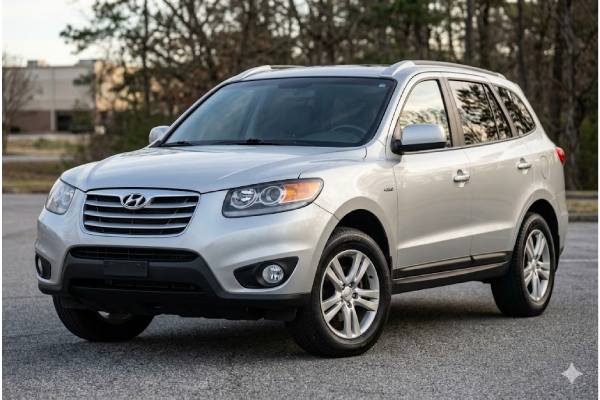
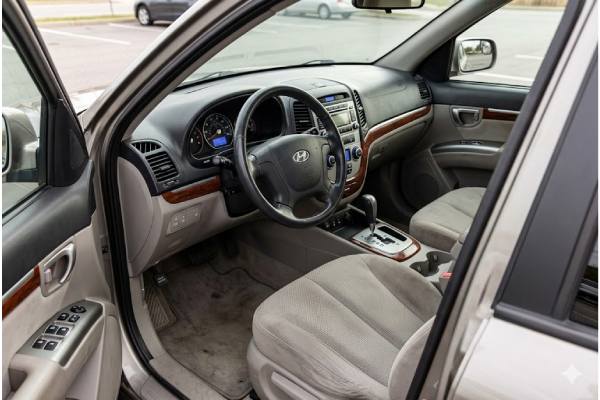
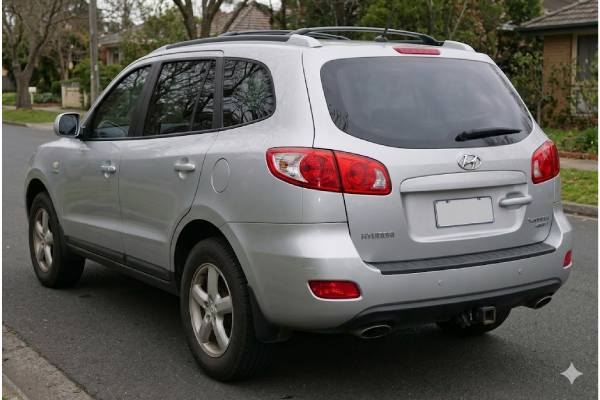
The second-generation Hyundai Santa Fe CM with the 2.2 CRDi diesel sits in a practical middle ground: larger and more comfortable than most compact SUVs of its era, but simpler and less expensive to run than premium seven-seat alternatives. In 4WD form, it was aimed at families who wanted winter traction, towing ability, and long-distance diesel economy without moving into a heavy-duty off-roader.
The 153 hp version covered here is the earlier D4EB 2.2 CRDi, sold before the later higher-output R-series diesel became common. It is a useful used buy when maintained properly, but age now matters as much as mileage. Timing belt history, corrosion, driveline fluids, diesel emissions equipment, and service records should decide the purchase more than trim level alone.
Owner Snapshot
- Strong low-rpm diesel torque, useful 4WD traction, and a spacious cabin make it a capable family SUV.
- Practical advantages include a large boot, available seven-seat layouts, and braked towing ratings around 2,000–2,200 kg depending on market and transmission.
- The main ownership caveat is age-related maintenance: timing belt, rear driveline fluids, corrosion, suspension wear, and diesel intake/EGR condition need close attention.
- Engine oil service is best kept to 10,000–15,000 km or 12 months on older examples, especially with short trips or towing.
- The D4EB diesel uses a timing belt; many markets list a long interval around 150,000–160,000 km or 10 years, but severe-use schedules can be much shorter.
Table of Contents
- Santa Fe CM Used Overview
- Santa Fe CM Technical Specs
- Santa Fe CM Trims and Safety
- Reliability Issues and Service Actions
- Maintenance Schedule and Buying Checks
- Driving Performance and Economy
- Comparison With Period Rivals
Santa Fe CM Used Overview
The Hyundai Santa Fe CM replaced the original Santa Fe with a more mature, road-biased SUV package. It remained a transverse-engine family crossover rather than a separate-chassis 4×4, but it grew into a more substantial vehicle with better refinement, more interior space, and stronger safety equipment on higher trims.
The 2.2 CRDi diesel is the most relevant engine for many European and export-market buyers. In this early 153 hp tune, it uses the D4EB four-cylinder common-rail diesel with a variable-geometry turbocharger and a timing belt. It produces its best work at low and medium rpm, which suits the Santa Fe’s weight and intended use. It is not quick by modern standards, but it has enough torque for relaxed motorway driving and moderate towing.
The 4WD system is an on-demand layout. In normal steady driving, the vehicle behaves mainly like a front-drive SUV, with rear torque added when slip is detected or when the coupling is commanded to engage. Some versions include a 4WD lock button for low-speed slippery conditions. It is helpful on snow, wet grass, gravel access roads, and poor rural surfaces, but it is not a substitute for low-range gearing, locking differentials, or proper all-terrain tyres.
Body style is a five-door SUV, with five or seven seats depending on trim and market. The seven-seat versions are useful for children or short trips, while the five-seat versions offer a simpler cargo layout. Compared with smaller SUVs of the same era, the Santa Fe feels wide, stable, and comfortable. Compared with body-on-frame rivals, it is easier to drive daily but less suitable for heavy off-road use.
For used buyers, the model’s appeal is straightforward: it offers a lot of space, good diesel range, useful towing capacity, and affordable parts availability. The trade-off is that most examples are now well into age-related maintenance territory. A cheap Santa Fe with no timing belt invoice, old automatic transmission fluid, tired rear suspension, leaking injector seals, and rusty brake pipes can become expensive quickly.
The best examples are not necessarily the lowest-mileage ones. A higher-mileage car with yearly oil changes, a documented timing belt kit, fresh driveline fluids, clean coolant, working air conditioning, and completed recalls is usually a safer bet than a neglected low-mileage SUV that has only done short urban trips.
Santa Fe CM Technical Specs
Specifications vary by country, trim, seating layout, emissions package, and gearbox. The figures below describe the 2006–2009 Santa Fe CM 4WD with the earlier 2.2 CRDi D4EB diesel in 153 hp form, with notes where market differences are common.
| Item | Hyundai Santa Fe CM 2.2 CRDi 4WD |
|---|---|
| Engine code | D4EB / D4EB-V, market dependent |
| Engine layout | Inline-4 diesel, DOHC, 4 valves per cylinder |
| Bore × stroke | 87.0 × 92.0 mm (3.43 × 3.62 in) |
| Displacement | 2.2 L (2,188 cc) |
| Induction | Turbocharged, variable-geometry turbo, intercooler |
| Fuel system | Common-rail direct injection |
| Compression ratio | About 17.3:1 |
| Maximum power | 153 hp / 155 PS (114 kW) at about 4,000 rpm |
| Maximum torque | 343 Nm (253 lb-ft) at about 1,800–2,500 rpm |
| Timing drive | Timing belt |
| Rated efficiency | About 7.2–7.3 L/100 km combined (32–33 mpg US / 39 mpg UK) |
| Real highway at 120 km/h | Typically around 7.5–8.8 L/100 km (27–31 mpg US / 32–38 mpg UK), depending on gearbox, tyres, load, and wind |
| Item | Typical specification |
|---|---|
| Transmission | 5-speed manual or 5-speed automatic, depending on market and trim |
| Drive type | On-demand 4WD / AWD with rear coupling |
| Differentials | Open differentials; no low range or mechanical lockers |
| Suspension | Front MacPherson struts; rear multi-link |
| Steering | Power-assisted rack-and-pinion; exact ratio varies by market |
| Brakes | Ventilated front discs about 320–321 mm (12.6 in); solid rear discs about 302 mm (11.9 in) |
| Popular tyre sizes | 235/65 R17 or 235/60 R18 |
| Ground clearance | About 200–203 mm (7.9–8.0 in) |
| Length / width / height | 4,675 / 1,890 / 1,795 mm (184.1 / 74.4 / 70.7 in) |
| Wheelbase | 2,700 mm (106.3 in) |
| Turning circle | About 10.8 m (35.4 ft), kerb-to-kerb |
| Kerb weight | About 1,823–1,916 kg (4,019–4,224 lb), depending on trim and seats |
| GVWR | About 2,570 kg (5,666 lb) |
| Fuel tank | 75 L (19.8 US gal / 16.5 UK gal) |
| Cargo volume | About 528 L (18.6 ft³) seats up; larger figures vary by five-seat or seven-seat measurement method |
| Item | Typical figure or note |
|---|---|
| 0–100 km/h | About 11.6 seconds |
| Top speed | About 179 km/h (111 mph) |
| 100–0 km/h braking | Often around 42–45 m (138–148 ft) in period testing, tyre dependent |
| Towing capacity | Commonly up to 2,000–2,200 kg (4,409–4,850 lb) braked; 750 kg (1,653 lb) unbraked |
| Payload | Roughly 650–750 kg (1,433–1,653 lb), depending on exact kerb weight and equipment |
| Engine oil | About 5.9 L (6.2 US qt) with filter; use market-correct diesel oil, often 5W-30 or 5W-40, with low-SAPS oil where a DPF is fitted |
| Coolant | About 8.4 L (8.9 US qt); ethylene-glycol long-life coolant, typically 50:50 premix |
| Automatic transmission fluid | About 7.8 L (8.2 US qt) total capacity; use the Hyundai specification stated for the fitted gearbox |
| Transfer case / rear differential | Use specified hypoid gear oil; capacities are small, so level and correct oil type matter |
| A/C refrigerant | R134a; charge amount must be checked from the under-bonnet label or service manual |
| Key torque examples | Wheel nuts commonly around 88–107 Nm (65–79 lb-ft); timing tensioner and cover fasteners must follow service data |
| Crash ratings | Euro NCAP old-protocol result: 4-star adult, 3-star child, 0-star pedestrian; ANCAP 2006 result: 4-star for variants with side and curtain airbags |
| ADAS | No modern AEB, adaptive cruise, lane keeping, or blind-spot monitoring on this generation |
Santa Fe CM Trims and Safety
Trim names differ widely. In the UK and parts of Europe, the Santa Fe CM appeared in grades such as GSi, CDX, and CDX+, while other markets used names such as GLS, Limited, Elite, or SLX. Equipment also changed by year and importer, so the badge on the tailgate is only a starting point.
Base and mid-level diesel 4WD models usually covered the essentials: alloy wheels, air conditioning or climate control, electric windows, ABS with electronic brake-force distribution, front airbags, roof rails, and a practical split-folding rear seat. Higher trims added leather upholstery, heated seats, larger wheels, parking sensors, upgraded audio, sunroof availability, automatic climate control, and in some markets a third row.
Mechanical differences are generally modest. The important functional distinctions are gearbox, seating layout, wheel size, safety equipment, towbar installation, and whether stability control and curtain airbags are fitted. The 17-inch wheel package tends to ride better and gives more sidewall protection. The 18-inch package looks sharper but can transmit more impact harshness and tyre cost.
Quick identifiers include:
- A 4WD badge or switch, but confirm the rear differential, prop shaft, and transfer case are physically present.
- Seven-seat versions have the third-row seat hardware, rear belts, and different cargo-floor trim.
- Higher trims often have leather, climate control, larger alloy wheels, parking sensors, and more airbags.
- Diesel particulate filter equipment varies by emissions market and year; check the under-bonnet emissions label and exhaust layout.
Safety is equipment-sensitive. Dual front airbags and ABS were common, but side airbags, curtain airbags, and ESC were not always universal in every market at launch. This matters because crash-test results for older vehicles often applied to a tested specification rather than every car sold. A low-trim Santa Fe without side and curtain airbags should not be judged the same as a fully equipped version.
The old Euro NCAP result was respectable for adult occupant protection at the time but poor for pedestrian protection by modern expectations. ANCAP rated variants with side and curtain airbags at four stars in 2006, while later Australian-market updates with ESC standard achieved stronger results. None of this makes the CM unsafe for its era, but it is far behind modern SUVs for active safety.
Child-seat provision is practical, with ISOFIX/LATCH availability depending on market. Before buying, check that rear seatbelts retract cleanly, buckles are not damaged, and the passenger airbag warning system behaves correctly. If any airbag or ESC warning light stays on, treat it as a fault requiring diagnostic work, not as a harmless old-car quirk.
Reliability Issues and Service Actions
A well-maintained 2.2 CRDi Santa Fe can cover high mileage, but neglected examples develop the predictable problems of an older diesel SUV. The most important issue is not one single fatal flaw; it is the combination of age, weight, diesel short-trip use, and skipped fluid services.
Common or important checks include:
- Timing belt system: The D4EB diesel uses a belt, not a lifetime chain. Replace the belt kit, tensioner, idlers, and usually the water pump if history is uncertain.
- EGR and intake deposits: Rough idle, hesitation, smoke, limp mode, and poor response can come from soot-clogged EGR passages, intake contamination, or sensor faults.
- Injectors and fuel system: Hard starting, diesel smell, uneven idle, or black residue around injector seats can point to injector seal leakage, return-line issues, or fuel filter neglect.
- Turbo and boost control: Split intercooler hoses, sticky variable vanes, vacuum leaks, or actuator faults can cause low boost, overboost, smoke, or limp-home behaviour.
- Cooling system: Watch for old hoses, weak thermostat behaviour, radiator leaks, water pump seepage, and coolant that has not been renewed.
- Driveline fluids: Transfer case and rear differential oil are often ignored. Whine, binding, or vibration under load should be investigated before purchase.
- Automatic transmission: Harsh shifts, flare, delayed engagement, or shudder often become worse when ATF has never been changed.
- Suspension and steering: Drop links, bushes, ball joints, rear multi-link components, wheel bearings, and steering joints wear under the Santa Fe’s weight.
- Corrosion: Inspect subframes, rear suspension mounts, brake pipes, fuel lines, inner sills, wheel arches, tailgate edges, towbar mounts, and underbody seams.
| System | Prevalence | Typical symptom | Cost tier |
|---|---|---|---|
| Timing belt and water pump | Age-critical | No proof of replacement, coolant seepage, belt noise | Medium to high |
| EGR / intake soot | Common on short-trip diesels | Smoke, limp mode, hesitation, warning light | Low to medium |
| Injector seals / fuel delivery | Occasional | Hard start, diesel smell, rough idle, black residue | Medium |
| Turbo control and hoses | Occasional | Low power, boost fault codes, whistling, smoke | Medium to high |
| Transfer case / rear differential | Occasional, worse with neglected oil | Whine, vibration, binding, driveline clunk | Medium to high |
| Suspension and wheel bearings | Common with age | Knocks, uneven tyre wear, humming, vague steering | Low to medium |
| Corrosion | Market dependent | Rusty brake pipes, subframe rust, seized fasteners | Medium to high |
Service actions and recalls must be checked by VIN. In some markets, Santa Fe CM vehicles were included in campaigns involving stop-lamp switches, occupant classification software, trailer-hitch wiring, and ABS module electrical risk. Not every diesel-market vehicle is affected by every campaign, and imported used vehicles can carry unresolved actions from another country. Ask for dealer records and run an official VIN check before purchase.
Software updates are less extensive than on newer cars, but engine, transmission, airbag, and stability-control calibrations can still matter. If warning lights are present, do not assume a simple sensor. Proper diagnostics should read Hyundai-specific codes from the engine ECU, ABS/ESC module, airbag module, and automatic transmission controller where fitted.
Maintenance Schedule and Buying Checks
Because these vehicles are now older, a sensible maintenance plan is more important than the minimum schedule printed when the car was new. Clean fluids, correct diesel oil, fresh filters, and early diagnosis are what keep the 2.2 CRDi dependable.
| Interval | Recommended work |
|---|---|
| Every 10,000–15,000 km or 12 months | Engine oil and filter; inspect leaks, coolant level, belts, hoses, brakes, tyres, suspension, exhaust, and underbody corrosion |
| Every 15,000–30,000 km | Engine air filter inspection or replacement; cabin filter; tyre rotation; alignment check if tyre wear is uneven |
| Every 30,000–40,000 km | Fuel filter on diesel models, especially in cold climates or where fuel quality is variable |
| Every 2 years | Brake fluid; inspect calipers, slide pins, brake pipes, parking brake, and rear discs |
| Every 60,000–80,000 km | Automatic transmission drain-and-fill if fitted; manual gearbox oil inspection; transfer case and rear differential oil service under towing or harsh use |
| Every 80,000–120,000 km | Coolant renewal if not using a longer official interval; inspect radiator, thermostat, water pump, and heater performance |
| Timing belt interval | Follow the market service book. Many references list about 150,000–160,000 km or 10 years, but severe-use intervals can be shorter. Replace immediately if history is unknown. |
| Every 4–6 years | 12 V battery test or replacement, depending on climate and starting performance |
For fluids, use the specification printed in the official service data for the VIN. As a working guide, the diesel takes about 5.9 L of engine oil with filter, the cooling system about 8.4 L, and the 5-speed automatic about 7.8 L total capacity. Manual gearbox, transfer case, and differential capacities are small enough that level accuracy matters. Do not mix “close enough” gear oils in the rear driveline; use the correct grade and friction requirements.
A good pre-purchase inspection should include:
- Cold start: It should start cleanly without excessive cranking, heavy smoke, or diesel knock that continues after warm-up.
- Timing belt proof: Look for an invoice listing belt, idlers, tensioner, and ideally water pump, not just a handwritten note.
- Cooling system: Check for stable temperature, clean coolant, no pressure build-up when cold, and no heater problems.
- Road test: Confirm smooth boost, clean shifts, no driveline vibration, no wheel-bearing hum, and no ESC/ABS warning lights.
- Underbody: Inspect rust before discussing price. Corroded brake lines, subframes, and seized rear suspension hardware can change the economics of the car.
- 4WD operation: Check for rear driveline presence, coupling function, leaks, and mismatched tyres, which can stress the system.
- Electronics: Test air conditioning, central locking, windows, parking sensors, audio, seat heaters, instrument lights, and all warning lamps.
The best trim to buy is usually the best-maintained one. Higher grades are nicer to live with, but extra equipment adds possible faults. A clean mid-spec diesel 4WD with good history is often a better long-term purchase than a neglected top-trim car with leather, sunroof, and warning lights.
Driving Performance and Economy
The Santa Fe CM 2.2 CRDi 4WD feels strongest when driven in the way its engine prefers: early upshifts, steady throttle, and use of the mid-range torque. It is not a sporty SUV, but it is relaxed, quiet enough for long journeys, and stable at motorway speeds.
Throttle response is moderate rather than sharp. Below the turbo’s useful range, the engine can feel heavy, especially with the automatic gearbox or a full load. Once boost arrives, the 343 Nm torque figure gives the car enough pull for hills, overtaking slower traffic, and towing moderate trailers. The manual gearbox gives more control on inclines, while the automatic is easier in traffic but can feel less responsive if the fluid is old or the engine is off boost.
Ride comfort is one of the model’s better qualities. The wheelbase and relatively soft suspension help it deal with poor roads, and the body does not feel as unsettled as many early crossovers. The trade-off is body roll in quick bends and a steering feel that is more reassuring than communicative. It prefers smooth inputs and sensible speeds.
Noise, vibration, and harshness are acceptable for a mid-2000s diesel SUV. There is noticeable diesel sound when cold and under load, but at a steady cruise the cabin settles down. Tyre choice makes a large difference: premium touring tyres can make the Santa Fe feel calmer, while cheap tyres often increase road roar and braking distances.
Real-world fuel economy depends heavily on use:
- City driving: About 9.5–12.0 L/100 km (20–25 mpg US / 24–30 mpg UK), worse with short cold trips.
- Mixed driving: About 8.0–9.5 L/100 km (25–29 mpg US / 30–35 mpg UK).
- Steady highway: About 7.0–8.5 L/100 km (28–34 mpg US / 33–40 mpg UK), depending on speed and load.
- Towing: Consumption can rise by 25–50 percent with a boxy trailer, hills, or headwinds.
The 4WD system is useful rather than adventurous. It helps when pulling away on wet roads, snow, gravel, muddy campsites, or steep driveways. It does not give the Santa Fe the axle articulation, low-speed gearing, or impact protection of a serious off-roader. Tyres matter more than the badge; good winter or all-season tyres transform its confidence in poor weather.
For towing, the diesel torque and long wheelbase are advantages. The car feels settled with moderate loads if the trailer is correctly balanced, the cooling system is healthy, and the brakes are in good condition. Before towing near the upper rating, inspect the towbar installation, rear suspension, transmission fluid, radiator condition, tyres, and brake system. An automatic transmission cooler inspection is also sensible on cars used regularly for towing.
Comparison With Period Rivals
The Santa Fe CM competed with a varied group of mid-2000s SUVs. Some rivals were smaller and more efficient, some were tougher off road, and some were more refined but more expensive to repair. The Hyundai’s advantage was its balance of space, value, diesel torque, and everyday usability.
Against the Kia Sorento of the same era, the Santa Fe is more road-biased and generally more car-like. The Sorento, especially earlier versions, feels tougher and more traditional, but the Hyundai is easier to live with in daily driving and often more comfortable for families. Buyers needing regular rough-track use may prefer the Sorento; buyers wanting a large road SUV usually prefer the Santa Fe.
Compared with the Honda CR-V and Toyota RAV4, the Hyundai feels larger and better suited to families who need more cabin and luggage room. The Honda and Toyota are usually easier on fuel and have strong reliability reputations, but they do not offer the same sense of size or towing confidence in many equivalent diesel trims. The Santa Fe is the more spacious choice; the CR-V and RAV4 are the lighter, simpler choices.
The Mitsubishi Outlander is closer in concept, especially in seven-seat versions. It can feel sharper and more compact on the road, while the Santa Fe feels softer, quieter, and more substantial. The Outlander may appeal to buyers who prefer a lighter-feeling SUV; the Hyundai suits those who prioritise comfort and diesel pulling power.
The Chevrolet Captiva and Opel/Vauxhall Antara are often cross-shopped because they can be inexpensive used. The Santa Fe usually feels better resolved, with a more convincing blend of ride, space, and durability when maintained properly. The Captiva can offer seven seats at a low price, but condition and parts quality should be judged carefully.
A Land Rover Freelander 2 offers better rough-road credibility and a more premium cabin feel, but ownership costs can be higher. The Hyundai is less prestigious but often more straightforward to maintain. For many used buyers, that matters more than badge appeal.
Overall, the Santa Fe CM 2.2 CRDi 4WD is worth considering when the inspection supports it. Its strongest case is as a roomy, comfortable, diesel family SUV with useful all-weather traction and towing ability. Its weakest case is as a neglected bargain. Buy on condition, service evidence, corrosion state, and driveline health, and it remains a practical alternative to more expensive rivals.
References
- Hyundai Owners manuals | Hyundai Motor UK 2026 (Owner’s Manual)
- Hyundai Santa Fe | Safety Rating & Report | ANCAP 2006 (Safety Rating)
- Vehicle Detail Search – 2007 HYUNDAI SANTA_FE | NHTSA 2026 (Recall Database)
- Hyundai 2020 (Recall)
- Engine (D4EB – Diesel 2.2) 2009 (Service Manual)
Disclaimer
This article is for informational purposes only and is not a substitute for professional diagnosis, repair, or inspection. Specifications, torque values, fluid capacities, service intervals, towing limits, safety equipment, and procedures can vary by VIN, market, trim, transmission, emissions package, and previous repairs. Always verify details against the official owner’s manual, service documentation, VIN records, and a qualified Hyundai technician.
If this article helped you evaluate or maintain a Hyundai Santa Fe CM, consider sharing it on Facebook, X/Twitter, or another platform to support our work.