

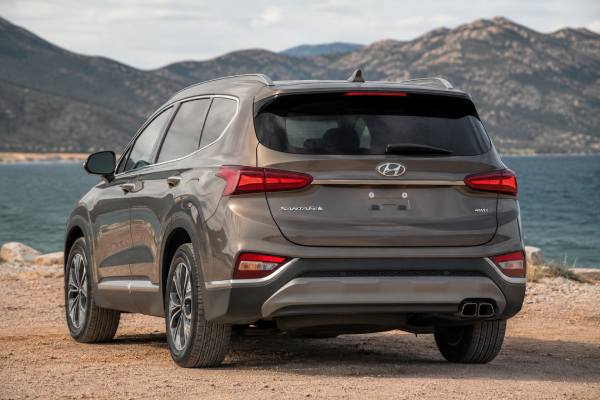
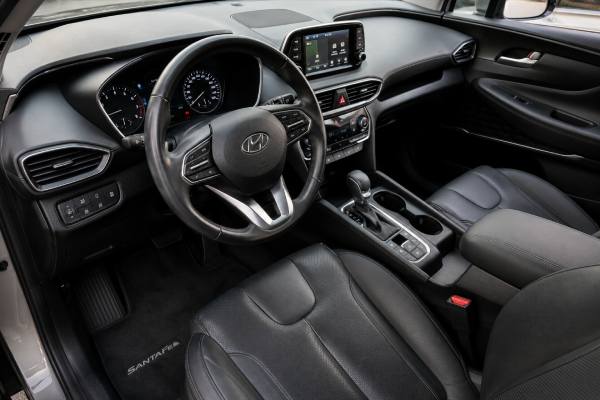
The 2018–2020 Hyundai Santa Fe TM with the 2.0 CRDi diesel and 4WD sits in a practical middle ground: large enough for family use, more refined than the previous Santa Fe, and efficient enough for long-distance driving. In European-market form, the 150 hp 2.0-litre diesel was a lower-output version of Hyundai’s R-series engine, paired with either a 6-speed manual or, in some markets, an 8-speed automatic.
As a used SUV, its appeal is strongest for buyers who want space, comfort, winter traction, and diesel range without moving to the heavier 2.2 CRDi. The key is choosing a well-maintained example, because emissions hardware, 4WD driveline fluids, brakes, tyres, and software updates matter more with age than the headline horsepower figure.
Owner Snapshot
- Strong cabin space, good motorway comfort, and useful 4WD traction for wet, snowy, or gravel roads.
- The 2.0 CRDi’s torque makes it relaxed in daily driving, though it is not a fast SUV when fully loaded.
- Best examples have clear oil, fuel-filter, brake-fluid, transmission, and 4WD fluid history.
- Engine oil service is commonly treated as every 15,000 km or 12 months in mixed use; shorten this for short trips, towing, cold starts, or heavy city driving.
- Check recalls, software updates, DPF regeneration history, and rear driveline condition before purchase.
Table of Contents
- Santa Fe TM Used Context
- Santa Fe TM Technical Specs
- Santa Fe TM Trims and Safety
- Reliability Issues and Service Actions
- Maintenance and Buying Advice
- Driving Performance and Economy
- Rivals and Market Comparison
Santa Fe TM Used Context
The TM-generation Hyundai Santa Fe arrived as a more polished SUV than the DM model it replaced. It brought a longer wheelbase, a more mature cabin layout, better driver assistance availability, and a calmer driving character. In many European markets, diesel power dominated early TM sales, and the 2.0 CRDi 150 hp version was positioned as an efficient, lower-output option beneath the stronger 2.0 CRDi 182 hp and 2.2 CRDi variants.
The vehicle covered here is the 4WD TM Santa Fe with the R II / D4HA 1,995 cc four-cylinder diesel. It is a front-transverse engine layout with on-demand all-wheel drive, meaning the front axle does most of the work in normal road driving while the rear axle is engaged when traction demand increases. Hyundai also offered drive modes and stability systems that alter throttle, gearbox, and traction-control response, but this is not a body-on-frame off-roader with low range or locking differentials.
For used buyers, the 150 hp version makes most sense when the priority is economy, comfort, and predictable running costs. It has enough torque for everyday driving, but it should not be confused with the more effortless 2.2 CRDi. Fully loaded with passengers, luggage, roof box, or trailer, the lower-output 2.0 diesel has to work harder. That does not make it weak, but it does make condition and maintenance more important.
The Santa Fe’s strengths are practical rather than emotional. The seats are comfortable, the ride is generally settled, visibility is good for the vehicle size, and the boot is large enough for family travel. Many cars were equipped with heated seats, reversing cameras, parking sensors, navigation, leather trim, adaptive cruise, blind-spot monitoring, and powered tailgates depending on trim and market.
The main caveat is that modern diesel ownership rewards longer journeys. Repeated short urban trips can prevent the diesel particulate filter from completing regeneration, can dilute oil with fuel, and can accelerate EGR and intake deposits. A Santa Fe that has spent its life on long commutes and motorway travel is usually a safer bet than a low-mileage diesel used only for short school runs.
Santa Fe TM Technical Specs
The figures below reflect the European-market 2.0 CRDi 150 hp 4WD TM Santa Fe, with market and trim variation noted where relevant. Always verify final values against the VIN, registration documents, and official service data, especially for fluid specifications, towing approval, tyre size, emissions standard, and transmission type.
| Category | Specification |
|---|---|
| Model | Hyundai Santa Fe IV / TM |
| Years | 2018–2020 pre-facelift range |
| Body | 5-door SUV |
| Seating | 5 seats in many 2.0 CRDi listings; 7-seat availability depends on market and trim |
| Engine code | R II / D4HA |
| Fuel | Diesel |
| Displacement | 2.0 L / 1,995 cc |
| Layout | Inline-4, transverse front-mounted |
| Valvetrain | DOHC, 16 valves, 4 valves per cylinder |
| Bore × stroke | 84.0 × 90.0 mm / 3.31 × 3.54 in |
| Induction | Turbocharged, intercooled |
| Fuel system | Common-rail direct injection |
| Compression ratio | Often listed as 10.6:1 for this TM 2.0 CRDi calibration; confirm by VIN-specific service data |
| Power | 150 hp / 110 kW at 4,000 rpm |
| Torque | 397–400 Nm / 293–295 lb-ft from about 1,750 rpm |
| Timing drive | Chain-driven camshafts |
| Emissions equipment | EGR, diesel oxidation catalyst, DPF, SCR/AdBlue on many Euro 6d-TEMP cars |
| AdBlue tank | Around 18–23 L depending market documentation |
| Rated economy | About 6.0–7.1 L/100 km combined depending transmission, wheels, and test cycle |
| Real highway use | About 7.0–8.0 L/100 km at 120 km/h / 75 mph in normal conditions |
| Transmission and driveline | Specification |
|---|---|
| Manual transmission | 6-speed manual on many 150 hp 4WD versions |
| Automatic transmission | 8-speed torque-converter automatic where fitted |
| Drive type | On-demand 4WD / AWD |
| Differential layout | Open differentials with electronic traction control |
| Centre coupling | Electronically controlled multi-plate coupling |
| Low range | Not fitted |
| Locking differential | Not fitted |
| Chassis and dimensions | Specification |
|---|---|
| Front suspension | MacPherson strut |
| Rear suspension | Independent multi-link |
| Steering | Rack-mounted electric power steering |
| Steering ratio | About 13.8:1 where specified |
| Front brakes | Ventilated discs, about 320 mm / 12.6 in |
| Rear brakes | Solid discs, about 305 mm / 12.0 in |
| Common tyres | 235/65 R17, 235/60 R18, 235/55 R19 |
| Ground clearance | 185 mm / 7.28 in |
| Approach / ramp / departure angles | About 18.5° / 15.7° / 21.2° |
| Length | 4,770 mm / 187.8 in |
| Width | 1,890 mm / 74.4 in, excluding mirrors |
| Height | About 1,680–1,703 mm / 66.1–67.0 in depending roof rails and trim |
| Wheelbase | 2,765 mm / 108.9 in |
| Turning circle | About 11.4 m / 37.4 ft |
| Kerb weight | About 1,800–2,020 kg / 3,968–4,453 lb depending equipment |
| GVWR | About 2,530–2,590 kg / 5,578–5,710 lb depending version |
| Fuel tank | 71 L / 18.8 US gal / 15.6 UK gal |
| Cargo volume | About 547–625 L seats up; up to about 1,625 L seats folded, method varies by market |
| Performance and capability | Specification |
|---|---|
| 0–100 km/h / 0–62 mph | About 10.6–11.2 seconds depending transmission and load |
| Top speed | About 187–193 km/h / 116–120 mph |
| 100–0 km/h braking | Typically about 40–44 m / 131–144 ft on good tyres; not an official universal value |
| Braked towing | Up to about 2,000–2,500 kg / 4,409–5,512 lb depending transmission and market approval |
| Unbraked towing | 750 kg / 1,653 lb |
| Payload | Roughly 570–700 kg / 1,257–1,543 lb depending trim and seating |
| Fluids and service data | Typical value |
|---|---|
| Engine oil | Low-SAPS diesel oil suitable for DPF-equipped engines, commonly SAE 5W-30 meeting ACEA C2/C3-type requirements; verify exact market spec |
| Engine oil capacity | About 6.5 L / 6.9 US qt |
| Coolant | Hyundai/Kia long-life ethylene-glycol coolant, normally 50:50 premix or equivalent |
| Coolant capacity | About 8.8 L / 9.3 US qt |
| Automatic transmission fluid | Hyundai/Kia ATF specified for the fitted 8-speed automatic; verify gearbox code before filling |
| Manual gearbox oil | Hyundai/Kia manual transaxle oil specification by gearbox code |
| Rear differential / transfer case | Hypoid gear oil specification varies by component; confirm by VIN |
| A/C refrigerant | R-134a or R-1234yf depending market and build date |
| Wheel nut torque | Typically 107–127 Nm / 79–94 lb-ft |
| Engine oil drain plug torque | Commonly around 35–45 Nm / 26–33 lb-ft; verify by sump and plug type |
Santa Fe TM Trims and Safety
Trim names varied by country, so equipment should be checked by the individual car rather than by badge alone. In the UK, for example, the TM Santa Fe used trims such as SE, Premium, and Premium SE, while other European markets used names such as Comfort, Style, Trend, Premium, Executive, or Prestige. Imported cars may not match local brochures.
The easiest identifiers are wheels, headlights, infotainment, seat trim, and driver-assistance buttons. Lower trims usually have 17-inch wheels, cloth or basic leather-look trim, simpler audio, and halogen or less advanced lighting. Mid and upper trims often add 18- or 19-inch wheels, leather upholstery, electric front seats, heated and ventilated seats, larger navigation screens, wireless charging, power tailgate, premium audio, and more complete Hyundai SmartSense equipment.
Mechanical differences are usually less dramatic than equipment differences. The 4WD system, suspension architecture, and brake hardware are broadly shared, but wheel size affects ride comfort, tyre price, grip, and cabin noise. A Santa Fe on 17- or 18-inch tyres often rides more quietly and is cheaper to maintain than one on 19-inch wheels. For towing, confirm the exact plated train weight and tow rating; some manual versions may have a higher braked tow rating than automatic versions in certain markets.
Safety is one of the TM Santa Fe’s stronger points. Euro NCAP rated the 2018 Santa Fe at five stars, with strong adult and child occupant scores. The rating applies to the 2.0 CRDi 4×4 variant as part of the tested model range. IIHS also rated the 2019 Santa Fe highly in the United States, though those cars used different engines and trim structures. The IIHS award depended on specific headlights, which is a useful reminder that crash structure and lighting performance are separate buying considerations.
Standard and optional safety equipment can include:
- Front, side, and curtain airbags.
- ABS, ESC, traction control, hill-start assist, downhill brake control, and trailer stability assist.
- ISOFIX/i-Size child-seat mounting points in the second row; some markets also list front passenger provisions.
- Autonomous emergency braking with car and pedestrian detection, with cyclist support depending year and market.
- Lane keeping assist, driver attention warning, blind-spot monitoring, rear cross-traffic alert, adaptive cruise control, and surround-view camera on better-equipped trims.
ADAS calibration matters after windscreen replacement, front bumper repair, radar replacement, suspension alignment, or crash repair. A car that has had bodywork should show proof that camera and radar calibration was completed correctly.
Reliability Issues and Service Actions
The 2.0 CRDi Santa Fe is generally robust when serviced properly, but it is still a modern diesel SUV with several systems that can become expensive if neglected. Most problems are not unique to Hyundai; they relate to emissions control, short-trip use, ageing sensors, transmission servicing, suspension wear, and heavy vehicle weight.
Common or realistic issues include:
| Issue | Prevalence | Severity | Typical symptoms | Likely remedy |
|---|---|---|---|---|
| DPF regeneration problems | Occasional to common on short-trip cars | Medium | Warning light, rising oil level, poor fuel economy, frequent fan operation | Diagnostic scan, forced regeneration if safe, oil change, repair root cause |
| EGR/intake deposits | Occasional | Medium | Hesitation, smoke, rough running, fault codes | Clean or replace EGR components; inspect intake |
| Fuel filter restriction | Occasional, worse with poor fuel | Low to medium | Hard starting, low power, rail-pressure faults | Replace filter and inspect fuel quality |
| Glow plug or module faults | Occasional in cold climates | Low to medium | Poor cold start, warning lamp | Test circuit and replace failed parts |
| AdBlue/SCR faults | Occasional | Medium to high | Countdown warning, NOx sensor codes | Diagnose tank, heater, injector, sensor, or software issue |
| 4WD coupling or rear diff neglect | Occasional | Medium | Binding, rumble, delayed rear engagement | Fluid service, inspect coupling, rear differential, propshaft |
| Suspension bushings and links | Common with mileage | Low to medium | Knocks, uneven tyre wear, vague steering | Replace worn links, bushes, ball joints; align |
| Brake corrosion | Common in wet/salted regions | Low to medium | Pulsation, scraping, poor rear brake contact | Clean, lubricate sliders, replace pads/rotors as needed |
| Battery and sensor voltage issues | Occasional | Low | Random warnings, stop-start faults | Test 12 V battery and charging system |
The timing chain is not a scheduled belt replacement item, but it should not be ignored. Listen for cold-start rattle, check for timing-correlation fault codes, and investigate metal debris or poor oil history. Chain life is strongly tied to oil quality and change frequency.
Transmission behaviour should be smooth. A manual car should have a consistent clutch bite point, no flywheel chatter beyond normal diesel vibration, and no difficulty engaging gears. An automatic should shift cleanly when cold and hot, should not flare between gears, and should not shudder under light throttle. “Sealed for life” should not be interpreted as “never service” on a used SUV; fresh fluid at sensible intervals is cheap compared with transmission repair.
Service actions and recalls vary by country and VIN. A used Santa Fe should be checked through Hyundai’s recall portal or an official dealer. Ask for proof of completed campaigns, not just a verbal assurance. Also ask whether ECU, TCU, infotainment, navigation, and ADAS updates have been applied, as updates can address drivability, warning messages, shift logic, and sensor behaviour.
Maintenance and Buying Advice
A Santa Fe 2.0 CRDi 4WD rewards preventive maintenance. The best schedule is the official one for the VIN, but used buyers should apply shorter intervals when the vehicle sees short trips, towing, dusty roads, mountain driving, winter salt, extended idling, or heavy urban use.
| Item | Practical interval |
|---|---|
| Engine oil and filter | Every 15,000 km or 12 months; 7,500–10,000 km for severe use |
| Engine air filter | Inspect yearly; replace around 30,000 km or sooner in dust |
| Cabin filter | Every 12 months or 15,000–20,000 km |
| Fuel filter | Commonly 30,000–60,000 km depending market and fuel quality |
| Brake fluid | Every 2 years |
| Coolant | Follow official long-life coolant interval; inspect annually |
| Manual gearbox oil | Inspect for leaks; consider replacement around 80,000–100,000 km |
| Automatic transmission fluid | Consider service around 60,000–90,000 km, sooner for towing or heat |
| Transfer case and rear differential oil | Around 60,000–90,000 km, especially for 4WD use |
| Brake pads and rotors | Inspect every service; clean rear brakes in salty climates |
| Tyre rotation | Every 10,000–15,000 km |
| Wheel alignment | Check after tyre wear, impacts, or suspension work |
| Serpentine belt and hoses | Inspect yearly after 5 years |
| 12 V battery | Test annually after 4 years |
| Timing chain | Inspect by symptoms, oil history, noise, and diagnostic faults |
Before purchase, start with the paperwork. A high-mileage Santa Fe with stamped services, invoices, recall proof, and documented fluid changes is preferable to a low-mileage car with vague history. Check whether the correct low-SAPS oil was used, because the DPF depends on it. Look for evidence of fuel-filter changes, brake-fluid changes, and 4WD driveline servicing.
During inspection, check the following:
- Cold start: quick start, no excessive smoke, no long rattling, no warning lights.
- Exhaust and emissions: no repeated DPF messages, AdBlue countdown, or NOx sensor faults.
- Oil level: not overfilled and not smelling strongly of diesel.
- Coolant: stable level, no oil contamination, no dried leaks around hoses and radiator.
- Transmission: smooth clutch or clean automatic shifts, no flare, thump, or shudder.
- 4WD system: no binding on tight turns, no rear diff rumble, no propshaft vibration.
- Brakes: no heavy lip, seized rear calipers, or steering-wheel shake under braking.
- Suspension: no knocking over small bumps, no sagging, no uneven tyre wear.
- Body: check sills, subframes, rear suspension mounts, tailgate edges, door bottoms, and underbody seams for corrosion.
- Electronics: test camera, parking sensors, blind-spot monitoring, tailgate, climate control, heated seats, and infotainment.
The most attractive examples are not always the highest trim. A mid-trim car on 18-inch wheels, with full history and fewer gadgets, can be a better long-term buy than a fully loaded car with neglected maintenance. Avoid modified engine software, deleted emissions equipment, poor-quality towing electrics, mismatched tyres, and cars that show repeated warning-light resets without repair invoices.
Driving Performance and Economy
The 150 hp 2.0 CRDi Santa Fe drives like a relaxed family SUV, not a sporty crossover. The engine’s useful torque arrives low in the rev range, so it feels more capable in normal traffic than the horsepower figure suggests. Around town, it pulls cleanly once the turbo is awake, and on open roads it settles into a quiet cruise. The main limitation appears during overtaking, steep climbs, or full-load driving, where the engine’s modest output has to move a heavy body.
Manual versions give the driver more control, but clutch condition matters. A healthy manual feels predictable and suits drivers who tow occasionally or prefer mechanical simplicity. The 8-speed automatic is easier in traffic and generally matches the Santa Fe’s comfort-biased character. It should shift smoothly and avoid harsh engagement; hesitation, flaring, or repeated hunting deserves a diagnostic check.
Ride comfort is one of the Santa Fe’s better qualities. On 17- and 18-inch wheels it absorbs rough roads well and feels composed at motorway speed. The 19-inch wheel package sharpens the look but can add tyre noise and firmer impacts. Steering is light rather than talkative, yet stable enough for long-distance use. Body roll is present in quick direction changes, but the chassis is predictable and secure.
The 4WD system improves traction rather than transforming the Santa Fe into a true off-roader. It helps on wet roads, gravel tracks, snow, steep driveways, and campsites, especially with good tyres. The system still depends heavily on tyre quality. Four matching tyres with even tread depth are important because mismatched tyres can stress the driveline and confuse stability systems.
Real-world economy depends heavily on journey type:
| Use case | Typical economy |
|---|---|
| Urban short trips | 8.0–9.5 L/100 km / 25–29 mpg US / 30–35 mpg UK |
| Mixed commuting | 6.8–8.0 L/100 km / 29–35 mpg US / 35–42 mpg UK |
| Steady 100 km/h cruise | 6.0–6.8 L/100 km / 35–39 mpg US / 42–47 mpg UK |
| 120 km/h motorway | 7.0–8.0 L/100 km / 29–34 mpg US / 35–40 mpg UK |
| Towing or roof box use | Often 15–35% higher consumption |
Cold weather increases fuel use, especially on short trips. Diesel engines take longer to warm up, winter tyres add rolling resistance, and DPF regeneration can occur more often if journeys are interrupted. A Santa Fe used mostly on longer routes can be impressively efficient for its size; one used only in town will rarely match brochure figures.
Towing stability is generally good when the load is legal and correctly balanced. The long wheelbase and vehicle mass help, and trailer stability assist is useful. Still, the 150 hp engine is the limiting factor on gradients. Keep transmission temperatures, brake condition, tyres, and nose weight within specification, and avoid assuming every 4WD Santa Fe has the same tow rating.
Rivals and Market Comparison
The Santa Fe 2.0 CRDi 4WD competes with SUVs such as the Kia Sorento, Skoda Kodiaq, Peugeot 5008, Nissan X-Trail, Mazda CX-5, Mitsubishi Outlander, Honda CR-V, and Volkswagen Tiguan Allspace. Its position depends on whether the buyer values comfort, space, diesel towing ability, seven-seat flexibility, or running costs.
Against the Kia Sorento, the Hyundai feels closely related in purpose. The Sorento often offers similar diesel strength and practicality, while the Santa Fe may feel slightly more road-focused and refined depending trim. The best choice between them usually comes down to condition, equipment, warranty history, and price.
The Skoda Kodiaq is a strong rival for cabin packaging and driving manners. It may feel lighter and more precise, and its 2.0 TDI engines are familiar to many European workshops. The Santa Fe counters with a plush cabin feel, strong safety equipment, and a relaxed long-distance character. For buyers who want a softer, more comfort-biased SUV, the Hyundai can be more appealing.
The Nissan X-Trail and Mitsubishi Outlander are often cheaper, but they may not match the Santa Fe for cabin polish or diesel pulling power in equivalent years. The Peugeot 5008 offers clever seating and a lighter feel but is primarily front-wheel-drive in many versions, so it does not replace the Hyundai for buyers who specifically want 4WD traction. The Mazda CX-5 is more enjoyable to drive but has less third-row or cargo flexibility and a different ownership profile.
The Santa Fe’s main advantages are space, comfort, safety credentials, diesel range, and generous equipment. Its disadvantages are weight, tyre and brake costs, emissions-system sensitivity, and less lively performance in 150 hp form. A buyer who mainly drives in town may be better served by a petrol hybrid or smaller SUV. A buyer who regularly covers long distances, carries family and luggage, and wants winter confidence may find the 2.0 CRDi 4WD a very sensible choice.
References
- OWNER’S MANUAL 2019 (Owner’s Manual)
- Euro NCAP | Hyundai SANTA FE 2018 (Safety Rating)
- 2019 Hyundai Santa Fe 2019 (Safety Rating)
- Hyundai Santa Fe IV (TM) R 2.0 CRDi (150 Hp) 4WD Automatic | Technical specs, data, fuel consumption, Dimensions 2018 (Technical Data)
- Hyundai Recalls & Service Campaigns: Home 2026 (Recall Database)
Disclaimer
This article is for informational purposes only and is not a substitute for professional diagnosis, repair, or official workshop documentation. Specifications, torque values, service intervals, fluids, towing limits, safety equipment, recalls, and procedures can vary by VIN, market, production date, trim, and equipment. Always verify important data against the official Hyundai service documentation for the exact vehicle.
If this information helped, consider sharing it on Facebook, X/Twitter, or another platform to support our work.