

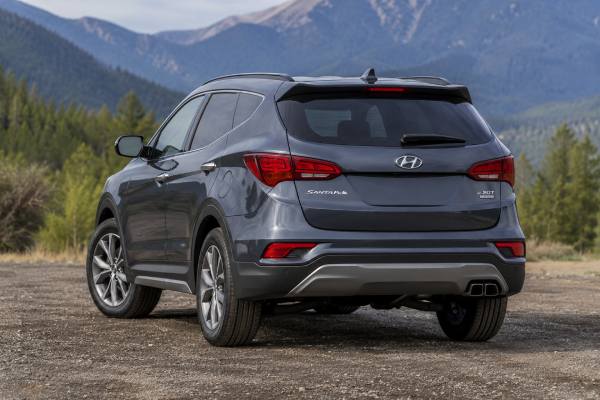
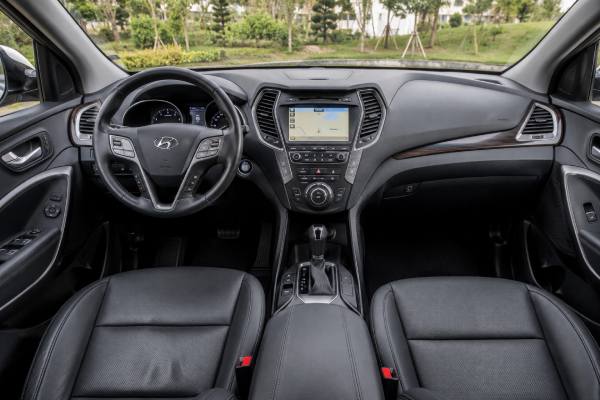
The 2017–2018 Hyundai Santa Fe AWD with the 3.3 GDi V6 is the facelifted version of Hyundai’s three-row NC-platform Santa Fe sold in North America, where it was closely related to the Santa Fe XL name used in Canada and later U.S. model years. It is a practical, naturally aspirated V6 crossover with standard family-SUV priorities: space, comfort, simple controls, strong equipment value, and enough towing capacity for light recreational use.
Its appeal on the used market comes from a straightforward 290 hp engine, a conventional 6-speed automatic, available six- or seven-seat layouts, and strong safety scores when correctly equipped. The trade-offs are also clear. Fuel economy is only average for the class, the GDi V6 rewards consistent maintenance, and recall completion should be checked carefully by VIN before purchase.
Quick Overview
- Strong 3.3-litre V6 performance, a comfortable ride, and useful three-row packaging make it a sensible family SUV.
- AWD models add all-weather traction, but they still use a road-biased system rather than a low-range off-road setup.
- Properly equipped versions offer strong safety technology, including optional forward collision prevention and adaptive cruise control.
- Used examples need proof of oil changes, recall completion, AWD fluid service, and inspection for rust in salt-belt regions.
- Normal oil service is typically every 12,000 km / 7,500 miles or 6 months, with severe-use oil service shortened to 6,000 km / 3,750 miles.
Table of Contents
- Santa Fe NC Used Overview
- Santa Fe NC Technical Specs
- Santa Fe NC Trims and Safety
- Reliability, Issues and Recalls
- Maintenance and Buying Advice
- Driving, Performance and Economy
- How Santa Fe NC Compares to Rivals
Santa Fe NC Used Overview
The 2017–2018 Santa Fe AWD 3.3 GDi V6 sits in a slightly confusing part of Hyundai’s naming history. In the U.S., the three-row model was sold as the Santa Fe, while the shorter two-row version was the Santa Fe Sport. In Canada, the three-row model was commonly branded Santa Fe XL. The NC reference generally points to the long-wheelbase, three-row version rather than the smaller Sport body.
This distinction matters because the 3.3-litre V6 model has different dimensions, equipment, towing capacity, safety results, and maintenance considerations from the four-cylinder Santa Fe Sport. The vehicle covered here is the facelifted 2017–2018 three-row AWD model with Hyundai’s Lambda II 3.3 GDi V6, rated at 290 hp and paired with a 6-speed automatic transmission.
As a used SUV, its strengths are practical rather than dramatic. The cabin is spacious enough for families who need occasional third-row seating, the V6 feels stronger and smoother than many turbocharged four-cylinder alternatives of the period, and the chassis is tuned more for comfort than aggressive handling. The AWD system helps in rain, snow, and gravel-road use, but it does not turn the Santa Fe into a body-on-frame 4×4. It has no low range, no locking differentials, and limited ground clearance for rough terrain.
The facelift brought updated styling, revised lighting, more available driver-assistance technology, and improved cabin and infotainment equipment. Higher trims can feel well-equipped even by later used-car standards, especially with leather, panoramic roof, navigation, upgraded audio, surround-view camera, blind-spot monitoring, and adaptive safety features.
The main compromise is running cost. A naturally aspirated V6 is pleasant and durable when maintained well, but it uses more fuel than smaller turbocharged rivals and most hybrids. The 3.3 GDi engine also uses gasoline direct injection, so oil quality, clean PCV operation, correct spark plugs, and good fuel quality matter more than they did on older port-injected V6 engines.
For shoppers comparing three-row crossovers from this period, the Santa Fe is usually most attractive when price, equipment, comfort, and warranty history matter more than maximum cargo space or the lowest fuel bill. A clean, fully serviced 2017–2018 AWD example can be a strong value. A neglected one, especially with incomplete recalls, mismatched tyres, delayed AWD fluid service, or unresolved warning lights, deserves caution.
Santa Fe NC Technical Specs
The following figures apply to the North American facelifted 2017–2018 three-row Santa Fe / Santa Fe XL AWD with the 3.3 GDi V6. Exact values can vary slightly by market, trim, tyre package, production date, and VIN.
| Powertrain item | Specification |
|---|---|
| Platform / body | Hyundai Santa Fe NC, long-wheelbase three-row crossover SUV |
| Engine code | G6DH Lambda II 3.3 GDi V6 |
| Engine layout | Naturally aspirated 60-degree V6, aluminium block and heads |
| Cylinders / valvetrain | 6 cylinders, DOHC, 4 valves per cylinder |
| Bore × stroke | 92.0 × 83.8 mm / 3.62 × 3.30 in |
| Displacement | 3.3 L / 3,342 cc |
| Induction | Naturally aspirated |
| Fuel system | Gasoline direct injection |
| Compression ratio | 11.5:1 |
| Timing drive | Timing chain with variable valve timing |
| Maximum power | 290 hp / 216 kW at 6,400 rpm |
| Maximum torque | 342 Nm / 252 lb-ft at 5,200 rpm |
| Rated fuel economy, AWD | 11.8 L/100 km combined / 20 mpg US / 24 mpg UK on many non-Ultimate AWD versions |
| Rated fuel economy, Ultimate AWD | 12.4 L/100 km combined / 19 mpg US / 23 mpg UK |
| Real-world highway at 120 km/h / 75 mph | About 10.0–11.5 L/100 km / 20–24 mpg US / 24–28 mpg UK, depending on tyres, weather, load, and roof accessories |
| Transmission and driveline | Specification |
|---|---|
| Transmission | Hyundai 6-speed electronically controlled automatic with manual shift mode |
| Common transmission family | A6LF-family 6-speed automatic; verify exact code by VIN |
| Drive type | AWD with electronically controlled rear coupling |
| Low range | Not fitted |
| Front / rear differential | Open differentials; traction control assists wheel slip management |
| Final drive | Approximately 3.041:1, market dependent |
| Chassis, dimensions and packaging | Specification |
|---|---|
| Front suspension | MacPherson strut with stabilizer bar |
| Rear suspension | Multi-link independent rear suspension |
| Steering | Motor-driven power steering |
| Steering ratio | About 15.0:1 |
| Turns lock-to-lock | About 2.95 |
| Front brakes | Ventilated discs, about 320 × 28 mm / 12.6 × 1.1 in |
| Rear brakes | Solid discs, about 302 × 10 mm / 11.9 × 0.4 in |
| Common wheel / tyre sizes | 235/60R18 on 18-inch wheels; 235/55R19 on 19-inch wheels |
| Recommended cold tyre pressure | Typically 230 kPa / 33 psi; verify door placard |
| Ground clearance | About 180 mm / 7.1 in |
| Length | 4,905 mm / 193.1 in |
| Width | 1,885 mm / 74.2 in |
| Height | 1,689–1,699 mm / 66.5–66.9 in, depending on roof rails |
| Wheelbase | 2,799 mm / 110.2 in |
| Turning circle, kerb-to-kerb | About 11.25 m / 36.9 ft |
| Curb weight, AWD | About 1,891–1,904 kg / 4,169–4,198 lb |
| GVWR | About 2,550 kg / 5,622 lb |
| Fuel tank | 71 L / 18.8 US gal / 15.6 UK gal |
| Cargo volume, SAE | 383 L / 13.5 ft³ behind third row; 1,159 L / 40.9 ft³ behind second row; 2,265 L / 80.0 ft³ behind first row |
| Performance and capability | Specification |
|---|---|
| 0–100 km/h / 0–62 mph | About 8.0–8.3 seconds |
| 0–60 mph | About 7.7–8.0 seconds, depending on trim and test conditions |
| Top speed | About 201–210 km/h / 125–130 mph, market dependent |
| 100–0 km/h braking distance | About 38–41 m / 125–135 ft, depending on tyres and test surface |
| Braked towing capacity | Up to 2,268 kg / 5,000 lb when properly equipped |
| Unbraked towing capacity | About 907 kg / 2,000 lb |
| Estimated payload | Roughly 645–660 kg / 1,420–1,455 lb before options; use the door label for the exact vehicle |
| Fluids and service capacities | Specification |
|---|---|
| Engine oil | API SM / ILSAC GF-4 or newer; commonly 5W-30, with viscosity adjusted for climate |
| Engine oil capacity | About 5.7 L / 6.0 US qt with filter |
| Engine coolant | Ethylene-glycol coolant suitable for aluminium engines |
| Cooling system capacity | About 9.1 L / 9.6 US qt |
| Automatic transmission fluid | Hyundai SP-IV specification |
| Automatic transmission capacity | About 7.8 L / 8.2 US qt total system capacity |
| Transfer case oil | API GL-5 SAE 75W-90 |
| Transfer case capacity | About 0.68 L / 0.72 US qt |
| Rear differential oil | API GL-5 SAE 75W-90 |
| Rear differential capacity | About 0.53 L / 0.56 US qt |
| Brake fluid | DOT 3 or DOT 4 |
| Brake fluid quantity | About 0.7–0.8 L / 0.74–0.85 US qt |
| A/C refrigerant | R-134a |
| A/C refrigerant charge | About 600 g front only; 800 g with rear A/C |
| A/C compressor oil | PAG FD46XG; charge depends on A/C configuration |
| Key torque value | Wheel lug nuts: 107–127 Nm / 79–94 lb-ft |
| Safety and driver assistance | Result or availability |
|---|---|
| NHTSA overall rating | 5 stars for many 2018 AWD configurations |
| NHTSA frontal crash | 4 stars |
| NHTSA side crash | 5 stars |
| NHTSA rollover | 4 stars |
| IIHS overall note | Top Safety Pick+ when fitted with qualifying front crash prevention and specific headlights |
| IIHS structure tests | Mostly Good ratings; passenger-side small overlap was Acceptable on the published 2018 assessment |
| IIHS headlight rating | Varies by headlight equipment, from Good to Poor |
| Euro NCAP | Not directly applicable to this North American three-row NC configuration |
| ADAS availability | Blind-spot monitoring, rear cross-traffic alert, lane-change assist, lane departure warning, adaptive cruise control, and automatic emergency braking available by trim/package |
| ADAS not typical for this model | No modern full lane-centering suite, no cyclist AEB rating, and no traffic-sign assist in the usual North American configuration |
Santa Fe NC Trims and Safety
The 2017 and 2018 Santa Fe three-row lineups changed slightly by model year, but the basic formula stayed consistent. All versions used the 3.3 GDi V6 and 6-speed automatic. Front-wheel drive was available on many trims, while this article focuses on AWD versions.
For 2017, the main North American trim structure commonly included SE, Limited, SE Ultimate, and Limited Ultimate. The SE was the value-oriented seven-seat version, usually with a second-row bench. Limited and Limited Ultimate models typically used second-row captain’s chairs, reducing seating capacity to six but improving second-row comfort and third-row access. For 2018, the lineup was simplified in many U.S. materials to SE, SE Ultimate, and Limited Ultimate.
The key trim differences are more about equipment and seating than mechanical hardware. The V6, automatic transmission, brake package, suspension layout, and towing potential are broadly similar across the range, though wheel size and tyre specification can affect ride, braking feel, road noise, and replacement cost. SE models commonly use 18-inch wheels with taller-sidewall tyres, which suit rough roads better. Ultimate trims often use 19-inch wheels, giving a firmer edge over broken pavement but a more upscale appearance.
Higher trims may include leather upholstery, heated and ventilated front seats, heated rear seats, panoramic sunroof, navigation, premium audio, power liftgate, larger infotainment screen, surround-view camera, and upgraded exterior lighting. Quick identifiers include the wheel size, second-row seating type, panoramic roof, factory navigation screen, exterior badging, LED lighting elements, and the presence of radar hardware for adaptive cruise control on equipped vehicles.
Safety equipment also varies by trim and package. A rearview camera, stability control, traction control, ABS, electronic brake-force distribution, brake assist, side airbags, curtain airbags, and LATCH / ISOFIX-style child-seat anchors are part of the expected core safety package. Blind-spot detection, rear cross-traffic alert, and lane-change assist were available on better-equipped versions and packages.
The most advanced driver-assistance features are concentrated on Ultimate and technology-package vehicles. Depending on market and year, these can include automatic emergency braking with pedestrian detection, smart cruise control with stop/start capability, lane departure warning, dynamic bending lights, high-beam assist, electronic parking brake, and auto hold. These systems are useful, but they are not equivalent to newer lane-centering or hands-free systems. The Santa Fe can warn, brake, and support the driver, but it still expects constant steering and attention.
For used buyers, the exact safety value of a Santa Fe depends heavily on equipment. An IIHS Top Safety Pick+ result applies only to vehicles with the right optional front crash prevention and specific headlights. A base vehicle without those options should not be assumed to have the same active-safety capability.
After windshield replacement, front-end collision repair, bumper removal, camera work, radar service, suspension alignment, or steering-angle sensor work, ADAS-equipped models may need calibration. A used Santa Fe with an accident history should be inspected not just for panel gaps and paintwork, but also for correct operation of blind-spot, camera, parking sensor, adaptive cruise, and forward-collision systems.
Reliability, Issues and Recalls
A well-maintained 2017–2018 Santa Fe AWD 3.3 can be a durable family vehicle, but it should not be treated as a “buy anything and ignore history” SUV. The best examples have consistent oil-change records, matching tyres, completed recall work, clean underbody condition, and no unresolved engine, transmission, ABS, or ADAS warning lights.
| Area | Prevalence | Cost tier | Typical symptoms | Likely cause and remedy |
|---|---|---|---|---|
| 2017 crankshaft recall population | Rare but serious | High | Engine knock, reduced power, oil pressure warning, check-engine light | Affected production range may need dealer inspection and engine replacement under recall |
| ABS / HECU fire-related campaigns | Vehicle-dependent | Medium to high | Recall notice, ABS warning, fire-risk advisory | Dealer VIN check and campaign repair, often involving multi-fuse or module-related service |
| Direct-injection intake deposits | Occasional | Medium | Rough idle, misfire codes, uneven cold running | Confirm misfire source, inspect ignition and injectors, clean intake valves if deposits are verified |
| Ignition coils and spark plugs | Occasional | Low to medium | Misfire under load, flashing check-engine light, poor fuel economy | Replace plugs and faulty coils with correct parts; do not ignore catalyst-damaging misfires |
| Cooling system ageing | Occasional | Medium | Coolant smell, low coolant, overheating, crusted hose joints | Pressure-test system, replace leaking hoses, thermostat, radiator, or cap as needed |
| 6-speed automatic shift quality | Occasional | Medium | Delayed engagement, shift flare, harsh 2–3 or 3–4 shifts | Check fluid condition, scan for codes, apply software updates if available, service ATF under severe use |
| AWD transfer case / rear differential | Occasional with neglect | Medium to high | Binding on tight turns, humming, clunking, rear coupling faults | Replace fluids, check tyre matching, inspect coupling, transfer case, mounts, and rear differential |
| Suspension and wheel bearings | Common with age | Low to medium | Clunks, wandering, humming, uneven tyre wear | Inspect struts, sway links, bushings, ball joints, alignment, and hub bearings |
| Corrosion in salt regions | Common by climate | Medium to high | Rusted subframe edges, brake-line corrosion, seized fasteners | Inspect underside closely; clean drains; treat early corrosion before structural parts are affected |
| Panoramic roof, camera, liftgate electronics | Occasional | Low to medium | Water stains, slow liftgate, camera image faults, sensor warnings | Clean drains, inspect wiring, update or replace failed modules and switches |
The 3.3 GDi V6 is a timing-chain engine, so there is no scheduled timing belt replacement. That does not mean the timing system should be ignored. Chain noise on cold start, cam/crank correlation faults, rough running, or evidence of poor oil maintenance should prompt inspection of chain stretch, guides, tensioners, and oil-pressure-related components.
Oil consumption is not as strongly associated with this engine as with some Hyundai four-cylinder families, but any used example should still be checked. Before purchase, inspect oil level cold, look for leaks around the timing cover and valve covers, listen for lower-end knock hot and cold, and scan for stored misfire, fuel-trim, cam timing, or catalyst codes.
Recall completion is especially important. Some 2017 vehicles were involved in a crankshaft-related engine recall for a limited production window. Separately, fire-risk campaigns involving ABS hydraulic electronic control hardware affected certain Santa Fe vehicles. A hood latch cable recall also applied to some earlier and 2017 vehicles, particularly where corrosion could affect the secondary hood latch. Vehicles with dealer-installed trailer wiring may also need careful recall and harness verification.
Software and calibration work is less visible but still worth asking about. Transmission control, engine control, infotainment, camera, and ADAS-related updates can address shift behaviour, warning messages, connectivity faults, or sensor operation. A complete dealer service printout is useful because it can show campaigns that a paper service book may not list.
A proper pre-purchase inspection should include a cold start, full module scan, road test from city speeds to highway speeds, tight-turn AWD check, brake inspection, underbody corrosion check, tyre match verification, A/C test front and rear, sunroof drain check where fitted, and confirmation that every recall is closed by VIN.
Maintenance and Buying Advice
The Santa Fe’s maintenance needs are conventional, but the AWD system, GDi engine, heavy body, and three-row use pattern make neglect expensive. Many examples are used for short trips, school runs, winter driving, and occasional towing. Those conditions often count as severe service, even when the vehicle looks clean.
| Item | Normal interval | Severe-use guidance |
|---|---|---|
| Engine oil and filter | 12,000 km / 7,500 miles or 6 months | 6,000 km / 3,750 miles or 6 months |
| Tyre rotation | 12,000 km / 7,500 miles | Same interval; more often if wear is uneven |
| Brake inspection | At tyre rotation and scheduled services | Inspect more often in city, mountain, towing, or salted-road use |
| Cabin air filter | About 24,000 km / 15,000 miles | Replace sooner in dusty or high-pollen areas |
| Engine air filter | Inspect regularly; often replaced around 48,000 km / 30,000 miles | Replace sooner in dusty conditions |
| Brake fluid | Inspect regularly; commonly replace every 2–3 years in real-world service | Shorter interval if moisture content is high |
| Spark plugs | About 160,000 km / 100,000 miles or 10 years | Replace earlier if misfire, heavy towing, or poor running appears |
| Coolant | First major service around 192,000 km / 120,000 miles or 60 months; then about every 48,000 km / 30,000 miles or 24 months | Follow coolant condition and service history closely |
| Automatic transmission fluid | Often treated as long-life in normal use | Replace around 96,000 km / 60,000 miles under severe use |
| Transfer case oil | Inspect periodically | Replace around 120,000 km / 75,000 miles under severe use |
| Rear differential oil | Inspect periodically | Replace around 120,000 km / 75,000 miles under severe use |
| Drive belts and hoses | Inspect at scheduled services; first major belt inspection around 96,000 km / 60,000 miles | Replace on cracks, glazing, swelling, or coolant/oil contamination |
| Timing chain | No routine replacement interval | Inspect if noisy, if cam timing faults appear, or if oil history is poor |
| 12 V battery | Test annually after 3 years | Expect replacement around 4–6 years depending on climate and use |
| Wheel alignment | Check with uneven wear, pulling, impacts, or suspension work | More often on rough roads or with 19-inch wheels |
For fluids, use the correct specification rather than only matching viscosity. Engine oil should meet the required API / ILSAC or newer standard and be suitable for the temperature range. The automatic transmission requires Hyundai SP-IV-type fluid. Transfer case and rear differential fluids use GL-5 75W-90. Brake fluid should be DOT 3 or DOT 4. Mixing unsuitable fluid types can cause shift quality problems, seal damage, or premature wear.
A buyer’s inspection should start with documentation. Look for oil changes at least every 12,000 km / 7,500 miles, and preferably more often on vehicles that spent time in heavy traffic, cold climates, dusty areas, or towing duty. Ask specifically for transmission, transfer case, and rear differential service records, because these are easy to skip and costly to repair later.
Physically, check the underbody before falling in love with the interior. Salt-belt vehicles can show corrosion around subframes, suspension mounting points, brake lines, brackets, exhaust hardware, and rear suspension fasteners. Surface rust is normal with age, but flaking metal, swollen seams, soft brake lines, or heavily corroded structural mounts are red flags.
During the road test, the V6 should start cleanly, idle steadily, pull smoothly, and shift without harsh flares or thumps. AWD models should not bind or hop during slow full-lock turns on dry pavement. Tyres should be a matched set in size, brand, model, and wear depth; mismatched tyres can stress AWD components.
The most attractive versions are usually well-documented SE Ultimate or Limited Ultimate models with completed recalls and no evidence of water leaks, collision repair, or electrical faults. The SE can be a smart buy when budget and tyre cost matter more than luxury features. The main trim to avoid is not a specific badge, but any vehicle with poor service history, unresolved warning lights, neglected AWD fluids, or heavy corrosion.
Driving, Performance and Economy
The Santa Fe AWD 3.3 drives like a comfort-focused family crossover rather than a sporty SUV. Its biggest dynamic strength is ease. The V6 is smooth, the 6-speed automatic is generally unobtrusive, and the chassis feels settled at highway speeds. Around town, visibility is reasonable for the vehicle size, and the turning circle is manageable for parking lots and school-run use.
The 3.3 GDi V6 does not deliver its strongest torque at very low rpm, so it feels more responsive when the transmission allows revs to build. Once moving, it has enough power for confident merging and passing, especially compared with many naturally aspirated four-cylinder crossovers. The 6-speed automatic can downshift decisively when asked, though it is not as quick or as fuel-efficient as later 8-speed and 10-speed units.
Ride quality depends strongly on wheel package. Models on 18-inch wheels generally ride better over potholes and expansion joints. Ultimate models on 19-inch wheels can feel firmer and transmit more tyre slap into the cabin, especially on worn or low-quality tyres. Steering is light and predictable rather than communicative. Body roll is present in quick corners, but the Santa Fe remains stable and easy to place when driven normally.
Brake feel is adequate for family use, though repeated heavy braking with a full load or trailer will reveal the vehicle’s weight. Brake condition matters more on older examples than the original specification. Pulsation, steering shake, long pedal travel, or rear brake corrosion should be addressed before towing or mountain driving.
Real-world fuel economy is the main ownership compromise. In city driving, expect roughly 13.5–15.5 L/100 km / 15–17 mpg US / 18–20 mpg UK. Mixed driving commonly falls around 11.5–13.0 L/100 km / 18–20 mpg US / 22–24 mpg UK. At steady highway speeds near 100–120 km/h / 60–75 mph, a healthy vehicle may return about 9.8–11.5 L/100 km / 20–24 mpg US / 24–28 mpg UK. Cold weather, winter tyres, roof boxes, short trips, and heavy loads can push consumption noticeably higher.
The AWD system is best understood as a traction aid. It can send torque rearward when front slip is detected and helps the Santa Fe feel secure in rain and snow, especially with good tyres. Tyres are the deciding factor, though. A Santa Fe AWD on worn all-seasons will not outperform a front-drive vehicle on proper winter tyres in severe weather.
Towing capacity is a useful advantage. When properly equipped, the Santa Fe can tow up to 2,268 kg / 5,000 lb with trailer brakes. That suits small boats, utility trailers, compact campers, and recreational loads. For frequent towing, keep the load conservative, service transmission and AWD fluids more often, use the correct hitch and wiring, watch cooling performance on grades, and expect fuel use to rise sharply.
How Santa Fe NC Compares to Rivals
The Santa Fe’s natural rivals are midsize three-row crossovers from the same period. It is not the roomiest, the most efficient, or the most rugged, but it often stands out for equipment value, V6 smoothness, safety scores, and used-market pricing.
| Rival | Main advantage over Santa Fe | Santa Fe advantage |
|---|---|---|
| Toyota Highlander V6 AWD | Strong resale value, refined drivetrain, excellent reputation | Often better used value for similar equipment |
| Honda Pilot AWD | More interior room, more flexible third row, stronger family packaging | Smaller footprint, simpler feel, often lower purchase price |
| Kia Sorento V6 AWD | Similar mechanical family, available shorter body, good value | Santa Fe three-row layout can feel more spacious than some Sorento versions |
| Ford Explorer V6 AWD | Larger cabin, stronger towing image, broader engine range | Santa Fe is easier to park, usually more efficient, and less truck-like |
| Nissan Pathfinder V6 AWD | Smooth V6, roomy cabin, competitive towing | Santa Fe uses a conventional 6-speed automatic rather than a CVT |
| Mazda CX-9 AWD | Sharper handling, more premium steering feel, efficient turbo four | Santa Fe has naturally aspirated V6 character and simpler power delivery |
Against the Toyota Highlander, the Hyundai usually wins on purchase price and equipment per dollar, while the Toyota wins on long-term resale confidence. Against the Honda Pilot, the Santa Fe feels slightly smaller and less cargo-focused, but it is also easier to live with in tight urban spaces. The Pilot is the better choice for regularly carrying adults in all three rows; the Santa Fe is better when the third row is occasional.
The Kia Sorento comparison depends heavily on model year and body configuration. Some Sorento V6 AWD models share a similar practical appeal and may feel closely related in service needs. The Hyundai’s trim packaging and three-row layout may be more attractive if the right example has captain’s chairs, better safety equipment, or a cleaner history.
Compared with the Ford Explorer, the Santa Fe is less imposing and less powerful in some trims, but it is also more manageable and less thirsty in ordinary use. The Pathfinder offers strong family utility, yet its CVT can be a concern for shoppers who prefer a traditional automatic. Mazda’s CX-9 is the more engaging driver’s SUV, but its turbocharged four-cylinder has a different character and may not appeal to buyers who prefer a naturally aspirated V6.
The Santa Fe NC AWD 3.3 is at its best as a value-rich, comfortable, well-equipped family crossover. It is not the default choice for maximum cargo space, serious off-road use, or low fuel bills. It makes the most sense when the price is fair, the service history is complete, recalls are closed, and the inspection confirms a healthy engine, transmission, AWD system, brakes, tyres, and underbody.
References
- 2018 HYUNDAI SANTA FE SPECIFICATIONS 2018 (Manufacturer Specifications)
- NC CAN eng 7.qxp 2018 (Owner’s Manual Maintenance)
- 2018 Hyundai Santa Fe AWD 2018 (Fuel Economy and Safety Rating)
- 2018 Hyundai Santa Fe 2018 (Safety Rating)
- Part 573 Safety Recall Report 17V-578 2017 (Recall Database)
Disclaimer
This article is for informational purposes only and is not a substitute for professional diagnosis, service, repair, or inspection. Specifications, torque values, service intervals, procedures, fluids, software updates, and recall applicability can vary by VIN, market, production date, trim, and installed equipment. Always verify critical information against the official owner’s manual, service documentation, under-hood labels, door placards, and dealer VIN records before making maintenance or repair decisions.
If you found this useful, consider sharing it on Facebook, X/Twitter, or your preferred social platform to support our work.