
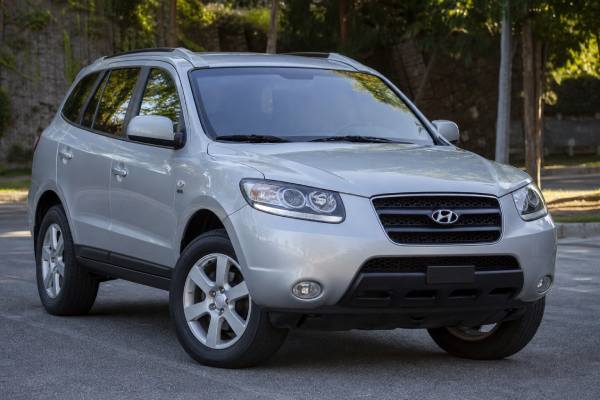
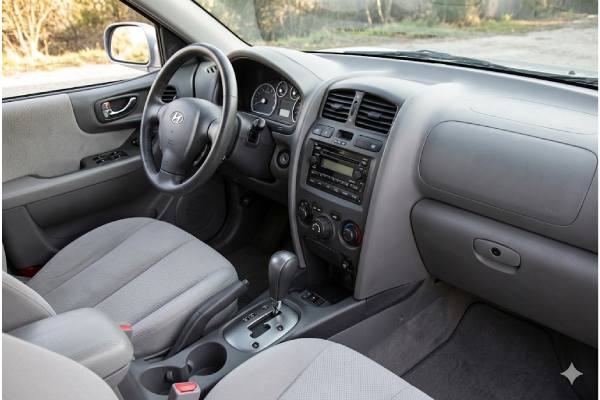
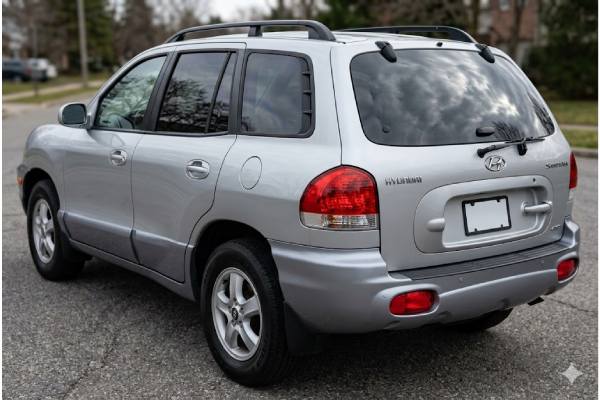
The facelifted first-generation Hyundai Santa Fe SM sits in an interesting place among early-2000s compact and midsize SUVs. It is not as truck-like as a body-on-frame 4×4, but it is also more substantial than many soft-road crossovers from the same period. In 2.7 V6 Fulltime 4WD form, it combines a naturally aspirated six-cylinder engine, a four-speed automatic transmission, and a mechanical full-time all-wheel-drive system designed for poor-weather security rather than serious trail work.
For used buyers, the appeal is straightforward: a roomy five-door SUV with simple mechanicals, decent comfort, useful ground clearance, and lower purchase prices than many Japanese rivals. The caution is just as clear. Age now matters more than mileage alone, and the best examples are those with documented timing-belt service, clean underbodies, correct transmission fluid, and completed recall work.
Quick Specs and Notes
- Strong points include a smooth 2.7 V6, practical cargo space, and a simple full-time 4WD system with no driver input needed.
- The facelifted 2005–2006 body has updated exterior trim, lighting, interior details, and better standard safety equipment than earlier SM models.
- The main ownership caveats are timing-belt age, corrosion in salt climates, and automatic-transmission condition.
- Normal-use engine oil service is typically every 7,500 miles / 12,000 km or 6 months; severe use calls for shorter intervals.
- Treat any undocumented timing belt as overdue, especially on a vehicle now around two decades old.
Table of Contents
- Santa Fe SM 4WD Profile
- Santa Fe SM Technical Specs
- Santa Fe SM Trims and Safety
- Reliability Issues and Service Actions
- Maintenance and Used Buyer Advice
- Driving Performance and Economy
- How Santa Fe SM Compares to Rivals
Santa Fe SM 4WD Profile
The Hyundai Santa Fe SM was the first generation of Hyundai’s five-door SUV, produced before the larger second-generation model arrived. The 2005–2006 facelift version is the most developed form of the original SM shape, with revised exterior details, updated interior trim, and a more mature equipment package. The vehicle covered here is the facelifted 2.7-litre V6 Fulltime 4WD model, typically paired with a four-speed automatic transmission.
The 2.7 V6 is Hyundai’s Delta-family G6BA engine, an all-aluminum, 24-valve, double-overhead-cam V6. It is naturally aspirated, uses multi-point fuel injection, and produces about 170 hp with 181 lb-ft of torque in North American specification. This engine is not a high-output unit by modern standards, but it suits the Santa Fe’s relaxed character. It is smoother than most four-cylinder rivals of the period and less thirsty than the larger 3.5 V6 that was available in some markets and trims.
The Fulltime 4WD system is an important part of this model’s identity. It is not a selectable low-range 4×4 system. Instead, it uses a mechanical center arrangement with a nominal front-biased torque split and viscous coupling assistance. In normal driving, it gives the Santa Fe stable, predictable traction on wet roads, snow, gravel, and loose surfaces. It is best understood as an all-weather SUV drivetrain rather than a dedicated off-road system.
Body style is a conventional five-door SUV with two rows of seating. The SM generation has a relatively upright cabin, a wide tailgate opening, and a useful cargo area. The driving position is higher than in a wagon but not as tall or heavy-feeling as a body-on-frame SUV. That made it attractive to families who wanted winter capability and cargo flexibility without moving into a larger, more expensive vehicle.
Market differences matter. The same basic Santa Fe SM was sold in North America, Europe, Australia, and other export regions, but equipment, towing ratings, lighting, emissions calibration, safety labels, and service intervals can differ. Some markets emphasize GLS and LX trims, while others use different grade names. A buyer should confirm the engine, drivetrain, transmission, and build specification by VIN, under-hood labels, and service documentation rather than relying only on badges.
The 2005 facelift also matters because it gives the SM a cleaner final-year package. Exterior changes included revised front and rear trim, updated lamps, and fresh wheel designs. Inside, Hyundai improved trim details and equipment availability. By this point, the model had also benefited from several years of production experience, although age-related maintenance is now the dominant ownership issue.
The best reason to consider this Santa Fe today is not cutting-edge performance or fuel economy. It is the combination of simple mechanical hardware, usable space, six-cylinder smoothness, and affordable used pricing. The best reason to be careful is that deferred maintenance can erase the value quickly. A cheap example with rust, an unknown timing belt, old ATF, warning lights, and tired suspension can cost more to rehabilitate than a cleaner, better-documented one.
Santa Fe SM Technical Specs
Specifications for the Santa Fe SM 2.7 Fulltime 4WD vary by market and trim, especially for towing ratings, weights, equipment, and service labels. The figures below reflect the facelifted 2005–2006 2.7 V6 automatic 4WD configuration and should be verified against the exact VIN and market documentation before purchase, repair, towing, or fluid service.
| Item | Hyundai Santa Fe SM 2.7 V6 Fulltime 4WD |
|---|---|
| Model years covered | Facelift 2005–2006, first-generation SM five-door SUV |
| Engine code | G6BA, Hyundai Delta V6 family |
| Engine layout and valvetrain | V6, 6 cylinders, DOHC, 4 valves per cylinder, 24 valves total |
| Bore × stroke | 86.7 × 75.0 mm / 3.41 × 2.95 in |
| Displacement | 2.7 L / 2,656 cc |
| Induction and fuel system | Naturally aspirated, multi-point fuel injection |
| Compression ratio | About 10.0:1, market calibration dependent |
| Maximum power | 170 hp / 127 kW, typically quoted around 6,000 rpm |
| Maximum torque | 245 Nm / 181 lb-ft, typically quoted around 4,000 rpm |
| Timing drive | Timing belt with service-age sensitivity |
| Fuel requirement | Regular unleaded, 87 AKI / 91 RON minimum in many markets |
| Transmission | 4-speed automatic with Shiftronic manual gate; F4A51 family commonly associated with this application |
| Drive type | Fulltime 4WD / AWD, mechanical system with viscous coupling assistance |
| Differentials | Open front/rear in most versions; rear LSD availability depends on market and trim |
| Official EPA efficiency | 16 mpg city, 21 mpg highway, 18 mpg combined US; about 14.7 / 11.2 / 13.1 L/100 km |
| Real-world highway at 120 km/h / 75 mph | Typically about 11.2–12.4 L/100 km / 19–21 mpg US / 23–25 mpg UK when healthy and lightly loaded |
| Item | Typical 2.7 V6 Fulltime 4WD figure |
|---|---|
| Front suspension | MacPherson struts with coil springs and anti-roll bar |
| Rear suspension | Independent multi-link/trailing-arm layout with coil springs |
| Steering | Hydraulic rack-and-pinion; ratio varies by source and should be service-data verified |
| Brakes | Four-wheel discs; ventilated front discs and solid rear discs in common specification |
| Popular tyre size | 225/70 R16 on 16-inch wheels |
| Ground clearance | About 207 mm / 8.1 in, market and tyre dependent |
| Approach / departure / breakover | Not usually published consistently; adequate for snow roads and light tracks, not rock-crawling |
| Length | 4,500 mm / 177.1 in |
| Width | About 1,820–1,845 mm / 71.5–72.6 in, market measurement dependent |
| Height | About 1,675 mm / 65.9 in without roof rack; about 1,730 mm / 68.1 in with roof rack |
| Wheelbase | 2,620 mm / 103.1 in |
| Turning circle | About 11.3 m / 37.1 ft, tyre and market dependent |
| Kerb weight | Typically around 1,700–1,800 kg / 3,750–3,970 lb depending on equipment |
| GVWR | VIN-label dependent; verify door-jamb certification label |
| Fuel tank | 72 L / 19.0 US gal / 15.8 UK gal |
| Cargo volume | Roughly 864 L / 30.5 ft³ seats up in North American-style measurement; maximum figures vary by SAE/VDA method |
| Towing capacity | About 1,225 kg / 2,700 lb braked in some North American 2.7 4WD guidance; up to about 1,800 kg / 3,968 lb in some export markets |
| Payload | VIN-label dependent; calculate from GVWR minus actual curb weight |
| Item | Specification or note |
|---|---|
| 0–100 km/h / 0–62 mph | Typically around 11–12 seconds depending on market, condition, tyres, and load |
| Top speed | About 178–182 km/h / 111–113 mph, market dependent |
| 100–0 km/h braking distance | Not consistently published by Hyundai; tyre age and brake condition matter more than nominal period data |
| Engine oil | API SJ/SL or newer, ILSAC GF-3 or newer; 5W-20, 5W-30, or 10W-30 depending on climate |
| Engine oil capacity | About 4.5 L / 4.76 US qt with filter |
| Coolant | Ethylene-glycol coolant suitable for aluminum engines; typical 50/50 mix unless climate requires otherwise |
| Coolant capacity | About 7.0 L / 7.4 US qt |
| Automatic transmission fluid | Hyundai Genuine ATF SP-III or approved equivalent; total capacity about 8.5 L / 8.98 US qt |
| Transfer case oil | API GL-5 SAE 80W-90; about 0.8 L / 0.85 US qt |
| Rear axle oil | API GL-5 SAE 80W-90; about 1.1 L / 1.16 US qt |
| Brake fluid | DOT 3 or DOT 4; replace by time and moisture condition |
| Power steering fluid | PSF-3 type; about 0.9 L / 0.95 US qt |
| A/C refrigerant | R-134a on this generation; charge amount must be verified from the under-hood label |
| Key torque values | Engine oil drain plug about 34–44 Nm / 25–33 lb-ft; oil filter about 12–16 Nm / 9–12 lb-ft |
| Item | Result or equipment status |
|---|---|
| IIHS frontal offset | Good overall for the 2005 Santa Fe generation, with some subcategory variation |
| IIHS headlight rating | Not tested under later IIHS headlight-rating protocols |
| Euro NCAP | No directly comparable modern Euro NCAP percentage set for this exact facelift 2.7 4WD variant |
| U.S. NCAP context | Period ratings vary by test and body configuration; verify the exact model-year listing before comparing |
| Airbags | Front airbags plus side-impact protection in later SM models; market equipment may differ |
| Child-seat provisions | LATCH/ISOFIX-type provisions depend on market; inspect anchor labels and owner documentation |
| ABS and traction control | ABS with traction control widely fitted on facelift models; confirm by VIN and dash warning-lamp check |
| Modern ADAS | No AEB, ACC, lane keeping, blind-spot monitoring, rear cross-traffic alert, or traffic-sign assist |
Santa Fe SM Trims and Safety
For many North American buyers, the facelifted 2005 Santa Fe line was organized around GLS and LX trims, with the 2.7 V6 closely associated with the GLS-level package and the larger 3.5 V6 positioned higher in the range. Other markets used different grade names, but the same general logic applied: the 2.7 V6 Fulltime 4WD sat as a practical, well-equipped version rather than the most powerful Santa Fe available.
The key mechanical identifiers are more important than trim names. A genuine 2.7 Fulltime 4WD example should have the G6BA 2.7 V6, a four-speed automatic transmission, rear driveline hardware, and 4WD badging or documentation. Underbody inspection should show the propeller shaft, rear differential, and transfer hardware. The VIN, engine bay labels, registration documents, and service records should all agree. If they do not, pause before assuming the vehicle is the exact variant being advertised.
Typical equipment on facelifted models can include air conditioning, power windows and locks, roof rails, 16-inch alloy wheels, four-wheel disc brakes, ABS, traction control, cruise control, and upgraded audio depending on market. Higher trims and option packages may add leather upholstery, heated front seats, automatic climate control, a sunroof, upgraded speakers, and different interior finishes. Wheel and tyre packages are usually conservative, with 225/70 R16 being the common, sensible size for comfort and replacement cost.
The 2005 facelift brought more than a cosmetic refresh. Exterior changes included updated grille treatment, revised body cladding, new tail-lamp detailing, tailgate trim changes, and revised wheel designs. Interior changes included a fresher instrument cluster, new fabric patterns, and updated color combinations. The 2006 model year was largely a continuation in many markets as the SM generation neared replacement by the larger second-generation Santa Fe.
Safety equipment should be checked carefully because specifications differ by market and build date. Later SM Santa Fe models commonly include front airbags, side-impact protection, ABS, traction control, three-point belts, and rear child-seat anchor provisions. However, this is not a modern driver-assistance vehicle. It does not have autonomous emergency braking, adaptive cruise control, lane-centering, blind-spot monitoring, or a modern rear camera system unless aftermarket equipment has been fitted.
Crash-test interpretation also requires context. The Santa Fe SM was tested under early-2000s procedures, not current, more demanding protocols. A good period result does not mean it equals a modern SUV with stronger small-overlap structures, curtain airbags, stability-control tuning, and crash-avoidance technology. When comparing safety, judge it against vehicles of its own era rather than against a current-generation crossover.
Airbag-related service actions are especially worth checking. Some Santa Fe vehicles from this period were affected by occupant-classification or airbag-control campaigns that required inspection or electronic reprogramming. A warning light that stays on after start-up is not a minor cosmetic fault; it can indicate a disabled or compromised restraint system. After seat replacement, collision repair, water intrusion, or electrical work, the restraint system should be scanned with appropriate diagnostic equipment.
Child-seat use deserves a hands-on check. The rear bench is broad enough for many family duties, but the upright seat shape, buckle stalk length, and anchor positions may not suit every modern child seat equally well. Test the exact child seat before purchase if this matters. Also inspect the seatbelts for slow retraction, fraying, water staining, and evidence of previous collision repair.
The most desirable examples are not necessarily the most option-heavy. A clean, mechanically sound GLS 2.7 4WD with complete maintenance can be a better long-term buy than a neglected higher-trim vehicle with leather, a sunroof leak, old tyres, and a slipping transmission. Equipment is nice, but on an aging SM Santa Fe, condition dominates.
Reliability Issues and Service Actions
The 2.7 V6 Santa Fe SM can be durable when serviced properly, but it is old enough that age-related issues now outweigh the original reputation of the platform. The central question is not whether the design can last; it is whether the individual vehicle has had the correct belt, fluid, cooling, rust, and recall work at the right times.
| System | Prevalence and severity | Symptoms | Likely cause and remedy |
|---|---|---|---|
| Timing belt and water pump | Common concern, high severity | No proof of service, belt noise, coolant seepage near timing cover | Replace belt, tensioner, idlers, water pump, seals, and accessory belts if history is unknown |
| Oil leaks | Common with age, low to medium severity | Burning-oil smell, wet valve covers, drips from timing area | Valve-cover gaskets, cam/crank seals, oil-pan sealing, and PCV inspection |
| Cooling system | Occasional, medium severity | Temperature creep, coolant smell, low coolant, brittle hoses | Inspect radiator tanks, hoses, thermostat, cap, fans, and water pump |
| Ignition and sensors | Common with age, low to medium severity | Misfire, rough idle, check-engine light, poor economy | Plugs, coils, leads, oxygen sensors, MAF, TPS, and vacuum leaks should be diagnosed rather than guessed |
| Automatic transmission | Occasional, medium to high severity | Harsh shifts, flare, delayed engagement, dark or burnt ATF | Use correct SP-III fluid, check service history, scan for codes, and avoid vehicles with persistent slip |
| 4WD driveline | Occasional, medium severity | Binding in tight turns, vibration, rear noise, clunks on take-up | Check matching tyres, prop shaft, viscous coupling behavior, transfer oil, rear differential oil, and mounts |
| Suspension and wheel bearings | Common with mileage, low to medium severity | Knocks, wandering, tyre wear, humming at speed | Struts, mounts, sway links, control-arm bushes, ball joints, alignment, and hubs |
| Corrosion | Common in salt climates, high severity if advanced | Rust on springs, subframes, brake lines, rocker seams, rear arches | Inspect on a lift; reject heavily corroded structural or brake-line examples |
The timing belt is the single most important engine-maintenance item. The 2.7 V6 is not a chain-driven engine, so there is no chain stretch to monitor; the belt, tensioner, idlers, and water pump are the relevant parts. A seller who says “it looks fine” is not offering meaningful reassurance. Age hardens rubber, weakens seals, and makes an undocumented belt a real risk. If there is no invoice with mileage, date, and parts detail, budget for a complete belt service immediately.
Transmission condition deserves the same seriousness. The four-speed automatic is not exotic, but it is sensitive to neglected or incorrect fluid. Harsh shifts, flares between gears, delayed reverse engagement, and burnt-smelling ATF are warning signs. A fluid change can help a healthy but overdue unit; it will not reliably save a transmission that already slips under load. The correct SP-III-type fluid is important because friction characteristics matter in this generation of Hyundai automatic.
The Fulltime 4WD system is generally simple, but it does not like mismatched tyres. Unequal tyre diameter across axles can stress the driveline and cause binding or abnormal wear. On inspection, look for four matching tyres with similar tread depth. During a test drive, make slow tight turns in both directions and listen for hopping, groaning, or driveline wind-up. Also check the prop shaft support, universal joints, rear differential mounts, and fluid condition.
Corrosion can be the difference between a usable Santa Fe and a parts vehicle. Rust-prone areas include front coil springs, lower suspension points, rear wheel arches, rocker seams, subframes, fuel and brake lines, exhaust hangers, and underbody brackets. Vehicles from coastal regions or road-salt states deserve a lift inspection, not just a walkaround. Fresh black undercoating can hide problems, so look for swelling seams, scaly metal, and brake-line pitting.
Service actions and recalls should be verified by VIN. One major recall area for 2001–2006 Santa Fe vehicles involved front coil spring corrosion in salt-belt conditions. A fractured spring can damage a tyre, so completion records matter. Some vehicles also had airbag or occupant-classification campaigns requiring inspection or reprogramming. The remedy status should be confirmed through an official VIN check and dealer service history, because age and market movement can make recall records incomplete.
Software and calibration issues are modest compared with modern vehicles. There is no complex ADAS suite, no traction battery, no onboard charger, and no hybrid drive system. The main electronic service concerns are engine/transmission control updates for specific drivability complaints, restraint-system calibration or recall work, ABS/traction-control faults, and aging sensors. Warning lights should not be dismissed as “just a sensor” until scanned properly.
For a pre-purchase inspection, request proof of timing-belt service, ATF service, transfer-case and rear-differential oil service, coolant changes, brake-fluid changes, recall completion, and rust repair history. A well-maintained Santa Fe should start cleanly from cold, idle smoothly, shift without flare, track straight, brake without pulsation, and show no coolant loss after a hot test drive.
Maintenance and Used Buyer Advice
A Santa Fe SM 2.7 4WD is easiest to own when maintained preventively. Waiting for symptoms can turn low-cost service into expensive repair, especially around the timing belt, cooling system, transmission, and driveline oils. Because these vehicles are now old, time-based service is as important as mileage-based service.
| Item | Typical interval or inspection point | Practical advice |
|---|---|---|
| Engine oil and filter | Normal: 7,500 miles / 12,000 km or 6 months; severe use: about 3,000 miles / 4,800 km or 3 months | Short trips, towing, dusty roads, heat, and winter use justify shorter intervals |
| Engine air filter | Inspect regularly; replace around 30,000 miles / 48,000 km or sooner in dust | A clogged filter hurts economy and throttle response |
| Cabin air filter | Every 12–24 months if equipped | Replace sooner if airflow is weak or odors are present |
| Spark plugs | About 60,000 miles / 96,000 km for platinum plugs in many schedules | Use the correct heat range and inspect coils/leads while access is open |
| Timing belt system | Follow VIN-market schedule; commonly treated as 60,000 miles / 96,000 km or 5–6 years | Replace belt, tensioner, idlers, water pump, coolant, and front seals when history is unknown |
| Accessory belts and hoses | Inspect at every service; replace if cracked, glazed, swollen, or oil-soaked | Old hoses can fail soon after other cooling work disturbs them |
| Coolant | About 30,000 miles / 48,000 km or 24 months in many service schedules | Use coolant compatible with aluminum engines and maintain correct freeze protection |
| Automatic transmission fluid | Normal use may allow long intervals; severe use around 30,000 miles / 48,000 km | Use SP-III-type fluid; avoid universal fluid unless explicitly approved |
| Transfer case oil | Inspect around 25,000 miles / 40,000 km; replace around 62,000 miles / 100,000 km or sooner under severe use | Small capacity means contamination matters |
| Rear differential oil | Inspect regularly; service interval depends on LSD status and market schedule | Confirm whether the rear axle requires LSD-compatible oil |
| Brake fluid | Every 2 years is a sensible age-based interval | Old fluid absorbs moisture and can corrode ABS components |
| Brake pads and rotors | Inspect at tyre rotation or every 6–12 months | Check slide pins and rear parking-brake function, not just pad thickness |
| Tyre rotation and alignment | Rotate about every 6,000–7,500 miles / 10,000–12,000 km | Keep all four tyres matched in size, brand, and tread depth for 4WD health |
| 12 V battery | Test annually after 3 years; replacement often falls around 4–6 years | Weak batteries can trigger misleading electrical symptoms |
| Valve clearances | No routine adjustment for normal hydraulic-lifter operation unless symptoms suggest otherwise | Investigate persistent ticking, misfire, or compression imbalance professionally |
Fluid selection is not a place to improvise. The engine can use common API-rated oil in climate-appropriate viscosity, but the transmission should receive the correct SP-III-type ATF. The transfer case and rear axle typically use API GL-5 SAE 80W-90 gear oil, while brake fluid should meet DOT 3 or DOT 4. When servicing air conditioning, use the under-hood refrigerant label rather than a generic charge figure.
Torque values are also worth respecting. The oil drain plug is commonly tightened around 34–44 Nm / 25–33 lb-ft, and the spin-on oil filter around 12–16 Nm / 9–12 lb-ft. Over-tightening can damage threads or make future service unnecessarily difficult. For suspension, brakes, driveline, and timing components, use the official service manual for the exact fastener, because torque often changes with bolt size, coating, and reuse rules.
A good buyer’s inspection should start underneath. Look at the front coil springs, lower arms, subframes, brake lines, fuel lines, rear suspension mounts, sills, and rear wheel arches. Surface rust is normal on an old SUV; swelling seams, perforation, cracked spring ends, and heavily scaled brake lines are not. If the seller will not allow a lift inspection, assume the risk is higher.
On the road test, start from cold and watch for smoke, belt noise, lifter clatter, coolant smell, and idle instability. The automatic should engage Drive and Reverse promptly, shift cleanly when cold and hot, and kick down without flare. The 4WD system should feel transparent on pavement. Binding, clunks, or vibration during tight turns can point to tyre mismatch, driveline wear, or viscous-coupling stress.
Common reconditioning items include tyres, battery, brakes, struts, sway-bar links, fluids, oxygen sensors, valve-cover gaskets, and timing-belt service. These are manageable on a well-priced vehicle, but they add up quickly. A seemingly inexpensive Santa Fe can become poor value if it needs tyres, belt service, ATF service, brakes, suspension, and rust repair at the same time.
The best version to seek is a clean, stock, documented 2.7 4WD with matching tyres, no warning lights, no structural rust, and a complete belt-and-fluid history. Avoid examples with overheating history, transmission slip, severe underbody corrosion, missing catalytic converters, improvised wiring, airbag lights, or unknown imported-market specifications that make parts sourcing difficult.
Long-term durability is realistic but not automatic. With correct belt service, clean fluids, rust control, and modest expectations, the 2.7 V6 Santa Fe can remain useful. It is not a low-maintenance vehicle by age, but it is mechanically understandable and generally repairable without the complexity of a modern turbocharged, direct-injected, multi-clutch AWD crossover.
Driving Performance and Economy
The Santa Fe SM 2.7 Fulltime 4WD drives like an early-2000s family SUV, not a modern performance crossover. Its strengths are smoothness, comfort, visibility, and poor-weather confidence. Its weaknesses are weight, modest gearing, noticeable fuel use, and limited high-speed acceleration when fully loaded.
The 2.7 V6 is pleasant at low and medium revs. It does not deliver a strong surge of torque, but it is smoother than many four-cylinder alternatives and works well for relaxed daily driving. Around town, throttle response is predictable, and the engine has enough flexibility to move the Santa Fe without constant high-rpm work. With passengers, cargo, or a trailer, the lack of modern six- or eight-speed gearing becomes more obvious.
The four-speed automatic is simple and generally unobtrusive when healthy. It may hold gears longer on hills and can feel busy when asked for quick passing power, because there are fewer ratios to keep the engine in its best range. Kickdown is functional rather than sharp. A good transmission shifts firmly but smoothly; flare, thump, hesitation, or repeated hunting at steady throttle should be treated as a mechanical warning, not a personality trait.
Ride comfort is one of the Santa Fe’s better qualities. The tall-sidewall 225/70 R16 tyres help absorb broken pavement, potholes, and gravel roads better than the low-profile tyres fitted to many newer SUVs. The suspension is tuned more for comfort than precision. It leans in corners, but it does not feel nervous when driven at normal speeds. Steering is light to moderate in effort, with limited feedback but acceptable straight-line stability.
Cabin noise depends heavily on tyres, door seals, engine mounts, and exhaust condition. A well-kept example is reasonably quiet at city speeds, with more wind and tyre noise on the highway. At 120 km/h / 75 mph, the engine and transmission are working harder than a modern vehicle with more gears, so noise and fuel consumption rise noticeably.
Fuel economy is acceptable for a naturally aspirated V6 AWD SUV of its age, but poor by modern compact-crossover standards. Official U.S. figures for the 2005 2.7 automatic 4WD are 16 mpg city, 21 mpg highway, and 18 mpg combined. In metric terms, that is roughly 14.7 L/100 km city, 11.2 L/100 km highway, and 13.1 L/100 km combined.
Real-world results usually depend on tyres, terrain, temperature, and maintenance condition. A healthy Santa Fe may return around 15–18 mpg US in city driving, 20–23 mpg US on moderate-speed highways, and around 17–20 mpg US mixed. At 120 km/h / 75 mph, expect roughly 19–21 mpg US in many conditions. Cold weather, short trips, roof racks, underinflated tyres, dragging brakes, and old oxygen sensors can push consumption much higher.
The Fulltime 4WD system improves confidence on wet pavement, snow, and loose surfaces. It is not a rock-crawling drivetrain, and it has no low range. The system’s main advantage is that the driver does not need to predict wheel slip or select a mode. In slippery conditions, the Santa Fe feels calmer than a front-drive SUV on the same tyres, though tyre quality remains the real deciding factor. Winter tyres transform the vehicle far more than the 4WD badge alone.
Braking performance is adequate when the system is fresh. The main concerns now are old brake fluid, sticky caliper slide pins, rusty rotors, tired hoses, and mismatched tyres. A long or spongy pedal, pulsing under light braking, or a pull to one side should be corrected before judging the vehicle’s road manners.
Towing should be approached conservatively. Although some markets list relatively high braked tow ratings, the 2.7 V6 and four-speed automatic are more comfortable with moderate loads than maximum-capacity towing. Use the correct hitch, keep tongue weight within the specified range, service the ATF and cooling system, and avoid sustained high-speed towing in heat. Expect fuel use to increase sharply under load.
Overall, the Santa Fe 2.7 4WD is at its best as a practical all-weather family SUV. It is comfortable enough for long trips, useful on rough roads, and easy to drive. It is less convincing for drivers who want modern fuel economy, sharp handling, advanced safety technology, or frequent heavy towing.
How Santa Fe SM Compares to Rivals
The facelifted Santa Fe SM competes most naturally with early-2000s compact and midsize SUVs such as the Toyota RAV4, Honda CR-V, Subaru Forester, Nissan X-Trail, Mitsubishi Outlander, Kia Sorento, and later Hyundai Tucson. Its advantage is that it feels more substantial and smoother than many four-cylinder crossovers, while usually costing less than the most sought-after Japanese alternatives. Its disadvantage is that it uses more fuel and depends heavily on maintenance condition.
| Rival | Where the Santa Fe is stronger | Where the rival may be stronger |
|---|---|---|
| Toyota RAV4 | Smoother V6 feel, larger cabin impression, often lower used prices | Fuel economy, resale value, lighter handling, parts familiarity |
| Honda CR-V | More relaxed six-cylinder character and stronger poor-weather traction in 4WD form | Interior packaging, economy, reliability reputation, simpler four-cylinder service |
| Subaru Forester | More SUV-like cabin height and V6 smoothness | AWD balance, handling, outward visibility, enthusiast support |
| Nissan X-Trail | Softer ride, V6 refinement, stronger loaded feel | Practical cargo layout, fuel use, lighter road manners |
| Kia Sorento | More car-like ride and easier daily driving | More truck-like towing and off-road ability in some Sorento versions |
| Hyundai Tucson | More space, more substantial feel, smoother highway character | Smaller size, easier parking, newer model-year availability |
Compared with the Toyota RAV4 and Honda CR-V, the Santa Fe feels heavier, quieter, and more relaxed. It is not as economical or as nimble, but the V6 gives it a smoother character at highway speeds. Buyers who value low running costs may prefer the Toyota or Honda. Buyers who value space, comfort, winter traction, and price may find the Hyundai more appealing if condition is strong.
Against the Subaru Forester, the Santa Fe has a softer SUV feel. The Subaru is usually sharper to drive and has a more deeply established AWD identity, but its own age-related concerns can be significant. The Hyundai’s advantage is cabin comfort and V6 refinement; the Subaru’s advantage is all-road handling and a more wagon-like sense of control.
The Kia Sorento comparison depends on generation and market. Older Sorentos can offer more truck-like capability, including stronger towing suitability in certain configurations, but they may feel heavier and less car-like. The Santa Fe is the better choice for everyday commuting, school runs, winter roads, and moderate leisure use. The Sorento is more relevant when towing and rougher-road durability matter more.
Compared with newer crossovers, the Santa Fe SM is clearly older. It lacks modern stability-control tuning in many versions, advanced airbags by current standards, modern driver assistance, efficient transmissions, touchscreen integration, and contemporary crash structure. However, it also avoids many modern costs: turbochargers, direct-injection carbon buildup, dual-clutch transmissions, complex ADAS sensors, and high-cost electronic modules.
The ownership verdict is condition-based. A well-maintained 2005–2006 Santa Fe 2.7 Fulltime 4WD can be a useful, comfortable, affordable SUV with honest all-weather ability. A neglected one is rarely worth rescuing unless the purchase price is extremely low and the buyer can do substantial repair work. Prioritize maintenance records, rust condition, belt history, transmission behavior, and tyre matching over mileage alone.
Its main advantages are practical space, simple V6 power, mechanical 4WD security, comfortable ride quality, and relatively approachable repair costs. Its main drawbacks are fuel consumption, age-related corrosion, timing-belt dependence, dated safety technology, and the possibility of expensive catch-up maintenance. For the right buyer, it remains a sensible used SUV; for anyone expecting modern economy and technology, it will feel old quickly.
References
- 2005 HYUNDAI SANTA FE 2004 (Manufacturer Specification Release)
- smhma-11.p65 2005 (Owner’s Manual)
- Gas Mileage of 2005 Hyundai Santa Fe 2005 (EPA Fuel Economy)
- 2005 Hyundai Santa Fe 2005 (Safety Rating)
- Part 573 Safety Recall Report 14V-435 2015 (Recall Database)
Disclaimer
This information is for general informational purposes only and is not a substitute for professional diagnosis, repair advice, or official service documentation. Specifications, torque values, fluid capacities, maintenance intervals, safety equipment, recalls, and procedures can vary by VIN, market, production date, and installed equipment. Always verify critical information against the official service manual, owner documentation, vehicle labels, and dealer or manufacturer records before servicing, towing, buying, or repairing the vehicle.
If this reference helped, please consider sharing it on Facebook, X/Twitter, or another platform to support our work.