
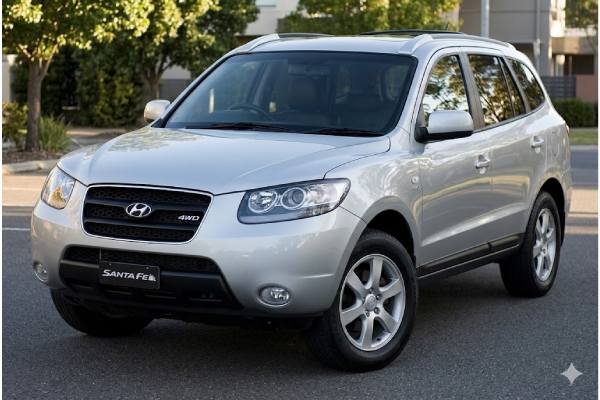
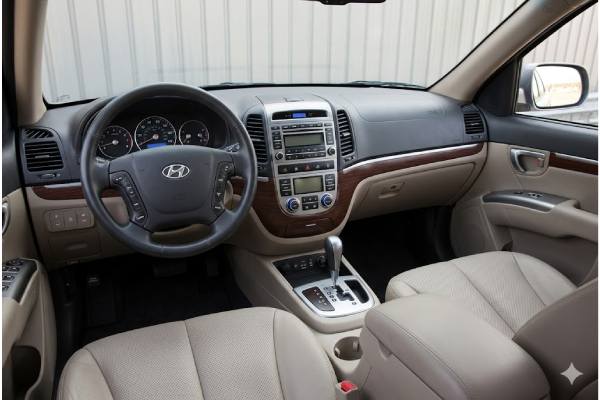
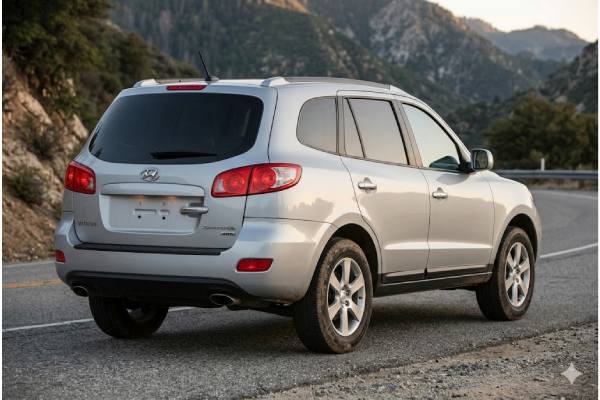
The second-generation Hyundai Santa Fe CM 2.2 CRDi 4WD is one of the more practical diesel family SUVs from the late 2000s: roomy, torquey, relatively simple by modern standards, and available with five or seven seats. In this 148 hp form, it is not a performance SUV, but it offers useful pulling power, a long-legged diesel character, and a comfortable chassis suited to commuting, holidays, poor weather, and light towing.
The important distinction is age and specification. These vehicles are now old enough that condition matters more than badge or mileage alone. A well-serviced Santa Fe CM can still be a dependable used SUV, but examples with neglected timing-belt work, tired suspension, corrosion, fuel-system issues, or unresolved recall work can quickly become expensive.
Quick Overview
- Strong low-rpm diesel torque, a large cabin, and available seven-seat practicality make it useful as a family or towing SUV.
- The 4WD system improves wet-road and winter traction, but it is an on-road AWD layout, not a low-range off-road drivetrain.
- Check timing-belt history, fuel-filter replacement, AWD fluid servicing, ABS recall status, and rear underbody corrosion before buying.
- Engine oil and filter service is typically every 15,000 km or 12 months, with shorter intervals for towing, short trips, or harsh use.
- The D4EB diesel uses a timing belt; depending on market guidance, verify replacement around 90,000–160,000 km or by age.
Table of Contents
- Santa Fe CM Diesel Profile
- Santa Fe CM Technical Specs
- Santa Fe CM Trims and Safety
- Reliability, Issues and Recalls
- Maintenance and Used Buying
- Driving Feel and Performance
- Rival Comparisons and Value
Santa Fe CM Diesel Profile
The Hyundai Santa Fe CM replaced the first-generation Santa Fe with a larger, more mature platform. In diesel 4WD form, it was aimed at buyers who wanted the space and stance of a mid-size SUV without moving into heavy body-on-frame territory. The body is a five-door monocoque SUV, with independent suspension front and rear, a transverse engine layout, and an on-demand 4WD system rather than a traditional transfer case with low range.
The covered version is the early 2.2 CRDi diesel commonly identified by the D4EB or D4EB-V engine family. Output is usually listed as 150 PS, which corresponds to 148 bhp, with 335 Nm of torque delivered from low revs. Some markets and databases list closely related 2.2 CRDi versions at slightly different power figures, especially around late-2009 changes, so the key used-buying check is the actual engine code, production date, emissions equipment, and registration documentation. The later R-series 2.2 CRDi used in facelifted CM models is a different engine and should not be treated as the same car for maintenance or reliability purposes.
In everyday terms, the 148 hp Santa Fe 4WD is best understood as a comfortable diesel utility vehicle. It is heavier than a compact crossover and slower than many later diesel SUVs, but it has enough torque for motorway cruising and moderate towing. The 5-speed manual gives better driver control and usually slightly better fuel economy, while the 5-speed automatic suits relaxed use but needs clean fluid and smooth shifts.
Its strengths are space, comfort, value, and mechanical simplicity compared with newer SUVs loaded with driver-assistance sensors and emissions hardware. Its compromises are also clear: road manners are safe rather than sharp, cabin materials are durable but not premium, and fuel economy depends heavily on tyres, servicing, load, and driving style.
This generation also sits in a transitional safety and emissions period. Earlier cars may have fewer active safety systems than later examples, and diesel particulate filter fitment varies by market and build. Buyers should not assume that every 2006–2009 Santa Fe CM has the same airbags, ESC calibration, DPF setup, or equipment package. The safest approach is to inspect the VIN plate, service book, emissions sticker, tyre placard, owner’s manual, and recall history together.
For the right buyer, the appeal remains strong. A well-kept Santa Fe CM 2.2 CRDi 4WD is spacious, stable, affordable, and better suited to poor weather than a two-wheel-drive MPV or estate. The best examples are not necessarily the cheapest; they are the ones with clear timing-belt proof, regular oil changes, clean cold starts, smooth driveline behaviour, dry underbody components, and evidence that recall and service campaigns have been checked.
Santa Fe CM Technical Specs
Specification data for older Hyundai models can vary by country, trim, production month, seating layout, transmission, and emissions equipment. The figures below reflect the common European-style 2006–2009 Santa Fe CM 2.2 CRDi 4WD 148 hp configuration, with ranges used where trim or equipment changes affect the value.
| Item | Hyundai Santa Fe CM 2.2 CRDi 4WD |
|---|---|
| Engine code | D4EB / D4EB-V family, market dependent |
| Engine layout | Inline-4 diesel, front transverse |
| Valvetrain | SOHC, 16 valves, 4 valves per cylinder |
| Bore × stroke | 87.0 × 92.0 mm (3.43 × 3.62 in) |
| Displacement | 2.2 L (2,188 cc) |
| Induction | Turbocharged, variable-geometry turbo, intercooler |
| Fuel system | Common-rail direct diesel injection |
| Compression ratio | 17.3:1 |
| Maximum power | 148 hp (110 kW) at 4,000 rpm; also listed as 150 PS |
| Maximum torque | 335 Nm (247 lb-ft) at about 1,800 rpm |
| Timing drive | Timing belt |
| Official combined economy | About 7.3 L/100 km (32 mpg US / 39 mpg UK), NEDC-style figures |
| Real-world 120 km/h highway | Typically about 7.5–8.5 L/100 km (28–31 mpg US / 33–38 mpg UK) when healthy |
| Item | Typical specification |
|---|---|
| Transmission | 5-speed manual; 5-speed automatic available in many markets |
| Drive type | Front-biased on-demand 4WD/AWD |
| Differentials | Open differentials with electronic traction control assistance where equipped |
| Front suspension | Independent MacPherson strut, coil springs, anti-roll bar |
| Rear suspension | Independent multi-link, coil springs |
| Steering | Hydraulic power-assisted rack and pinion |
| Brakes | Front ventilated discs about 321 mm (12.6 in); rear solid discs about 302 mm (11.9 in) |
| Popular tyre size | 235/65 R17; some markets used 16 or 18 inch packages |
| Ground clearance | About 203 mm (8.0 in) |
| Length / width / height | 4,675 mm / 1,890 mm / about 1,725–1,795 mm (184.1 / 74.4 / 67.9–70.7 in) |
| Wheelbase | 2,700 mm (106.3 in) |
| Turning circle | About 10.9 m (35.8 ft) |
| Kerb weight | About 1,798–1,898 kg (3,964–4,184 lb), depending on trim, seats, and transmission |
| GVWR | About 2,520 kg (5,556 lb) |
| Fuel tank | 75 L (19.8 US gal / 16.5 UK gal) |
| Cargo volume | About 528 L (18.6 ft³) seats up; about 1,582 L (55.9 ft³) seats folded, method varies |
| Metric | Typical figure |
|---|---|
| 0–100 km/h (0–62 mph) | About 11.6 seconds for the 5-speed manual 4WD |
| Top speed | About 179 km/h (111 mph) |
| 100–0 km/h braking | Not consistently published; condition, tyres, load, and brake health dominate on used cars |
| Braked towing capacity | Up to about 2,000 kg (4,409 lb), market and transmission dependent |
| Unbraked towing capacity | About 750 kg (1,653 lb) |
| Payload | About 600–620 kg (1,323–1,367 lb), depending on kerb weight and specification |
| System | Specification and capacity |
|---|---|
| Engine oil | Usually 5W-30; ACEA C3 for DPF-equipped cars, suitable ACEA diesel oil for non-DPF cars; about 5.9 L (6.2 US qt) with filter |
| Coolant | Ethylene-glycol coolant suitable for aluminium engines, usually 50:50 with demineralised water; about 8.4 L (8.9 US qt) |
| Manual gearbox oil | Typically 75W-85 or 75W-90 GL-4 type manual-transmission oil; capacity varies by gearbox, commonly around 1.7–2.2 L |
| Automatic transmission fluid | Hyundai/Kia automatic-transmission fluid specification for the fitted 5-speed unit; total capacity commonly around 7.8 L, drain refill less |
| Transfer case | API GL-5 hypoid gear oil, usually SAE 75W-90; about 0.6–0.8 L |
| Rear differential | API GL-5 hypoid gear oil, usually SAE 75W-90; about 0.7–0.9 L |
| Brake fluid | DOT 3 or DOT 4 brake fluid, replaced by time as well as condition |
| A/C refrigerant | R134a; about 600 g (21.2 oz), or about 850 g (30.0 oz) with rear evaporator |
| A/C compressor oil | PAG 46 type; about 150 mL (5.1 fl oz), or about 210 mL (7.1 fl oz) with rear evaporator |
| Key torque values | Wheel nuts commonly about 100–108 Nm (74–80 lb-ft); D4EB oil drain plug about 34–44 Nm (25–33 lb-ft); always verify by VIN |
| Area | Typical 2006–2009 Santa Fe CM status |
|---|---|
| Euro NCAP | Older 2006-style ratings: 4-star adult, 3-star child, 0-star pedestrian for the tested configuration |
| ANCAP | 2006 assessment applied to variants with side and curtain airbags; later upgraded vehicles received different results |
| IIHS | US testing does not directly represent the European 2.2 CRDi 4WD diesel specification |
| Headlight rating | No modern IIHS headlight rating for this diesel variant |
| ADAS | No modern AEB, ACC, lane keeping, blind-spot monitoring, or traffic-sign assist on this generation |
| Core safety systems | ABS/EBD, front airbags, side and curtain airbags on many trims, ISOFIX/LATCH in rear positions, ESC availability varies by market and trim |
Santa Fe CM Trims and Safety
Trim naming varied widely. In Europe, names such as Classic, Comfort, Style, Premium, GLS, or similar local grades were used. In the UK and some right-hand-drive markets, equipment levels could be branded differently, while Australian-market cars used their own grade structure. That makes VIN-level checking more useful than relying on a trim badge alone.
Most versions shared the same basic body, engine, suspension layout, and 4WD concept. The more meaningful differences were equipment, seating, transmission, wheel size, airbag package, stability-control fitment, climate-control layout, audio system, and sometimes towing-related details. A lower-grade five-seat manual can be mechanically simpler and lighter, while a higher-grade seven-seat automatic may be more comfortable but more expensive to refresh.
Useful identifiers include:
- Engine code and emissions label: confirm D4EB/D4EB-V rather than the later R-series diesel.
- Seating layout: five-seat cars have more underfloor cargo flexibility; seven-seat cars may have rear climate hardware in some markets.
- Wheel and tyre package: 17-inch wheels with 235/65 R17 tyres are common and give a good balance of comfort and cost.
- Safety equipment: check for curtain airbags, ESC switch or warning lamp, ISOFIX markings, and airbag labels.
- Transmission: the automatic should shift smoothly from cold and hot; the manual should not rattle excessively from the dual-mass flywheel.
Year-to-year changes were usually modest before the facelift. The 2006 launch cars established the CM platform. 2007 and 2008 examples often gained market-specific equipment revisions and wider availability of seven-seat layouts. By late 2009, some markets began moving toward the facelifted Santa Fe and the later 2.2 R-series diesel, which is outside this exact 148 hp D4EB scope. A 2009 registration can therefore be either an older pre-facelift build or a later specification depending on market and production date.
The safety picture needs careful interpretation. Modern readers may expect active crash avoidance, but the 2006–2009 Santa Fe CM belongs to an earlier era. Its safety value came mainly from structure, airbags, anti-lock braking, stability control where fitted, and child-seat anchorage provisions. It did not offer modern AEB, adaptive cruise control, lane-keeping assist, rear cross-traffic alert, or camera-based traffic-sign recognition.
The old Euro NCAP result is not directly comparable with current Euro NCAP percentages because the testing protocols have changed substantially. For this generation, the notable point is that adult occupant protection was respectable for the period, child protection was moderate, and pedestrian protection was weak by today’s standards. ANCAP documentation also distinguishes between early vehicles and later upgraded variants, so production date and equipment matter.
For family use, inspect the rear seatbelts, ISOFIX points, top-tether anchors, airbag warning lamp, and seat-folding mechanisms. A permanently lit airbag lamp can be a simple connector issue, but it can also indicate a failed clock spring, seat occupancy sensor, side-airbag circuit fault, or previous crash damage. Any fault in the restraint system should be diagnosed properly, not cleared casually.
After windscreen replacement, front-end repair, suspension work, or steering work, there is no complex ADAS calibration to manage on this generation. That is one advantage of the older CM. However, ABS, ESC, steering-angle, wheel-speed, and yaw-sensor faults still need proper diagnostic equipment. A car with warning lamps hidden, bulbs removed, or repeated “temporary” resets should be avoided.
Reliability, Issues and Recalls
The Santa Fe CM 2.2 CRDi can be durable, but it is sensitive to age-related neglect. The engine itself is not fragile when serviced correctly, yet small diesel issues can cascade: a blocked fuel filter strains the pump, weak glow plugs worsen cold starts, EGR soot affects intake flow, and old oil shortens turbo life. The same is true underneath. Worn bushes, corroded brake pipes, tired dampers, and neglected AWD fluids can make a solid SUV feel loose and expensive.
| Prevalence | System | Symptoms | Likely remedy | Cost tier |
|---|---|---|---|---|
| Common | EGR and intake soot | Hesitation, smoke, poor response, rough idle | Clean or replace EGR components, inspect intake and vacuum lines | Low to medium |
| Common | Fuel filter and diesel supply | Hard starting, limp mode, poor high-load running | Replace fuel filter, drain water, inspect lines and primer assembly | Low |
| Common | Suspension bushes and links | Knocks, wandering, uneven tyre wear | Replace drop links, bushes, ball joints, then align | Low to medium |
| Occasional | Turbo control and vacuum system | Boost faults, limp mode, underboost or overboost codes | Check actuator, solenoids, vacuum hoses, intercooler plumbing | Medium |
| Occasional | Dual-mass flywheel and clutch | Rattle, judder, slipping, vibration at idle | Replace clutch and flywheel as a set if worn | Medium to high |
| Occasional | Automatic transmission | Shift flare, delayed engagement, harsh changes | Fluid service, adaptation check, solenoid or valve-body diagnosis | Medium to high |
| Rare but serious | Timing belt | Noisy belt area, unknown service history, non-start after failure | Replace belt, tensioners, idlers, and usually water pump | Medium; engine damage if failed |
| Age-related | Corrosion | Rust on rear subframe, brake pipes, suspension mounts, seams | Inspect, treat early, replace structural or brake components as needed | Low to high |
The D4EB timing belt is one of the most important checks. Service interval information differs by market and service book, with some references using longer intervals and others recommending shorter severe-service replacement. On a vehicle of this age, the practical rule is simple: if there is no dated proof of belt, tensioner, idler, and ideally water-pump replacement, budget for the work immediately.
Diesel particulate filter fitment is market dependent. DPF-equipped cars dislike repeated short cold trips that never allow proper regeneration. Warning signs include frequent fan running after short trips, rising oil level from failed regenerations, poor economy, soot-related fault codes, and limp mode. Non-DPF cars avoid that particular cost but may face emissions-test or local-regulation restrictions in some areas.
The 4WD system is generally straightforward, but it must be serviced and inspected. Listen for rear differential whine, check for transfer-case leaks, feel for binding on tight turns, and confirm that all four tyres are matching size, similar wear, and correct load rating. Mismatched tyres can stress AWD components.
Recall and service-campaign history should be checked with the official Hyundai tool or a dealer using the VIN. Several Hyundai and Kia models from this period have been associated with ABS-module electrical concerns in certain markets and VIN ranges. The exact applicability depends on market, production date, and recall campaign. The buyer’s task is not to guess from the model year; it is to verify the VIN and obtain proof that any open campaign has been completed.
A proper pre-purchase inspection should include a cold start, smoke check, diagnostic scan, underbody corrosion inspection, coolant pressure check, brake-pipe inspection, tyre wear review, clutch or automatic-transmission test, and a full look at service records. For a diesel Santa Fe, incomplete history is not a minor inconvenience. It is a pricing issue.
Maintenance and Used Buying
The Santa Fe CM rewards conservative maintenance. It is not a complicated modern hybrid or sensor-heavy luxury SUV, but it is a heavy diesel 4WD vehicle with ageing rubber, fluid, belts, seals, and brake hardware. Skipping basic work usually costs more later.
| Item | Suggested interval for a used vehicle | Notes |
|---|---|---|
| Engine oil and filter | Every 15,000 km or 12 months; 10,000 km or 6 months for severe use | Use correct diesel oil, especially on DPF-equipped cars |
| Engine air filter | Every 15,000–30,000 km | Replace sooner in dusty use |
| Cabin air filter | Every 12 months | Important for HVAC airflow and demisting |
| Fuel filter | About every 30,000 km or 2 years | Critical on common-rail diesels; drain water if applicable |
| Timing belt kit | Verify market interval; commonly treated as 90,000–160,000 km or age limited | Replace immediately if history is unknown |
| Auxiliary belts and hoses | Inspect annually; replace when cracked, noisy, or oil-contaminated | Include tensioners and pulleys during major service |
| Coolant | About every 5 years or 90,000 km, then by coolant condition | Use correct antifreeze mix; inspect radiator and water pump |
| Manual gearbox oil | Every 60,000–90,000 km on older cars | Use correct manual-transmission fluid, not generic axle oil unless specified |
| Automatic transmission fluid | Every 60,000–90,000 km for long life | Avoid power flushing a failing unit; use correct Hyundai/Kia fluid spec |
| Transfer case and rear differential oil | Every 60,000–90,000 km, sooner for towing or water exposure | Small fluid quantities make neglect risky |
| Brake fluid | Every 2 years | Old fluid contributes to corrosion and poor pedal feel |
| Brake pads, rotors, parking brake | Inspect every service | Rear brakes and parking brake hardware can suffer from corrosion |
| Tyre rotation and alignment | Rotate every 10,000–15,000 km; align if wear is uneven | Keep all four tyres matched on 4WD cars |
| Glow plugs | Test when cold starting worsens; many last beyond 100,000 km | Replace carefully to avoid breakage in the cylinder head |
| Valve clearances | No routine adjustment on hydraulic-lifter versions | Investigate persistent top-end noise |
| 12 V battery | Test annually after 4 years | Diesel cold-start load is high |
When buying, prioritise evidence over presentation. A polished car with no service documents is a riskier purchase than a slightly worn car with invoices for timing belt, fluids, suspension, brakes, tyres, and recalls. The highest-value work to confirm is timing-belt replacement, oil history, fuel-filter history, brake-fluid changes, AWD fluid changes, and any ABS or safety campaign completion.
Inspection checklist:
- Start from cold and watch for excessive smoke, rough idle, extended cranking, or diesel knock.
- Check the coolant tank for oil contamination, pressure build-up, or unexplained loss.
- Inspect around the turbo, intercooler hoses, EGR area, injectors, sump, and crank pulley.
- Drive at low speed on full lock to feel for AWD binding or driveline clunks.
- Test full-throttle acceleration gently once warm; limp mode may point to boost, EGR, MAF, fuel, or DPF faults.
- On automatics, check smooth engagement from P to D and R, plus consistent shifts when hot.
- On manuals, listen for dual-mass flywheel rattle and check clutch bite point.
- Inspect rear subframe areas, brake pipes, fuel lines, suspension arms, tailgate seams, and sill edges for corrosion.
- Confirm all warning lamps illuminate at key-on and go out correctly after starting.
The best examples are often mid- or higher-spec cars with full history, matching tyres, recent brakes, and no warning lamps. A seven-seat version is attractive for family use, but check rear-seat mechanisms, rear climate function if fitted, and the condition of the load floor. A simpler five-seat manual may be cheaper to maintain and slightly more economical.
Long-term durability is good when the car is maintained as a diesel 4WD, not like a basic hatchback. The common mistake is buying one because it is inexpensive and then delaying the maintenance that a heavy SUV requires. Budgeting for catch-up work is part of realistic ownership.
Driving Feel and Performance
The Santa Fe CM 2.2 CRDi 4WD drives like a comfortable, practical diesel SUV from the late 2000s. It is stable, easy to place, and relaxed at cruising speeds, but it does not feel sporty. The steering is fairly light, the body leans when pushed, and the chassis prefers smooth inputs. That suits the vehicle’s role: long trips, family use, poor weather, and towing rather than enthusiastic cornering.
The engine’s best quality is torque. With 335 Nm available low in the rev range, the Santa Fe moves cleanly from modest speeds and does not need to be revved hard in normal driving. There is some turbo lag below the main boost range, especially if the EGR system is dirty or the vacuum control system is tired, but a healthy engine pulls well from around 1,800 rpm. Above 3,500 rpm it becomes noisier without adding much extra urgency.
The manual gearbox gives better control on hills and when towing. The automatic is smoother in traffic and suits the car’s relaxed nature, but its condition is important. A good automatic should shift without flare, thump, or hesitation once warm. Harsh changes may be fluid-related, but they can also point to valve-body, solenoid, or internal wear.
Ride comfort is one of the Santa Fe’s stronger traits. The suspension is absorbent on modest wheels and sensible tyres, and the long wheelbase helps it feel settled on motorways. Worn rear bushes, tired dampers, or cheap tyres can quickly spoil that character. Cabin noise is acceptable rather than quiet by modern standards. Expect diesel clatter when cold, wind noise at higher speeds, and more tyre roar on coarse surfaces.
Real-world economy depends heavily on use:
- City driving: about 9.0–11.0 L/100 km (21–26 mpg US / 26–31 mpg UK).
- Mixed driving: about 8.0–9.5 L/100 km (25–29 mpg US / 30–35 mpg UK).
- Steady highway use at 100–120 km/h: about 7.3–8.5 L/100 km (28–32 mpg US / 33–39 mpg UK).
- Cold weather, short trips, roof boxes, winter tyres, and towing can increase consumption by 10–40%.
The 4WD system is useful in rain, snow, gravel tracks, wet grass, and steep driveways. It is front-biased in normal driving and sends torque rearward when slip is detected. Some versions have a 4WD lock mode for low-speed traction, but this is not a substitute for low-range gearing. Ground clearance is useful, yet the Santa Fe is not designed for rock crawling or deep mud.
Towing is a strong part of the package if the car is healthy. The diesel torque, long wheelbase, and stable body help with a caravan or small trailer, but cooling-system condition, tyres, brakes, rear suspension, and transmission servicing become much more important. Expect a moderate towing load to raise fuel consumption noticeably, often by 25–40% depending on speed, weight, wind, and terrain. On long climbs, watch temperature, avoid overloading, and do not rely on old brake fluid or worn pads.
Performance figures tell the same story as the driving feel. A 0–100 km/h time around 11.6 seconds is adequate, not quick. The 179 km/h top speed is largely irrelevant in normal use. What matters more is whether the car starts cleanly, pulls consistently under load, tracks straight, stops confidently, and feels tight over rough roads.
Rival Comparisons and Value
The Santa Fe CM 2.2 CRDi 4WD sits between compact crossovers and heavier off-road SUVs. That middle-ground character is its main selling point. It is larger and more family-friendly than many compact rivals, but less rugged than a proper ladder-frame 4×4. For most used buyers, that is a reasonable compromise.
| Rival | How it compares | Best choice if |
|---|---|---|
| Kia Sorento 2.5 CRDi | More rugged, body-on-frame feel, better for heavier off-road work; less refined and usually thirstier | You need stronger off-road or towing hardware |
| Chevrolet Captiva / Opel Antara diesel | Similar budget SUV appeal; often cheaper, but not clearly better for durability or finish | Purchase price matters more than refinement |
| Toyota RAV4 2.2 D-4D | Smaller and more agile, with strong resale; less cabin and towing space | You want a smaller SUV with easier city manners |
| Nissan X-Trail 2.0 dCi | More compact and efficient, practical cabin, less substantial as a towing family SUV | You value economy and a lower running-cost profile |
| Land Rover Freelander 2 TD4 | Better off-road polish and premium feel; usually higher repair risk and parts cost | You accept higher costs for capability and cabin feel |
| Mitsubishi Outlander diesel | More car-like and efficient in some versions; can feel lighter-duty than the Santa Fe | You want seven-seat flexibility with lower weight |
Against these rivals, the Hyundai’s main advantage is value. It offers a large body, useful diesel torque, available seven seats, and good standard comfort equipment for less money than many Japanese or European alternatives. Parts availability is generally reasonable, and independent garages are familiar with the basic mechanical layout.
Its disadvantage is that cheap examples can be falsely economical. A neglected Santa Fe may need a timing-belt kit, tyres, brakes, suspension arms, fluids, battery, glow plugs, and corrosion work soon after purchase. That can exceed the price gap between an average car and a very good one.
The best reason to choose the Santa Fe CM 2.2 CRDi 4WD is not prestige. It is usefulness. It works well for drivers who need space, bad-weather confidence, diesel range, and moderate towing ability without paying modern SUV prices. It is less appealing for drivers who mainly do short urban journeys, need the latest safety technology, or want low-emission-zone compatibility without checking the exact emissions class.
A sensible verdict is conditional: buy on condition, not on mileage alone. A documented, rust-free, mechanically quiet Santa Fe with fresh fluids and completed recalls remains a solid used SUV. A cheap one with vague history, dashboard warnings, mismatched tyres, and visible corrosion is usually cheap for a reason.
References
- Hyundai Owners manuals | Hyundai Motor UK 2026 (Owner’s Manual)
- Hyundai Santa Fe (CM) 2.2 CRDi VGT 4WD Specs, Performance, Comparisons 2026 (Technical Specifications)
- Hyundai Santa Fe | Safety Rating & Report | ANCAP 2006 (Safety Rating)
- Home | Hyundai Recalls & Service Campaigns 2026 (Recall Database)
- Part 573 Safety Recall Report 20V-061 2020 (Recall Database)
Disclaimer
This article is for informational purposes only and is not a substitute for professional diagnosis, inspection, maintenance, or repair. Specifications, torque values, service intervals, fluids, equipment, safety ratings, recall applicability, and procedures can vary by VIN, production date, market, trim, transmission, emissions equipment, and previous repairs. Always verify details against the official owner’s manual, service documentation, parts catalogue, and a Hyundai dealer or qualified technician.
If this information helped, please consider sharing it on Facebook, X/Twitter, or another platform to support our work.