


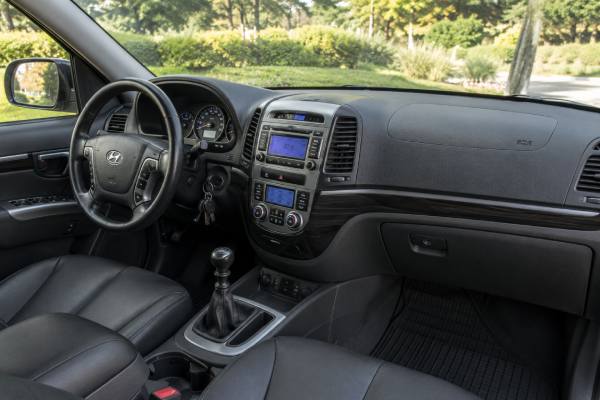
The facelifted Hyundai Santa Fe CM with the 2.2 CRDi diesel is one of the more practical used family SUVs from its period. In European and UK-style specification, it combined seven-seat availability, a strong 194 hp diesel engine, a torque-on-demand 4WD system, useful towing capacity, and relatively simple driver-assistance technology compared with newer SUVs.
Its appeal is not only the spec sheet. The Santa Fe CM is large enough for family duty, strong enough for towing, and generally durable when serviced correctly. The main used-buying questions are whether the diesel emissions system has been looked after, whether the 4WD driveline has received fluid service, and whether age-related corrosion, suspension wear, or electrical faults have been ignored.
Owner Snapshot
- Strong 2.2 CRDi torque, especially useful for towing, hills, and loaded motorway driving.
- Practical 5- or 7-seat cabin with a large cargo area and simple controls.
- Torque-on-demand 4WD gives useful bad-weather traction without full-time 4WD fuel use.
- Check diesel, EGR, DPF, turbo, clutch/automatic, rear differential, and corrosion condition before buying.
- A sensible oil-service rhythm is every 10,000–15,000 km or 12 months, with shorter intervals for short-trip or towing use.
Table of Contents
- Santa Fe CM Diesel Profile
- Santa Fe CM Technical Data
- Santa Fe CM Trims and Safety
- Reliability Issues and Actions
- Maintenance and Buying Checks
- Driving Performance and Economy
- Santa Fe CM Rivals
Santa Fe CM Diesel Profile
The 2010–2012 facelift Hyundai Santa Fe CM sits in the final phase of the second-generation Santa Fe. In this form it was a mid-size SUV by the standards of its time, with a five-door body, available five- or seven-seat layouts, and a diesel-heavy European market focus. The variant covered here is the 2.2 CRDi 4WD using Hyundai’s R-series D4HB common-rail diesel, rated at 145 kW, commonly listed as 194 bhp or 197 PS depending on market convention.
The facelift brought a cleaner front-end design, revised equipment, and a major powertrain update compared with earlier CM diesels. The older 2.2 CRDi units in pre-facelift cars were lower-output engines, while the later D4HB-based version gave the Santa Fe noticeably better mid-range torque and more relaxed highway performance. The engine is an inline-four, 16-valve, turbocharged diesel with common-rail injection, a timing chain, and Euro 5 emissions equipment in many European applications.
The 4WD system is not a heavy-duty off-road transfer-case setup with low range. It is a torque-on-demand system that normally behaves like a front-biased SUV and sends drive rearward when traction requires it. That suits the Santa Fe’s real role: wet roads, snow, gravel tracks, campsites, boat ramps, and towing on slippery surfaces. It is not designed to replace a ladder-frame 4×4 for repeated rock crawling or deep-rut off-road work.
Transmission choice is important. The six-speed manual gives the best official fuel economy and the highest listed braked towing rating in UK-style data. The six-speed automatic is smoother in traffic and better suited to drivers who value ease over maximum economy, but it usually uses more fuel and, in some markets, carries a lower tow rating. Both can be durable, but both need checking on a used vehicle: manuals for clutch and dual-mass flywheel wear, automatics for shift quality and fluid-service history.
The Santa Fe’s strongest practical qualities are its space, visibility, towing usefulness, and generally robust mechanical layout. Its weaknesses are mostly age-related. By now, any example is old enough for worn suspension bushes, tired wheel bearings, sticky brake calipers, tired batteries, seized fasteners, corroded subframes or springs, and neglected fluids to matter more than the original brochure promise.
For used buyers, condition is more important than trim badge. A well-serviced Style on good tyres with documented fluids is usually a safer purchase than a neglected Premium with more equipment. The best examples feel tight over bumps, start cleanly from cold, pull strongly without smoke, shift smoothly, and have no warning lights after a proper road test.
Santa Fe CM Technical Data
Specifications vary by market, model year, seating layout, transmission, and emissions equipment. The figures below reflect the common UK/European facelift 2.2 CRDi 4WD specification for 2010–2012, with notes where the manual and automatic differ.
| Item | Specification |
|---|---|
| Engine code | D4HB, R-series 2.2 CRDi diesel |
| Layout | Inline-4, DOHC, 4 valves per cylinder |
| Bore × stroke | 85.4 × 96.0 mm (3.36 × 3.78 in) |
| Displacement | 2.2 L, 2,199 cc |
| Induction | Turbocharged diesel with intercooler |
| Fuel system | Common-rail direct injection |
| Compression ratio | 16.0:1 |
| Maximum power | 194 hp (145 kW) at 3,800 rpm |
| Maximum torque | 422 Nm (311 lb-ft) manual; 436 Nm (322 lb-ft) automatic, both around 1,800–2,500 rpm |
| Timing drive | Timing chain |
| Official combined economy | Manual: 6.8 L/100 km, 41.5 mpg UK, 34.6 mpg US; automatic: about 7.2–7.4 L/100 km, 39.2–38.2 mpg UK, 32.6–31.8 mpg US |
| Real highway at 120 km/h | Typically about 7.5–9.0 L/100 km depending on tyres, load, weather, terrain, and transmission |
| Item | Specification |
|---|---|
| Transmission | 6-speed manual or 6-speed automatic, market dependent |
| Drive type | Torque-on-demand 4WD, front-biased in normal driving |
| Differentials | Open differentials with electronic traction/stability control support |
| Front suspension | MacPherson strut with coil spring |
| Rear suspension | Multi-link layout with anti-roll stabiliser; self-levelling rear suspension on some 7-seat versions |
| Steering | Hydraulic power-assisted rack and pinion; about 3.02 turns lock-to-lock |
| Brakes | Front ventilated discs, rear solid discs; diameter varies by market and parts listing |
| Popular tyre sizes | 235/65 R17 on Style; 235/60 R18 on Premium |
| Ground clearance | 200 mm (7.9 in) |
| Approach / departure / breakover | 24.6° / 21.6° / 17.9° |
| Length / width / height | 4,685 mm / 1,890 mm / 1,725–1,760 mm (184.4 / 74.4 / 67.9–69.3 in) |
| Wheelbase | 2,700 mm (106.3 in) |
| Kerb weight | About 1,920–1,987 kg (4,233–4,381 lb), depending on seating and transmission |
| GVWR | 2,570 kg (5,666 lb) |
| Fuel tank | 70 L (18.5 US gal / 15.4 UK gal) |
| Cargo volume | UK brochure SAE method: 969 L seats up, 2,247 L seats down (34.2 / 79.4 ft³); VDA figures are usually lower |
| Item | Specification or guidance |
|---|---|
| 0–100 km/h / 0–62 mph | Manual about 9.8 s; automatic about 10.2 s |
| Top speed | 190 km/h (118 mph) |
| Braking distance | No single official value for all tyres/markets; judge condition by tyre age, brake balance, pedal feel, and straight-line stops |
| Towing capacity | Manual up to 2,500 kg (5,512 lb) braked; automatic commonly 2,000 kg (4,409 lb) braked; unbraked 750 kg (1,653 lb) |
| Payload | Roughly 580–650 kg, depending on kerb weight, seating, accessories, and registration data |
| Engine oil | Use Hyundai-approved diesel oil for DPF/non-DPF equipment; many DPF cars require low-SAPS 5W-30 ACEA C3. Service fill is typically around 6–7 L; verify by dipstick and service data. |
| Coolant | Ethylene-glycol long-life coolant at the correct mix, usually around 50/50 with deionised water; capacity varies by heater/rear-heater configuration |
| Automatic transmission fluid | Use the correct Hyundai/Kia ATF specification for the fitted 6-speed automatic; do not mix generic fluids |
| Transfer case / rear differential | Use the specified hypoid gear oil grade for 4WD components; change sooner after water immersion or towing use |
| A/C refrigerant | R134a; many listings show about 600 g without rear evaporator and about 850 g with rear evaporator |
| A/C compressor oil | PAG 46-type oil; charge varies by system configuration, commonly about 150–210 mL |
| Key torque spec | Wheel nuts: 88–107 Nm (65–79 lb-ft). Other fasteners should be verified from VIN-specific service data. |
| Crash ratings | IIHS lists Good ratings for moderate-overlap front, side, and head restraints on relevant 2007–2012 models. Older Euro NCAP/ANCAP-style ratings used pre-modern scoring and are not directly comparable with current percentage ratings. |
| ADAS | No modern AEB, adaptive cruise, lane keeping, or cyclist/pedestrian detection on this CM facelift. Safety equipment is mainly structural, airbag, ABS/EBD, ESP, traction control, and parking aids. |
Santa Fe CM Trims and Safety
In UK-style facelift form, the 2.2 CRDi 4WD range was relatively simple. The main grades were commonly Style and Premium, with both offered in five- and seven-seat layouts and with manual or automatic transmission, depending on model year and market. Some countries used different trim names, so a vehicle’s equipment should be checked directly rather than assumed from the badge.
Style was the more straightforward version. It generally included 17-inch alloy wheels, cloth trim, air conditioning, Bluetooth, USB/AUX inputs, reversing sensors, ABS with electronic brake-force distribution, ESP, traction control, front fog lights, active front head restraints, front airbags, front side airbags, and full-length curtain airbags with rollover sensing. Rear ISOFIX points were fitted to the outer second-row seats.
Premium added the equipment most buyers now expect on a used family SUV: 18-inch alloys, leather-faced seats, heated front seats, cruise control, dual-zone climate control, automatic headlights, rain-sensing wipers, electric folding mirrors, roof rails, and extra cabin finish details. On some cars, a Media Pack added touchscreen navigation, a reversing camera, and parking guidance. Privacy glass and metallic paint were often listed separately or varied by seating layout.
Mechanical differences by trim were limited, but not irrelevant. Seven-seat versions could have self-levelling rear suspension, which is useful for load control but more expensive to refresh if worn. Wheel size also changes the ride and tyre cost. The 17-inch setup usually gives the best comfort and the widest tyre choice. The 18-inch Premium wheels look better and sharpen the stance slightly, but they can transmit more impact harshness on broken surfaces.
Quick identifiers include the wheel size, seat material, climate-control panel, roof rails, cruise-control switches, navigation screen, and the presence of a third row. A VIN or build sheet remains the safest way to confirm original equipment, especially on imported cars or vehicles that have had wheels, seats, or head units swapped.
Safety equipment was respectable for its age but not modern. The Santa Fe CM relies on airbags, stability control, anti-lock braking, traction control, a strong passenger cell for its period, and reasonable visibility. It does not offer the active safety systems that many current SUVs have, such as autonomous emergency braking, adaptive cruise control, lane-centering assistance, rear cross-traffic braking, or traffic-sign recognition.
Child-seat practicality is a strong point. The rear doors open wide, the second row is roomy, and the outer second-row ISOFIX points are useful. The third row, where fitted, is better for children or occasional adults rather than regular long-distance adult use. Families should test their actual child seats before purchase because seat shape, belt-buckle position, and front-seat adjustment can affect fit.
Any work around airbags, steering-angle sensors, ABS components, suspension geometry, or radar-like aftermarket accessories should be handled carefully. This generation does not have complex camera/radar ADAS calibration, but it still uses stability-control and restraint-system sensors that need correct diagnosis after accident repair or major chassis work.
Reliability Issues and Actions
A well-maintained D4HB Santa Fe can cover high mileage, but examples are now old enough that maintenance quality matters more than brand reputation. The best cars usually have regular oil changes, clean intake and emissions behaviour, documented driveline-fluid service, matching tyres, and no long gaps in inspection history.
| System | Prevalence | Severity | Symptoms | Likely remedy |
|---|---|---|---|---|
| EGR and intake deposits | Common on short-trip diesels | Medium | Rough idle, hesitation, smoke, reduced power, EGR-related fault codes | Diagnosis, EGR cleaning or replacement, intake cleaning, software check |
| DPF loading | Common if used mainly in town | Medium to high | Frequent regens, high fuel use, warning lights, limp mode | Find root cause, forced regen only when safe, repair sensors/leaks, avoid deleting emissions equipment |
| Turbo and boost control | Occasional | Medium to high | Whistle, underboost, overboost, black smoke, limp mode | Check boost hoses, vacuum/electronic actuator, intercooler, turbo vanes, oil feed condition |
| Timing-chain noise | Occasional at high mileage or poor oil history | High | Rattle on cold start, persistent chain noise, timing-correlation faults | Inspect chain, guides, tensioner, oil pressure, and service history; replace components if out of spec |
| Manual clutch and dual-mass flywheel | Common with towing or city use | Medium to high | Judder, slip, vibration at idle, rattling at shutdown | Replace clutch kit and flywheel as needed |
| Automatic shift quality | Occasional | Medium | Flare, harsh shifts, delayed engagement, shudder | Scan for codes, check mounts and fluid condition, service with correct ATF, diagnose before replacement |
| 4WD coupling, rear diff, prop shaft | Occasional | Medium | Binding, clunks, vibration, whining, rear-drive loss | Check tyre matching, fluid service, mounts, coupling function, and differential wear |
| Suspension, wheel bearings, brakes | Common with age | Low to medium | Knocks, uneven tyre wear, humming, brake drag, vibration | Replace bushes, links, bearings, calipers, pads, discs; align after suspension work |
| Corrosion | Market dependent | Medium to high | Rust on subframes, suspension arms, brake pipes, spring seats, tailgate edges | Inspect on lift, repair early, reject structurally rusty cars |
The diesel system deserves the most attention. Short urban journeys are hard on EGR valves, intake tracts, DPFs, thermostats, glow systems, and oil quality. A Santa Fe that has mostly done warm motorway miles may be in better mechanical condition at 220,000 km than a short-trip car at 120,000 km. During inspection, start the engine cold, watch for excessive smoke, listen for chain rattle, and check that it reaches normal temperature promptly.
The timing chain is not a scheduled replacement item in the same way as a timing belt, but that does not mean it can be ignored. Chain noise, poor oil history, delayed oil pressure, tensioner faults, or timing-correlation codes are warning signs. A quiet chain on a well-serviced engine is usually not a concern. A noisy chain on a cheap car can turn into an expensive repair.
The 4WD system depends on matched tyres and healthy fluids. A set of mixed brands, different tread depths, or different rolling circumferences can stress the coupling and driveline. Buyers should check for clunks during tight low-speed turns, vibration under load, whining at speed, and leaks around the transfer case and rear differential.
Recalls and service campaigns vary by country and VIN. Some Santa Fe CM recalls in North American databases involve stop-lamp switches, trailer wiring harness issues, brake or driveline-related campaigns, and other market-specific items. Many do not apply to European diesel 4WD vehicles. The correct action is to check the VIN through Hyundai’s official recall system and ask for dealer proof that relevant actions were completed.
Maintenance and Buying Checks
The Santa Fe CM rewards preventive servicing. It is not a delicate SUV, but it is heavy, diesel-powered, often used for towing, and old enough that fluids and rubber components should not be stretched to optimistic intervals.
| Item | Suggested interval | Notes |
|---|---|---|
| Engine oil and filter | 10,000–15,000 km or 12 months; shorter for severe use | Use the correct diesel oil for DPF equipment. Short-trip and towing use justify shorter intervals. |
| Engine air filter | Inspect yearly; replace around 20,000–30,000 km | Replace sooner in dusty areas. |
| Cabin air filter | 12 months | Cheap and improves demisting and HVAC airflow. |
| Fuel filter | Often 30,000–60,000 km, market dependent | Important for injector and high-pressure pump health. |
| Coolant | Every 4–5 years unless service data says otherwise | Use correct long-life coolant and mix. Inspect radiator, hoses, thermostat, and heater lines. |
| Brake fluid | Every 2 years | Also inspect caliper sliders, handbrake mechanism, brake pipes, pads, and discs. |
| Manual gearbox oil | Inspect for leaks; consider change around 80,000–100,000 km | Useful on high-mileage or towing vehicles. |
| Automatic transmission fluid | Consider 60,000–80,000 km for used/towing service | Use exact Hyundai/Kia specification; poor fluid choice can cause shift problems. |
| Transfer case and rear differential oil | Inspect around 60,000 km; replace around 100,000–120,000 km or sooner after water exposure | Critical for 4WD longevity. |
| Auxiliary belt, pulleys, hoses | Inspect yearly; replace on cracks, noise, swelling, or age | Do not wait for belt failure on a high-mileage diesel. |
| Timing chain | No routine belt-style interval | Inspect if noisy, fault codes appear, or oil history is poor. |
| Tyres, alignment, rotation | Rotate around 10,000–12,000 km; align when wear suggests | Keep four tyres closely matched for 4WD health. |
| 12 V battery | Test yearly after 4 years | Weak batteries cause many misleading electrical symptoms. |
A buyer’s inspection should start underneath. Look at the front and rear subframes, suspension arms, brake pipes, fuel lines, rear spring areas, sills, jacking points, towbar mounting points, and exhaust. Surface rust is normal in many climates; flaking structural corrosion is not.
On the engine, look for oil leaks around the rocker cover, turbo oil lines, intercooler hoses, crankcase ventilation, sump, and timing cover. A light oil mist in diesel intake plumbing is common, but wet hoses, heavy smoke, or oil dripping from the intercooler area deserve investigation. Coolant loss, hard hoses from cold, heater problems, or temperature instability should not be dismissed.
During the road test, include town driving, a full warm-up, steady 100–120 km/h cruising, uphill acceleration, tight low-speed turns, and several firm stops. The engine should pull cleanly from low rpm, the turbo should build boost without surging, and the gearbox should not flare or thump. The car should track straight, brake straight, and settle quickly after bumps.
The most desirable used example is not necessarily the highest trim. A manual 5-seat car may suit a buyer who wants lower fuel use and maximum tow rating. A seven-seat Premium automatic may suit family use better but brings more equipment, more weight, and potentially higher repair costs. Avoid cars with missing service history, mixed tyres, persistent warning lights, smoke under load, slipping clutch, harsh automatic shifts, neglected 4WD fluids, or fresh underseal hiding rust.
Long-term durability is good when the Santa Fe is treated like a heavy diesel SUV rather than a light hatchback. Preventive fluid changes, quality tyres, clean brakes, and early rust control are the difference between a dependable family workhorse and a cheap SUV that becomes uneconomical to repair.
Driving Performance and Economy
The 2.2 CRDi gives the Santa Fe CM a relaxed, muscular character. It is not sporty in a modern sense, but the torque arrives early and makes the vehicle feel stronger than the peak horsepower figure suggests. Loaded with passengers or towing a trailer, it feels more convincing than many naturally aspirated petrol SUVs of the same period.
Throttle response is generally measured rather than sharp. The diesel pulls best in the mid-range, so smooth progress comes from using torque instead of revs. The manual can feel strong and economical when driven with early upshifts, while the automatic suits urban and family use because it removes clutch effort and smooths low-speed driving. A healthy automatic should engage promptly, shift cleanly, and kick down without harsh bangs.
Ride quality is one of the Santa Fe’s better traits, especially on 17-inch wheels. It is softly sprung enough to deal with poor roads and family loads, but the body is tall and heavy, so it leans if pushed hard through bends. The steering is not especially communicative, yet it is predictable and reasonably weighted. At motorway speeds, the facelift car is stable and calmer than many older SUVs, helped by decent straight-line tracking and a diesel engine that does not need high revs.
Cabin noise depends heavily on tyres, wheel bearings, engine mounts, and door seals. A good car should cruise without excessive boom or vibration. Loud humming often points to tyres or wheel bearings. Drumming from the rear can come from uneven tyre wear, tired suspension bushes, cargo-area trim, or rear wheel bearings.
Real-world fuel economy is best judged by use pattern. In mixed driving, a manual commonly lands around 7.5–8.5 L/100 km, while an automatic may sit closer to 8.5–9.5 L/100 km. City use, winter operation, short trips, roof boxes, towing, and aggressive tyres can push those numbers higher. On a steady highway run at 100–110 km/h, the manual can be impressively frugal for a heavy 4WD SUV. At 120 km/h, wind resistance and weight become more obvious.
Towing is a strong reason to choose this model. The long wheelbase, diesel torque, and 4WD traction make it confident with a moderate caravan, horsebox, small boat, or utility trailer, provided the vehicle is within legal limits and in good mechanical condition. The manual’s higher tow rating is useful, but driver preference matters too. The automatic is easier in traffic and on manoeuvres, while the manual gives more direct control and often better economy.
Brake feel is adequate when the system is fresh, but the Santa Fe is heavy. Old fluid, cheap pads, rusty rear discs, sticky calipers, or budget tyres can make braking feel much worse. Anyone planning to tow should budget for top-quality tyres, fresh brake fluid, good pads and discs, and a cooling-system check before heavy use.
The 4WD system improves traction rather than handling precision. It helps on wet junctions, muddy fields, snow, and gravel, but tyres remain the main factor. A Santa Fe on worn all-season tyres will not match one on fresh winter tyres in cold weather. Stability control is generally reassuring, though it can feel intrusive if tyres are poor or the vehicle is heavily loaded.
Santa Fe CM Rivals
The Santa Fe CM competes with older family SUVs and crossovers that offer diesel torque, available AWD, and practical cabins. Its closest rivals include the Kia Sorento, Chevrolet Captiva, Toyota RAV4, Honda CR-V, Nissan X-Trail, Land Rover Freelander 2, Mitsubishi Outlander, and larger seven-seat alternatives such as the Toyota Land Cruiser or Nissan Pathfinder.
| Rival | Where it beats the Santa Fe | Where the Santa Fe responds |
|---|---|---|
| Kia Sorento | Often stronger towing image and later models with more modern cabins | Santa Fe CM can feel more car-like and may be better value in similar condition |
| Honda CR-V | Excellent cabin packaging, lighter feel, strong reliability reputation | Santa Fe offers more diesel torque and seven-seat availability in many markets |
| Toyota RAV4 | Good dependability and easier urban size | Santa Fe is larger, more tow-oriented, and better for families needing extra seats |
| Nissan X-Trail | Practical square load bay and useful AWD versions | Santa Fe feels bigger, more refined, and stronger in 2.2 CRDi form |
| Land Rover Freelander 2 | Better rough-road polish and premium feel in some trims | Santa Fe is usually simpler, roomier, and often cheaper to buy |
| Mitsubishi Outlander | Useful packaging and some efficient diesel versions | Santa Fe has stronger towing credentials and a more substantial cabin feel |
| Chevrolet Captiva | Often inexpensive and available with seven seats | Santa Fe generally has a stronger ownership reputation and better interior finish |
Against these rivals, the Santa Fe’s main advantage is balance. It is not the most agile, most luxurious, most economical, or most off-road-capable SUV in the class, but it combines space, torque, equipment, towing ability, and used-market value well. For a family that needs a practical diesel 4WD without premium-brand repair costs, it still makes sense.
The Honda CR-V and Toyota RAV4 are often safer choices for buyers who do mostly urban driving and do not need seven seats or heavy towing ability. They are lighter, easier to park, and less demanding on tyres and brakes. The Santa Fe is better when load carrying, diesel torque, and cabin size matter more.
The Freelander 2 is more sophisticated on rough surfaces and can feel more premium, but buyers must be comfortable with Land Rover maintenance risk. The Sorento is the Santa Fe’s closest relative in spirit, and condition should decide between them more than brand loyalty. A well-kept Sorento is a strong alternative; a neglected one is no bargain.
The Santa Fe CM 2.2 CRDi 4WD is worth considering when the example is clean, documented, and mechanically calm. It is less attractive if the use case is short city trips, because that is exactly the pattern that can cause diesel emissions problems. For regular longer journeys, family holidays, bad-weather use, and moderate towing, a properly maintained one remains a capable and honest used SUV.
References
- Hyundai Owners Manuals 2026 (Owner’s Manual)
- 2010 Hyundai Santa Fe 2010 (Safety Rating)
- Vehicle Detail Search – 2010 HYUNDAI SANTA FE | NHTSA 2026 (Recall Database)
- Check for Recalls: Vehicle, Car Seat, Tire, Equipment | NHTSA 2026 (Recall Database)
- Hyundai Santa Fé 2.2 CRDi 4WD specs (2010-2012), performance, dimensions & technical specifications – encyCARpedia 2023 (Technical Data)
Disclaimer
This information is for general guidance only and is not a substitute for professional diagnosis, repair, inspection, or official service documentation. Specifications, torque values, fluid capacities, service intervals, safety equipment, recalls, and procedures can vary by VIN, market, model year, transmission, seating layout, and installed equipment. Always verify critical information against the correct Hyundai service data and a qualified technician before maintenance or repair.
If you found this useful, please consider sharing it on Facebook, X/Twitter, or another platform to support our work.