
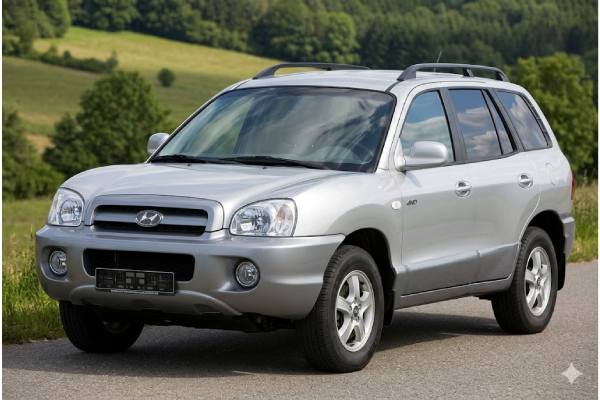
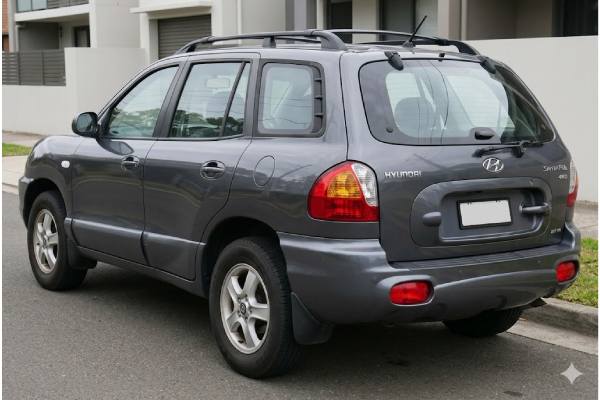
The late first-generation Hyundai Santa Fe SM is a practical, old-school compact-to-midsize SUV with a diesel engine, five seats, useful cargo space, and a simple 4WD system compared with many newer crossovers. In 2.0 CRDi 113 hp form, it was aimed less at speed and more at everyday torque, winter traction, family use, light towing, and long-distance economy.
For used buyers today, the main question is not whether the Santa Fe SM feels modern. It does not. The better question is whether a well-kept diesel 4WD example still offers dependable value. The answer can be yes, but only if the timing belt, fluids, clutch or automatic transmission, suspension, corrosion protection, and recall history are treated seriously. Age matters as much as mileage on this vehicle.
What to Know
- Strong low-speed diesel torque, roomy seating, and a large boot make the Santa Fe SM useful as a family, winter, or light towing SUV.
- The 4WD version adds traction on wet roads, snow, gravel, and steep tracks, but it is not a heavy-duty off-roader.
- The biggest ownership caveats are corrosion, neglected timing-belt service, diesel fuel-system issues, worn suspension parts, and tired driveline fluids.
- Plan engine oil service roughly every 10,000–15,000 km or 6–12 months, with shorter intervals for city use, towing, or cold starts.
- Timing belt service is a priority; many owners use a 90,000–120,000 km or 5–8 year window, but the correct interval must be checked against the service book for the exact VIN and market.
Table of Contents
- Santa Fe SM Diesel Context
- Santa Fe SM Core Specs
- Santa Fe SM Trims and Safety
- Known Issues and Recalls
- Maintenance and Buying Advice
- Real-World Drive and Performance
- Santa Fe SM Against Rivals
Santa Fe SM Diesel Context
The Hyundai Santa Fe SM was the first-generation Santa Fe, sold globally from the early 2000s until the larger CM generation replaced it. The vehicle covered a broad mix of petrol and diesel powertrains depending on market. The version covered here is the 4WD Santa Fe SM with the 2.0 CRDi D4EA diesel engine in the 113 hp class, most relevant to European and other diesel-oriented markets.
The “facelift 2005–2006” description needs careful handling because late SM Santa Fe models overlapped with different diesel calibrations. In some markets, the 2.0 CRDi was offered as an earlier fixed-geometry turbo version around 112–113 hp, while other late examples used a VGT version with about 125 PS. Badges, registration documents, engine codes, and VIN-specific data matter. This article focuses on the 113 hp diesel 4WD variant, not the higher-output 125 PS VGT version.
Mechanically, the 2.0 CRDi is a Hyundai D4EA common-rail diesel. It is a 1,991 cc inline-four with a cast-iron block, aluminum cylinder head, turbocharging, intercooling, and belt-driven valve timing. In this Santa Fe, its character is defined by mid-range torque rather than high-rev power. It suits steady motorway cruising, rural roads, winter use, and moderate loads, but it feels heavy when asked to accelerate hard.
The 4WD system gives the Santa Fe more confidence than a front-wheel-drive version on slippery roads. It should be viewed as an all-weather traction system rather than a dedicated off-road package. Ground clearance is useful, and the body is robust enough for gravel roads and rough lanes, but there are no low-range gears and no serious locking differentials in normal passenger versions.
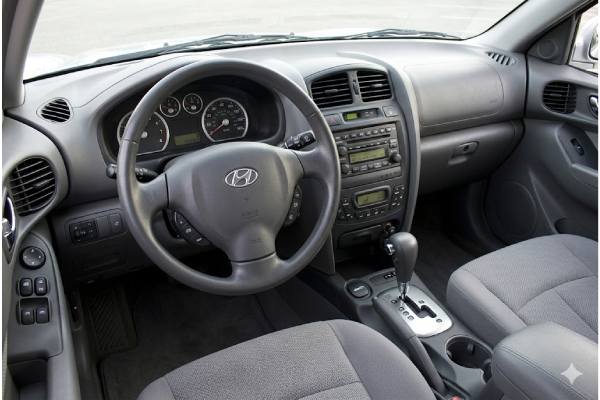
The body style is a five-door SUV with five seats. The cabin is wide and upright, with simple controls, a high seating position, and a practical cargo area. Compared with newer Hyundai crossovers, it feels less refined, less efficient, and far less advanced in active safety. Compared with many same-era used SUVs, it still has appeal because parts availability is reasonable, the layout is straightforward, and a good example is easy to live with.
The best examples are not necessarily the lowest-mileage cars. A higher-mileage Santa Fe with clear timing-belt records, regular oil changes, fresh driveline fluids, good tyres, clean underbody metal, and a smooth transmission is often a better buy than a low-mileage car that has done short trips, sat unused, or skipped age-based service.
Santa Fe SM Core Specs
Specification data for this model varies by country, trim, transmission, type-approval source, and whether the car is the fixed-geometry 113 hp diesel or the later VGT diesel. The values below reflect the 2.0 CRDi 4WD 113 hp class and should be checked against the VIN plate, registration document, and market service literature before ordering parts or fluids.
| Item | Hyundai Santa Fe SM 2.0 CRDi 4WD 113 hp |
|---|---|
| Engine code | D4EA / 2.0 CRDi |
| Engine layout | Front transverse inline-four diesel, 4 cylinders |
| Valvetrain | OHC/SOHC-type layout, 4 valves per cylinder, 16 valves total |
| Bore × stroke | 83.0 × 92.0 mm (3.27 × 3.62 in) |
| Displacement | 2.0 L / 1,991 cc (121.5 cu in) |
| Induction | Turbocharged and intercooled; non-VGT or market-specific early CRDi calibration for the 113 hp version |
| Fuel system | Bosch-type common-rail direct diesel injection |
| Compression ratio | About 17.7:1 |
| Maximum power | 113 hp / 83 kW / 113 PS class at about 4,000 rpm |
| Maximum torque | Commonly listed around 255 Nm (188 lb-ft) at 2,000 rpm; some sources list 235 Nm (173 lb-ft) depending market calibration |
| Timing drive | Timing belt |
| Official combined economy | About 7.6 L/100 km (30.9 mpg US / 37.2 mpg UK) |
| Typical real highway use at 120 km/h | About 7.8–9.0 L/100 km (26–30 mpg US / 31–36 mpg UK), depending tyres, load, wind, terrain, and injector health |
| Item | Typical specification |
|---|---|
| Transmission | 5-speed manual most commonly associated with this 113 hp 4WD version; some markets also had automatic variants |
| Drive type | 4WD / AWD, front-based layout with rear-drive assistance depending market system |
| Differential | Open differentials in normal passenger models; no low-range transfer case |
| Front suspension | Independent MacPherson strut with coil springs and anti-roll bar |
| Rear suspension | Independent coil-spring rear suspension; layout and component detail vary by market documentation |
| Steering | Hydraulic power-assisted rack and pinion |
| Brakes | Ventilated front discs, rear discs; ABS fitted on many markets and trims |
| Common tyre size | 225/70 R16 |
| Ground clearance | About 207 mm (8.1 in), market and tyre dependent |
| Approach/departure angles | Often quoted around 26–28°, depending trim and measurement method |
| Length / width / height | About 4,500 mm / 1,820–1,845 mm / 1,730 mm (177.2 in / 71.7–72.6 in / 68.1 in) |
| Wheelbase | 2,620 mm (103.1 in) |
| Turning circle | About 11.4 m (37.4 ft), depending tyre and market data |
| Kerb weight | Approximately 1,690–1,845 kg (3,725–4,068 lb), depending trim, transmission, equipment, and measuring standard |
| GVWR | Often listed around 2,380–2,520 kg (5,247–5,556 lb), market dependent |
| Fuel tank | 65 L (17.2 US gal / 14.3 UK gal) |
| Cargo volume | About 850–2,100 L (30.0–74.2 ft³) in some VDA-style listings; other standards quote smaller seats-up figures |
| Metric | Typical figure |
|---|---|
| 0–100 km/h | About 14.9 seconds |
| Top speed | About 166 km/h (103 mph) |
| 100–0 km/h braking distance | Not consistently published for this diesel variant; condition of tyres, brake fluid, and dampers matters more on used cars |
| Towing capacity | Commonly 1,800–1,870 kg braked and 700–750 kg unbraked; some late/VGT European listings show 2,000 kg braked |
| Payload | Typically about 535–700 kg (1,179–1,543 lb), depending kerb weight and GVWR |
| Item | Typical value or specification |
|---|---|
| Engine oil | ACEA B4 / API CH-4 class diesel oil commonly listed; 10W-30, 5W-30, or 5W-40 depending climate and market; capacity about 5.9 L (6.2 US qt) |
| Coolant | Ethylene-glycol coolant compatible with aluminum parts; 50/50 mix typical; system capacity about 8.7 L (9.2 US qt) |
| Manual gearbox oil | Commonly 75W-90 or 75W-85/75W-90 GL-4 type depending transaxle; around 2.1 L is often listed for the 5-speed manual |
| Automatic transmission fluid | Hyundai/Kia SP-III type for automatic variants; total capacity varies, so service by drain/fill quantity and procedure |
| Transfer case and rear axle | Typically GL-5 gear oil, often 75W-90 or 80W-90; around 1.1 L per axle/differential area in common lubricant guides |
| Brake fluid | DOT 3 or DOT 4, depending market literature; renew on time, not only by mileage |
| A/C refrigerant and oil | R134a system on this era; charge varies by market and compressor, so use the under-bonnet label |
| Wheel nuts | 88–108 Nm (65–80 lb-ft) |
| Engine oil drain plug | About 34–44 Nm (25–33 lb-ft) |
| Oil filter | About 12–16 Nm (9–12 lb-ft), or follow filter manufacturer procedure |
| Area | Santa Fe SM 2005–2006 context |
|---|---|
| Euro NCAP | Early SM Santa Fe results are generally associated with 4-star adult occupant and weak pedestrian protection under the older test protocol, not the modern percentage-based protocol |
| IIHS | U.S. 2002–2006 Santa Fe listings show Good moderate-overlap front, Acceptable side, and Poor head-restraint/seat performance in the older test regime |
| Headlight rating | No modern IIHS headlight rating for this generation |
| ADAS | No modern AEB, ACC, lane keeping, blind-spot monitoring, or traffic-sign assistance |
| Core safety equipment | Dual front airbags, front side airbags on many later markets, ABS on many trims, three-point belts, ISOFIX/LATCH availability depending market |
Santa Fe SM Trims and Safety
The Santa Fe SM was sold with different trim names across Europe, the UK, Australia, and other markets. Common naming included GLS, GSI, CDX, and market-specific comfort or executive packages. Because diesel equipment differed sharply by country, it is safer to inspect the actual car than to rely only on the badge.
On many 2.0 CRDi 4WD examples, the important identifiers are mechanical rather than cosmetic. Confirm the engine output on the registration document, check whether the engine is the 113 hp calibration or the later VGT version, and verify whether the gearbox is the 5-speed manual or automatic. Look for 4WD badging, rear differential hardware, prop shaft, and transfer components underneath. A seller’s “4×4” description is not enough.
Equipment varied, but higher trims could include alloy wheels, roof rails, front fog lamps, leather or part-leather upholstery, heated seats, climate control, upgraded audio, sunroof, cruise control, and rear privacy glass. Some of these items age well; others become liabilities. A sunroof that drains poorly, tired leather, inoperative electric seat functions, weak air conditioning, and pixel-faded displays are normal old-SUV inspection points.
Safety equipment also depends on market and build date. Later first-generation examples commonly had dual front airbags, front seat-mounted side airbags in many versions, ABS, front seatbelt pretensioners, height-adjustable belts, and child-seat anchorage provisions. Electronic stability control was not universal in this generation and should not be assumed unless the specific vehicle has the system and it passes self-check correctly.
The older crash-test results need context. A four-star result under an early-2000s Euro NCAP protocol does not equal a four-star result under today’s far tougher testing. The Santa Fe SM’s structure was respectable for its era, and IIHS moderate-overlap front performance was strong for many 2002–2006 examples, but head-restraint performance and pedestrian protection were weak by modern standards. There is no modern active-safety layer to compensate for driver error.
Driver assistance is therefore simple. The car may help with braking through ABS, and some markets may have traction-control or stability-related systems, but it will not brake automatically for a pedestrian, hold distance in traffic, steer in lane, warn of cross traffic, or detect vehicles in blind spots. Good tyres, fresh brake fluid, working dampers, correct alignment, and clear headlights matter more than feature count.
After collision repair, pay close attention to airbag warning lights, seatbelt pretensioner circuits, side-airbag wiring under the seats, ABS wheel-speed sensor wiring, and steering-angle or yaw-related sensors if fitted. Older Hyundai connectors can be disturbed during seat removal, carpet work, welding, or dashboard repairs. Warning lamps that come on and go off correctly at start-up are a minimum requirement, not proof that the system has never been repaired.
Known Issues and Recalls
The Santa Fe SM can be durable, but by 2005–2006 age is now the dominant reliability factor. Rubber, seals, bushings, wiring, brake lines, cooling-system plastics, air-conditioning components, and underbody metal may be more important than the odometer reading.
| Issue | Prevalence | Severity/cost | Symptoms and remedy |
|---|---|---|---|
| Timing belt neglect | Common risk | High | No proof of recent service, belt noise, oil contamination near covers. Replace belt, tensioners, idlers, and often water pump as a kit. |
| Injector or fuel-system wear | Occasional | Medium to high | Hard starting, smoke, rough idle, diesel knock, poor economy. Perform leak-off test, scan live data, check rail pressure, repair with quality parts. |
| Turbo and boost-control faults | Occasional | Medium | Low power, limp mode, overboost or underboost codes, split hoses. Check vacuum lines, intercooler hoses, actuator movement, and turbo shaft play. |
| Clutch and dual-mass flywheel wear | Common on manuals with towing or city use | Medium to high | Judder, rattle at idle, slipping under load, heavy pedal. Replace clutch kit and assess flywheel condition. |
| Automatic shift harshness | Occasional | Medium to high | Delayed engagement, flares, harsh shifts. Check SP-III fluid condition, leaks, solenoid faults, and service history before condemning the unit. |
| 4WD driveline wear | Occasional | Medium | Whine, vibration, clunks, binding, mismatched tyres. Replace fluids, inspect prop shaft, mounts, rear differential, and transfer components. |
| Suspension wear | Common | Low to medium | Knocks, wandering, uneven tyre wear. Inspect control arms, ball joints, anti-roll-bar links, bushes, dampers, and rear suspension links. |
| Corrosion | Common in wet or salted climates | Medium to high | Rust on sills, subframes, brake lines, spring seats, arches, rear suspension areas, fuel tank straps, and front coil springs. Inspect on a lift. |
The D4EA diesel itself is not a fragile engine when serviced properly. Its enemies are old oil, long cold-idle use, dirty intake systems, poor fuel quality, deferred belt service, and overheating. A healthy engine should start cleanly, idle evenly once settled, pull from low rpm without excessive smoke, and maintain stable coolant temperature.
Diesel-specific checks should include injector correction values, leak-off quantity, rail-pressure behavior, glow-plug operation, crankcase pressure, turbo hose oiling, and EGR/intake contamination. A light oil mist in the intake tract is normal on an old turbo diesel; heavy oil pooling, runaway smoke, or a siren-like turbo noise is not.
Cooling-system problems are serious because overheating can turn a cheap SUV into an uneconomical repair. Inspect the radiator, thermostat behavior, coolant color, expansion tank, hose softness, water pump area, heater performance, and signs of pressure build-up. A timing belt job is a good time to consider the water pump and auxiliary belts if service history is unclear.
Known recall and service-action history depends heavily on market. U.S. records include a front coil spring corrosion recall for certain 2001–2006 Santa Fe vehicles in salt-belt areas, where spring fracture could contact the tyre. There was also a 2005 airbag occupant-classification recall affecting a defined production range. European and imported vehicles may not map directly to U.S. campaigns, but the same principle applies: check the VIN through the official Hyundai recall tool, national recall database, and dealer service records.
Pre-purchase checks should include:
- Proof of timing belt, tensioner, idler, and water pump service.
- Evidence of regular engine oil, fuel filter, coolant, brake fluid, gearbox, transfer case, and rear differential servicing.
- Cold start from fully cold, not pre-warmed.
- Scan for stored and pending engine, ABS, airbag, and 4WD faults.
- Lift inspection for corrosion, leaks, play in suspension joints, and damaged underbody parts.
- Road test at city speed, motorway speed, full steering lock, and moderate braking.
- Verification that tyre sizes and tread depths match across all four wheels, especially on 4WD cars.
Maintenance and Buying Advice
A Santa Fe SM diesel should be maintained as an older common-rail 4WD vehicle, not as a cheap disposable car. The maintenance items that protect it are not exotic, but they must be done on time. Skipping fluids to save money usually creates bigger bills in the gearbox, fuel system, cooling system, brakes, or driveline.
| Item | Suggested interval for an older used example | Why it matters |
|---|---|---|
| Engine oil and filter | 10,000–15,000 km or 6–12 months; shorter for severe use | Protects turbo, bearings, hydraulic lifters, and diesel soot control. |
| Air filter | 15,000–30,000 km; sooner in dust | Reduces turbo compressor wear and helps airflow. |
| Cabin filter | 12 months or as needed | Improves demisting and HVAC airflow. |
| Fuel filter | 30,000–60,000 km, or sooner with poor fuel | Protects high-pressure pump and injectors. |
| Timing belt kit | 90,000–120,000 km or 5–8 years depending official market schedule | Failure can cause major engine damage. |
| Water pump and auxiliary belts | Inspect at every service; often replaced with timing belt | Prevents overheating and belt-driven accessory failure. |
| Coolant | About 5 years or per official service book | Prevents corrosion, freezing, and overheating. |
| Brake fluid | Every 2 years | Protects ABS components and maintains braking consistency. |
| Manual gearbox oil | 50,000–80,000 km or 4–6 years on used cars | Improves shift quality and bearing life. |
| Automatic transmission fluid | 40,000–60,000 km drain-and-fill if history is unknown | Old fluid can worsen shift shock and clutch wear. |
| Transfer case and rear axle oil | 40,000–80,000 km; immediately after water submersion | Protects 4WD gears and bearings. |
| Tyre rotation | About 12,000 km | Helps tyre wear and protects 4WD driveline balance. |
| Alignment check | Annually or after suspension work | Prevents wandering and uneven tyre wear. |
| 12 V battery | Test yearly after 4 years | Weak voltage can cause starting and electrical faults. |
For fluids, do not rely only on internet parts catalogues. Use the service book, under-bonnet labels, gearbox code, and dealer parts data. Older Hyundai diesels may have different oil recommendations by climate, emissions level, and market. A good diesel oil in the correct ACEA/API class is more important than chasing a single viscosity for every climate.
When buying, prioritize structure and service history. Surface rust on brackets is normal; perforation, spring-seat corrosion, brake-line rust, jacking-point weakness, or subframe deterioration can make the vehicle uneconomical. Inspect behind plastic sill trims and around rear suspension mounts. On a 4WD model, check the rear differential, transfer case, prop shaft supports, CV boots, and tyre matching.
The engine should be tested from cold. A reluctant cold start may point to glow plugs, injector leak-off, weak compression, air in the fuel system, or a tired battery. Blue smoke suggests oil burning. Black smoke under load may indicate boost leaks, EGR/intake restriction, injector issues, or poor remapping. White smoke after warm-up needs careful diagnosis.
A manual gearbox should shift cleanly without crunching, and the clutch should bite smoothly without vibration. A heavy clutch, idle rattle, or judder under load can mean clutch or flywheel wear. An automatic should engage Drive and Reverse without a long pause, shift without harsh flares, and have clean red-brown fluid rather than burnt dark fluid.
Best buys are original, well-maintained cars with moderate corrosion, four matching quality tyres, documented belt service, working air conditioning, and no warning lights. Avoid cars with unexplained overheating, missing underbody parts, smoky performance tunes, mixed tyre sizes, fresh underseal hiding rust, or sellers who cannot explain when the timing belt was last replaced.
Real-World Drive and Performance
The 2.0 CRDi 113 hp Santa Fe is steady rather than quick. The engine has enough torque for relaxed urban driving and rural hills, but the body is heavy and the gearing is not sporty. Expect acceptable progress if you keep the engine in its torque band, and slow acceleration if you ask it to pull hard from too low a gear.
Throttle response is typical of an older turbo diesel. There is some lag below the main boost range, then a useful mid-range push. The engine is happiest between roughly 1,800 and 3,500 rpm. Above that, it becomes noisier without delivering much extra pace. The 5-speed manual suits the engine well enough, but frequent downshifts are needed on steep grades, with a trailer, or when overtaking.
Ride comfort is one of the Santa Fe’s better traits. It has a relatively soft, long-travel feel compared with many modern crossovers on large wheels. It deals well with rough roads, patched tarmac, gravel lanes, and winter surfaces. The trade-off is body roll. It is not a sharp-handling SUV, and quick direction changes remind you that this is an older, high-riding vehicle.
Steering is hydraulic and generally light to moderate in weight. It gives more mechanical feel than many new electric systems, but it is not especially precise. Worn front suspension bushes, tired dampers, poor tyres, or incorrect alignment can make the Santa Fe wander, so do not assume loose steering is normal.
Braking performance depends heavily on condition. A healthy system has enough stopping power for normal use, but the pedal will not feel as crisp as a modern SUV. Old brake fluid, corroded rear calipers, cheap tyres, warped discs, and tired dampers all increase stopping distance. Any used example should have a full brake inspection before towing or mountain use.
Real-world fuel economy is reasonable for a 4WD diesel SUV of this age. In mixed use, many owners should expect about 7.8–9.2 L/100 km (26–30 mpg US / 31–36 mpg UK). Gentle rural cruising can improve that; short cold trips, roof boxes, winter tyres, automatic transmission, poor injectors, and towing can push consumption into double figures. At 120 km/h, wind resistance and gearing make it less efficient than a newer diesel crossover.
The 4WD system is useful in rain, snow, muddy tracks, and loose surfaces, especially with proper tyres. Tyres matter more than the badge. A front-wheel-drive Santa Fe on excellent winter tyres can outperform a neglected 4WD car on old budget tyres. On the 4WD version, all four tyres should be the same size, similar tread depth, and similar construction to avoid driveline stress.
For towing, the diesel’s torque is helpful, but the modest power output and older braking system set realistic limits. Stay within the VIN-specific tow rating, keep trailer nose weight correct, use trailer brakes where required, and watch coolant temperature on long climbs. A full load or moderate trailer can increase fuel consumption by 20–40%, more in hills or headwinds.
Santa Fe SM Against Rivals
The Santa Fe SM 2.0 CRDi 4WD competed in a crowded group of early-2000s family SUVs. Its natural rivals include the Toyota RAV4, Honda CR-V, Nissan X-Trail, Kia Sorento, Mitsubishi Outlander, Land Rover Freelander, and Suzuki Grand Vitara. Each takes a different approach.
Against the Toyota RAV4 and Honda CR-V, the Santa Fe feels heavier, less nimble, and less petrol-refined, but it offers a more substantial diesel-SUV feel and often more towing confidence. The RAV4 and CR-V are usually easier to recommend for drivers who value reliability above all else, but diesel availability and purchase price can make the Santa Fe attractive.
Against the Nissan X-Trail, the comparison is closer. The X-Trail is practical, square, and easy to use, with good visibility and a lighter feel. The Santa Fe has a more rounded cabin and can feel more substantial on the motorway. Both need rust checks and driveline inspection at this age.
Against the Kia Sorento, the Santa Fe is less truck-like. The Sorento of the era is more serious for towing and rougher use, with a stronger ladder-frame character in many versions. The Santa Fe is better as a family SUV for daily comfort and lighter-duty 4WD use. Buyers who tow frequently may prefer the Sorento; buyers who mostly commute and travel with occasional snow or gravel may prefer the Santa Fe.
Against the Land Rover Freelander, the Hyundai’s main advantage is simplicity and lower-risk ownership. The Freelander can be charming and capable, but neglected examples can be expensive. The Santa Fe is not immune to faults, but its diesel engine, suspension, and driveline are generally straightforward for competent independent workshops.
| Model | Main advantage | Main caution |
|---|---|---|
| Hyundai Santa Fe SM 2.0 CRDi 4WD | Roomy, torquey, affordable, useful 4WD traction | Rust, timing belt, diesel fuel system, ageing suspension |
| Toyota RAV4 | Strong reliability reputation and lighter driving feel | Often more expensive; diesel availability varies |
| Honda CR-V | Excellent practicality and petrol reliability | Less diesel-focused in some markets; AWD system is light duty |
| Nissan X-Trail | Practical shape, good visibility, versatile cabin | Rust and diesel issues can be costly if neglected |
| Kia Sorento | Better suited to heavier towing and rougher use | Heavier, thirstier, and more truck-like |
| Land Rover Freelander | Good traction and character | Higher ownership-risk perception and drivetrain sensitivity |
The Santa Fe’s strongest argument is value. It gives you diesel torque, five-seat practicality, a large load area, decent comfort, and 4WD traction for less money than many better-known rivals. Its weakest argument is age-related risk. A cheap neglected one can quickly become expensive.
For most buyers, the right decision is simple: buy only on condition. A well-serviced Santa Fe SM 2.0 CRDi 4WD with a clean structure, current timing belt, fresh fluids, matching tyres, and no warning lights is still a usable older SUV. A rusty, smoky, poorly maintained one is not a bargain at any price.
References
- Specs of Hyundai Santa Fe I (SM) 2.0 CRDi 4WD (113 Hp) | Technical specs, data, fuel consumption, Dimensions 2026 (Technical Data)
- 2002 Hyundai Santa Fe 2026 (Safety Rating)
- Check for Recalls: Vehicle, Car Seat, Tire, Equipment | NHTSA 2026 (Recall Database)
- Part 573 Safety Recall Report 14V-435 2015 (Recall Report)
- Manuals & Warranties | Hyundai Resources | MyHyundai 2026 (Owner Resources)
Disclaimer
This article is for informational purposes only and is not a substitute for professional diagnosis, inspection, repair, or official service documentation. Specifications, torque values, service intervals, safety equipment, recall coverage, and procedures can vary by VIN, market, trim, transmission, and equipment. Always verify critical data with the official service manual, owner’s manual, VIN plate, dealer records, and a qualified technician.
If this helped you evaluate the Hyundai Santa Fe SM, please consider sharing it on Facebook, X/Twitter, or your preferred social platform to support our work.