

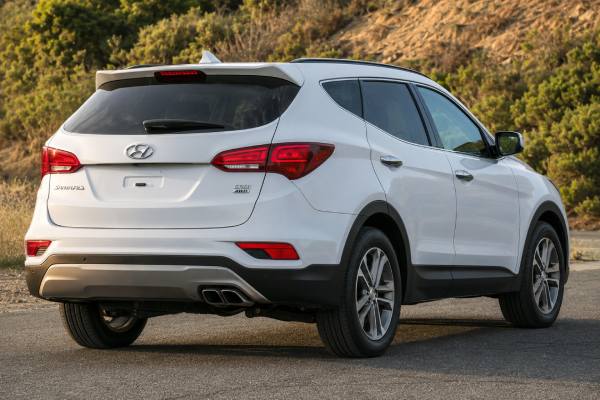
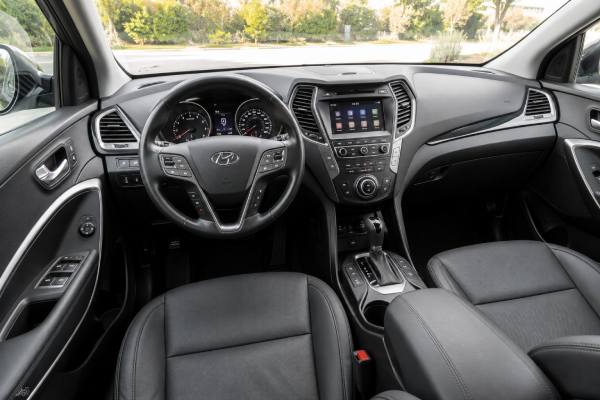
The facelifted DM-generation Hyundai Santa Fe with the 2.2 CRDi diesel and front-wheel drive is a practical midsize SUV aimed at drivers who want seven-seat usefulness, strong diesel torque, and lower running costs than an AWD version. In European-style specification, it sits in an interesting place: large enough for family and towing duties, but simpler than the all-wheel-drive models because it avoids the rear coupling, propshaft, rear differential, and related service items.
The important detail is market variation. Some facelift DM Santa Fe specifications list the 2.2 CRDi as 200 PS, while others round it to 200 hp; the technical output is 147 kW, about 197 mechanical horsepower. Equipment, emissions hardware, seating, ADAS, and service schedules also vary by country, model year, trim, and VIN, so the figures below should be read as a careful model-specific guide rather than a substitute for the exact build sheet.
Fast Facts
- Strong 2.2 CRDi torque makes the FWD Santa Fe relaxed on hills, motorways, and with moderate loads.
- Front-wheel drive reduces weight and driveline complexity compared with AWD versions.
- Seven-seat availability, a large boot, and a 64 L fuel tank make it useful for long family trips.
- Short-trip diesel use can clog the DPF/EGR system, so service history and drive pattern matter.
- Engine oil service is commonly treated as every 10,000–15,000 km or 12 months, depending on market and duty cycle.
Table of Contents
- Santa Fe DM FWD Used Overview
- Santa Fe DM FWD Specs
- Santa Fe DM FWD Trims and Safety
- Reliability, Issues and Service Actions
- Maintenance and Buying Checks
- Driving, Performance and Efficiency
- Rivals and Used Value
Santa Fe DM FWD Used Overview
The 2016–2018 facelift Santa Fe DM is the late version of Hyundai’s third-generation Santa Fe. In this specification it uses the 2.2-litre R-series CRDi diesel, a transverse front-mounted four-cylinder engine, and front-wheel drive. Depending on market, the FWD 2.2 CRDi was sold mainly with a 6-speed manual gearbox, while some regions also offered a 6-speed torque-converter automatic. The article scope is the standard-wheelbase Santa Fe DM, not the longer Grand Santa Fe/Maxcruz.
The FWD version is best understood as the road-focused, efficiency-minded Santa Fe. It keeps the high seating position, generous cabin, and diesel towing ability, but it is not the best choice for repeated muddy-site use, steep wet grass, or snowy mountain roads. For that, the AWD version has better traction and stability under load. The FWD model is lighter and usually cheaper to buy and maintain, which matters on older vehicles where driveline wear, tyres, brakes, and suspension costs can add up.
The 2.2 CRDi is the main attraction. It has enough low-rpm torque to move the Santa Fe without constant revving, and it suits the vehicle’s character better than smaller diesels in markets where both were available. It is not a sporty SUV, but it feels confident on the motorway and comfortable at legal cruising speeds. The engine’s useful torque band also makes it good for overtaking when the gearbox is used correctly.
The facelift brought updated styling, improved equipment availability, and wider availability of active safety systems on higher trims. Typical equipment could include 17-, 18-, or 19-inch wheels, dual-zone climate control, heated seats, navigation, parking sensors, reversing camera, panoramic sunroof, xenon headlights, blind-spot monitoring, adaptive cruise control, and autonomous emergency braking, depending on trim and option packages.
As a used purchase, the best examples are not simply the lowest-mileage cars. A higher-mileage Santa Fe that has seen long motorway running and regular oil changes can be healthier than a low-mileage diesel used only for short urban trips. Diesel particulate filter condition, EGR cleanliness, clutch and dual-mass flywheel wear, brake condition, rear suspension corrosion, and completed recall work are more important than mileage alone.
For many buyers, the FWD 2.2 CRDi Santa Fe DM makes most sense as a family SUV, long-distance commuter, or light-to-moderate towing vehicle. It is less convincing for drivers who mainly do short city journeys, want petrol refinement, or need serious winter traction without investing in high-quality tyres.
Santa Fe DM FWD Specs
The specifications below focus on the facelift Santa Fe DM 2.2 CRDi FWD sold in European-style markets from 2016 to 2018. Some figures differ between 5-seat and 7-seat versions, manual and automatic transmissions, wheel packages, and local homologation data.
| Item | Hyundai Santa Fe FWD (DM) 2.2 CRDi |
|---|---|
| Engine code | R II / D4HB |
| Engine layout | Front transverse inline-4 diesel, DOHC, 4 valves/cylinder |
| Bore × stroke | 85.4 × 96.0 mm (3.36 × 3.78 in) |
| Displacement | 2.2 L (2,199 cc) |
| Induction | Turbocharged and intercooled |
| Fuel system | Common-rail diesel direct injection |
| Compression ratio | 16.0:1 |
| Maximum power | 200 PS / 147 kW / about 197 hp @ 3,800 rpm |
| Maximum torque | 440–441 Nm (325 lb-ft) @ 1,750–2,750 rpm |
| Timing drive | Chain |
| Rated efficiency | About 5.7 L/100 km manual FWD; about 6.5 L/100 km automatic FWD where offered |
| Real highway at 120 km/h | Typically about 6.5–7.6 L/100 km depending on tyres, load, wind, and terrain |
| Item | Specification |
|---|---|
| Transmission | 6-speed manual in common FWD European specification; 6-speed automatic in some markets |
| Drive type | Front-wheel drive |
| Differential | Open front differential with brake-based stability and traction assistance |
| Item | Specification |
|---|---|
| Front suspension | MacPherson strut |
| Rear suspension | Independent multi-link |
| Steering | Electric rack-and-pinion; steering ratio not consistently published by market |
| Brakes | Front 320 mm ventilated discs; rear 302 mm solid discs |
| Common tyres | 235/65 R17, 235/60 R18, or 235/55 R19 |
| Ground clearance | About 185 mm (7.3 in) |
| Approach / departure / breakover | About 16.5° / 21.2° / 16.6° |
| Length / width / height | 4,690–4,700 / 1,880 / 1,675–1,690 mm, depending on market data and roof rails |
| Wheelbase | 2,700 mm (106.3 in) |
| Turning circle | About 10.9 m (35.8 ft) |
| Kerb weight | About 1,737–1,852 kg (3,829–4,083 lb), depending on seats, gearbox, and trim |
| GVWR | About 2,510 kg (5,534 lb) |
| Fuel tank | 64 L (16.9 US gal / 14.1 UK gal) |
| Cargo volume | About 585–1,680 L in 5-seat data; around 516–1,615 L in some 7-seat layouts |
| Item | Typical figure |
|---|---|
| 0–100 km/h | About 8.7–9.4 seconds, depending on seating/gearbox specification |
| Top speed | About 190–203 km/h (118–126 mph), depending on version |
| 100–0 km/h braking | Often around 39–42 m in independent testing conditions; tyre dependent |
| Towing capacity | Up to 2,500 kg braked in suitable manual-market specification; 750 kg unbraked |
| Payload | Roughly 650–770 kg depending on kerb weight and equipment |
| System | Typical specification or capacity |
|---|---|
| Engine oil | Low-SAPS diesel oil suitable for DPF-equipped Hyundai CRDi engines, commonly 5W-30 or 5W-40; service fill about 6.3 L (6.7 US qt) |
| Coolant | Hyundai long-life ethylene-glycol coolant, normally 50/50 premix; about 9.1 L (9.6 US qt) |
| Manual transmission oil | GL-4 manual transaxle oil, commonly about 1.8–1.9 L |
| Automatic transmission fluid | Hyundai/Kia SP-IV type ATF where automatic is fitted; total capacity about 7.7 L |
| Differential / transfer case | Not applicable to FWD; AWD versions require separate rear driveline service |
| A/C refrigerant | Build-label controlled; R-134a or R-1234yf depending on market and date, often around 550–650 g |
| A/C compressor oil | PAG-type oil as specified on the under-bonnet A/C label; charge must be verified by VIN |
| Key torque values | Wheel nuts commonly 107–127 Nm (79–94 lb-ft); oil drain plug often around 35–45 Nm, verify service manual |
| Item | Result or availability |
|---|---|
| Euro NCAP basis | 2012 Santa Fe test: 5 stars; 96% adult, 89% child, 71% pedestrian, 86% safety assist |
| ANCAP applicability | 2012 rating applied to Aug 2012–Jun 2018 Santa Fe variants in that market |
| IIHS / headlight rating | Not directly applicable to the European 2.2 CRDi FWD DM specification |
| Standard safety systems | ABS, EBD, ESC/VSM, traction control, brake assist, hill-start assist, downhill brake control, airbags, ISOFIX |
| ADAS availability | AEB/FCWS, adaptive cruise, lane warning, blind-spot monitoring, lane-change assist, rear cross-traffic alert, and around-view camera were trim/option dependent |
Santa Fe DM FWD Trims and Safety
Trim naming varied widely. In some European markets, the facelift Santa Fe was offered in grades such as Confidence, Style, and Executive; other markets used names such as SE, Premium, Premium SE, Comfort, Klass, Tecno, or Style. The same badge can mean different equipment in different countries, so buyers should identify the car by VIN, build sheet, wheel size, gearbox, seating layout, and fitted safety hardware rather than by trim name alone.
The core FWD 2.2 CRDi package usually includes the same engine output as equivalent AWD models, but it deletes the AWD transfer path. That means no rear drive engagement, no rear differential service, and no AWD-specific traction advantage. Mechanically, the most important trim differences are transmission, wheel size, seating configuration, towing approval, and safety-option availability. A 17-inch-wheel car usually rides more comfortably and has cheaper tyres; a 19-inch-wheel car looks sharper but can feel firmer and is more sensitive to potholes and tyre choice.
Equipment identifiers are useful during inspection. Factory xenon headlights, 19-inch wheels, leather trim, ventilated front seats, memory driver’s seat, panoramic roof, larger navigation screen, premium audio, electric tailgate, Smart Parking Assist, and around-view monitor usually point to a higher-grade car. AEB/FCWS, adaptive cruise control, blind-spot monitoring, lane-change assist, and rear cross-traffic alert may appear in technology packs or top trims. On many cars, buttons near the steering wheel, radar hardware in the grille area, and warning icons in the instrument cluster help confirm what is actually fitted.
Safety equipment is strong for the age, especially in passive protection. Seven airbags were commonly listed, including dual front airbags, front side airbags, curtain airbags, and a driver knee airbag. ISOFIX child-seat mounts, ESC, ABS, EBD, brake assist, tyre pressure monitoring, hill-start assist, and downhill brake control were widely available or standard in many markets. Trailer Stability Assist is especially relevant for buyers planning to tow.
The Euro NCAP result belongs to the third-generation Santa Fe tested in 2012, before the facelift, but it remained the key safety basis for the DM generation. The structure, airbags, and restraint systems gave it a strong adult and child occupant result for its time. The rating should not be compared directly with a 2024 or 2026 test because assessment standards have become much harder, especially for crash avoidance and vulnerable road user protection.
ADAS availability is the main safety limitation. A base Santa Fe DM may have no autonomous emergency braking, no adaptive cruise, and no lane-keeping support. A high-spec facelift car may have forward collision warning, AEB, smart cruise, lane departure warning, blind-spot detection, lane-change assist, rear cross-traffic alert, and a 360-degree camera. After windscreen replacement, front-end repairs, suspension work, or steering-angle sensor faults, ADAS-equipped cars may require calibration. Any warning light after body, glass, or alignment work should be treated seriously.
Reliability, Issues and Service Actions
A well-maintained Santa Fe DM 2.2 CRDi can cover high mileage, but its reliability depends heavily on diesel use pattern and service quality. The R-series diesel is generally robust, yet it has the same weak points as many modern common-rail diesels: emissions systems dislike short trips, fuel systems dislike contamination, and turbocharged engines punish long oil intervals.
| Prevalence | Issue | Symptoms | Likely cause | Remedy / cost tier |
|---|---|---|---|---|
| Common | DPF loading and failed regenerations | Warning light, limp mode, rising fuel use, frequent fan running | Short trips, weak thermostat, sensor faults, ash load | Diagnose soot/ash data, fix root cause, forced regen or clean/replace DPF; medium to high |
| Common | EGR and intake soot | Rough running, hesitation, smoke, fault codes | Diesel soot and oil mist buildup | Clean or replace EGR/intake parts; medium |
| Occasional | Clutch and dual-mass flywheel wear | Rattle at idle, vibration, slipping, hard engagement | Towing, city use, high torque at low rpm | Replace clutch/DMF as a set; high |
| Occasional | Turbo control faults | Underboost, overboost, limp mode, whistle | Vacuum/control issue, actuator wear, carboned vanes, boost leak | Smoke test and actuator diagnosis before replacing turbo; medium to high |
| Occasional | Suspension links, bushes, and wheel bearings | Knocks, rumble, uneven tyre wear | Vehicle weight, poor roads, large wheels | Replace worn links/bushes/bearings; low to medium |
| Occasional | Rear brake and parking brake issues | Dragging, uneven pad wear, EPB warning | Corrosion, seized sliders, actuator issues | Strip, clean, lubricate, replace parts as needed; low to medium |
| Rare but serious | High-pressure fuel system damage | Hard start, metal particles, misfire, rail pressure faults | Contaminated diesel or pump wear | Fuel-system repair and cleaning; high |
Timing chain failure is not a routine scheduled item in the way a timing belt is, but chain condition should not be ignored. Listen for cold-start rattle, uneven idle, cam/crank correlation faults, or metal debris in drained oil. On high-mileage cars, chain guides, tensioners, and the oil pump drive should be assessed if noise or timing faults appear.
The 6-speed manual is usually durable, but clutch and dual-mass flywheel life varies dramatically. A car used for towing, steep driveways, or heavy traffic can need major clutch work much earlier than a motorway car. During a test drive, accelerate from low rpm in a higher gear and check for clutch slip, vibration, or drivetrain shunt.
Where a 6-speed automatic is fitted, shift quality should be smooth when cold and hot. Any flare, harsh 2–3 or 3–4 shifts, delayed engagement, or shudder deserves a diagnostic scan and fluid-history check. “Sealed for life” should not be taken literally on an older tow-capable SUV; fresh fluid at reasonable intervals is cheap compared with valve body or transmission repairs.
Software and calibration updates can matter. Engine, transmission, infotainment, parking sensor, camera, and ADAS modules may have market-specific updates for drivability, sensor faults, warning messages, or compatibility problems. A Hyundai dealer can confirm open campaigns and calibration history from the VIN.
Service actions and recalls must be verified by market. One notable official action in some regions involved the ABS/HECU module, where moisture or internal electrical faults could create a fire risk; remedies included fuse, relay, or module-related repairs depending on campaign. Other markets had seat-belt warning wiring or equipment-specific actions. Do not assume a recall applies, or does not apply, because the car looks similar. Use the official VIN recall system for the country where the vehicle was sold and ask for dealer proof of completion.
Maintenance and Buying Checks
Maintenance should be based on the official schedule for the VIN, but a used diesel SUV benefits from conservative servicing. For the 2.2 CRDi, clean oil, clean filters, correct coolant, and proper diesel-system care are more important than cosmetic trim condition.
| Item | Practical interval | Notes |
|---|---|---|
| Engine oil and filter | 10,000–15,000 km or 12 months | Use correct low-SAPS diesel oil for DPF-equipped engines; shorten interval for towing, city use, or cold starts |
| Engine air filter | Inspect every service; replace around 30,000–40,000 km | Replace sooner in dust |
| Cabin filter | 12 months or 15,000–20,000 km | Helps blower performance and demisting |
| Diesel fuel filter | Often 20,000–40,000 km depending on market | Do not neglect; protects high-pressure pump and injectors |
| Coolant | Commonly around 80,000–100,000 km, then by schedule | Use Hyundai-compatible long-life coolant, correct mix |
| Brake fluid | Every 2 years | Important for ABS/ESC reliability |
| Manual gearbox oil | Inspect around 60,000 km; replace if contaminated or heavy use | Fresh GL-4 oil can improve shift feel |
| Automatic transmission fluid | About 60,000–90,000 km in practical used-car service | Use only correct SP-IV type fluid |
| Timing chain | No fixed belt-style replacement interval | Inspect for rattle, stretch, guide/tensioner wear, and timing faults |
| Auxiliary belt and hoses | Inspect every service; replace by condition | Look for cracking, oil contamination, coolant crusting |
| Tyres and alignment | Rotate/check every 10,000–15,000 km | Uneven wear may point to bushes, alignment, or accident damage |
| 12 V battery | Test annually after year 4 | Weak batteries trigger misleading electronic faults |
A buyer should start with paperwork. Look for invoices showing oil grade, filter changes, brake fluid, coolant, fuel filter, gearbox service, tyres, brakes, and recall completion. A stamped book with no supporting invoices is better than nothing, but detailed invoices are much more useful.
On inspection, check for oil leaks around the timing cover, sump, turbo oil lines, intercooler hoses, and rocker cover. Look for coolant staining near the radiator, expansion tank, thermostat area, and heater hoses. Scan the engine module before and after a test drive; recently cleared codes are a warning sign.
The diesel emissions system deserves special attention. Ask how the car was used. A car that regularly drives 30–60 minutes at open-road speed is much more likely to keep the DPF healthy than one used for school runs and short errands. During diagnostics, check DPF soot load, ash estimate, differential pressure, last regeneration distance, EGR data, and exhaust temperature sensor plausibility.
Under the car, inspect rear suspension arms, subframe edges, brake lines, exhaust hangers, jacking points, and rear brake hardware for corrosion. Check tyre age and brand, not only tread depth. Heavy SUVs can feel poor on cheap tyres, especially in wet weather.
Recommended buys are usually mid- or high-trim cars with full service history, sensible wheels, working ADAS, and proof of recall completion. Avoid cars with unresolved DPF faults, warning lights, poor cold starting, clutch slip, overheating, missing service records, water leaks, or evidence of heavy towing without transmission and clutch maintenance.
Driving, Performance and Efficiency
The Santa Fe DM FWD 2.2 CRDi is at its best when driven smoothly. The engine delivers its strongest pull from low to mid rpm, so it does not need to be revved hard. In normal use, the diesel feels muscular rather than quick. It moves the Santa Fe confidently from junctions and has enough torque for motorway inclines, but the vehicle’s weight is always present.
With the 6-speed manual, the clutch and gearshift are more utility than sport. A good car should shift cleanly without crunching, baulking, or excessive flywheel vibration. The engine pulls well from around 1,700 rpm, but repeatedly loading it at very low rpm is unkind to the clutch, dual-mass flywheel, and drivetrain. Downshifting for overtakes is better than asking the engine to drag the SUV from idle speed in a high gear.
Automatic versions are smoother in traffic and often better for relaxed family driving, though they use more fuel and can feel less direct. The torque-converter automatic suits the engine’s character, but fluid condition matters. Harsh engagement, flares, or hunting between gears should not be dismissed as normal age.
Ride comfort depends strongly on wheels and tyres. On 17-inch wheels, the Santa Fe generally feels settled and comfortable, with enough sidewall to absorb rough roads. On 19-inch wheels, steering response is sharper but low-speed ride can become busy. The suspension is tuned for stability and comfort rather than aggressive cornering. It corners securely, but body roll and weight transfer remind the driver that this is a family SUV, not a sporty crossover.
At motorway speeds, the Santa Fe is stable and reasonably quiet for its age. Diesel noise is more noticeable when cold or under acceleration, but it settles at cruise. Wind noise around mirrors and roof rails, tyre noise from worn or budget tyres, and rear suspension noise over broken surfaces are the most common comfort complaints on older examples.
Real-world economy is usually far from the best official number if the car is used in mixed family duty. In steady open-road driving, 5.8–6.8 L/100 km is realistic for a healthy FWD manual on sensible tyres. At 120 km/h, expect roughly 6.5–7.6 L/100 km. Urban use can easily move into the 8.0–10.0 L/100 km range, especially in cold weather or with repeated DPF regeneration attempts. Mixed use often lands around 6.8–8.2 L/100 km.
Towing is one of the diesel’s strengths, particularly where the FWD manual is rated up to 2,500 kg braked. Still, the practical limit depends on trailer nose weight, tyres, brakes, cooling system health, and driver experience. FWD traction can be a limitation on wet ramps, grass, gravel, or steep starts with a heavy trailer. Under tow, fuel consumption can rise by 30–70% depending on trailer shape and speed.
Rivals and Used Value
The facelift Santa Fe DM 2.2 CRDi FWD competes with diesel family SUVs such as the Kia Sorento, Skoda Kodiaq, Nissan X-Trail, Mitsubishi Outlander diesel, Honda CR-V diesel, Toyota RAV4 diesel, Ford Edge, and Volkswagen Tiguan Allspace in later years. It also overlaps with larger MPVs for buyers who care more about seating and cargo space than off-road ability.
Against the Kia Sorento, the Santa Fe feels closely related in philosophy. The Sorento is often slightly more practical and may offer a roomier third row depending on generation, while the Santa Fe can feel a little more compact and easier to place. Both share similar strengths: diesel torque, family space, and good equipment for the money.
The Skoda Kodiaq is more modern in cabin packaging and infotainment, and it often feels more car-like. It can be more efficient with smaller diesel engines, but equivalent high-spec used examples may cost more. The Santa Fe counters with a strong 2.2 diesel and a generally durable feel.
The Nissan X-Trail is usually cheaper and lighter, but its smaller diesel options do not match the Santa Fe’s torque in the same relaxed way. The Outlander diesel is practical and straightforward, though interior quality and refinement can feel less polished. The Honda CR-V diesel is dependable and efficient, but most versions do not offer the same seven-seat family role.
The main advantage of the FWD Santa Fe is value. It gives a lot of cabin, towing ability, and equipment for the money. It is also less mechanically complex than AWD rivals. The trade-off is traction: buyers in wet, snowy, rural, or towing-heavy use should think carefully before choosing FWD.
The best long-term value comes from buying condition rather than trim. A clean mid-spec car with full maintenance, good tyres, completed campaigns, and no emissions faults is usually a better purchase than a neglected high-spec car with a panoramic roof, 19-inch wheels, and warning lights. A healthy Santa Fe DM 2.2 CRDi FWD remains a sensible used SUV, but it rewards buyers who inspect it as a diesel working vehicle rather than as simple family transport.
References
- Hyundai Motor Company 2016 (Brochure)
- New Hyundai Santa Fe 2017 (Price List)
- Hyundai Santa Fe – Crash Test 2012 2012 (Safety Rating)
- Hyundai Santa Fe | Safety Rating & Report | ANCAP 2012 (Safety Rating)
- Hyundai Motor Company – HYUNDAI SANTA FE 2020 (Recall Database)
Disclaimer
This article is for informational purposes only and is not a substitute for professional diagnosis, repair, or inspection. Specifications, torque values, service intervals, fluids, procedures, safety equipment, and recall applicability can vary by VIN, market, trim, build date, and installed equipment. Always verify details against the official owner’s manual, service documentation, under-bonnet labels, and manufacturer or dealer records for the specific vehicle.
If you found this useful, please share it on Facebook, X/Twitter, or your preferred platform to support our work.