
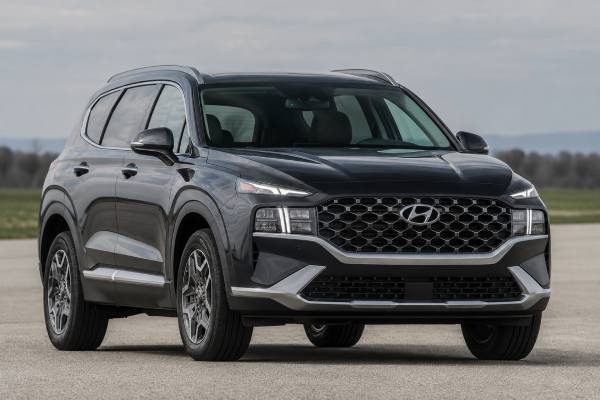
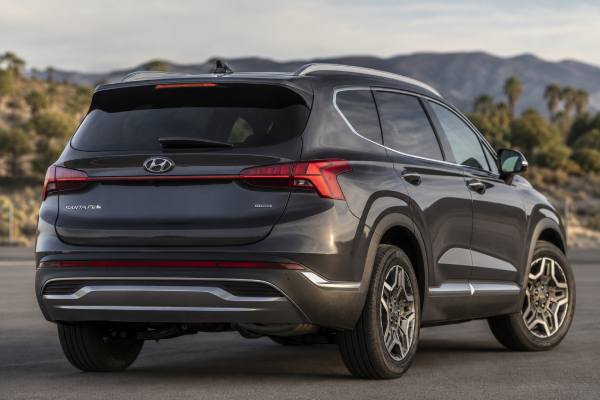
The facelifted Hyundai Santa Fe TM with the 2.2 CRDi diesel engine is a practical seven-seat SUV aimed at drivers who want strong torque, long-distance economy, towing ability, and a more conventional ownership profile than the hybrid and plug-in hybrid versions. In front-wheel-drive form, it is usually lighter and simpler than the HTRAC AWD version, while still using the same 202 hp Smartstream diesel and 8-speed dual-clutch transmission.
For used buyers, the key is to understand that this Santa Fe varies significantly by market. Some regions received the diesel with FWD and AWD choices, while others moved mainly to hybrid powertrains. Equipment, emissions hardware, service intervals, ADAS features, and even official economy figures can differ by VIN. The core vehicle, however, remains the fourth-generation TM facelift: a roomy family SUV with a strong diesel engine, useful towing capacity, and a few maintenance points that deserve careful checking before purchase.
Owner Snapshot
- Strong 440 Nm diesel torque makes the FWD Santa Fe relaxed with passengers, luggage, and highway overtakes.
- Seven-seat packaging, large cargo volume, and a 2,500 kg braked tow rating in many diesel markets are major practical advantages.
- The 8-speed wet DCT is efficient and quick-shifting, but recall/software status and smooth low-speed operation should be checked.
- Short-trip diesel use can accelerate DPF, EGR, fuel-filter, and battery issues, especially in cold or urban conditions.
- Typical diesel service intervals are up to 15,000 km in some markets, but severe use may justify oil and filter service closer to 10,000 km or 6 months.
Table of Contents
- Santa Fe TM Buying Context
- Santa Fe TM Technical Data
- Santa Fe TM Trims Safety
- Reliability Issues Service Actions
- Maintenance Schedule Used Checks
- Driving Feel Real Efficiency
- Santa Fe TM Versus Rivals
Santa Fe TM Buying Context
The 2021–2023 Hyundai Santa Fe TM facelift sits in an interesting part of the used SUV market. It is not as compact as a Tucson or Sportage, not as large as a Palisade, and not as premium-priced as many European seven-seat SUVs. Its appeal is based on useful space, strong equipment levels, a comfortable road manner, and the familiar Hyundai ownership package.
The 2.2 CRDi diesel is the important point here. Earlier TM Santa Fe diesels used the older 2.2 R-family engine in different outputs, but the facelifted model moved to the Smartstream 2.2 diesel in many markets. This D4HE engine has an aluminium block, 2,151 cc displacement, electronic variable-geometry turbocharging, common-rail injection, and 440 Nm of torque from low revs. In daily use, that torque matters more than the headline horsepower figure. It gives the Santa Fe a calm, low-effort feel when merging, climbing gradients, or carrying a full cabin.
The front-wheel-drive version is usually the sensible choice for buyers who spend most of their time on paved roads. It avoids the additional rear driveline components of AWD, reduces weight, and can be marginally more efficient. It is not the best choice for regular snow, steep gravel, wet boat ramps, or muddy campsites, but for school runs, commuting, long highway trips, and occasional towing, FWD suits the Santa Fe’s family-SUV role well.
Transmission choice is simple for this variant: the facelifted diesel uses an 8-speed wet dual-clutch automatic. It is not a traditional torque-converter automatic. It shifts quickly and helps economy, but it should feel clean and progressive in traffic. Jerky creeping, delayed take-up, warning lights, limp mode, or harsh engagement are reasons to investigate further before buying.
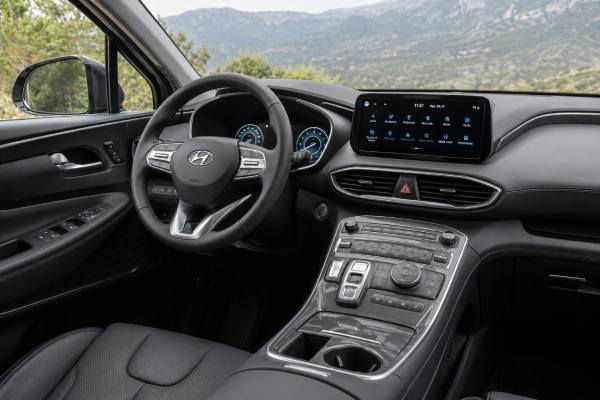
The TM facelift also brought updated styling, a more upscale dashboard, shift-by-wire controls on many versions, larger infotainment options, and expanded driver assistance. Depending on market and trim, features may include LED headlights, adaptive cruise control, lane support, blind-spot systems, rear cross-traffic alert, rear occupant alert, 360-degree camera, ventilated front seats, panoramic sunroof, and larger alloy wheels.
For used buyers, the best Santa Fe FWD diesel is not simply the cheapest one. A well-serviced example with documented oil changes, fuel-filter maintenance, completed recall work, clean DCT behavior, healthy tyres, and working ADAS sensors is worth more than one with missing records. Diesel SUVs can tolerate high mileage well when used for longer trips, but they dislike repeated short cold runs where the engine rarely reaches full temperature.
Santa Fe TM Technical Data
The tables below focus on the 2021–2023 Santa Fe TM facelift FWD diesel with the 2.2 CRDi Smartstream engine and 8-speed DCT. Some figures vary by market, trim, tyre package, emissions level, and test method, so VIN-specific documentation remains the final authority.
| Item | Hyundai Santa Fe FWD 2.2 CRDi TM facelift |
|---|---|
| Engine code | Smartstream D4HE / 2.2 CRDi |
| Engine layout | Front transverse inline-4 diesel, DOHC, 4 valves per cylinder, hydraulic lash adjusters |
| Bore × stroke | 83.0 × 99.4 mm (3.27 × 3.91 in) |
| Displacement | 2.151 L (2,151 cc) |
| Induction | Electronic variable-geometry turbocharger with intercooler |
| Fuel system | CRDi common-rail direct injection |
| Compression ratio | 16.0:1 |
| Maximum power | 202 hp / 148 kW at 3,800 rpm |
| Maximum torque | 440 Nm (325 lb-ft) at 1,750–2,750 rpm |
| Timing drive | Timing belt on the Smartstream D4HE diesel; replace by the official interval for the VIN |
| Rated efficiency | Common published figures range from about 6.3 to 7.9 L/100 km depending on market and test cycle (about 37–30 mpg US / 45–36 mpg UK) |
| Real-world highway at 120 km/h | Typically about 7.0–8.0 L/100 km (34–29 mpg US / 40–35 mpg UK), depending on tyres, load, wind, terrain, and DPF regeneration |
| Item | Specification |
|---|---|
| Transmission | 8-speed wet dual-clutch automatic, shift-by-wire on many trims |
| Common transmission family | Hyundai/Kia 8DCT wet-clutch unit; code may vary by market and calibration |
| Drive type | Front-wheel drive |
| Differential | Open front differential integrated with the transaxle |
| Drive modes | Commonly Eco, Comfort, Smart, and Sport; terrain modes may depend on market and drivetrain |
| Item | Specification |
|---|---|
| Front suspension | MacPherson strut |
| Rear suspension | Multi-link |
| Steering | C-MDPS electric power steering; about 2.62 turns lock-to-lock in published diesel-market data |
| Brakes | Front ventilated discs about 325 × 30 mm (12.8 × 1.18 in); rear solid discs about 305 × 11 mm (12.0 × 0.43 in), market dependent |
| Popular tyre sizes | 235/60 R18 and 235/55 R19; some markets also used 20-inch packages |
| Ground clearance | About 176 mm (6.9 in) for some FWD diesel specifications |
| Approach / departure / breakover | About 17.9° / 20.0–20.8° / 16.8° in published diesel-market data |
| Length / width / height | 4,785 / 1,900 / 1,685 mm (188.4 / 74.8 / 66.3 in), height excluding roof rails where specified |
| Wheelbase | 2,765 mm (108.9 in) |
| Turning circle | About 11.4 m (37.4 ft) kerb-to-kerb, based on a 5.7 m turning radius |
| Kerb weight | About 1,745–1,770 kg (3,847–3,902 lb), depending on market and equipment |
| GVWR / GVM | About 2,560 kg (5,644 lb) in one published FWD diesel specification |
| Fuel tank | 67 L (17.7 US gal / 14.7 UK gal) |
| Cargo volume | SAE: 332 L (11.7 ft³) behind third row, 1,032 L (36.4 ft³) behind second row, 2,041 L (72.1 ft³) behind first row |
| Item | Specification |
|---|---|
| 0–100 km/h | About 9.0 seconds for FWD diesel |
| Top speed | 205 km/h (127 mph) |
| 100–0 km/h braking | About 42.5 m (139 ft) in published diesel-market data |
| Braked towing capacity | Up to 2,500 kg (5,512 lb), market and equipment dependent |
| Unbraked towing capacity | 750 kg (1,653 lb) |
| Payload | About 815 kg (1,797 lb) in one FWD diesel specification; check local plate and VIN data |
| System | Useful specification |
|---|---|
| Engine oil | Typically low-SAPS diesel oil such as ACEA C2/C3 5W-30, or market-approved 5W-40 where specified; capacity about 5.6 L (5.9 US qt) |
| Coolant | Hyundai-approved long-life ethylene-glycol coolant, normally 50:50 mix; published capacity about 10.2 L (10.8 US qt) in one diesel-market specification |
| DCT fluid | Use Hyundai/Kia wet-DCT fluid specified by VIN; published capacities include about 3.3–3.4 L gear oil and 2.45–2.5 L control oil |
| Differential / transfer case | FWD has no rear differential or transfer case; front final drive is integrated with the transaxle |
| A/C refrigerant | R-1234yf or R-134a depending on market and production; verify the under-hood label before charging |
| A/C compressor oil | Use only the type and charge specified on the service label and workshop data for the VIN |
| Wheel nuts | Common Hyundai range: 107–127 Nm (79–94 lb-ft), but confirm with the owner’s manual |
| Oil drain plug | Common Hyundai/Kia diesel range: about 34–44 Nm (25–33 lb-ft), using a new sealing washer |
| Area | What to know |
|---|---|
| Euro NCAP | The fourth-generation Santa Fe achieved a 5-star rating under the 2018 protocol, with 94% adult occupant, 88% child occupant, 67% vulnerable road user, and 76% safety assist scores |
| IIHS | U.S.-market 2021 Santa Fe was a Top Safety Pick with specific headlights; 2022 models built after July 2021 achieved Top Safety Pick+ in the U.S. context |
| Headlights | IIHS results varied by trim and build date, from Good-rated projector LED lamps to weaker reflector LED setups in lower U.S. trims |
| ADAS availability | AEB, lane support, blind-spot monitoring, rear cross-traffic alert, adaptive cruise, parking sensors, camera systems, and driver attention warning vary by trim and market |
Santa Fe TM Trims Safety
The Santa Fe TM facelift diesel was not sold in identical form everywhere. In some markets the FWD diesel was the entry or mid-level version, while AWD was reserved for a higher trim. In others, the 2.2 CRDi was paired with one highly equipped grade. The common pattern is straightforward: the engine and DCT are usually the same, while wheels, interior trim, infotainment, roof, seat features, cameras, and ADAS content define the trim level.
On FWD diesel examples, expect seven seats in a 2-3-2 layout in many markets. The second row usually slides and reclines, and the third row is best for children or shorter adult trips. Useful identifiers include the 2.2 CRDi or R2.2 badging, diesel filler label, DCT shift-by-wire console on many facelift models, and a VIN/build plate that confirms FWD rather than HTRAC AWD. Under the vehicle, the FWD version lacks the rear differential and prop shaft found on AWD models.
Wheel packages matter more than they first appear. An 18-inch tyre such as 235/60 R18 gives the Santa Fe the most forgiving ride and better sidewall protection. A 19-inch tyre such as 235/55 R19 still suits the vehicle well and is common on higher trims. Larger 20-inch packages, where fitted, sharpen the look but can increase tyre cost, impact harshness, and road noise.
Typical trim differences may include:
- Base or Executive-type FWD diesel: 18-inch alloys, leather or leather-look trim in some regions, LED lighting, rear camera, cruise control, rear cross-traffic alert, blind-spot detection, wireless charging, roof rails, and dual-zone climate control.
- Higher diesel trims: 19-inch alloys, panoramic sunroof, heated steering wheel, powered or ventilated front seats, larger infotainment screen, premium audio, front parking sensors, rear-door curtains, rear occupant alert, and expanded camera or blind-spot display systems.
- AWD diesel versions: HTRAC or active-on-demand AWD, sometimes higher ground clearance in local published data, and the same broad engine output with slightly slower acceleration due to added weight.
Safety equipment is one of the Santa Fe’s strengths, but buyers should separate crash-test results from exact-market equipment. The Euro NCAP rating belongs to the fourth-generation Santa Fe tested under the 2018 protocol. It is relevant to the TM generation, but a facelifted diesel in a specific country may have different standard equipment. IIHS results apply to U.S.-market vehicles, not the diesel FWD sold elsewhere, but they are still useful for understanding structure, crash performance, and headlight variation.
Most diesel TM facelift models include front, side, and curtain airbags, electronic stability control, anti-lock braking, electronic brake-force distribution, hill-start assist, downhill brake control, ISOFIX anchors in the second row, three-point belts for all seating positions, and impact-sensing door unlock. Some versions include safe exit assist and rear occupant alert, which are especially useful in a family vehicle.
ADAS calibration deserves practical attention. If a Santa Fe has had a windscreen replacement, front-end repair, bumper repaint, suspension work, wheel alignment, or radar/camera removal, the forward camera and radar systems may need calibration. Warning lights, unavailable adaptive cruise, inconsistent lane centering, or false front-collision warnings should not be dismissed as minor glitches. On a used purchase, verify that all cameras, parking sensors, blind-spot lamps, rear cross-traffic alerts, and lane systems operate normally during a proper road test.
Reliability Issues Service Actions
The Santa Fe TM 2.2 CRDi is generally a durable SUV when serviced correctly, but it is not maintenance-free. The engine itself is strong on paper: aluminium construction, high torque at low rpm, and improved efficiency compared with older diesels. The ownership risks are more often linked to diesel emissions equipment, DCT software or operation, fuel quality, battery condition, and missed maintenance.
| Issue area | Prevalence | Severity / cost | Symptoms | Recommended action |
|---|---|---|---|---|
| 8-speed wet DCT software / fail-safe behavior | Occasional, campaign-dependent | Medium to high | Warning lamp, limp mode, delayed acceleration, loss of drive after a fault | Check VIN for recalls or campaigns; confirm TCU software update and any inspection or replacement history |
| Low-speed DCT hesitation or shudder | Occasional | Medium | Jerky parking maneuvers, clutch smell, harsh take-up, vibration in traffic | Road-test from cold and hot; check fluid service history and scan for DCT faults |
| DPF regeneration problems | Common on short-trip diesels | Medium to high | Frequent fan operation, rising oil level, warning lights, poor economy, forced regeneration needed | Assess usage pattern; scan soot load; avoid cars used only for short urban trips unless maintained carefully |
| EGR / intake deposits | Occasional | Medium | Rough running, hesitation, fault codes, reduced power | Inspect codes and live data; clean or replace affected components rather than repeatedly clearing faults |
| Fuel filter or water contamination | Occasional, fuel-quality dependent | Low to high | Hard starting, rail-pressure faults, limp mode, poor cold running | Replace fuel filter on schedule; use quality diesel and investigate contamination promptly |
| 12 V battery weakness | Common after 3–5 years | Low to medium | Random warnings, stop-start unavailable, slow cranking, ADAS faults | Load-test the battery before diagnosing complex electronics |
| Suspension bushes, links, and wheel bearings | Occasional with mileage or rough roads | Low to medium | Knocks, uneven tyre wear, humming, wandering alignment | Inspect front lower arms, rear links, bearings, tyres, and alignment records |
The biggest service-action item to know is the 8-speed DCT campaign reported in several markets. The concern involves DCT control logic and fail-safe behavior, with remedies typically involving a transmission control software update, inspection, and replacement where necessary. A used Santa Fe should have proof that any applicable DCT campaign has been completed. A dealer VIN check is the cleanest way to confirm it.
Seat-belt pretensioner recalls affected some Santa Fe TM vehicles in certain markets. The issue involves abnormal deployment or inflator fracture risk, and the remedy is dealer-installed. This is not something to inspect visually and ignore; it needs an official recall completion record.
Trailer tow-hitch harness fire recalls also appeared in some markets for Santa Fe vehicles equipped with certain genuine accessory tow-hitch wiring. This may not apply to every FWD diesel, but any used example with a towbar should be checked carefully. Look for dealer-installed wiring, aftermarket splices, water ingress, corroded connectors, and proof of recall or campaign completion where relevant.
For the D4HE engine, the timing drive deserves specific attention because many buyers assume all modern Hyundai diesels use timing chains. The Smartstream 2.2 diesel is widely documented with a timing belt. That is not automatically a weakness, but it changes long-term maintenance planning. The belt, tensioner, idlers, and related components should be replaced at the official interval for the VIN and market. Do not use a generic interval from an older D4HB chain-driven engine.
Diesel aftertreatment depends on market. Euro 6 versions may use a DPF and SCR/AdBlue system, while some lower-emission-market versions differ. Short journeys, repeated interrupted regenerations, incorrect oil, poor fuel quality, and weak batteries can all create emissions faults. A proper pre-purchase scan should include engine ECU codes, DPF soot and ash values where available, EGR operation, exhaust temperature sensor data, NOx sensor status, and any AdBlue system codes on SCR-equipped vehicles.
Corrosion is not a headline issue on a well-kept TM Santa Fe, but the vehicle should still be inspected underneath. Check subframe seams, suspension arms, brake pipes, rear underbody areas around the spare wheel carrier, towbar mounting points, door lower edges, tailgate seams, and any stone-damaged front subframe areas. Coastal climates, road salt, and muddy use accelerate corrosion.
Maintenance Schedule Used Checks
A Santa Fe diesel rewards preventive maintenance. It is a large, heavy SUV with a high-torque engine, wet DCT, emissions hardware, large brakes, and expensive tyres. Skipping routine work may not show immediately, but it often appears later as DPF faults, harsh shifting, suspension wear, brake judder, or electrical warnings.
| Item | Typical interval | Notes |
|---|---|---|
| Engine oil and filter | Up to 15,000 km in some markets; 10,000 km or 6 months is sensible for severe use | Use correct low-SAPS diesel oil where DPF-equipped; check oil level for dilution if regenerations are frequent |
| Engine air filter | Inspect every service; replace about 30,000–40,000 km or sooner in dust | A clogged filter hurts economy and turbo response |
| Cabin filter | About 12 months, or sooner in dusty or humid climates | Helps HVAC airflow and demisting performance |
| Fuel filter | Commonly 20,000–40,000 km depending on market | Do not stretch intervals where diesel quality is inconsistent |
| Coolant | Often around 80,000–100,000 km after initial period, market dependent | Use Hyundai-approved coolant; inspect hoses, radiator, expansion tank, and thermostat behavior |
| Timing belt system | Follow official VIN interval | Replace belt, tensioner, idlers, and related parts as specified; do not treat it like a chain engine |
| Auxiliary belts and hoses | Inspect every service; replace if cracked, glazed, noisy, swollen, or oil-soaked | Pay attention before long trips or towing |
| DCT fluid | Follow market service schedule; consider earlier service for towing, heat, or heavy urban use | Use only the correct wet-DCT fluid and procedure |
| Brake fluid | Every 2 years is a good practice | Important for ABS, ESC, and consistent pedal feel |
| Brake pads and rotors | Inspect every service | Check rear discs for corrosion if the vehicle does light-duty commuting |
| Tyre rotation and alignment | Rotate about every 10,000–15,000 km; align if wear is uneven | Large SUV tyres are expensive; poor alignment quickly becomes costly |
| 12 V battery | Test annually after year three | A weak battery can trigger misleading ADAS, stop-start, and transmission warnings |
For a pre-purchase inspection, start with the service book and invoices. The ideal history shows regular oil/filter services, fuel-filter replacement, brake-fluid changes, DCT fluid attention where required, coolant work, recall completion, and tyre replacements in matched sets. Missing invoices are more concerning than high mileage. A 100,000 km diesel that has done long trips and has full records can be a better buy than a 45,000 km example used only for short urban runs.
On the test drive, begin from cold. The engine should start promptly without extended cranking, heavy smoke, or rough idle. Some diesel sound is normal, but knocking, belt squeal, turbo siren noise, or exhaust fumes in the cabin are not. Watch for engine warnings, DPF messages, AdBlue countdowns where fitted, and stop-start faults.
The DCT should engage Drive and Reverse without a heavy bang. In slow traffic, it may feel more mechanical than a torque-converter automatic, but it should not shudder repeatedly, flare, grind, or hesitate dangerously when pulling into a gap. Test gentle acceleration, firm kickdown, hill starts, reverse parking, and a hot restart.
Check the brakes from moderate speed. Pulsation suggests rotor runout or pad deposits. Rear brake corrosion is common on vehicles that spend their life lightly loaded. Inspect tyre dates, tread depth, inner-shoulder wear, and matching brands. Uneven wear can reveal alignment issues, worn suspension bushes, or previous impact damage.
Inside, confirm every electrical feature works: tailgate, camera, parking sensors, adaptive cruise, lane support, blind-spot alerts, climate control, seat ventilation/heating, third-row fan controls, USB ports, wireless charging, and all windows. A Santa Fe with many convenience features is pleasant to own, but neglected electrical faults can be time-consuming to trace.
The durability outlook is positive if the vehicle is used as a diesel should be used: longer runs, proper oil, clean fuel, completed campaigns, and no ignored warning lights. The FWD layout reduces driveline complexity, but the DCT and emissions systems still make documentation important.
Driving Feel Real Efficiency
The Santa Fe FWD 2.2 CRDi is at its best as a relaxed long-distance SUV. The engine’s 440 Nm torque plateau gives it good response from low revs, and the DCT keeps the engine in its useful range without needing high rpm. It does not feel sporty in the way a petrol turbo crossover can, but it feels confident, settled, and well matched to family use.
Around town, the diesel pulls cleanly once moving. The main difference from a torque-converter automatic is low-speed behavior. A wet DCT can feel slightly more deliberate when creeping into a parking space or inching up a steep driveway. It should still be smooth when healthy, but drivers who spend most of their time in bumper-to-bumper traffic should road-test carefully before committing.
On the highway, the Santa Fe feels stable and mature. The long wheelbase helps straight-line confidence, and the cabin is generally quiet for a diesel SUV. Tyres make a noticeable difference. Eighteen-inch wheels tend to give the best ride comfort and the least sharp impact noise. Nineteen-inch wheels look more upscale and still ride acceptably, but worn tyres, cheap replacements, or aggressive tread patterns can add road roar.
Handling is safe and predictable rather than eager. The steering is light enough for parking and steady enough at speed, but it does not provide much road texture. The FWD version can push wide if rushed into a wet corner, and hard acceleration on low-grip surfaces can produce some front-end traction management. For most drivers, the stability control works quietly in the background.
Braking performance is appropriate for the vehicle’s size. Published data around 42.5 m from 100 km/h to zero is respectable for a large seven-seat SUV, but real-world braking depends heavily on tyre quality, load, brake condition, and road surface. A fully loaded Santa Fe needs more stopping distance than a lightly occupied one, so brake fluid, pad condition, and tyre age matter.
Real-world economy is one of the diesel’s main advantages. In mixed use, many owners should expect roughly 7.0–8.5 L/100 km (34–28 mpg US / 40–33 mpg UK) if the vehicle is healthy and driven normally. Dense city use can rise to about 8.0–10.0 L/100 km (29–24 mpg US / 35–28 mpg UK), especially with short trips and DPF regenerations. At 100–120 km/h, a realistic highway range is about 6.5–8.0 L/100 km (36–29 mpg US / 43–35 mpg UK), depending on speed, weather, tyres, and load.
Cold weather can worsen economy and emissions-system behavior. Diesel engines warm more slowly than petrol engines, and short winter trips may prevent full DPF regeneration. Heated screens, seat heaters, lights, blowers, and repeated cold starts also stress the 12 V battery. A weekly longer drive is helpful for diesel health if the car otherwise lives in town.
Towing is a strong point when the vehicle is correctly equipped. The 2,500 kg braked tow rating in many diesel specifications gives the Santa Fe serious capability for caravans, trailers, or boats. The FWD version is better suited to paved towing than slippery launch ramps or loose campsites. Under load, expect fuel consumption to increase sharply. A moderate trailer can add 20–40% to consumption, while a large caravan, hills, and headwinds can add more. Cooling-system health, brake condition, tyre pressures, towbar wiring, and DCT behavior should be checked before regular towing.
The Santa Fe’s overall driving character is not about excitement. Its strength is making difficult family transport feel easy: seven seats when needed, diesel torque for load, sensible cruising economy, and enough refinement to make long journeys comfortable.
Santa Fe TM Versus Rivals
The Santa Fe FWD 2.2 CRDi competes with several seven-seat or near-seven-seat SUVs, but its position depends heavily on market. In regions where diesel SUVs remained popular, it sits against the Kia Sorento 2.2 CRDi, Skoda Kodiaq 2.0 TDI, Volkswagen Tiguan Allspace diesel, Peugeot 5008 diesel, and sometimes Mazda CX-8 diesel. In markets that moved away from diesel, buyers may compare it with hybrid alternatives such as the Toyota Highlander Hybrid, Hyundai Santa Fe Hybrid, Kia Sorento Hybrid, or Mitsubishi Outlander PHEV.
| Rival | Where it may be better | Where the Santa Fe FWD diesel stands out |
|---|---|---|
| Kia Sorento 2.2 CRDi | Similar powertrain, often sharper packaging, newer cabin design in some trims | Santa Fe may offer a softer ride, strong equipment value, and familiar Hyundai ownership support |
| Skoda Kodiaq 2.0 TDI | Efficient diesel options, clever interior details, strong European road manners | Santa Fe offers a larger-feeling cabin in some rows and a stronger 2.2-litre torque character |
| Volkswagen Tiguan Allspace TDI | Polished controls, efficient powertrain, broad parts ecosystem | Santa Fe often feels more substantial and better equipped for the money |
| Peugeot 5008 BlueHDi | Lower weight, clever seating, strong economy | Santa Fe is stronger for towing, torque, and large-family load carrying |
| Toyota Highlander Hybrid | Urban economy, hybrid smoothness, petrol-hybrid simplicity in short-trip use | Santa Fe diesel is usually better for long-distance diesel economy and heavier towing in applicable markets |
Against the Kia Sorento, the Santa Fe’s closest relative, the decision often comes down to price, condition, warranty, and trim. The Sorento may feel slightly newer in some markets, but both share broadly similar diesel strengths and DCT considerations. A better-maintained Santa Fe is preferable to a neglected Sorento, and vice versa.
Compared with European diesels, the Santa Fe is less sharp in steering feel but often more generous in standard equipment. It also has a relaxed character that suits long drives. European rivals may offer better infotainment integration, more precise chassis tuning, or lower fuel consumption in smaller diesel variants, but they can also bring higher maintenance costs as they age.
Compared with hybrids, the diesel’s value depends on use. For city driving, school runs, and short commutes, a hybrid Santa Fe or Highlander may be the better match because it avoids DPF and diesel warm-up issues. For long-distance motorway use, rural driving, towing, and high annual mileage, the 2.2 CRDi remains compelling.
The main advantages of the Santa Fe FWD diesel are clear: strong torque, low-effort cruising, useful towing capacity, family-friendly space, and simpler driveline hardware than AWD. The main cautions are also clear: verify DCT campaign completion, service the diesel correctly, avoid neglected short-trip examples, and confirm market-specific safety and equipment before buying.
For the right owner, the 2021–2023 Santa Fe TM FWD 2.2 CRDi is one of the more sensible large family SUVs of its period. It is not the newest design now, and it is not immune to diesel or DCT maintenance needs, but a clean, documented example still offers a strong mix of comfort, practicality, economy, and long-distance capability.
References
- Santa Fe TM MY21 2021 (Specifications)
- SANTA FE 2022 (Brochure)
- PERIODIC MAINTENANCE SERVICE FOR SANTA FE TM 2.2 CRDI 2021 (Maintenance Schedule)
- Euro NCAP | Hyundai SANTA FE 2018 (Safety Rating)
- Service & Safety Campaigns | Hyundai New Zealand 2026 (Recall Database)
Disclaimer
This article is for informational purposes only and is not a substitute for professional diagnosis, repair, or inspection. Specifications, torque values, fluid requirements, service intervals, recall applicability, and procedures can vary by VIN, market, production date, trim, and equipment. Always verify details against the official owner’s manual, service documentation, recall database, and Hyundai dealer records for the specific vehicle.
If this helped you evaluate the Santa Fe TM diesel, please consider sharing it on Facebook, X/Twitter, or another platform to support our work.