
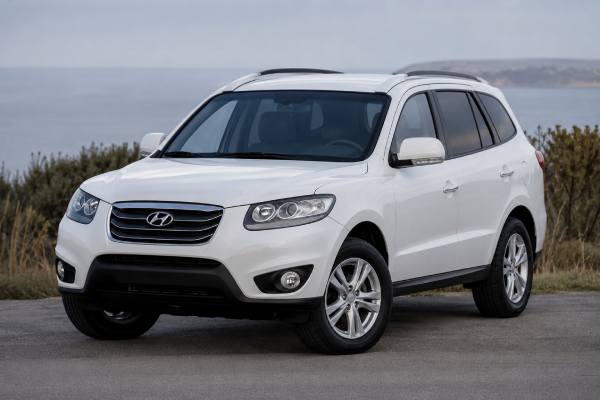
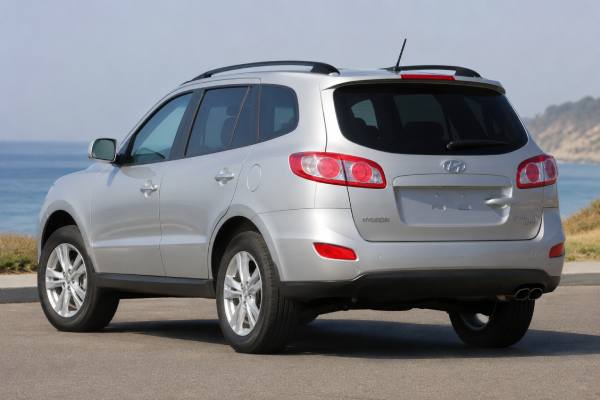
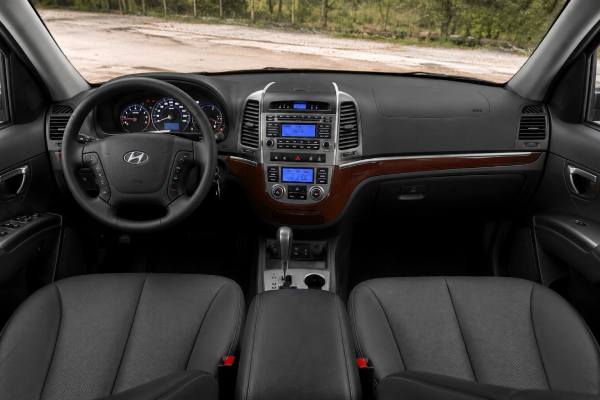
The facelifted CM-generation Hyundai Santa Fe with the 3.5-liter V6 is one of the more interesting versions of Hyundai’s second-generation midsize crossover. It kept the practical, easy-driving character of the earlier CM Santa Fe, but replaced the older V6 lineup with a stronger Lambda II 3.5-liter engine and a six-speed automatic transmission.
For used buyers, the front-wheel-drive 3.5 V6 model sits in a useful middle ground. It is simpler than the AWD version, more powerful than the four-cylinder, and generally less expensive to maintain than many premium-badged midsize SUVs from the same period. The main things to judge carefully are service history, corrosion exposure, transmission behavior, recall completion, suspension wear, and whether the exact vehicle’s equipment matches its market and VIN.
Quick Overview
- Strong 276 hp V6 gives the Santa Fe CM noticeably better passing power than the four-cylinder models.
- FWD keeps weight and driveline complexity lower than AWD, which can help maintenance costs.
- Practical cabin, large cargo area, standard stability control, and simple controls make it a useful family SUV.
- Check for stop-lamp switch recalls, brake system campaigns, oil leaks, suspension wear, and rust underneath.
- Normal-service oil and filter replacement is typically every 12,000 km or 12 months; severe use calls for shorter intervals.
Table of Contents
- Santa Fe CM FWD Profile
- Santa Fe CM 3.5 V6 Specs
- Santa Fe CM Trims and Safety
- Reliability, Issues and Recalls
- Maintenance and Used Buying
- Real World Driving and Performance
- How It Compares to Rivals
Santa Fe CM FWD Profile
The 2010–2012 Hyundai Santa Fe CM facelift covered the final years of the second-generation Santa Fe before the DM generation arrived. In North American form, the 3.5 V6 FWD model used a transverse, naturally aspirated Lambda II V6, front-wheel drive, and a six-speed torque-converter automatic. It was sold as a five-door, two-row midsize crossover, with seating for five in most facelift North American configurations.
The major mechanical change for 2010 was the move to newer engines and six-speed transmissions. The older 3.3-liter V6 was replaced by the 3.5-liter Lambda II V6, rated at 276 hp and 248 lb-ft. That put the Santa Fe closer to rivals such as the Toyota Highlander V6, Honda Pilot, Nissan Murano, Ford Edge, and Kia Sorento V6 in everyday performance.
The FWD version is best understood as a road-focused family SUV rather than an off-road vehicle. It has useful ground clearance, a comfortable driving position, and a large cargo area, but it lacks the traction reserve of the AWD Santa Fe in snow, mud, steep gravel, or wet boat-ramp use. For drivers in mild climates who mainly use paved roads, FWD can be the smarter used buy because it avoids rear differential, prop shaft, coupling, and transfer-case maintenance.
Strengths include good V6 refinement, straightforward controls, strong standard safety equipment for its era, and a roomy second row. The 3.5 V6 also suits highway driving better than the four-cylinder because it does not need to work as hard with passengers, luggage, or a modest trailer.
The main trade-offs are fuel consumption, age-related maintenance, and the dated safety technology. There is no modern AEB, adaptive cruise control, lane centering, blind-spot monitoring, or advanced camera suite on this version. Safety equipment is centered on structure, airbags, ABS, brake assist, traction control, and electronic stability control.
For used-car evaluation, this model rewards condition more than trim level. A clean FWD 3.5 with documented oil changes, completed recalls, fresh suspension components, good tires, and no corrosion is usually more appealing than a higher-trim example with neglected fluids or rust.
Santa Fe CM 3.5 V6 Specs
Specification data varies slightly by market, trim, and publication year. The tables below focus on the 2010–2012 facelift CM Santa Fe 3.5 V6 FWD with the six-speed automatic, while noting where VIN-level verification matters.
| Item | Hyundai Santa Fe CM 3.5 V6 FWD |
|---|---|
| Engine code | Lambda II / G6DC commonly listed; verify by VIN |
| Engine layout | Front transverse V6, 6 cylinders, DOHC, 4 valves per cylinder |
| Bore × stroke | 92.0 × 87.0 mm (3.62 × 3.43 in) |
| Displacement | 3.5 L (3,470 cc) |
| Induction | Naturally aspirated |
| Fuel system | Multi-point port fuel injection |
| Compression ratio | 10.6:1 |
| Maximum power | 276 hp (206 kW) @ 6,300 rpm |
| Maximum torque | 336 Nm (248 lb-ft) @ 5,000 rpm |
| Timing drive | Timing chain |
| Rated efficiency | About 11.8 / 9.0 / 10.7 L/100 km city/highway/combined under U.S. EPA-style figures, or 20 / 26 / 22 mpg US; about 24 / 31 / 26 mpg UK |
| Real-world highway at 120 km/h | Typically about 9.5–11.0 L/100 km (21–25 mpg US / 26–30 mpg UK), depending on tires, load, wind, and maintenance |
| Item | Specification |
|---|---|
| Transmission | Six-speed automatic with lock-up torque converter and SHIFTRONIC manual mode; A6LF-family, exact code by VIN |
| Drive type | Front-wheel drive |
| Differential | Open front differential |
| Front / rear suspension | MacPherson struts with stabilizer bar / multi-link with stabilizer bar |
| Steering | Hydraulic power-assisted rack and pinion; 3.02 turns lock-to-lock; published steering ratio varies by source |
| Brakes | Front ventilated discs, rear solid discs; common rotor sizes around 321 mm front and 302 mm rear, verify by build date and part number |
| Popular tire sizes | 235/65 R17 on GL/GLS-type trims; 235/60 R18 on Sport/SE/Limited-type trims |
| Ground clearance | About 185–200 mm (7.3–7.9 in), market and measurement dependent |
| Approach / departure / breakover | About 24.6° / 21.6° / 17.9° in markets where these angles were published |
| Length / width / height | About 4,650–4,676 mm / 1,890 mm / 1,725–1,760 mm (183.1–184.1 in / 74.4 in / 67.9–69.3 in) |
| Wheelbase | 2,700 mm (106.3 in) |
| Turning circle | 10.79–10.8 m (35.4 ft) kerb-to-kerb |
| Curb weight | About 1,769 kg (3,900 lb) for 3.5 V6 FWD automatic; equipment changes can shift this |
| GVWR / payload | Door-label GVWR must be verified by VIN; practical payload is commonly around 450–550 kg (990–1,210 lb) |
| Fuel tank | 68 L (18.0 US gal / 15.0 UK gal) in some owner data; some North American sales data lists about 75 L (19.8 US gal / 16.5 UK gal) |
| Cargo volume | About 968 L (34.2 ft³) seats up; 2,214 L (78.2 ft³) seats folded, published cargo method varies |
| Towing capacity | Up to 1,587 kg (3,500 lb) braked when properly equipped; about 749 kg (1,650 lb) unbraked |
| Item | Specification or guidance |
|---|---|
| 0–100 km/h | Typically around 7.0–7.5 seconds in independent estimates/tests; load and tires matter |
| Top speed | About 210–219 km/h (130–136 mph) in non-official estimates; market limiters may vary |
| 100–0 km/h braking | Commonly around 40–43 m (131–141 ft) when tested on good tires; not an official universal figure |
| Engine oil | API SM / ILSAC GF-4 or better; SAE 5W-20 recommended for fuel economy, 5W-30 or 10W-30 acceptable by temperature chart; 5.2 L (5.49 US qt) drain and refill |
| Coolant | Ethylene-glycol coolant suitable for aluminum radiators, mixed with distilled/deionized water; 8.6 L (9.09 US qt) |
| Automatic transmission fluid | ATF SP-IV specification; 7.8 L (8.24 US qt) total listed capacity |
| Power steering fluid | PSF-3; about 1.0 L (1.06 US qt) |
| Brake fluid | FMVSS116 DOT 3 or DOT 4; about 0.7–0.8 L (0.74–0.85 US qt) |
| Differential / transfer case | Not applicable to FWD; AWD versions use GL-5 75W-90 in rear differential and transfer case |
| A/C refrigerant | R134a; commonly about 600 g (21.2 oz) without rear evaporator, about 850 g (30.0 oz) with rear evaporator; verify under-hood label |
| A/C compressor oil | PAG 46; commonly about 150 mL (5.1 fl oz) single evaporator, about 210 mL (7.1 fl oz) with rear evaporator |
| Key torque value | Wheel lug nuts: 88–107 Nm (65–79 lb-ft). Other chassis, brake, and engine torques should be taken from VIN-matched service data. |
| System or rating | 2010–2012 Santa Fe CM notes |
|---|---|
| IIHS crashworthiness | Good ratings for moderate overlap front, side, and head restraints/seats under the test protocols of the period |
| IIHS headlight rating | Not applicable; headlight ratings were not part of IIHS testing for this vehicle at the time |
| Euro NCAP | Market-dependent and not directly aligned with this North American FWD 3.5 V6 specification |
| Airbags | Six airbags: dual front, front seat-mounted side, and side-curtain airbags; rollover sensor added for 2010 |
| Stability and braking systems | ESC, traction control, ABS, EBD, and brake assist standard on major North American trims |
| ADAS | No AEB, ACC, LKA/LPA, BSD/RCTA, cyclist detection, or traffic-sign assist on this generation; rear camera available with navigation on some trims |
Santa Fe CM Trims and Safety
Trim names depend on region. In Canada, the 3.5 V6 appeared in GL, Sport, Limited, and Limited with Navigation forms. In the United States, the V6 was associated mainly with SE and Limited trims. Mechanically, the important identifier is the 3.5-liter V6 paired with the six-speed automatic; front-wheel drive or all-wheel drive then determines the driveline layout.
Lower V6 trims usually had cloth seating, 17-inch wheels, fog lights, manual air conditioning, Bluetooth, USB/aux input, cruise control, roof rails, and stability control. Sport or SE-type trims added 18-inch alloy wheels, heated front seats in many markets, a power driver seat, leather-wrapped controls, a sunroof in some packages, and more exterior trim. Limited versions commonly added leather upholstery, dual-zone automatic climate control, upgraded audio, auto headlamps, and more convenience equipment. Navigation-equipped models could add the touch-screen system and rearview camera.
Quick identifiers include the V6 badge or 3.5 trim listing, 18-inch wheels on many higher trims, fog lights, leather seating on Limited models, and the navigation screen/rear camera on the top package. A VIN decode or Hyundai dealer build sheet is the best way to confirm whether a vehicle is originally FWD or AWD, especially if badges have been removed or body panels have been replaced.
Year-to-year changes were modest after the 2010 facelift. The 2010 model brought the new 3.5 V6, six-speed automatic, exterior revisions, standard Bluetooth and audio controls, and rollover-sensing side-curtain airbags. Later 2011–2012 examples mainly differ by trim packaging, availability, and market details rather than major mechanical redesign.
Safety equipment was strong for the class and period, but it should not be confused with modern driver-assistance technology. The structure and passive systems performed well in IIHS tests of the era, and stability control was an important standard feature. Child-seat support includes rear LATCH/ISOFIX provisions, rear child locks, and three-point belts. Airbag and occupant-classification systems should be checked for warning lights at startup; any SRS light that stays on needs diagnosis before purchase.
After collision repair, suspension work, windshield work, seat replacement, or dashboard electrical repair, confirm that the SRS system has no stored faults and that seat wiring connectors under the front seats have not been damaged or left loose.
Reliability, Issues and Recalls
The 3.5 Lambda II Santa Fe is generally a durable vehicle when serviced on time, but most examples are now old enough that age, corrosion, and previous maintenance matter more than factory reputation. A low-mileage example can still need rubber parts, fluids, brakes, struts, and battery work simply because of time.
| System | Prevalence | Severity / cost | Symptoms and remedy |
|---|---|---|---|
| Stop lamp switch | Common recall/campaign item | Low if repaired under recall | Brake lamps fail, cruise control does not cancel, shift interlock issues. Verify recall completion and replace switch if affected. |
| Engine oil leaks | Occasional | Low to medium | Burning-oil smell, wet valve covers, seepage near timing cover. Replace gaskets/seals and clean to confirm leak source. |
| Ignition coils / spark plugs | Occasional with age | Low to medium | Misfire, rough idle, flashing check-engine light. Replace plugs with correct iridium type and diagnose coils by cylinder. |
| Transmission shift quality | Occasional | Medium to high | Harsh engagement, flare, limp mode, speed-sensor codes. Check ATF history, scan TCM codes, apply updates or repair valve-body/sensor faults as needed. |
| Cooling system | Occasional | Medium | Coolant smell, low reservoir, overheating in traffic. Inspect radiator, hoses, thermostat, fans, cap, and water pump area. |
| Suspension and steering | Common on high-mileage cars | Low to medium | Clunks, wandering, tire wear. Inspect struts, sway-bar links, control-arm bushings, ball joints, tie rods, and alignment. |
| Wheel bearings and brakes | Occasional to common | Low to medium | Humming, vibration, brake pulsation, seized caliper slide pins. Replace worn bearings and service calipers with proper lubrication. |
| Corrosion | Climate-dependent | Medium to high | Rust on subframes, brake lines, rockers, rear suspension mounts, exhaust, and fuel/brake line brackets. Inspect on a lift before buying. |
The Lambda II V6 uses a timing chain rather than a scheduled timing belt. There is no routine belt replacement interval, but chain noise at startup, cam/crank correlation codes, or poor maintenance history should not be ignored. Chain, guide, and tensioner work is not a casual service job, so persistent rattle needs proper diagnosis.
The six-speed automatic is usually smooth when healthy. A brief cold firmness can be normal, but delayed engagement, repeated flare between gears, harsh reverse engagement, or transmission-related diagnostic codes are warning signs. Because the normal schedule may describe the ATF as no-service under ordinary use, many used examples still have original fluid. For severe use, Hyundai lists ATF replacement at 96,000 km, and many careful owners service it earlier than “lifetime” language implies.
Service actions and recalls should always be checked by VIN. Important areas include stop-lamp switch campaigns, certain rear brake caliper campaigns on affected production ranges, and any market-specific ABS, airbag, or electrical actions. Some Hyundai fire-risk recalls apply to later Santa Fe generations or different model-year ranges, so do not assume a campaign applies simply because it mentions “Santa Fe.” Use the official VIN lookup and dealer service history.
Pre-purchase checks should include:
- Cold start after sitting overnight, listening for timing-chain rattle or accessory noise.
- Full scan of engine, transmission, ABS, airbag, and body modules.
- Lift inspection for corrosion, oil leaks, ATF seepage, exhaust leaks, and brake-line condition.
- Road test from cold to fully warm, including highway lock-up, kickdown, reverse, and low-speed parking maneuvers.
- Verification of recall completion, maintenance invoices, tire age, and correct matching tire size.
Maintenance and Used Buying
A good maintenance plan for the 3.5 V6 FWD Santa Fe should be more conservative than the bare minimum, especially if the vehicle is used for short trips, winter driving, towing, hot climates, dusty roads, or heavy city traffic.
| Item | Typical interval or guidance |
|---|---|
| Engine oil and filter | Every 12,000 km or 12 months in normal use; every 6,000 km or 6 months in severe use |
| Engine air filter | Inspect regularly; replace about every 48,000 km or sooner in dusty use |
| Cabin air filter | Every 12–24 months, sooner in dusty or high-pollen areas |
| Coolant | First replacement around 100,000 km or 60 months, then about every 48,000 km or 24 months |
| Spark plugs | Iridium plugs; long interval, commonly around 160,000–168,000 km, but replace sooner for misfire or poor history |
| Timing chain | No scheduled replacement; inspect/diagnose for rattle, stretch, guide wear, tensioner faults, and correlation codes |
| Drive belts and hoses | Inspect from about 96,000 km or 72 months, then every 24,000 km or 24 months; replace cracked, glazed, swollen, or soft parts |
| Automatic transmission fluid | No routine service under normal use in some schedules; replace every 96,000 km in severe use with SP-IV fluid |
| Brake fluid | Inspect regularly; replacement every 2–3 years is prudent even where only inspection is listed |
| Brake pads, rotors, calipers | Inspect at each service; clean and lubricate slide pins, especially in salted climates |
| Tires | Rotate every 8,000–12,000 km; align if tire wear, pulling, or suspension work is present |
| 12 V battery | Test annually after year 3; typical replacement window is 4–6 years depending on climate |
| Fuel filter | Usually treated as maintenance-free but inspect/diagnose if fuel restriction, hesitation, or loss of power appears |
When buying, prioritize the cleanest body and best records. Cosmetic wear is less important than underbody condition, fluid history, and how the engine and transmission behave when cold. A Santa Fe that has recently received quality tires, brakes, struts, plugs, coolant, and transmission fluid may be worth more than a cheaper one needing all of those items.
Recommended versions are usually the simpler FWD V6 trims if traction needs are modest. Limited trim adds comfort features, but it also adds more electrical and interior items to check. Avoid examples with unresolved SRS warning lights, overheating history, unknown transmission faults, heavy rust, mismatched tires, salvage repairs, or evidence of towing beyond rating.
Long-term durability is respectable when the vehicle is maintained, but it is no longer a “buy and ignore” used SUV. Budget for age-related reconditioning after purchase: fluids, filters, spark plugs if due, brake service, tires, alignment, battery, wipers, and suspension links are all common first-year expenses.
Real World Driving and Performance
The 3.5 V6 changes the Santa Fe CM’s character. The four-cylinder versions are adequate for calm driving, but the V6 gives the vehicle a much easier highway stride. It pulls cleanly from low and mid revs, and the six-speed automatic keeps engine speed lower at cruising speeds than the older four- and five-speed automatics used before the facelift.
Throttle response is smooth rather than sharp. Around town, the torque converter helps the Santa Fe move away cleanly without needing high revs. Kickdown is decisive enough for overtaking, although the transmission can hesitate briefly if the driver asks for sudden acceleration from a steady cruise. The engine is quieter and more refined than many four-cylinder rivals of the period, but it becomes audible near the top of the rev range.
Ride quality is one of the CM Santa Fe’s stronger traits. It feels settled on highways and absorbs broken pavement well when fitted with sensible tires. The 18-inch wheel package looks better and can sharpen turn-in slightly, but 17-inch tires usually give a more forgiving ride and lower replacement cost. Steering is light and predictable, with limited feedback. This is a comfort-oriented crossover, not a sporty SUV.
Handling is safe and mildly front-biased. In FWD form, hard acceleration on wet pavement can produce wheelspin or torque steer, especially on worn tires. Electronic stability control is useful and should never be disabled for normal road driving. Braking feel is generally progressive, but any pulsing, steering shimmy, or soft pedal should be investigated because older examples often need rotors, caliper service, brake fluid, or hose inspection.
Real-world fuel consumption depends heavily on speed and usage. In mixed driving, many owners should expect about 11–13 L/100 km (18–21 mpg US / 22–26 mpg UK). Careful highway driving at 100–110 km/h can drop closer to 9 L/100 km, while 120 km/h cruising, winter tires, roof bars, hills, and cargo can push the figure above 10 L/100 km. Short winter trips are much thirstier because the V6, torque converter, and cabin heating all spend more time below efficient operating temperature.
For towing, the V6 is much better suited than the four-cylinder, but the Santa Fe is still a midsize crossover with front-wheel drive. A moderate trailer within the braked rating is manageable with proper tongue weight, trailer brakes, good tires, and fresh transmission fluid. Heavy towing in hot weather or mountains places more stress on the cooling system and automatic transmission, so conservative loading matters.
How It Compares to Rivals
Against a Toyota Highlander V6, the Santa Fe 3.5 FWD usually offers stronger value and similar practical usefulness, but the Highlander has a stronger reputation for long-term resale and perceived durability. The Toyota can cost more to buy, while the Hyundai may leave more budget for maintenance catch-up.
Compared with the Honda Pilot, the Santa Fe is smaller and easier to park, but the Pilot offers three-row practicality and a more spacious family layout. The Santa Fe’s FWD V6 feels lighter and simpler; the Pilot is better for larger households and frequent passenger hauling.
The Ford Edge is a close conceptual rival: two rows, V6 power, comfort-focused road manners, and good cargo space. The Edge often feels wider and more substantial, while the Santa Fe can feel easier to maneuver and less expensive to buy. Both need careful inspection for age-related suspension, brake, and electronics issues.
The Nissan Murano offers a smoother, more premium-feeling cabin and strong V6 performance, but its CVT is a major inspection point. Buyers who dislike CVT risk often prefer the Santa Fe’s conventional six-speed automatic, provided it shifts properly and has not been neglected.
The Kia Sorento of the same broad period shares some Hyundai/Kia mechanical thinking and can offer three-row configurations depending on market, but condition and service history again matter more than badge. The Santa Fe’s simpler two-row layout can be an advantage for buyers who want space without maximum seating complexity.
The Santa Fe CM 3.5 FWD is worth considering when the goal is a practical, comfortable, naturally aspirated V6 crossover at a reasonable used price. Its best advantages are power, simplicity relative to AWD versions, cargo space, and strong basic safety equipment for its era. Its weaknesses are fuel economy, lack of modern ADAS, and the need for careful age-related inspection.
References
- 2010 SANTA FE UNWRAPPED WITH A PAIR OF NEW ENGINES 2010 (Manufacturer Publication)
- CM FL (CAN) ENG 7.qxp 2012 (Owner’s Manual)
- CM FL (CAN) ENG 8.qxp 2012 (Owner’s Manual)
- 2010 Hyundai Santa Fe 2010 (Safety Rating)
- Vehicle Detail Search – 2010 HYUNDAI SANTA FE | NHTSA 2026 (Recall Database)
Disclaimer
This article is for informational purposes only and is not a substitute for professional diagnosis, repair, or inspection. Specifications, torque values, service intervals, fluids, capacities, recalls, procedures, and equipment can vary by VIN, market, production date, trim, and previous repair history. Always verify critical information against the official service documentation for the specific vehicle.
If this article was useful, please consider sharing it on Facebook, X/Twitter, or another platform to support our work.