
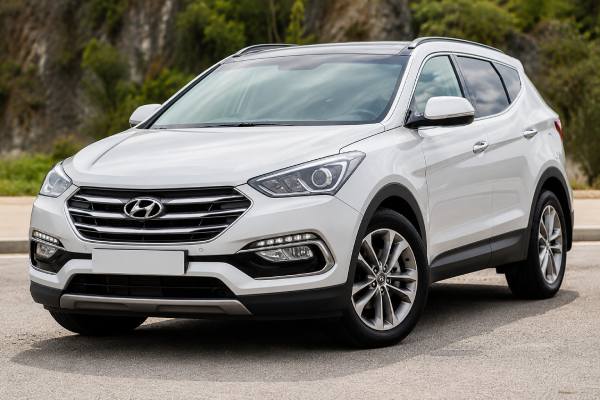

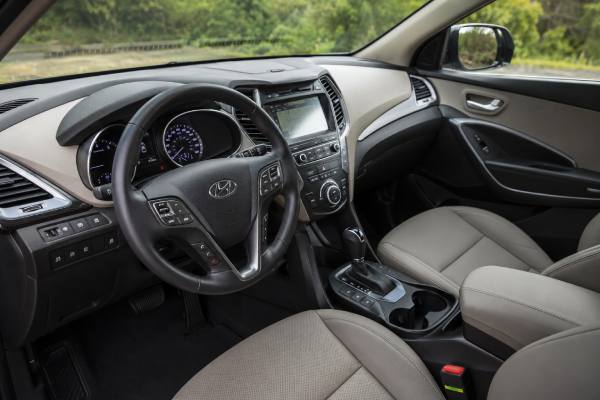
The facelifted DM-generation Hyundai Santa Fe with the 2.4 GDi petrol engine is a spacious, naturally aspirated family SUV aimed at buyers who want comfort, practical cargo space, and straightforward drivability rather than diesel torque or sporty performance. In front-wheel-drive form, it is lighter and mechanically simpler than the AWD version, but it also gives up some poor-weather traction and heavy-load confidence.
This version is most common in markets where the third-generation Santa Fe was sold as a five-seat or seven-seat SUV, while North America used the closely related Santa Fe Sport name for the shorter 2.4 GDi model. Exact trim names, safety equipment, fluids, and towing limits vary by country, so VIN-specific checks matter when buying or servicing one.
Quick Overview
- Strong cabin space, comfortable ride quality, and a useful 585–1,680 L cargo range make it practical for family use.
- The 2.4 GDi is smooth and simple compared with turbo engines, but it needs revs and regular oil changes to stay healthy.
- Front-wheel drive reduces weight and servicing complexity, though wet-road traction is weaker than AWD under load.
- Engine oil service is typically every 10,000–15,000 km or 6–12 months, with shorter intervals for city or hot-climate use.
- Check recall completion, oil consumption history, ATF condition, suspension wear, and ADAS calibration records before buying.
Table of Contents
- Santa Fe DM Facelift Profile
- Santa Fe DM Technical Specs
- Santa Fe DM Trims and Safety
- Reliability Issues and Recalls
- Maintenance and Used Buying
- Driving Performance and Economy
- Rivals and Used Value
Santa Fe DM Facelift Profile
The 2016–2018 Hyundai Santa Fe DM facelift sits in the final phase of the third-generation Santa Fe line. The facelift brought sharper front and rear styling, updated lighting, revised trim details, and broader availability of driver-assistance features in many markets. Underneath, it remained a unibody SUV with MacPherson strut front suspension, a multi-link rear axle, electric power steering, four-wheel disc brakes, and a transverse engine layout.
The 2.4 GDi version uses Hyundai’s Theta II G4KJ petrol engine, a 2,359 cc naturally aspirated inline-four with direct fuel injection, dual overhead camshafts, four valves per cylinder, and a timing chain. Output is usually quoted as 188 PS, commonly rounded to 188 hp in many databases, with 138 kW and 241 Nm of torque. It is not a high-torque engine by modern SUV standards, but it is quiet at moderate revs and avoids the extra heat and pressure of the 2.0 turbo version.
The FWD configuration is the simpler choice. There is no transfer case, propshaft, rear differential, or AWD coupling to service. That helps weight, fuel use, and long-term maintenance cost. The trade-off is traction. With a large body, a petrol four-cylinder, and family cargo onboard, the front tyres do all the driving and steering work. In rain, snow, or on steep loose surfaces, good tyres matter more than they do on the AWD model.
Transmission availability depends on market. A six-speed manual existed in some regions, while the six-speed torque-converter automatic is the common choice for urban and family use. The automatic suits the engine’s smooth character, although it sometimes needs a firm throttle input for passing because peak torque arrives at 4,000 rpm.
This Santa Fe is best understood as a comfortable, practical used SUV rather than a performance model. Its advantages are cabin size, relaxed cruising, simple FWD running gear, strong equipment on upper trims, and a generally solid body structure. Its ownership caveats are the Theta II GDi engine’s known sensitivity to oil quality, possible oil consumption or bearing-related trouble in some markets, and the need to confirm recall and service campaign completion.
For a used buyer, the ideal example is not necessarily the highest trim. A well-serviced mid-grade car with clean oil records, fresh tyres, smooth automatic shifts, no warning lights, and documented recall work is usually a safer purchase than a heavily optioned vehicle with patchy maintenance.
Santa Fe DM Technical Specs
Specifications below reflect the 2016–2018 facelifted Hyundai Santa Fe DM 2.4 GDi FWD. Some figures differ by market, trim, wheel size, seating layout, emissions certification, and transmission. Where factory publications and regional data differ, the values are shown as typical ranges rather than a single universal number.
| Item | Hyundai Santa Fe DM FWD 2.4 GDi |
|---|---|
| Engine code | Theta II G4KJ |
| Engine layout | Front transverse inline-four, 4 cylinders, DOHC, 4 valves/cyl |
| Bore × stroke | 88.0 × 97.0 mm (3.46 × 3.82 in) |
| Displacement | 2.4 L; 2,359 cc (143.96 cu in) |
| Induction | Naturally aspirated |
| Fuel system | Gasoline direct injection |
| Compression ratio | 11.3:1 |
| Maximum power | 188 hp/PS (138 kW) @ 6,000 rpm |
| Maximum torque | 241 Nm (178 lb-ft) @ 4,000 rpm |
| Timing drive | Timing chain |
| Rated combined efficiency | About 9.4 L/100 km (25.0 mpg US / 30.1 mpg UK), market-dependent |
| Real-world highway at 120 km/h | About 8.0–9.5 L/100 km (25–29 mpg US / 30–35 mpg UK), tyre and load dependent |
| Item | Specification |
|---|---|
| Transmission | 6-speed manual in some markets; 6-speed torque-converter automatic, commonly Hyundai A6 family, in most used examples |
| Drive type | Front-wheel drive |
| Differential | Open front differential; traction control by brake intervention |
| Item | Specification |
|---|---|
| Front suspension | MacPherson strut |
| Rear suspension | Independent multi-link |
| Steering | Rack-and-pinion electric power steering; exact ratio not consistently published |
| Front brakes | Ventilated discs, about 320 mm (12.6 in) |
| Rear brakes | Solid discs, about 302 mm (11.9 in) |
| Popular tyre sizes | 235/65 R17, 235/60 R18, 235/55 R19; 235/60 R18 is a common balanced setup |
| Ground clearance | About 185 mm (7.3 in) |
| Approach / departure / breakover | About 16.5° / 21.2° / 16.6° |
| Length / width / height | About 4,690–4,700 / 1,880 / 1,675–1,685 mm (184.6–185.0 / 74.0 / 65.9–66.3 in) |
| Wheelbase | 2,700 mm (106.3 in) |
| Turning circle | About 10.9 m (35.8 ft) kerb-to-kerb |
| Kerb weight | About 1,590–1,650 kg (3,505–3,638 lb), depending trim and transmission |
| GVWR | Commonly around 2,510 kg (5,534 lb), market dependent |
| Fuel tank | 64 L (16.9 US gal / 14.1 UK gal) |
| Cargo volume | About 585 L seats up / 1,680 L seats folded (20.7 / 59.3 ft³), VDA-style market data |
| Item | Typical figure |
|---|---|
| 0–100 km/h | About 9.9 s |
| 0–62 mph | About 9.9 s; 0–60 mph often listed around 9.4 s |
| Top speed | About 202 km/h (126 mph) |
| 100–0 km/h braking | Typically about 39–42 m (128–138 ft), tyre and load dependent |
| Towing capacity | Up to 2,000 kg (4,409 lb) braked in many EU-type markets; 750 kg (1,653 lb) unbraked. North American 2.4 FWD ratings are much lower, commonly 2,000 lb braked. |
| Payload | Market rating varies widely; typically about 550–900 kg (1,213–1,984 lb) depending homologation and trim |
| System | Specification and capacity |
|---|---|
| Engine oil | API SM / ILSAC GF-4 or better; SAE 5W-30 commonly preferred, with 5W-20 or 10W-30 allowed by climate; about 4.8 L (5.1 US qt) with filter |
| Coolant | Ethylene-glycol coolant suitable for aluminium engines, usually 50/50 premix; about 7.1 L (7.5 US qt) |
| Automatic transmission | Hyundai/Kia ATF SP-IV; service drain commonly around 4.0 L (4.2 US qt), total fill higher and service-method dependent |
| Manual transmission | Where fitted, use VIN-specific Hyundai GL-4 manual transaxle oil; capacity varies by gearbox |
| Transfer case / rear differential | Not applicable to FWD models |
| A/C refrigerant | R134a commonly 600 g (21.2 oz), or 800 g (28.2 oz) with rear evaporator; some markets use R1234yf at about 550/750 g |
| A/C compressor oil | PAG46 or PAG46yf type depending refrigerant; about 120 mL (4.1 fl oz), or 210 mL (7.1 fl oz) with rear evaporator |
| Key torque values | Wheel nuts about 107–127 Nm (79–94 lb-ft); oil drain plug about 39 Nm (29 lb-ft). Verify exact values by VIN before repair. |
| Area | Typical data |
|---|---|
| Euro NCAP | Third-generation Santa Fe tested in 2012: 5 stars; 96% adult, 89% child, 71% pedestrian, 86% safety assist. Facelift equipment may differ. |
| IIHS | 2017 Santa Fe Sport: strong crashworthiness ratings overall; optional front crash prevention rated Superior; headlight rating Poor on the tested Sport configuration. |
| Airbags | Typically 7 airbags: front, front side, side curtain, and driver knee airbag, with rollover sensing |
| Core stability systems | ABS, EBD, ESC, traction control, hill-start assist, downhill brake control |
| ADAS availability | Market and trim dependent: blind-spot detection, rear cross-traffic alert, lane departure warning, advanced smart cruise control, smart high beam, dynamic bending lights, AEB on some versions |
Santa Fe DM Trims and Safety
Trim names vary substantially. In Europe and many export markets, the facelift Santa Fe was offered in grades similar to Comfort, Style, Premium, Executive, or region-specific equivalents. In the United States and Canada, the related five-seat model was usually called Santa Fe Sport, with 2.4 base trims and higher trims using the 2.0T. In some countries, the Santa Fe name covered both five-seat and seven-seat layouts.
The important point for a buyer is that the 2.4 GDi FWD is usually the entry or mid-range petrol powertrain. Mechanical differences between trims are modest. Wheel size, tyre package, transmission, seating layout, lighting, parking technology, and driver-assistance equipment matter more than suspension or brake changes.
Common trim and option identifiers include:
- 17-inch wheels with higher-profile tyres on lower trims, usually giving the best ride comfort and lowest tyre cost.
- 18-inch wheels as the best everyday compromise between steering response and comfort.
- 19-inch wheels on upper trims, improving appearance but increasing tyre cost and impact harshness.
- Halogen, HID, or projector-style headlamp packages depending market and trim.
- Navigation with an 8-inch screen on higher grades, often paired with a premium audio system.
- Panoramic sunroof, power tailgate, ventilated front seats, heated rear seats, electric parking brake, and memory driver’s seat on upper trims.
- Around-view monitor, smart parking assist, blind-spot detection, and advanced cruise systems where available.
Safety equipment begins with a strong passive package for the period. Most facelift DM Santa Fe models have front airbags, side airbags, curtain airbags, a driver knee airbag, ABS, stability control, hill-start assist, and downhill brake control. ISOFIX/LATCH child-seat anchors are normally fitted to the second-row outboard seats, with top-tether points. Seven-seat versions add extra child-seat and access considerations, so the owner’s manual should be checked before installing restraints in the third row.
The Euro NCAP rating often quoted for this generation comes from the 2012 pre-facelift model, tested as a 2.2 diesel five-seat left-hand-drive Santa Fe. It scored strongly for adult and child protection. The facelift did not erase that basic body structure, but safety ratings are not automatically identical across every market, engine, seating layout, and equipment package.
In the United States, the 2017 Santa Fe Sport improved its small-overlap crash performance compared with earlier versions. Optional front crash prevention could perform very well, but headlight performance was a weak point on some configurations. This is why two cars that look similar can differ meaningfully in real-world night-driving safety.
ADAS equipment needs careful checking. A badge or brochure line is not enough. Confirm the actual car has the camera, radar, switches, dashboard menus, and warning lamps for the system claimed. After windshield replacement, front-end repair, bumper removal, steering alignment, or suspension work, camera and radar calibration may be required. Poor calibration can cause false warnings, unavailable systems, or weak intervention when assistance is needed.
Reliability Issues and Recalls
The Santa Fe DM is generally solid in body, cabin durability, suspension layout, and automatic transmission design, but the 2.4 GDi engine deserves careful attention. It belongs to the wider Theta II family, which has had well-publicized engine bearing, knock-sensor, and warranty-extension actions in several markets. Not every 2.4 GDi Santa Fe will suffer major engine trouble, but a used buyer should treat maintenance history as critical.
| Issue | Prevalence | Severity | Typical signs | Recommended action |
|---|---|---|---|---|
| Oil consumption | Occasional | Medium to high | Low oil level between services, blue smoke, catalyst stress, ticking | Document consumption test, inspect PCV, check compression/leakdown, avoid extended oil intervals |
| Rod-bearing wear or knock | Occasional, market dependent | High | Metallic knock, oil-pressure warning, limp mode, DTC P1326 on some cars | Stop driving, check campaign coverage, dealer diagnosis, possible engine replacement |
| Direct-injection carbon buildup | Occasional | Medium | Rough idle, hesitation, misfires, poor cold running | Intake inspection, walnut blasting or approved cleaning if confirmed |
| Automatic shift flare or harshness | Occasional | Medium | Delayed engagement, flare between gears, shudder under light throttle | Check ATF condition, scan TCM, update calibration, service fluid if appropriate |
| Suspension bushings and links | Common with age | Low to medium | Clunks, uneven tyre wear, wandering alignment | Inspect control arms, stabilizer links, rear bushings, and alignment hardware |
| ABS module fire-risk recalls | VIN-specific | High | May have no warning before recall remedy | Verify recall completion through official VIN check and dealer records |
Engine-specific concerns are the most expensive. The G4KJ uses direct injection and a relatively high compression ratio. It benefits from high-quality oil, correct viscosity, genuine or high-quality filters, clean intake air, and not being run low on oil. Short trips and long idle periods can accelerate fuel dilution and moisture accumulation. Hot climates, towing, and heavy traffic also justify shorter oil intervals.
The timing chain has no routine replacement interval, but it is not a lifetime-ignore component. Listen for cold-start rattles, check for cam/crank correlation fault codes, and investigate guide or tensioner noise early. A quiet, properly serviced chain system is normal; a rattling one should not be dismissed.
Fuel-system faults are less common but can be costly. High-pressure fuel pump issues, injector imbalance, and sensor faults can cause hard starting, lean/rich codes, or hesitation. Because GDi systems operate at high pressure, diagnosis and repair should be handled with the correct equipment.
The six-speed automatic is usually durable when not overheated or neglected. Hyundai often described these units as low-maintenance, but used examples with city use, towing, or uncertain history benefit from ATF inspection and sensible fluid service. Harsh shifts can also be calibration-related, so a scan for TCU updates is worthwhile before assuming the gearbox is mechanically worn.
Chassis wear is predictable for the vehicle’s size. Front lower control-arm bushings, stabilizer links, rear suspension bushings, wheel bearings, brake calipers, and alignment bolts are common age-related checks. Corrosion inspection should focus on the rear subframe area, suspension mounts, brake lines, exhaust hangers, door bottoms, tailgate seams, and underbody seams, especially in salted-road climates.
Recall and service-action history must be verified by VIN. Important items may include ABS module/fuse recalls, engine inspection or knock-sensor software campaigns in some markets, hood latch or TPMS-related recalls on certain North American Santa Fe Sport builds, and market-specific software updates. A seller’s verbal assurance is not enough; ask for official dealer printouts or use the manufacturer and government VIN tools.
Maintenance and Used Buying
A Santa Fe 2.4 GDi FWD can be a sensible used SUV if maintenance has been disciplined. The problem cars are usually the ones with long oil intervals, missing invoices, unresolved recalls, cheap tyres, neglected ATF, or warning lights that have been cleared without diagnosis.
| Item | Recommended interval | Notes |
|---|---|---|
| Engine oil and filter | 10,000–15,000 km or 6–12 months; shorter for severe use | Use correct viscosity and quality; check level monthly |
| Engine air filter | Inspect every 15,000 km; replace around 30,000 km | Replace earlier in dusty conditions |
| Cabin air filter | 15,000–20,000 km or annually | Important for HVAC airflow and demisting |
| Spark plugs | About 100,000–160,000 km depending market schedule | Use correct iridium plugs and torque carefully |
| Fuel filter | Usually part of in-tank module; inspect by symptom | Use quality fuel; investigate hard starting or lean codes |
| Timing chain | No scheduled replacement | Inspect for rattle, stretch, guide wear, and timing-correlation codes |
| Serpentine belt and hoses | Inspect every service; replace around 90,000–120,000 km if aged | Check tensioner, idlers, cracks, swelling, and coolant residue |
| Automatic transmission fluid | Inspect from 60,000 km; service around 60,000–90,000 km in severe use | Use SP-IV fluid only; avoid universal-fluid guesswork |
| Brake fluid | Every 2 years | Moisture-contaminated fluid affects ABS and corrosion resistance |
| Brake pads and rotors | Inspect every 10,000–15,000 km | Rear brakes can corrode if used lightly |
| Coolant | Market dependent; commonly 80,000–120,000 km initial, then shorter | Use aluminium-compatible coolant at correct mix |
| Tyre rotation | Every 8,000–10,000 km | Preserves front tyres on FWD models |
| Alignment | Annually or after suspension work | Essential if tyres feather or steering wheel is off-centre |
| 12 V battery | Test annually after 3 years; replace often at 4–6 years | Weak batteries create false electronic faults |
When inspecting a used Santa Fe, start cold. A pre-warmed engine can hide chain rattle, piston slap, smoke, and slow starting. Check the oil level before starting, then listen for bearing knock, ticking, or rattling. During the test drive, the engine should pull cleanly to higher rpm without misfires, warning lights, or hesitation.
The automatic should engage Drive and Reverse promptly, shift smoothly when cold and hot, and kick down without a harsh bang. A slight torque-converter feel is normal; flare, shudder, or delayed engagement deserves diagnosis.
The body should be checked for uneven panel gaps, mismatched paint, water in the spare-wheel well, blocked sunroof drains, and tailgate corrosion. Inside, test every switch: power tailgate, parking sensors, camera, seat heaters, ventilation, folding mirrors, navigation, Bluetooth, cruise control, and all ADAS warnings.
Best buys are usually later facelift cars with complete service records, moderate wheel sizes, no unresolved campaigns, clean underbody condition, and evidence of regular oil changes. Avoid cars with unexplained engine noise, low oil, coolant contamination, repeated misfire codes, harsh transmission behaviour, non-functioning safety systems, or a seller who cannot prove recall completion.
Driving Performance and Economy
The 2.4 GDi FWD Santa Fe drives like a comfort-oriented family SUV. The steering is light at parking speeds, the ride is compliant on 17- or 18-inch wheels, and the cabin is quiet enough for long trips. The multi-link rear suspension gives the car a more settled feel than simpler torsion-beam crossovers, especially with passengers in the back.
Performance is adequate rather than strong. The engine makes its best torque at 4,000 rpm and peak power at 6,000 rpm, so it feels relaxed in gentle driving but needs revs for overtaking. With the automatic, the gearbox often downshifts on hills or when joining fast traffic. That is normal for this engine; it does not have the low-rpm shove of the diesel or the 2.0 turbo.
In city use, expect fuel consumption around 11.5–14.0 L/100 km (17–20 mpg US / 20–25 mpg UK), depending traffic, temperature, and trip length. Mixed driving often falls near 9.5–11.0 L/100 km (21–25 mpg US / 26–30 mpg UK). On steady highway trips at 100–120 km/h, a healthy FWD car on sensible tyres can return about 8.0–9.5 L/100 km (25–29 mpg US / 30–35 mpg UK). Cold weather, roof boxes, underinflated tyres, short trips, and full passenger loads can push those numbers higher.
Ride comfort is one of the model’s better qualities. The Santa Fe feels stable in a straight line and does not become nervous at motorway speed. It is not as sharp as a Mazda CX-5, but it feels more substantial than many compact crossovers. Body roll is present but controlled, and the brakes are easy to modulate in normal driving.
The FWD layout is predictable but not ideal for every use. In dry conditions, it is lighter and efficient enough. In heavy rain or on loose climbs, the front tyres can spin if the driver asks for too much throttle. Tyre quality is therefore a major part of the vehicle’s safety and performance. Cheap tyres can make a FWD Santa Fe feel vague, noisy, and traction-limited.
Towing and heavy-load use require realistic expectations. In markets where the car is rated for higher braked towing, the chassis can handle moderate trailers, but the 2.4 petrol engine works hard on long grades. Expect fuel use to rise sharply, often by 25–50% depending trailer shape and speed. For frequent towing, the diesel or AWD version is usually the better tool.
Rivals and Used Value
The Santa Fe DM 2.4 GDi FWD competes with a wide set of used SUVs, including the Kia Sorento, Honda CR-V, Toyota RAV4, Nissan X-Trail/Rogue, Mitsubishi Outlander, Mazda CX-5, and larger alternatives such as the Toyota Highlander in some markets. Its position depends heavily on whether the buyer values cabin space over fuel economy.
| Rival | Santa Fe advantage | Rival advantage |
|---|---|---|
| Kia Sorento UM | Similar platform feel, often good value, comfortable cabin | Sorento may offer more seven-seat practicality and diesel availability |
| Honda CR-V 2.4 | Santa Fe feels larger and more substantial | CR-V is usually more efficient and easier to park |
| Toyota RAV4 2.5 | More cabin width and a more premium feel in higher trims | RAV4 often has stronger resale and simpler ownership reputation |
| Mazda CX-5 2.5 | More rear-seat and cargo space | CX-5 handles better and usually feels more responsive |
| Nissan X-Trail/Rogue | More solid highway feel and stronger conventional automatic appeal where fitted | Nissan may be cheaper to buy and more economical in some versions |
| Mitsubishi Outlander | Better cabin quality and stronger road manners | Outlander can be simpler and less expensive to run |
The Santa Fe’s strongest selling points are space, comfort, equipment, and value. It often gives buyers more car for the money than a Toyota or Honda of similar age. Upper trims can feel well-equipped even by current standards, with features such as ventilated seats, panoramic glass, navigation, parking cameras, blind-spot monitoring, and power tailgate.
Its weaknesses are fuel consumption, engine-risk perception, and resale value. The 2.4 GDi is not especially economical for the performance offered, and the Theta II reputation means informed buyers will discount cars without excellent records. That does not make every example a poor buy, but it does make documentation unusually important.
For most buyers, the best version is a clean facelift FWD automatic on 17- or 18-inch wheels with complete service history and confirmed recalls. Choose AWD only if the climate, roads, or usage justify the extra components. Choose the diesel if towing and long-distance economy matter more than petrol smoothness. Choose the 2.4 GDi FWD if the priority is a comfortable, spacious SUV with simpler driveline maintenance and a fair purchase price.
References
- Hyundai Motor Company 2015 (Brochure)
- 2017 Hyundai Santa Fe Sport 2017 (Safety Rating)
- Consumer Alert: Important Hyundai Recall for Fire Risk 2022 (Recall Database)
- Part 573 Safety Recall Report 22V-056 2022 (Recall Database)
- theta gdi engine dtc p1326 2020 (TSB)
Disclaimer
This article is for informational purposes only and is not a substitute for professional diagnosis, repair, inspection, or official service information. Specifications, torque values, service intervals, procedures, recalls, and equipment vary by VIN, market, production date, trim, and installed options. Always verify details against the official owner’s manual, workshop documentation, recall database, and a qualified Hyundai service professional before making maintenance or purchase decisions.
If this article helped you, consider sharing it on Facebook, X/Twitter, or another platform to support our work.