
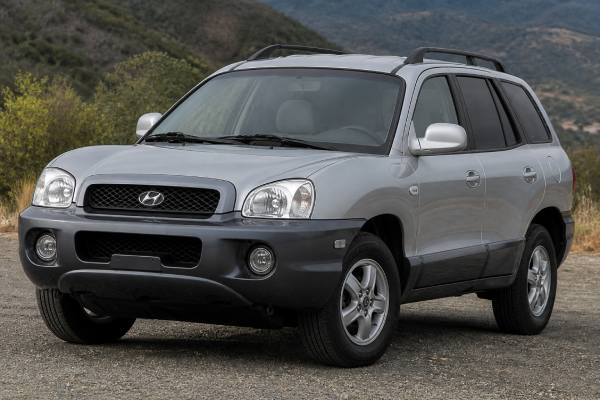
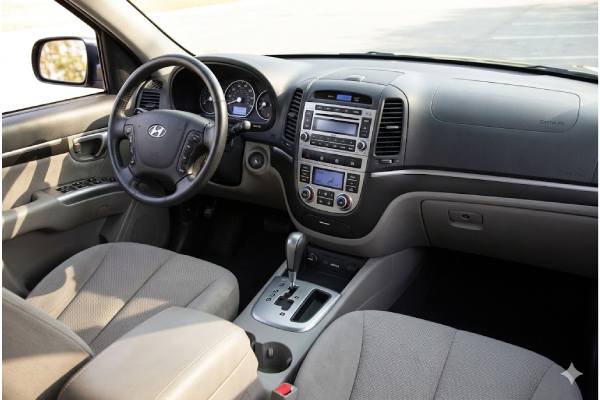
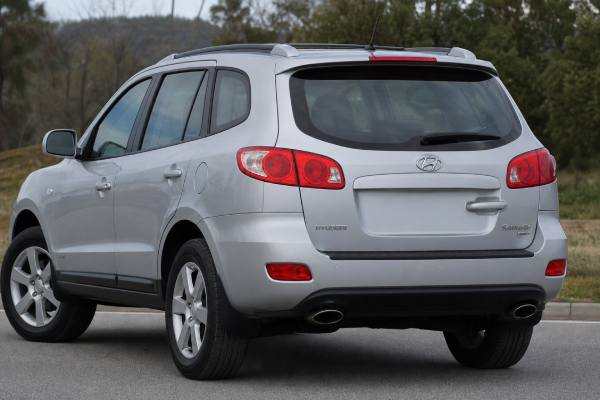
The facelifted Hyundai Santa Fe SM with the 3.5-liter V6 is a practical, old-school compact SUV from the mid-2000s. In front-wheel-drive form, it combines a naturally aspirated six-cylinder engine, a 5-speed automatic transmission, generous cargo space, and a simpler driveline than the AWD version. That makes it an appealing used option when purchase price, mechanical simplicity, and comfort matter more than modern fuel economy or advanced driver assistance.
For 2005–2006, the 3.5 V6 was the strongest Santa Fe engine offered in this generation. It gave the SM better highway passing ability than the smaller V6 models, but it also brought higher fuel use and a timing-belt maintenance requirement that should be treated seriously. The best examples are rust-free, have a documented timing-belt service, use the correct SP-III automatic transmission fluid, and show completed safety recalls.
Owner Snapshot
- The 3.5 V6 gives the Santa Fe SM relaxed highway power and stronger passing than the smaller 2.7 V6.
- FWD keeps the driveline simpler than AWD, with no rear differential or transfer-case service to manage.
- The cabin and cargo area are useful for a compact SUV of this era, especially with the rear seats folded.
- Timing-belt, cooling-system, rust, and automatic-transmission history matter more than mileage alone.
- Under severe use, engine oil service can be as frequent as 3,000 miles / 4,800 km or 3 months.
Table of Contents
- Santa Fe SM Used Context
- Santa Fe SM Core Specs
- Santa Fe SM Trims and Safety
- Known Issues and Recalls
- Maintenance and Buying Advice
- Road Manners and Efficiency
- Rivals and Value Position
Santa Fe SM Used Context
The Hyundai Santa Fe SM was Hyundai’s first-generation compact SUV, sold before crossovers became as refined and technology-heavy as they are today. The 2005–2006 facelift models sit near the end of the SM production run, so they benefit from the most developed version of the original design while still keeping the simple structure of an early-2000s SUV.
The version covered here is the front-wheel-drive Santa Fe SM with the 3.5-liter V6. It is a five-door, five-seat SUV with a transverse front engine, automatic transmission, and no rear-driven axle. That last point matters. AWD versions can be better in snow or on loose surfaces, but the FWD model is lighter, mechanically simpler, and usually cheaper to maintain. There is no rear differential, prop shaft, rear coupling, or transfer hardware to inspect or service.
The 3.5 V6 is Hyundai’s Sigma-family G6CU engine. It is a naturally aspirated, port-injected, dual-overhead-cam V6 with a timing belt. It was not a high-output performance engine by modern standards, but in the Santa Fe SM it gave the vehicle useful torque and more relaxed acceleration than the smaller 2.7-liter V6. It suits highway driving, gentle towing within limits, and fully loaded family use better than the base engines.
The trade-off is fuel consumption. A FWD Santa Fe 3.5 V6 is noticeably thirstier than a four-cylinder Honda CR-V or Toyota RAV4 of the same era, and it is far less efficient than a modern compact crossover. Buyers should expect mid-teens mpg in city use and low-20s mpg on gentle highway trips, with worse results in winter, short-trip driving, hilly areas, or when neglected maintenance increases drag and rolling resistance.
As a used vehicle, this Santa Fe is best judged by condition rather than badge prestige. A clean, well-maintained FWD 3.5 can be a useful budget SUV. A rusty or undocumented one can quickly become uneconomical. Timing-belt history is central because the belt drives the camshafts and ages with both mileage and time. Cooling-system health also matters because old hoses, radiators, thermostats, and coolant can turn a low-cost vehicle into a roadside failure.
The facelifted SM also belongs to an older safety era. It had important basics for its time, including front airbags, available or standard side airbags depending on market and trim, anti-lock brakes, and traction control on many V6 models. It does not have modern systems such as automatic emergency braking, adaptive cruise control, lane keeping, blind-spot monitoring, or rear cross-traffic alert. That does not make it unusable, but it does mean a buyer should evaluate it as a pre-ADAS vehicle and drive accordingly.
Its strongest ownership case is straightforward: low purchase price, comfortable ride, useful cargo capacity, simple FWD layout, and a smooth V6. Its weakest points are fuel economy, age-related deterioration, dated crash protection, corrosion exposure, and the need for disciplined maintenance. For a driver who wants a cheap, comfortable runabout with occasional utility, the right example can still make sense. For someone expecting modern driver assistance, low fuel use, or a no-maintenance bargain, it is the wrong place to start.
Santa Fe SM Core Specs
Specifications for older vehicles can vary by market, trim, production date, tire package, and certification method. The figures below focus on the North American-style 2005–2006 Hyundai Santa Fe SM FWD with the 3.5-liter V6 and automatic transmission. Where a figure was not consistently published in open manufacturer material, it is marked as approximate or VIN-dependent rather than presented as a single universal value.
| Category | Detail |
|---|---|
| Brand and model | Hyundai Santa Fe |
| Generation / platform | First generation SM, facelift |
| Model years covered | 2005–2006 |
| Body style | 5-door compact SUV / crossover-style wagon |
| Seating | 5 seats |
| Engine | 3.5-liter V6 gasoline |
| Engine code | G6CU, Sigma-family V6 |
| Drivetrain covered | Front-wheel drive |
| Transmission | 5-speed automatic with Shiftronic manual shift mode |
| Typical market focus | North America and comparable export-market specifications |
| Powertrain and efficiency | Specification |
|---|---|
| Engine layout and cylinders | Transverse V6, 6 cylinders |
| Valvetrain | DOHC, 24 valves, 4 valves per cylinder |
| Bore × stroke | 93.0 × 85.8 mm / 3.66 × 3.38 in |
| Displacement | 3.5 L / 3,497 cc |
| Induction | Naturally aspirated |
| Fuel system | Multi-point / port fuel injection |
| Compression ratio | About 10.0:1 |
| Max power | 200 hp / 149 kW @ 5,500 rpm |
| Max torque | 297 Nm / 219 lb-ft @ 3,500 rpm |
| Timing drive | Timing belt |
| Rated efficiency | 16 city / 22 highway / 18 combined mpg US; about 14.7 / 10.7 / 13.1 L/100 km |
| Real-world highway at 120 km/h / 75 mph | About 11.5–13.0 L/100 km, or 18–20 mpg US, depending on tires, load, wind, and condition |
| Transmission and driveline | Specification |
|---|---|
| Transmission type | 5-speed torque-converter automatic |
| Manual mode | Shiftronic gate control |
| Drive type | FWD |
| Front differential | Open differential |
| Rear differential / transfer case | Not applicable to FWD model |
| AWD availability | Offered separately on some trims, but not part of this FWD specification |
| Chassis and dimensions | Specification |
|---|---|
| Front suspension | MacPherson strut with coil springs and anti-roll bar |
| Rear suspension | Independent rear suspension with coil springs and hydraulic dampers |
| Steering | Power-assisted rack and pinion |
| Steering ratio | Not consistently published in owner literature; verify by service data if needed |
| Brakes | Front ventilated discs, rear discs; ABS on V6 models in many markets |
| Popular tire size | 225/70 R16 |
| Recommended cold tire pressure | Typically 207 kPa / 30 psi; verify door placard |
| Ground clearance | About 207 mm / 8.1 in, depending on tire and load |
| Length | 4,500 mm / 177.1 in |
| Width | 1,820 mm / 71.5 in |
| Height | About 1,655 mm / 65.2 in without roof rack; about 1,710 mm / 67.3 in with roof rack |
| Wheelbase | 2,620 mm / 103.1 in |
| Turning circle | About 11.0–11.2 m / 36–37 ft |
| Curb weight | About 1,720–1,780 kg / 3,790–3,925 lb, depending on trim and equipment |
| GVWR | VIN placard dependent; verify the door label |
| Fuel tank | 72 L / 19.0 US gal / 15.8 UK gal |
| Cargo volume | About 864 L / 30.5 ft³ seats up; about 2,100 L / 74 ft³ seats folded, using period manufacturer-style measurement |
| Performance and capability | Specification |
|---|---|
| 0–100 km/h / 0–62 mph | About 9.0–9.5 seconds in good condition |
| 0–60 mph | About 8.5–9.0 seconds |
| Top speed | About 180 km/h / 112 mph |
| 100–0 km/h braking | Common period-test expectation around 43–46 m / 141–151 ft, strongly tire- and condition-dependent |
| Braked towing capacity | Up to about 1,134 kg / 2,500 lb when properly equipped |
| Unbraked towing capacity | Market-dependent; verify local manual and legal limit |
| Tongue weight | Usually around 10 percent of trailer weight, within manual limits |
| Payload | VIN placard dependent; inspect the tire-and-loading label |
| Fluids and service capacities | Specification |
|---|---|
| Engine oil specification | API SJ / SL or later, ILSAC GF-3 or later where applicable |
| Engine oil viscosity | 5W-20 or 5W-30 commonly preferred; 10W-30 may be suitable in warmer conditions per temperature chart |
| Engine oil capacity | About 4.3 L / 4.54 US qt with filter |
| Coolant | Ethylene-glycol coolant suitable for aluminum engines; 50/50 mix commonly used |
| Coolant capacity | About 8.2 L / 8.66 US qt |
| Automatic transmission fluid | Hyundai Genuine ATF SP-III or approved SP-III equivalent |
| ATF total capacity | About 8.5 L / 8.98 US qt; drain-and-fill amount is lower |
| Power steering fluid | PSF-3-type fluid where specified |
| Brake fluid | DOT 3 or DOT 4 equivalent |
| Spark plugs | Platinum type; typical gap 1.0–1.1 mm / 0.039–0.043 in |
| A/C refrigerant | R-134a system; charge amount should be verified from under-hood label |
| Engine oil drain plug torque | About 34–44 Nm / 25–33 lb-ft |
| Oil filter torque | About 12–16 Nm / 9–12 lb-ft |
| Safety and driver assistance | Specification |
|---|---|
| IIHS moderate-overlap front rating | Good for applicable 2001–2006 models built after the relevant change date |
| IIHS side-impact rating | Acceptable for applicable 2002–2006 models with standard seat-mounted side airbags |
| IIHS head restraints / seats | Poor in period testing |
| Euro NCAP | Not the primary rating source for this North American-focused specification |
| Airbags | Front airbags and front seat-mounted side airbags on many facelift models; verify by trim and market |
| Child-seat anchors | LATCH / ISOFIX-style provisions in rear outboard positions, market dependent |
| ABS / traction control | Common on 3.5 V6 trims; verify equipment |
| Modern ADAS | Not fitted: no AEB, ACC, LKA, BSD, RCTA, or traffic-sign assist |
The most important technical takeaway is that this is not a complicated vehicle by modern standards, but it is not maintenance-free. The 3.5 V6 uses a timing belt, the automatic transmission needs the correct SP-III fluid, and the chassis should be inspected carefully for rust and suspension wear. The FWD layout removes some AWD-specific costs, yet the age of the vehicle means rubber parts, fluids, sensors, and brake hardware still deserve close attention.
Santa Fe SM Trims and Safety
For 2005–2006, the Santa Fe SM lineup varied by country, but North American examples were commonly arranged around GLS, LX, and late-run higher trims such as Limited-style equipment packages. The 3.5-liter V6 was the premium engine choice and was usually paired with the 5-speed automatic. Smaller-engine models may have used different equipment, so a buyer should not assume all Santa Fe SM examples have the same brakes, safety equipment, transmission, or cabin features.
The 3.5 V6 FWD models often included or offered features that made them feel upscale for the period: alloy wheels, roof rack, fog lamps, leather upholstery on higher trims, heated front seats, power driver’s seat, automatic climate control, upgraded audio, a sunroof, and steering-wheel audio controls depending on year and trim. These features are not rare, but many are now old enough that condition matters more than the original brochure specification. A working sunroof, cold A/C, intact seat heaters, clean leather, and functional power locks are more valuable than a trim badge alone.
Mechanical differences are more important than cosmetic differences. A true FWD model will not have a rear differential, rear half-shafts, prop shaft, or transfer hardware. Underbody inspection is the quickest confirmation. Badge placement is less reliable because used vehicles may have missing or replaced badges. The VIN, build sheet, underbody layout, and maintenance records are better identifiers.
Wheels and tires were usually 16-inch on this version, with 225/70 R16 tires being a common fitment. That tire size contributes to the Santa Fe’s comfortable ride and reasonable sidewall protection. Oversized aftermarket wheels can reduce ride quality, add noise, and make suspension problems more obvious. For a practical used Santa Fe, standard-size tires from a reputable brand are usually better than flashy wheel packages.
Safety equipment should be checked by production date and trim. By the facelift years, the Santa Fe SM had basic passive safety features expected for the time, including front airbags and side-impact protection on many versions. It also had child-seat anchor provisions in the rear. Anti-lock brakes and traction control were common on V6 models, which helped braking stability and front-wheel traction, but this should not be confused with a full modern stability-control and ADAS package.
Period crash-test results are mixed but understandable for the age. The Santa Fe performed well in the IIHS moderate-overlap frontal test, earning a Good rating for the applicable configuration. Side-impact performance was weaker, with an Acceptable overall result for models equipped as tested. Head-restraint and seat performance was poor by IIHS standards, which is important for rear-impact whiplash protection. These ratings should not be directly compared with today’s stricter testing and larger number of crash scenarios.
Modern driver-assistance systems are essentially absent. There is no automatic emergency braking, no adaptive cruise control, no lane-centering system, no blind-spot monitoring, and no rear cross-traffic alert. Parking assistance, if present, is limited compared with modern camera-and-sensor systems. Drivers coming from a newer Hyundai Santa Cruz, Tucson, or Santa Fe will notice the difference immediately.
A used buyer should test every safety-related warning light. The airbag light should illuminate briefly at startup and then go out. ABS and traction-control lights should not remain on. A persistent airbag, ABS, or brake warning light is not a cosmetic issue; it can indicate disabled safety functions or a fault that may require proper diagnostic equipment. After collision repair, suspension replacement, steering work, or windshield-related service, any sensor or warning-light concern should be addressed before relying on the vehicle.
Known Issues and Recalls
The Santa Fe SM 3.5 FWD can be durable when maintained, but age is now the main enemy. Most examples are old enough that rubber, plastic, seals, electrical connectors, brake lines, suspension joints, and underbody coatings may be more important than the odometer reading. A 110,000-mile vehicle with rust and no timing-belt record is riskier than a higher-mileage example with clean structure and documented service.
| Issue or system | Prevalence | Severity / cost | Symptoms and remedy |
|---|---|---|---|
| Timing belt, idlers, tensioner, water pump | Common concern when history is unknown | High | No record, belt age over interval, coolant seepage, front-engine noise. Replace belt, idlers, tensioner, water pump, and related seals as a set. |
| Valve-cover, cam, and crank seals | Common with age | Low to medium | Burning-oil smell, drips, smoke after parking, oily lower engine. Reseal properly and clean residue before rechecking. |
| Cooling-system aging | Common | Medium to high | Coolant smell, crust at radiator seams, overheating, weak heat, old hoses. Replace worn radiator, hoses, thermostat, cap, and coolant. |
| Automatic transmission shift issues | Occasional | Medium to high | Delayed engagement, flare, harsh shifts, shudder, dark fluid. Use correct SP-III fluid, inspect mounts and solenoids, avoid universal fluid mistakes. |
| Front suspension wear | Common at high mileage | Low to medium | Clunks, wandering, uneven tire wear. Inspect struts, control-arm bushings, ball joints, tie rods, and stabilizer links. |
| Wheel bearings and CV axles | Occasional | Medium | Humming, vibration under load, clicking on turns. Replace failed bearing or axle and check alignment. |
| Coil-spring corrosion recall area | Climate and VIN dependent | High safety risk | Broken front spring, uneven stance, tire contact, noise. Check recall completion and inspect both front springs. |
| Occupant classification airbag recall | Certain 2005 vehicles | High safety risk | Passenger-airbag indicator issues or recall open by VIN. Dealer remedy usually involves OCS reprogramming or related repair. |
| Body and subframe corrosion | Common in salt regions | Medium to high | Rust at wheel arches, rocker panels, brake lines, fuel lines, subframes, spring seats. Reject severely corroded vehicles. |
| EVAP, oxygen sensors, misfire faults | Occasional | Low to medium | Check-engine light, rough idle, poor economy. Diagnose with scan data before replacing parts randomly. |
The timing belt is the first major mechanical checkpoint. The 3.5 V6 is not a chain-driven engine. A seller who says “it has a chain” is confusing it with another engine or does not know the vehicle. The ideal record shows the belt, tensioner, idler pulleys, and water pump replaced together, with mileage and date. Because rubber ages, a belt that is far under mileage but very old is still a risk.
Automatic transmission care is the second major point. The 5-speed automatic is generally usable when serviced correctly, but it is sensitive to fluid condition and specification. The correct SP-III-type fluid matters. Harsh engagement, slipping, delayed reverse, or repeated flare between gears can point to internal wear, valve-body issues, solenoid faults, poor maintenance, or incorrect fluid. A single drain-and-fill may improve old fluid condition, but it will not repair a worn transmission.
Cooling-system neglect can shorten the life of an otherwise good engine. A proper inspection includes the radiator tanks and seams, thermostat operation, water-pump seepage, heater performance, coolant color, hose swelling, and fan operation. Any overheating history should be taken seriously. On an older V6, overheating can lead to gasket issues, warped components, and expensive labor.
Rust is the most important chassis concern in cold-climate regions. Front coil springs, lower control arms, subframes, brake lines, fuel lines, rocker panels, rear wheel arches, and suspension mounting points should all be checked on a lift. Cosmetic surface rust is expected on many vehicles of this age. Flaking structural rust, soft jacking points, cracked spring seats, or heavily corroded brake lines are reasons to walk away.
Known safety campaigns should be verified by VIN, not by memory or model year alone. Important recall themes for this generation include occupant-classification airbag software concerns on certain 2005 vehicles and front coil-spring corrosion in salt-belt areas. Completion should be confirmed through an official recall lookup and dealer records. An old recall does not always mean the vehicle is unsafe today, but an open recall should be addressed before regular use.
For pre-purchase inspection, ask for the timing-belt invoice, ATF service records, coolant service records, recall proof, and any brake or suspension repairs. Then inspect the vehicle cold, not after the seller has warmed it up. Cold-start noise, blue smoke, delayed transmission engagement, coolant smell, airbag lights, ABS lights, and heavy underbody corrosion are all more revealing than a short, warmed-up test drive.
Maintenance and Buying Advice
A Santa Fe SM 3.5 FWD rewards preventive maintenance. Because most examples are now well beyond their original warranty life, a buyer should build a baseline service plan rather than assume past care was complete. Even when mileage is low, age-sensitive parts such as belts, hoses, tires, brake fluid, coolant, seals, and the 12-volt battery may be due.
| Item | Practical interval or check point | Notes |
|---|---|---|
| Engine oil and filter | Up to 7,500 miles / 12,000 km / 6 months in normal use; as often as 3,000 miles / 4,800 km / 3 months in severe use | Short trips, cold starts, dust, towing, heat, and stop-go driving justify the severe schedule. |
| Engine air filter | Inspect every service; replace about every 15,000–30,000 miles / 24,000–48,000 km | Replace sooner in dusty areas. |
| Cabin air filter | About every 12–24 months | A clogged filter weakens defrost and A/C performance. |
| Spark plugs | Around 60,000 miles / 96,000 km, or per local schedule | Use the correct platinum plug type and gap. |
| Timing belt system | Commonly around 60,000 miles / 96,000 km or age-based interval | Replace belt, tensioner, idlers, water pump, and inspect cam/crank seals. |
| Coolant | About every 2–3 years after baseline service | Use coolant compatible with aluminum components and correct mix. |
| Automatic transmission fluid | Inspect regularly; severe-use service around 30,000 miles / 48,000 km | Use SP-III-type fluid. Avoid generic fluid unless explicitly approved. |
| Brake fluid | Every 2–3 years | Old fluid absorbs moisture and can corrode internal brake parts. |
| Brake pads, rotors, hoses, lines | Inspect at tire rotation and annually | Pay close attention to corrosion on lines and calipers. |
| Serpentine belts and hoses | Inspect at every oil service | Replace cracked, glazed, swollen, or oil-soaked parts. |
| Tires | Rotate every 7,500 miles / 12,000 km | Keep 225/70 R16 tires correctly inflated unless a different approved size is fitted. |
| Alignment | Check after tire replacement, suspension work, or uneven wear | Worn bushings can make alignment impossible to hold. |
| 12-volt battery | Test annually after 3 years; replacement often 4–5 years | Weak batteries can cause misleading electrical symptoms. |
| A/C system | Check cooling performance each warm season | Charge level should be verified by weight, not by guesswork. |
The first maintenance decision after purchase is whether to establish a baseline. If there is no proof of recent timing-belt service, treat it as due. If the coolant, brake fluid, and ATF are old or unknown, service them with the correct specifications. If tires are aged, cracked, mismatched, or unevenly worn, replace them before judging noise, vibration, handling, or braking.
Oil leaks should be evaluated calmly. A light valve-cover seep is common on old engines and may be repairable without major expense. A heavy front-engine leak near the timing cover is more concerning because it can contaminate the timing belt area or indicate neglected seals. Oil dripping onto exhaust components also creates smell and smoke complaints that many sellers minimize.
For the automatic transmission, a smooth cold engagement is important. Shift from Park to Reverse, then Drive, with the brake applied. Long delays, hard bangs, or repeated slipping are warning signs. On the road, the transmission should shift without flare or shudder during light and moderate throttle. A used Santa Fe with a questionable transmission is rarely worth buying unless priced for repair.
A strong buyer’s inspection should include:
- Timing-belt documentation with both mileage and date.
- Cold start after sitting overnight.
- Check-engine, ABS, airbag, and traction-control warning-light behavior.
- ATF color, smell, level, and service history.
- Coolant condition, radiator seams, hose condition, and fan operation.
- Front spring, strut, control-arm, and subframe corrosion inspection.
- Brake-line and fuel-line corrosion inspection.
- Tire age, brand matching, tread pattern, and wear shape.
- Sunroof, A/C, power windows, locks, seat heaters, and audio function.
- Official VIN recall check and dealer completion records.
The best examples to seek are rust-free FWD 3.5 models with a clean interior, documented timing-belt service, correct ATF maintenance, no warning lights, and original-size tires. Higher-trim models are pleasant if the luxury equipment still works, but a clean GLS can be a better purchase than a neglected LX or Limited with broken features.
The examples to avoid are heavily corroded vehicles, those with no belt history, overheating signs, slipping transmissions, persistent airbag lights, or cheap mismatched tires. Because market value is modest, one major repair can exceed the sensible value of the vehicle. Buy the best condition you can find rather than the cheapest one advertised.
Long-term durability is fair to good when the maintenance baseline is under control. The engine itself is not especially exotic, the FWD driveline is simple, and parts availability is still reasonable in many regions. The limitation is age: at nearly two decades old, every Santa Fe SM should be treated as a condition-dependent used vehicle, not as a guaranteed low-cost appliance.
Road Manners and Efficiency
The Santa Fe SM 3.5 FWD drives like a comfortable early-2000s SUV rather than a sharp modern crossover. The seating position is upright, visibility is good, and the controls are simple. The ride is one of its stronger traits. With 16-inch wheels and tall-sidewall tires, it absorbs broken pavement better than many newer crossovers on larger wheels.
The 3.5 V6 is smooth and relaxed in normal driving. Its 219 lb-ft of torque arrives low enough to make city acceleration easy, and the engine does not need to be worked hard just to keep up with traffic. Compared with the 2.7 V6, the 3.5 feels more confident when merging, climbing grades, or carrying passengers and luggage. It is not sporty, but it gives the Santa Fe a more grown-up character.
The 5-speed automatic is a good match when healthy. It is not as quick or intelligent as modern transmissions, but it offers better flexibility than older 4-speed units. Shifts should be smooth, with a mild kickdown delay when the driver asks for passing power. Hunting between gears on hills can occur, especially with load or a headwind. Old ATF, worn mounts, or tired sensors can make the transmission feel worse than it should.
Handling is safe and predictable, but not agile. The FWD Santa Fe naturally understeers if pushed into a corner, and body roll is noticeable. Steering effort is light to moderate, with more isolation than feedback. That character is acceptable for commuting, family use, and long drives, but anyone expecting a modern Hyundai Santa Cruz or newer Santa Fe level of control will find the SM softer and less precise.
Braking feel depends heavily on maintenance. With good pads, clean fluid, healthy calipers, and quality tires, stopping performance is adequate for the vehicle’s age. With old fluid, corroded lines, seized slide pins, cheap tires, or warped rotors, the pedal can feel soft or uneven. Because this Santa Fe is often bought cheaply, brake condition should be checked carefully rather than assumed.
Noise levels are also period-correct. Around town, the V6 is smooth and reasonably quiet. At highway speeds, tire noise, wind noise around the mirrors and roof rack, and general road roar become more noticeable. Worn engine mounts, cupped tires, weak wheel bearings, or loose exhaust parts can add vibration and hum. A quiet test drive on several road surfaces is useful because the cabin can mask some mechanical problems at low speed.
Real-world fuel economy is the main daily-use downside. In city driving, expect about 14.5–16.5 L/100 km, or roughly 14–16 mpg US. Mixed driving often falls around 12.5–14.5 L/100 km, or 16–19 mpg US. Gentle highway cruising can return about 10.7–12.0 L/100 km, or 20–22 mpg US, but 120 km/h cruising, winter tires, roof racks, hills, or headwinds can push consumption closer to 11.5–13.0 L/100 km.
Cold weather hurts economy noticeably. Short trips keep the engine rich, the transmission cold, and the tires stiff. Remote starts, defrost use, winter fuel, and snow tires can increase consumption by 10–20 percent. A stuck thermostat, dragging brake caliper, lazy oxygen sensor, or underinflated tire can make the numbers worse.
Towing should be approached conservatively. The 3.5 V6 has enough power for a small trailer, but the FWD layout means traction can be limited on wet ramps, gravel, or steep driveways. Proper tongue weight, good rear tires, working trailer lights, fresh ATF, and healthy brakes matter. A moderate utility trailer is realistic; heavy, frequent towing is better suited to a larger SUV or truck-based vehicle.
Rivals and Value Position
The Santa Fe SM 3.5 FWD competes most naturally with compact and midsize-leaning SUVs from the same period. Its main appeal is value. It usually costs less than a similarly clean Toyota or Honda, offers a smoother V6 than most four-cylinder rivals, and provides a comfortable cabin with useful cargo room. Its disadvantage is that it uses more fuel and does not carry the same resale reputation as the Japanese leaders.
Compared with a 2005–2006 Honda CR-V, the Hyundai feels stronger in a straight line and more relaxed when loaded. The CR-V is usually better on fuel, easier to park, and stronger in long-term resale value. The Honda also has a simpler four-cylinder engine, but many examples command higher prices because of reputation. A Santa Fe can be the better buy only when its condition and service history are clearly better for the money.
Compared with a Toyota RAV4 of the same era, the Hyundai offers a more substantial feel and available V6 character, though the RAV4 is lighter, more efficient, and often easier to own long term. The Toyota’s reputation keeps prices high. The Santa Fe’s value case depends on buying carefully and avoiding deferred maintenance.
Compared with the Ford Escape or Mazda Tribute V6, the Santa Fe is similar in concept: compact SUV size, available V6 power, and practical packaging. The Hyundai’s ride comfort and cabin space are competitive, while the Ford/Mazda twins can feel a little lighter and more nimble. Rust and transmission condition are important checks on all of them.
Compared with a Subaru Forester, the Hyundai has more V6 torque and a broader cabin feel, while the Subaru offers standard AWD and better traction in poor weather. The Forester is smaller and more car-like. Buyers in snowy regions may prefer Subaru traction, but a clean FWD Santa Fe with good winter tires can still be usable where roads are regularly cleared.
A newer 2007 Santa Fe CM is also worth considering. It is larger, more refined, and more modern, with improved structure and a more contemporary interior. It will usually cost more, but it may be a better long-term family choice if safety and refinement are priorities. The older SM makes more sense when budget is tight and simplicity is valued.
The Santa Fe SM 3.5 FWD is worth considering when the vehicle is clean, documented, and priced realistically. Its advantages are comfort, V6 smoothness, cargo usefulness, simple FWD hardware, and low purchase cost. Its disadvantages are fuel consumption, aging safety design, timing-belt maintenance, rust exposure, and the possibility of repairs that exceed market value.
The smartest verdict is conditional. A neglected Santa Fe SM is not a bargain. A well-kept, rust-free, recall-complete 3.5 FWD with a fresh timing belt and good fluids can still be a useful inexpensive SUV. For buyers who understand its age and maintenance needs, it remains a practical old crossover. For buyers who want modern driver assistance, excellent fuel economy, or a nearly maintenance-free vehicle, newer alternatives are a better fit.
References
- 2005 HYUNDAI SANTA FE 2004 (Manufacturer Press Kit)
- 2005 Hyundai Santa Fe 2026 (Fuel Economy Data)
- 2006 Hyundai Santa Fe 2026 (Fuel Economy Data)
- 2005 Hyundai Santa Fe 2026 (Safety Rating)
- Check for Recalls 2026 (Recall Database)
Disclaimer
This information is provided for general informational purposes and is not a substitute for professional diagnosis, repair, inspection, or official service documentation. Specifications, torque values, service intervals, safety equipment, capacities, and procedures can vary by VIN, market, trim, production date, and fitted equipment. Always verify critical details against the official owner’s manual, service manual, VIN label, recall database, and qualified repair guidance before servicing or purchasing a vehicle.
If this resource was useful, please consider sharing it on Facebook, X/Twitter, or with someone evaluating an older Hyundai Santa Fe. Your support helps keep detailed automotive references available.