

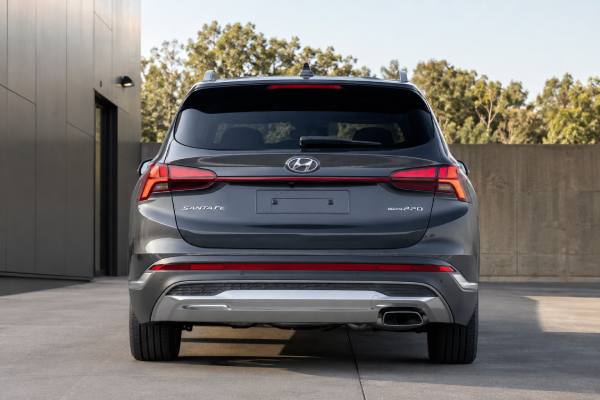

The facelift Hyundai Santa Fe TM with the naturally aspirated 2.5 GDi engine is the calmer, simpler version of this generation. It does not have the stronger 2.5 turbo, hybrid hardware, or all-wheel-drive driveline covered by other Santa Fe variants, but that simplicity is exactly why many used buyers consider it. In FWD form, it offers a spacious five-seat cabin, good safety equipment, a conventional 8-speed automatic transmission, and lower mechanical complexity than the AWD, turbo, hybrid, and plug-in hybrid models.
For 2021–2023, the key point is to verify the market and trim. In North America, the 191 hp 2.5 GDi FWD setup was mainly associated with lower and mid-level trims such as SE, SEL, and XRT, while upper trims often moved to the turbocharged engine. Equipment, service schedules, tire sizes, and recall applicability can vary by VIN, so the best ownership decisions come from combining the specification sheet with the vehicle’s build label, service records, and official VIN checks.
Fast Facts
- Spacious two-row SUV with a quiet ride, generous cargo room, and useful standard driver-assistance features.
- The 2.5 GDi FWD model avoids the turbo engine, AWD hardware, and dual-clutch transmission used on some other Santa Fe versions.
- Official FWD fuel economy is around 9.4 / 8.4 / 9.0 L/100 km city/highway/combined, or 25 / 28 / 26 mpg US.
- Main ownership caveats are software updates, recall verification, brake wear in salted climates, and careful oil-level monitoring.
- A common service rhythm is engine oil and filter at about 8,000 km / 6 months in severe-use schedules, with intervals varying by market.
Table of Contents
- Santa Fe TM 2.5 GDi Profile
- Santa Fe TM Technical Specs
- Santa Fe TM Trims and Safety
- Reliability and Service Actions
- Maintenance and Used Buying
- Driving Character and Efficiency
- Santa Fe Against Rivals
Santa Fe TM 2.5 GDi Profile
The 2021–2023 Hyundai Santa Fe TM facelift is a two-row midsize crossover SUV, positioned above compact family SUVs but below three-row models in size and seating capacity. In this FWD 2.5 GDi specification, it uses Hyundai’s Smartstream naturally aspirated 2.5-liter inline-four gasoline engine, a conventional 8-speed automatic transmission, and front-wheel drive. It is a practical family vehicle rather than a performance-focused version.
The “TM” code refers to the fourth-generation Santa Fe platform, while the facelift brought updated exterior styling, revised interior technology, more driver-assistance availability, and a broader range of powertrains. The 2.5 GDi version is the least mechanically complex gasoline model in many markets. It uses no turbocharger, no rear differential, no transfer case, no hybrid battery, and no plug-in charging system. That does not make it maintenance-free, but it does reduce the number of high-cost systems to inspect compared with some alternatives.
The 2.5 GDi engine produces 191 hp and 181 lb-ft of torque. Output is adequate for normal commuting, family use, and highway cruising, but the engine needs revs when the vehicle is fully loaded or climbing long grades. Buyers expecting effortless passing performance may prefer the turbo or hybrid versions, but those versions bring their own costs and complexity. The FWD 2.5 GDi is better understood as the sensible, value-oriented Santa Fe.
This version is best suited to drivers who want:
- A roomy five-seat SUV with a large cargo area.
- A conventional automatic transmission rather than a dual-clutch unit.
- Lower purchase cost than upper trims.
- Good standard safety technology.
- Moderate fuel consumption without hybrid complexity.
- A vehicle used mainly on paved roads, mild winter conditions, and family-duty routes.
It is less ideal for frequent towing, mountain driving with heavy loads, or drivers who need strong winter traction without relying heavily on tire choice. FWD can be perfectly acceptable with quality winter tires, but it cannot match the launch traction of the HTRAC AWD models on snow, gravel, or steep wet surfaces.
The main used-buying risk is not the basic concept of the vehicle. It is verification. A Santa Fe badge can cover several different engines, transmissions, drivetrains, and safety-equipment combinations in the same model year. Before treating any specification as final, confirm the VIN, engine, transmission, trim, tire size, recall status, and maintenance schedule for that specific vehicle.
Santa Fe TM Technical Specs
The following specifications focus on the North American-style 2021–2023 Santa Fe TM facelift with the naturally aspirated 2.5 GDi engine, front-wheel drive, and 8-speed automatic transmission. Figures can vary slightly by market, trim, wheel package, measuring method, and equipment.
| Item | Hyundai Santa Fe FWD 2.5 GDi |
|---|---|
| Engine code / family | Smartstream G2.5 GDi, commonly listed in service data as part of the G4KN family |
| Engine layout | Inline-4 gasoline, DOHC, 16 valves, 4 valves per cylinder |
| Bore × stroke | 88.5 × 101.5 mm (3.48 × 4.00 in) |
| Displacement | 2.5 L (2,497 cc) |
| Induction | Naturally aspirated |
| Fuel system | Gasoline direct injection with multi-point injection support on Smartstream applications |
| Compression ratio | 13.0:1 |
| Maximum power | 191 hp (142 kW) @ 6,100 rpm |
| Maximum torque | 245 Nm (181 lb-ft) @ 4,000 rpm |
| Timing drive | Timing chain |
| Rated efficiency | 9.4 city / 8.4 highway / 9.0 combined L/100 km; 25 / 28 / 26 mpg US; 30 / 34 / 31 mpg UK |
| Real-world highway at 120 km/h | Typically about 8.7–9.8 L/100 km (24–27 mpg US), depending on tires, weather, traffic, load, and roof accessories |
| Item | Specification |
|---|---|
| Transmission | 8-speed automatic, A8MF1 on 2.5 GDi applications |
| Drive type | Front-wheel drive |
| Differential | Open front differential with electronic traction and stability control |
| Front suspension | MacPherson struts with coil springs and stabilizer bar |
| Rear suspension | Independent multi-link with separated springs and dampers |
| Steering | Motor-driven rack-and-pinion; 13.7:1 ratio; about 2.6 turns lock-to-lock |
| Brakes | Ventilated front discs about 325 mm (12.8 in); solid rear discs about 305 mm (12.0 in) |
| Common tire sizes | 235/60 R18, 235/55 R19, and 255/45 R20 depending on trim; 18-inch tires are the common base size |
| Ground clearance | About 208 mm (8.2 in) |
| Length / width / height | 4,785 / 1,900 / about 1,685–1,710 mm; 188.4 / 74.8 / about 66.3–67.3 in |
| Wheelbase | 2,765–2,766 mm (108.9 in) |
| Turning circle | About 11.4 m (37.4 ft), curb to curb |
| Curb weight | About 1,655–1,728 kg (3,649–3,810 lb), depending on trim and equipment |
| GVWR | About 2,330 kg (5,137 lb) for 2WD 2.5 GDi applications |
| Fuel tank | 67 L (17.7 US gal / 14.7 UK gal) |
| Cargo volume | About 1,032 L (36.4 ft³) behind second row and 2,041 L (72.1 ft³) behind front seats, SAE-style published volume |
| Item | Typical figure |
|---|---|
| 0–100 km/h | About 10.0–10.8 seconds, depending on trim, tires, load, and conditions |
| 0–60 mph | About 9.2–10.0 seconds in typical independent testing conditions |
| Top speed | Usually electronically limited in the region of 190–200 km/h (118–124 mph), market dependent |
| 100–0 km/h braking distance | Commonly around 39–43 m (128–141 ft) with good tires and dry pavement |
| Towing capacity | Up to 907 kg (2,000 lb) braked; about 748 kg (1,650 lb) unbraked where permitted |
| Payload estimate | About 600–675 kg (1,325–1,490 lb), depending on curb weight, trim, occupants, and accessories |
| System | Specification / capacity |
|---|---|
| Engine oil | 0W-20 full synthetic, API SN PLUS or later / ILSAC-equivalent where specified; about 5.8 L (6.13 US qt) |
| Engine coolant | Phosphate-based ethylene-glycol coolant for aluminum engines; about 7.1 L (7.5 US qt); typical mix 50/50 with deionized or distilled water |
| Automatic transmission fluid | Hyundai/Kia SP-IV-type ATF as specified; about 6.5 L (6.87 US qt) service capacity reference |
| Differential / transfer case | Not applicable to FWD models; AWD versions have separate rear driveline service requirements |
| Brake fluid | DOT 4 |
| A/C refrigerant | R1234yf; about 625 ± 25 g (22.05 ± 0.88 oz) on front A/C applications |
| A/C compressor oil | PAG oil; quantity varies by A/C configuration, about 100 ± 10 g on front-only systems |
| Wheel nut torque | 107–127 Nm (79–94 lb-ft) |
| Item | Notes |
|---|---|
| IIHS crash structure ratings | 2019–2023 Santa Fe body structure received strong core crash-test results, with trim-dependent headlight ratings |
| IIHS headlight rating | Varies by trim and year; upper projector LED systems generally rated better than some lower reflector LED systems |
| Euro NCAP reference | European TM Santa Fe achieved a 5-star 2018 rating; market equipment and test applicability differ from North American 2021–2023 vehicles |
| ADAS availability | AEB, pedestrian and cyclist detection, lane support, blind-spot monitoring, rear cross-traffic assistance, and adaptive cruise availability vary by trim and year |
Santa Fe TM Trims and Safety
For the 2.5 GDi FWD Santa Fe, the most relevant trims in many North American listings are SE, SEL, and XRT. Higher trims such as Limited and Calligraphy often used the 2.5 turbo engine instead, so a buyer should not assume that every well-equipped Santa Fe with leather, larger wheels, or premium audio has the 191 hp engine.
The SE trim is the straightforward entry point. It usually has 18-inch wheels, LED exterior lighting, cloth upholstery, the core infotainment system, and the major basic safety systems. It is attractive as a used buy because it is simpler and less expensive, but it may lack convenience features many families expect, such as upgraded seating, power liftgate availability, or richer interior materials.
The SEL trim is often the best balance. It commonly adds convenience features, broader package availability, more comfort equipment, and better resale appeal without necessarily requiring the turbo engine. The XRT version is more appearance-focused, using darker exterior trim, side steps or side moldings in some markets, roof-rail styling, and rugged visual cues. Mechanically, the XRT should still be checked as a 2.5 GDi FWD vehicle rather than assumed to have special off-road hardware.
Quick identifiers include the engine label, window sticker, VIN decoding, tailgate trim badge, wheel size, and shifter layout. The 2.5 GDi FWD model has a conventional 8-speed automatic; the turbo version is a different driving experience and may use different transmission hardware depending on market and model year. The safest confirmation is always the VIN and original build data.
Safety equipment is one of the Santa Fe’s strongest points. Depending on trim and year, the model can include forward collision avoidance, pedestrian and cyclist detection, lane-keeping support, lane-following assist, blind-spot collision-avoidance assist, rear cross-traffic collision-avoidance assist, adaptive cruise control, high-beam assist, safe-exit warning, and rear occupant alert. Availability and exact naming vary, but even lower trims generally include more driver-assistance features than many older used SUVs.
The body structure performed well in major crash-test programs, but safety ratings require careful interpretation. IIHS results for the 2019–2023 Santa Fe are strong in core crashworthiness areas, while headlight ratings vary by trim and lamp type. That means two Santa Fe vehicles from the same model year can have different headlight performance depending on equipment. Euro NCAP’s 5-star TM Santa Fe result is useful background for the platform, but it was tested under European specifications and should not be treated as a direct substitute for a North American VIN-specific safety check.
Child-seat practicality is good for a two-row SUV. Rear-seat space is generous, the second row is wide enough for many family setups, and LATCH/ISOFIX provisions are available in the outer rear seating positions with tether support. As with any family vehicle, parents should test actual child seats before purchase, because seat shape, buckle access, and front-seat position matter more than brochure dimensions.
Driver-assistance calibration is an important service point. Windshield replacement, front bumper repair, radar replacement, alignment work, suspension repairs, or collision repair can require camera and radar calibration. A Santa Fe with warning lights, intermittent lane-assist faults, or unexplained adaptive cruise behavior should not be dismissed as having a “minor sensor issue” until it has been scanned and calibrated correctly.
Reliability and Service Actions
The 2.5 GDi FWD Santa Fe has a generally sensible reliability profile because it avoids several costly systems fitted to other versions. There is no turbocharger, no AWD transfer case, no rear differential, no hybrid battery, and no plug-in charging equipment. The engine is chain-driven and paired with a conventional 8-speed automatic transmission. That combination gives it a good foundation, provided maintenance is timely and software updates are handled.
| Issue area | Prevalence | Severity / cost tier | Typical symptoms and response |
|---|---|---|---|
| ECM software / P2074-type faults | Occasional | Low to medium | MIL, reduced power, airflow or throttle correlation codes; check for Hyundai ECM update or service campaign completion |
| Brake rotor corrosion or pulsation | Common in salted climates | Low to medium | Vibration, scraping, uneven wear; inspect pads, rotors, slide pins, and parking-brake operation |
| 12 V battery and idle-stop issues | Occasional | Low to medium | Weak start, idle-stop disabled, electronic warnings; test battery health and charging system |
| Suspension links, bushings, alignment wear | Occasional | Low to medium | Knocks, tire feathering, steering pull; inspect front end and rear multi-link components |
| Fuel, camera, hitch, or equipment recalls | VIN-dependent | Low to high | Recall status depends on build date, equipment, accessory tow hitch, engine, and market; verify through official VIN lookup |
One known service topic for some 2021–2022 Santa Fe 2.5L applications is an ECM update related to P2074-type airflow, manifold pressure, or throttle correlation diagnostic logic. The typical complaint is a check-engine light, possible reduced performance, or limp-mode behavior. The correct remedy is not random sensor replacement before diagnosis. A dealer or qualified workshop should check campaign applicability, scan stored and pending codes, confirm the software level, and apply the official update when required.
The Smartstream 2.5 GDi engine uses high compression and modern fuel control. It should be run on the specified gasoline grade and maintained with the correct low-viscosity oil. Owners should check the oil level regularly, especially between services, during heavy city use, long highway trips, or after buying a used example with unknown service habits. Any persistent oil consumption, timing-chain noise on start-up, misfire, or fuel smell should be investigated early.
Carbon buildup is less severe than on some older pure direct-injection engines because Smartstream applications use injection strategies designed to reduce deposits, but intake deposits can still become a concern with high mileage, short trips, poor fuel quality, or long oil intervals. Symptoms include rough idle, hesitation, misfires, and reduced economy. A proper diagnosis should rule out ignition coils, spark plugs, vacuum leaks, fuel pressure faults, and software issues before intake cleaning is recommended.
The automatic transmission should shift smoothly when warm. Slight low-speed gear changes are normal in many modern 8-speed units, but harsh engagement, delayed drive selection, flare between gears, or shudder under light throttle deserves attention. Software adaptation, fluid condition, mounts, and engine performance all affect shift feel. A used Santa Fe should be driven from cold start through full operating temperature, including light throttle, moderate acceleration, reverse engagement, and highway kickdown.
Chassis durability is mostly conventional. Watch for worn stabilizer links, control-arm bushings, ball-joint play, wheel-bearing noise, and alignment-related tire wear. The rear multi-link suspension gives the Santa Fe a more settled ride than many simpler crossovers, but it also means there are more bushings to inspect after pothole use. In road-salt regions, inspect brake lines, subframes, suspension mounting points, lower door seams, liftgate edges, and underbody fasteners.
Recalls and service actions require careful VIN checking because many headline Santa Fe recalls apply only to specific engines, build dates, accessories, or drivetrains. For example, some fuel-pipe recall material applies to 2.5 turbo vehicles rather than the naturally aspirated 2.5 GDi covered here. Tow-hitch harness fire-risk recalls may depend on whether a genuine accessory tow hitch or harness was fitted. Rear camera campaigns can also be year- and build-specific. The right process is simple: run the VIN through the official Hyundai recall tool, check NHTSA records where applicable, and ask for dealer proof that campaigns were completed.
For a pre-purchase inspection, request:
- Full oil-change history with correct oil grade.
- Recall and service-campaign completion records.
- A scan of all control modules, not just generic engine codes.
- Cold-start observation for timing noise, smoke, misfire, and idle quality.
- Transmission behavior from cold and warm.
- Brake, tire, suspension, and alignment inspection.
- Confirmation that ADAS sensors work and have no stored calibration faults.
- Evidence of coolant, brake-fluid, air-filter, cabin-filter, spark-plug, and transmission-fluid maintenance where mileage requires it.
Maintenance and Used Buying
Maintenance for the Santa Fe 2.5 GDi FWD is not difficult, but it is sensitive to interval discipline. The engine uses low-viscosity oil, high-pressure fuel injection, emissions controls, idle-stop hardware, and electronic driver-assistance systems. A vehicle that has received regular service, software updates, quality tires, and proper brake care is much more attractive than one with only cosmetic appeal.
| Item | Typical interval or inspection point | Practical note |
|---|---|---|
| Engine oil and filter | About 8,000 km / 6 months in severe-use schedules; longer normal-service intervals may apply by market | Use specified 0W-20 full synthetic and verify the exact VIN schedule |
| Engine air filter | Inspect regularly; replace as scheduled or sooner in dusty conditions | A restricted filter can affect drivability and fuel economy |
| Cabin air filter | Often around 24,000 km / 12 months | Replace sooner in dusty, humid, or high-pollen areas |
| Spark plugs | Up to about 160,000 km / 84 months in some schedules | Use the correct plug type and torque; misfires can damage emissions components |
| Fuel filter | Generally treated as maintenance-free on gasoline models, but inspect if symptoms appear | Loss of power, surging, or hard starting can justify fuel-system checks |
| Timing chain | No routine replacement interval | Inspect if there is chain noise, timing-correlation fault codes, poor oil history, or cam/crank synchronization issues |
| Serpentine belt and hoses | Inspect from about 96,000 km / 72 months, then periodically | Look for cracking, glazing, coolant seepage, swelling, and tensioner noise |
| Automatic transmission fluid | Often around 96,000 km in severe-use schedules | Use the specified SP-IV-type ATF; avoid universal fluid unless explicitly approved |
| Coolant | First major replacement may be around 192,000 km / 120 months, then shorter follow-up intervals | Use phosphate-based ethylene-glycol coolant and the correct water mix |
| Brake fluid | Inspect regularly; replace based on schedule, moisture content, or pedal feel | DOT 4 fluid is specified; old fluid increases corrosion and boiling risk |
| Brake pads and rotors | Inspect at routine service | Salt, short trips, and long parking periods accelerate corrosion |
| Tire rotation and alignment | Rotate at oil-service rhythm or seasonal tire change | Alignment checks are worthwhile if tire wear is uneven or the vehicle pulls |
| 12 V battery | Test annually after 3 years | Idle-stop and electronics are sensitive to weak battery condition |
The most important fluid specifications are 0W-20 full synthetic engine oil, the correct Hyundai/Kia automatic transmission fluid specification, DOT 4 brake fluid, R1234yf refrigerant, and phosphate-based ethylene-glycol coolant. The wheel-nut torque range is 107–127 Nm, and tire pressure should be checked against the door label for the fitted wheel and tire size. Do not rely only on generic online torque charts for drain plugs, brake fasteners, suspension bolts, or transmission service points; those values must be verified from official service information for the VIN.
For used buyers, the SEL trim is often the sweet spot if it has the comfort and safety features desired without the cost jump of turbo-equipped upper trims. The SE can be a smart value buy if the price is right and the condition is strong. The XRT is appealing if the buyer likes the appearance package, but its side steps, trim pieces, and larger visual add-ons should be inspected for damage, corrosion, and poor repair.
Avoid examples with missing service history, unresolved warning lights, mismatched tires, evidence of collision repair around the windshield or front bumper, harsh transmission behavior, coolant odor, fuel smell, or incomplete recall records. A cheap Santa Fe with neglected fluids, uneven tires, and unresolved electronics can cost more than a well-kept higher-mileage example.
A strong used example should have even tire wear, clean shifts, stable idle, no fluid leaks, working ADAS, no stored fault codes, and a maintenance record that matches age and mileage. Long-term durability should be solid if the vehicle is serviced on time and not used beyond its intended duty cycle. The naturally aspirated FWD model is not the most exciting Santa Fe, but it is one of the more straightforward versions to own.
Driving Character and Efficiency
The Santa Fe 2.5 GDi FWD drives like a comfort-oriented family crossover. Its main strengths are ride quality, cabin space, predictable controls, and relaxed highway behavior. It is not quick, and it does not try to feel sporty, but it covers daily use well.
Around town, throttle response is smooth rather than sharp. The naturally aspirated engine does not have turbo lag, but it also does not have the low-rpm shove of the 2.5T or the electric assist of the hybrid. The 8-speed automatic keeps revs low during gentle driving, then downshifts when more power is needed. In stop-and-go traffic, the powertrain is generally easy to manage, although idle-stop operation can feel more noticeable if the battery is weak or the climate-control load is high.
On the highway, the Santa Fe feels stable and mature. The wheelbase and body structure help it feel more substantial than many compact SUVs, and the cabin remains reasonably quiet at normal cruising speeds. At 120 km/h, wind and tire noise become more apparent, especially on coarse pavement or larger wheel packages. The engine is quiet while cruising, but it can sound strained when asked for hard acceleration or loaded uphill passing.
Steering is light and predictable. It is not rich in feedback, but it suits the vehicle’s purpose. The Santa Fe turns confidently enough for family use, and the independent rear suspension helps it stay composed over rough pavement. Eighteen-inch wheels usually give the best ride comfort and tire cost balance. Nineteen- and twenty-inch packages can sharpen response slightly but tend to add tire noise, firmer impacts, and higher replacement costs.
Braking feel is stable in normal use. The four-wheel disc setup is adequate for the vehicle’s weight, but pad and rotor condition matter. A Santa Fe that has lived through winter salt or long parking periods may have rotor rust, rear brake noise, or uneven pad wear. A clean test drive should include a few moderate stops from road speed to check for vibration, pulling, grinding, or soft pedal feel.
Real-world fuel economy depends heavily on speed, terrain, tire choice, temperature, and driving style. In mixed use, many drivers should expect roughly 9.0–10.5 L/100 km, or about 22–26 mpg US. City-heavy use can move into the 10–12 L/100 km range, especially in cold weather or with short trips. Steady highway driving at 100 km/h is more efficient than fast 120 km/h cruising; at 120 km/h, about 8.7–9.8 L/100 km is a realistic expectation for a healthy vehicle on normal tires.
Cold weather affects economy through thicker fluids, longer warm-up time, winter tires, battery load, and cabin heating. A 10–20 percent winter penalty is not unusual for short-trip use. Roof boxes, crossbars, underinflated tires, and aggressive acceleration can also erase much of the official highway advantage.
The FWD layout is fine for rain and mild winter use with good tires, but it has limits on steep snowy driveways or loose surfaces. Stability control and traction control help, but they cannot create grip. Buyers in heavy-snow regions should budget for quality winter tires or consider an AWD Santa Fe if traction is a priority.
Towing should remain light. The 2,000 lb braked rating suits small utility trailers, light recreational loads, or occasional household use. It is not a substitute for a larger SUV with more torque, longer wheelbase, and higher thermal capacity. Under tow, fuel consumption can rise by 20–35 percent or more, and the driver should watch payload, tongue weight, tire pressure, brake condition, and transmission temperature behavior on grades.
Santa Fe Against Rivals
The Santa Fe 2.5 GDi FWD sits in an interesting space. It is roomier and more substantial than many compact SUVs, but it is not a three-row family hauler. Its closest rivals depend on what the buyer values: space, price, fuel economy, safety equipment, ride comfort, or long-term reputation.
| Rival | How it compares | Santa Fe advantage | Santa Fe drawback |
|---|---|---|---|
| Kia Sorento 2.5 | Related powertrain family, available with three rows in some versions | Santa Fe has a more relaxed two-row layout and generous cargo space | Sorento may offer more seating flexibility |
| Toyota RAV4 | Smaller but very efficient, especially as a hybrid | Santa Fe feels larger, quieter, and more comfortable | RAV4 has stronger fuel-economy reputation and hybrid availability |
| Honda CR-V | Efficient, practical, and easy to own | Santa Fe offers a more substantial cabin feel and larger-SUV presence | CR-V is often more efficient and easier to park |
| Subaru Outback | Standard AWD and wagon-like cargo practicality | Santa Fe has a higher seating position and more conventional SUV feel | Outback is better suited to rough weather and gravel-road lifestyles |
| Nissan Murano | Comfort-focused two-row crossover with V6 power | Santa Fe has newer driver-assistance tech and better packaging efficiency | Murano feels stronger and smoother under acceleration |
| Ford Edge | Wide, comfortable two-row SUV with stronger engine options | Santa Fe can be more efficient and easier to buy with modern safety features | Edge offers more power in many trims |
Against smaller SUVs such as the RAV4 and CR-V, the Santa Fe’s main advantage is size and comfort. It feels more like a midsize family vehicle, with a wider cabin, more relaxed second row, and a larger cargo area. That makes it attractive for families who do not need a third row but find compact crossovers a little tight.
Against larger or more powerful two-row SUVs, the Santa Fe 2.5 GDi’s weakness is performance. The 191 hp engine is sufficient, not strong. It will do normal work without drama, but it does not deliver the effortless acceleration of V6, turbocharged, or hybrid rivals. Buyers who often drive loaded, pass on two-lane roads, or tow should take a long test drive rather than assuming the base engine will be enough.
As a used purchase, its strongest argument is balance. It combines modern safety equipment, good space, approachable maintenance, a conventional automatic transmission, and reasonable fuel consumption. The best examples are not necessarily the flashiest trims. They are the ones with verified maintenance, complete recalls, clean tires and brakes, good battery health, and no electronic warning history.
The Santa Fe 2.5 GDi FWD is worth considering for buyers who want a comfortable, practical, lower-complexity SUV and do not need AWD or strong acceleration. It is not the most fuel-efficient, most powerful, or most rugged choice in the class, but it is a well-rounded family vehicle when bought carefully and maintained correctly.
References
- 2022 Santa Fe Specifications 2021 (Specifications)
- 2. Vehicle Information and Reporting Safety Defects 2021 (Owner’s Manual)
- 2023 Hyundai Santa Fe 4-door SUV 2023 (Safety Rating)
- Hyundai SANTA FE 2018 (Safety Rating)
- DTC P2074XX ECM UPDATE (SERVICE CAMPAIGN T7M) 2021 (TSB)
Disclaimer
This article is for informational purposes only and is not a substitute for professional diagnosis, repair, inspection, or official service documentation. Specifications, torque values, maintenance intervals, fluids, software updates, recalls, procedures, and equipment can vary by VIN, market, trim, production date, and installed options. Always verify the exact vehicle against the owner’s manual, official service information, dealer records, and VIN-specific recall databases before making service or purchase decisions.
If this information was useful, consider sharing it on Facebook, X/Twitter, or another platform to help other owners and buyers make better-informed decisions.