

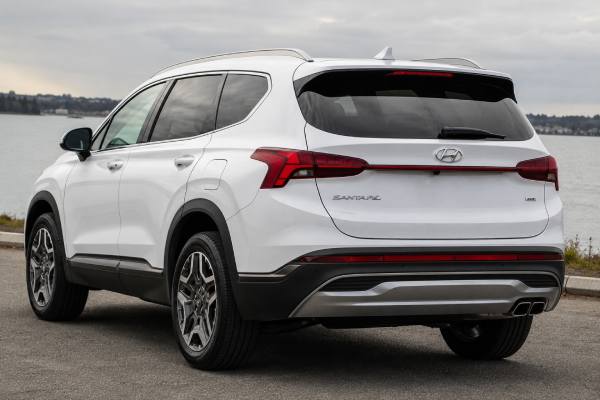

The facelifted TM-generation Hyundai Santa Fe with the 2.5 T-GDi engine is one of the more powerful two-row family SUVs from Hyundai’s 2021–2023 lineup. In front-wheel-drive form, it pairs a 277 hp turbocharged Smartstream four-cylinder with an 8-speed wet dual-clutch transmission, giving it stronger passing performance than the naturally aspirated 2.5-litre Santa Fe while keeping the same practical cabin, generous cargo area, and broad safety equipment package.
For used buyers, the key question is not whether the 2.5 T-GDi Santa Fe feels quick enough. It does. The more important questions are whether the wet DCT has received the required software and recall work, whether maintenance has been done on time, and whether the chosen trim has the equipment and headlight rating expected. The best examples are well-documented, serviced on schedule, and checked by VIN before purchase.
Quick Specs and Notes
- Strong 277 hp turbo engine gives the Santa Fe better highway passing power than the base 2.5 GDi model.
- FWD keeps weight and mechanical complexity lower than AWD while still offering stable road manners.
- Cargo space, rear-seat room, and standard driver assistance make it a practical family SUV.
- The 8-speed wet DCT needs careful VIN recall verification and smooth low-speed operation during a test drive.
- Normal-service oil changes are typically every 8,000 km / 5,000 miles or 6 months in some markets; always confirm the schedule for the VIN and region.
Table of Contents
- Santa Fe TM FWD Overview
- Santa Fe TM 2.5T Specs
- Santa Fe TM Trims Safety
- Reliability and Service Actions
- Maintenance and Buyer’s Guide
- Driving and Performance
- Comparison With Rivals
Santa Fe TM FWD Overview
The 2021–2023 Hyundai Santa Fe 2.5 T-GDi FWD belongs to the facelifted version of the fourth-generation Santa Fe, internally known as TM. In North American terms, it sits between compact crossovers such as the Tucson and larger three-row SUVs such as the Palisade. It is a five-passenger, front-engine, front-wheel-drive SUV with a broad cabin, a large cargo area, and a more comfort-oriented chassis tune than many sportier-looking rivals.
The 2.5 T-GDi engine is the major reason to choose this version over the base naturally aspirated Santa Fe. It uses Hyundai’s Smartstream turbocharged 2.5-litre four-cylinder architecture, with direct and port fuel injection, a timing chain, and a strong 422 Nm / 311 lb-ft torque output. That torque figure matters in daily use. It gives the Santa Fe easier acceleration onto highways, more relaxed climbing on grades, and less need to work the engine hard when carrying passengers.
FWD versions are best suited to buyers who mainly drive on paved roads, in mild climates, or in areas where winter tyres are used instead of relying on AWD. They are lighter and simpler than AWD models, and they avoid rear differential and transfer-case service needs. The trade-off is traction under hard acceleration, especially on wet roads, where the turbo engine can ask more from the front tyres than the base engine does.
The transmission is a wet 8-speed dual-clutch automatic. It is not a conventional torque-converter automatic, and it does not behave exactly like one at crawling speeds. In normal driving it shifts quickly and helps the turbo engine feel responsive. In heavy stop-start traffic, it can feel more mechanical than a traditional automatic, especially when creeping, reversing uphill, or repeatedly moving from brake to throttle. A healthy unit should still be predictable, smooth once rolling, and free from harsh clunks, warnings, or delayed engagement.
The facelift brought sharper exterior styling, upgraded interior screens on many trims, expanded driver assistance, and improved safety equipment availability. The cabin has a raised centre console, useful storage, supportive front seats, and a second row with adult-friendly space. It is not a three-row SUV, but that is part of its appeal: cargo room and second-row comfort are stronger than in many compact crossovers, while overall size remains manageable.
The 2.5 T-GDi FWD is most appealing as a used family SUV when it has complete service records, verified recall completion, and tyres in good condition. It is powerful and comfortable, but it is not the lowest-maintenance Santa Fe variant. Buyers who want maximum simplicity may prefer the naturally aspirated 2.5 GDi. Buyers who want better fuel economy may prefer the hybrid. Buyers who want the strongest petrol performance without AWD complexity will find this FWD turbo version the most direct fit.
Santa Fe TM 2.5T Specs
Specification details can vary by market, trim, wheel package, emissions calibration, and model year. The data below reflects the 2021–2023 facelifted TM Santa Fe 2.5 T-GDi FWD as most commonly sold in North American-style specification, with notes where figures are trim-dependent.
| Item | Hyundai Santa Fe 2.5 T-GDi FWD |
|---|---|
| Engine code | Smartstream G2.5 T-GDi, commonly listed as G4KP family |
| Layout and cylinders | Front transverse inline-4, DOHC, 4 valves per cylinder, 16 valves total |
| Bore × stroke | 88.5 × 101.5 mm / 3.48 × 4.00 in |
| Displacement | 2.5 L / 2,497 cc |
| Induction | Turbocharged and intercooled |
| Fuel system | GDI + MPI / direct and port injection |
| Compression ratio | About 10.0–10.5:1 depending on published market data |
| Maximum power | 277 hp / 207 kW at about 5,800–6,000 rpm |
| Maximum torque | 422 Nm / 311 lb-ft from about 1,700–4,000 rpm |
| Timing drive | Timing chain |
| Rated efficiency | About 9.4 L/100 km combined / 25 mpg US / 30 mpg UK; EPA-style rating commonly 22 city / 28 highway / 25 combined mpg US |
| Real-world highway at 120 km/h / 75 mph | Typically about 8.3–9.4 L/100 km / 25–28 mpg US / 30–34 mpg UK, depending on tyres, wind, load, and terrain |
| Item | Specification |
|---|---|
| Transmission | 8-speed wet dual-clutch automatic, Hyundai/Kia D8LF1 family |
| Drive type | FWD |
| Differential | Open front differential with traction and stability control |
| Front suspension | MacPherson strut |
| Rear suspension | Independent multi-link |
| Steering | Motor-driven rack-and-pinion power steering; about 13.7:1 ratio in published Hyundai data |
| Brakes | Ventilated front discs about 345 mm / 13.6 in; rear discs about 305 mm / 12.0 in |
| Popular tyre sizes | 235/55 R19 on many Limited versions; 255/45 R20 on many Calligraphy versions |
| Ground clearance | About 208 mm / 8.2 in |
| Length / width / height | 4,785 / 1,900 / about 1,685–1,710 mm; 188.4 / 74.8 / about 66.3–67.3 in |
| Wheelbase | 2,765 mm / 108.9 in |
| Turning circle | About 11.4 m / 37.4 ft kerb-to-kerb |
| Curb weight | About 1,772–1,825 kg / 3,907–4,025 lb depending on trim and equipment |
| GVWR | About 2,530 kg / 5,578 lb in common North American specification |
| Fuel tank | 67 L / 17.7 US gal / 14.7 UK gal |
| Cargo volume | About 1,031 L / 36.4 ft³ seats up; about 2,042 L / 72.1 ft³ seats folded, SAE method |
| Item | Typical figure |
|---|---|
| 0–100 km/h / 0–62 mph | About 7.6–8.0 seconds, depending on test method, tyres, and launch conditions |
| 0–60 mph | About 6.8–7.2 seconds in independent testing of closely related 2.5T models |
| Top speed | About 190–210 km/h / 118–130 mph, market-dependent |
| 100–0 km/h braking distance | Typically about 39–42 m / 128–138 ft on good tyres |
| Towing capacity | Up to 1,588 kg / 3,500 lb with trailer brakes; about 748 kg / 1,650 lb without trailer brakes in many North American ratings |
| Payload | Roughly 500–750 kg / 1,100–1,650 lb depending on trim, passengers, and equipment; verify door-jamb label |
| Item | Specification or capacity |
|---|---|
| Engine oil | SAE 0W-30 full synthetic; API SN PLUS / SP or later where specified; about 5.8 L / 6.1 US qt with filter in many service listings |
| Coolant | Hyundai long-life ethylene-glycol coolant, normally 50/50 premix; capacity varies by market and service method |
| Transmission fluid | Hyundai/Kia wet DCT fluid specification; service fill depends on repair procedure and should be dealer-confirmed |
| Differential / transfer case | Not applicable to FWD; no rear differential or transfer case |
| A/C refrigerant | R-1234yf in many markets; charge should be verified from under-hood label |
| A/C compressor oil | PAG-type oil as specified on the vehicle label; charge varies by compressor and market |
| Key torque specs | Wheel nuts commonly about 107–127 Nm / 79–94 lb-ft; oil drain plug commonly about 39 Nm / 29 lb-ft; verify by service manual |
| Item | Rating or equipment note |
|---|---|
| Euro NCAP | TM Santa Fe family rated 5 stars in 2018: 94% adult, 88% child, 67% vulnerable road users, 76% safety assist |
| IIHS | 2021–2023 Santa Fe achieved strong crash-test results; Top Safety Pick+ status applies to qualifying 2022–2023 vehicles and build dates |
| IIHS headlight rating | Good on many projector-LED Limited/Calligraphy versions; Acceptable or lower on some reflector-LED lower trims depending on year and build date |
| ADAS suite | AEB with pedestrian/cyclist capability on many versions, lane keeping/lane following, blind-spot systems, rear cross-traffic alert, adaptive cruise, Highway Driving Assist on higher trims |
Santa Fe TM Trims Safety
In the 2021–2023 facelift period, the 2.5 T-GDi engine was generally associated with the higher Santa Fe trims rather than the entry versions. In North America, the turbo engine appeared most commonly in Limited and Calligraphy grades, while SE, SEL, and XRT often used the naturally aspirated 2.5 GDi unless equipped differently by market. Trim naming outside the U.S. and Canada can differ, so the engine badge, VIN data, window sticker, and build sheet matter more than the trim name alone.
The main functional trim differences are not just upholstery and screens. Higher trims may bring larger wheels, projector LED headlights, more complete driver assistance, parking cameras, ventilated seats, upgraded audio, a larger infotainment screen, navigation-based adaptive cruise features, and a more premium interior finish. The 2.5 T-GDi FWD buyer should check whether the car has 19-inch or 20-inch wheels, because this affects replacement tyre cost, ride comfort, and pothole tolerance. The 19-inch package is usually the more comfortable and economical choice; the 20-inch package looks sharper but can transmit more impact harshness.
Quick identifiers include the engine label under the hood, dual-clutch transmission behaviour, turbo-specific parts layout, and the original window sticker. A 2.5 T-GDi vehicle should not be confused with the non-turbo 2.5 GDi. The turbo model has substantially more torque, uses the wet DCT rather than the base powertrain’s conventional automatic in many markets, and has different maintenance considerations.
Safety equipment is a major Santa Fe strength. Depending on trim and year, equipment may include:
- Forward Collision-Avoidance Assist with vehicle and pedestrian detection, with cyclist and junction-turning support on many later or higher trims.
- Lane Keeping Assist and Lane Following Assist.
- Blind-Spot Collision-Avoidance Assist and Rear Cross-Traffic Collision-Avoidance Assist.
- Adaptive cruise control, often with stop-and-go capability.
- Highway Driving Assist on higher trims.
- Surround-view camera and Blind-Spot View Monitor on upper grades.
- Multiple airbags, stability control, traction control, ABS, brake assist, hill-start assist, and downhill brake control.
Child-seat practicality is strong for the class. The second row has ISOFIX/LATCH anchor points, wide-opening rear doors, and a relatively flat floor. Rear-facing child seats usually fit well, though very tall front occupants should still test the seating arrangement before purchase.
Safety ratings need careful wording because the Santa Fe’s results are affected by market, build date, lighting package, and test protocol. The TM-generation Santa Fe achieved a 5-star Euro NCAP rating in 2018, before the facelift, and those results are commonly associated with the broader TM family. In the U.S., IIHS ratings for 2021–2023 models were strong, but headlight performance varied. Higher trims with projector LED headlights typically performed better than lower trims with reflector LED units. For a used purchase, this is not a small detail: headlight rating can be the difference between a good night-driving experience and a car that feels underlit on dark roads.
ADAS calibration is another ownership point. After windshield replacement, front camera work, bumper repairs, radar replacement, suspension alignment changes, or collision repair, the forward-facing camera and radar systems may require calibration. A Santa Fe with warning lights, unavailable lane support, or inconsistent adaptive cruise behaviour should be diagnosed before purchase rather than treated as a minor nuisance.
Reliability and Service Actions
The 2.5 T-GDi Santa Fe is not a fragile vehicle when maintained correctly, but it has several known areas that deserve more attention than a routine cosmetic inspection. The highest-priority item is the 8-speed wet dual-clutch transmission, especially on affected 2021–2022 vehicles covered by Hyundai safety recall and service action material related to the transmission electric oil pump and TCU software.
The headline recall concern involved the transmission high-pressure electric oil pump fault logic. In affected vehicles, warning lights and fault codes could appear, followed by a limited-mobility condition and potential loss of motive power. The official remedy centred on a transmission control unit update, with transmission replacement required in certain fault-code cases. For a buyer, the practical step is simple: check the VIN through the official recall tool and ask for dealer records showing recall completion. A seller saying “it was probably done” is not enough.
Common and occasional issues to watch include:
| Prevalence | System | Symptoms | Likely cause | Remedy and cost tier |
|---|---|---|---|---|
| Common enough to verify | 8-speed wet DCT | Warnings, limp mode, harsh engagement, delayed drive, clunking | TCU calibration, electric oil pump fault, internal DCT issue | Software update or DCT repair/replacement; medium to high |
| Occasional | Turbo oil feed and sealing | Oil smell, visible leak, smoke, low oil level | Oil line or gasket concern on affected vehicles | Inspect and replace affected pipe/seals; medium |
| Occasional | Direct-injection intake deposits | Rough idle, hesitation, misfire at higher mileage | Carbon build-up on intake valves, short-trip use | Diagnosis and intake cleaning if confirmed; medium |
| Occasional | Cooling system | Coolant loss, temperature fluctuation, warning message | Hose, clamp, thermostat module, or radiator-related leak | Pressure test and repair leaking component; low to medium |
| Occasional | Rear camera | Blank or intermittent reverse image | Camera circuit board or solder-joint failure on affected 2021–2022 vehicles | Recall inspection and camera replacement where applicable; low if covered |
| Normal wear | Suspension and brakes | Knocks, vibration, brake pulsation, tyre feathering | Bushings, links, rotors, alignment, tyre wear | Wear-part service; low to medium |
The engine itself uses a timing chain, so there is no scheduled timing belt replacement. That does not mean the timing system should be ignored forever. Rattling at cold start, cam/crank correlation faults, persistent oil neglect, or metallic noise from the timing cover area should be investigated. Chain stretch, tensioner wear, and guide wear are not expected as routine early-life failures, but poor oil service can shorten timing-component life.
Oil quality matters because the turbocharger, timing system, and hydraulic components all depend on clean, correct-viscosity oil. The 2.5 T-GDi commonly calls for 0W-30 full synthetic oil meeting Hyundai’s required API specification. Long oil intervals, cheap filters, wrong viscosity, or repeated short trips can increase the chance of sludge, turbo wear, chain noise, and oil-control issues. A well-kept service history is therefore a major value marker.
Software updates also matter. Beyond the DCT recall, updates may address transmission shift logic, warning behaviour, infotainment bugs, camera operation, and driver assistance calibration. During a pre-purchase inspection, ask the dealer to check open campaigns, completed recalls, and applicable technical service bulletins. For a vehicle still under warranty, this is usually straightforward.
Corrosion is not a defining weakness of the facelifted TM Santa Fe, but regional climate matters. Inspect the rear subframe area, suspension mounting points, brake lines, lower door seams, tailgate edges, exhaust hangers, and underbody fasteners. Vehicles from salted-road regions deserve a lift inspection. Surface rust on fasteners is normal; swelling seams, flaky structural corrosion, or heavily rusted brake lines are not.
The best pre-purchase checks are a cold start, a full diagnostic scan, a long test drive with city creeping and highway acceleration, a VIN recall check, underbody inspection, tyre wear reading, and confirmation that the transmission engages Drive and Reverse cleanly when hot. If the car has any DCT warning history, unresolved check-engine light, or inconsistent service documentation, price it accordingly or walk away.
Maintenance and Buyer’s Guide
The Santa Fe 2.5 T-GDi rewards disciplined maintenance. It is a high-output turbocharged SUV with a wet DCT, so it should not be treated like a low-stress naturally aspirated commuter. Service intervals vary by country, oil specification, driving conditions, and warranty schedule, but the following practical schedule is a sensible framework for ownership planning.
| Service item | Typical interval | Notes |
|---|---|---|
| Engine oil and filter | Every 8,000 km / 5,000 miles or 6 months in severe use; some normal schedules allow longer | Use correct 0W-30 full synthetic and OEM-quality filter |
| Engine air filter | Inspect every 16,000 km / 10,000 miles; replace around 32,000–48,000 km / 20,000–30,000 miles | Replace sooner in dusty regions |
| Cabin air filter | Every 12 months or about 16,000 km / 10,000 miles | Cheap and useful for HVAC performance |
| Spark plugs | About 72,000 km / 45,000 miles in some Hyundai maintenance schedules for the 2.5 T-GDi | Use correct heat range; misfires under boost can damage catalysts |
| Coolant | First replacement often around 192,000 km / 120,000 miles or 10 years, then shorter intervals | Inspect level and hoses at every service |
| Brake fluid | Every 2–3 years | Important for pedal feel and ABS/ESC reliability |
| Brake pads and rotors | Inspect every service | Check inner pad wear and rear parking-brake function |
| Wet DCT fluid | Follow official schedule; consider earlier service under towing, heat, or heavy traffic | Use only specified wet DCT fluid and correct procedure |
| Tyre rotation | Every 8,000–12,000 km / 5,000–7,500 miles | FWD turbo models can wear front tyres quickly |
| Wheel alignment | Annually or after impacts / uneven wear | Protects tyres and improves lane-assist behaviour |
| Serpentine belt and hoses | Inspect every 16,000–24,000 km / 10,000–15,000 miles | Replace if cracked, swollen, noisy, or contaminated |
| Timing chain system | No routine belt-style replacement | Inspect if noise, correlation faults, or oil-neglect history appear |
| 12 V battery | Test annually after year three | Weak batteries can create electronic and ADAS nuisance faults |
A good buyer’s inspection starts before the test drive. Check the VIN, build date, recall completion, maintenance history, tyre brand and date codes, and whether the car still has factory-size wheels. A Santa Fe with mismatched budget tyres, no DCT recall proof, and long oil-change gaps should be treated cautiously even if it looks clean.
During the test drive, start the engine cold and listen for timing-chain rattle, injector noise beyond the normal direct-injection tick, belt squeal, or exhaust leaks. The idle should settle smoothly. The transmission should engage Reverse and Drive without a long pause or violent thump. At low speed, a wet DCT may feel slightly more direct than a torque-converter automatic, but it should not surge, shudder heavily, or trigger warnings.
On the road, test light throttle, moderate acceleration, and a firm highway merge. The turbo engine should build torque smoothly, and the transmission should shift decisively without flare or repeated hunting. Brake from highway speed if safe to do so; vibration suggests rotor runout or uneven pad deposits. Let go lightly of the wheel on a flat road to check tracking, while staying ready to correct. Uneven pull can indicate alignment, tyre, or suspension issues.
Recommended versions are usually the cleanest Limited or Calligraphy examples with documented dealer campaign completion and conservative wheel/tyre condition. The Limited trim often gives a good balance of equipment, projector headlights, comfort features, and lower replacement cost than a fully loaded Calligraphy on 20-inch wheels. Calligraphy models are appealing if the buyer values premium interior trim, larger wheels, and extra convenience features, but condition matters more than badge.
Avoid cars with unexplained DCT warnings, repeated transmission repairs without clear paperwork, oil leaks around the turbo, overheating history, accident repairs near radar/camera mounting points, or heavily worn front tyres at low mileage. A cheaper example can quickly become expensive if it needs tyres, brakes, DCT diagnosis, camera replacement, and overdue fluids at the same time.
Long-term durability should be solid when the car is serviced correctly, recalls are complete, and the transmission operates normally. The engine has strong output for its size, so oil discipline and cooling-system health are essential. For owners planning to keep the vehicle beyond 160,000 km / 100,000 miles, shorter oil intervals, early attention to small leaks, periodic DCT service evaluation, and careful tyre/alignment maintenance are worthwhile.
Driving and Performance
The Santa Fe 2.5 T-GDi FWD feels more muscular than its family-SUV shape suggests. The engine’s 422 Nm / 311 lb-ft torque output arrives low enough in the rev range to make normal driving easy. It does not need to be revved hard to keep up with traffic, and it feels notably stronger than the base 2.5 GDi when joining a motorway or passing on a two-lane road.
Throttle response is generally prompt, although the wet DCT shapes the first few metres of movement. From a stop, there can be a brief moment of clutch engagement before the car moves cleanly. Once rolling, shifts are quick and the powertrain feels more energetic than most naturally aspirated four-cylinder rivals. Sport mode sharpens throttle and holds lower gears longer, but Comfort or Normal mode is better for smooth family driving.
Ride quality depends heavily on wheel size. On 19-inch wheels with sensible all-season tyres, the Santa Fe is calm and comfortable over broken pavement. On 20-inch wheels, it can feel firmer over sharp edges, though still not harsh by class standards. The suspension controls body movement well, and the longer wheelbase gives the SUV good highway stability. It is not as crisp as a Mazda CX-5 or as cushioned as a Subaru Outback on tall-sidewall tyres, but it strikes a useful middle ground.
Steering is light at parking speeds and steady on the highway. Feedback is limited, but response is predictable. The FWD chassis will understeer if pushed hard, especially because the turbo engine can load the front tyres aggressively. In normal use, the stability control system manages traction without drama. Good tyres make a major difference, particularly in rain, because a front-drive turbo SUV can spin or tug at the steering wheel if the tyres are old or poor quality.
Braking performance is appropriate for the vehicle’s weight. Pedal feel is usually progressive, and the larger front discs used on turbo-equipped versions help with repeated stops. A loaded Santa Fe or one towing a small trailer will still need extra braking distance, so maintenance of pads, rotors, brake fluid, and tyres is important.
Real-world efficiency is reasonable rather than exceptional. In city use, expect roughly 10.7–12.4 L/100 km / 19–22 mpg US / 23–26 mpg UK depending on traffic and trip length. Mixed driving often lands around 9.0–10.2 L/100 km / 23–26 mpg US / 28–31 mpg UK. Highway cruising at 100–120 km/h / 60–75 mph can return about 8.3–9.4 L/100 km / 25–28 mpg US / 30–34 mpg UK if the vehicle is lightly loaded and tyres are properly inflated. Cold weather, roof boxes, short trips, and 20-inch tyres can push consumption higher.
Towing is possible, but this is not the ideal version for frequent heavy towing. The 2.5 T-GDi has enough torque, and the rated braked capacity is useful for small trailers, compact campers, or utility loads. Still, the DCT should be treated with mechanical sympathy. Avoid repeated creeping uphill with a trailer, keep loads within the rated limits, use trailer brakes where required, and service the vehicle more frequently if towing is common. Expect fuel consumption to rise significantly under tow, often by 30–60% depending on trailer shape and speed.
Cabin noise is well controlled for the class. Wind noise is moderate, engine noise is subdued at cruise, and road noise mainly depends on tyres. Higher trims with better glass and insulation feel more refined. The Santa Fe’s strongest dynamic qualities are relaxed cruising, confident passing power, and everyday comfort, not sporty handling.
Comparison With Rivals
The Santa Fe 2.5 T-GDi FWD competes with a wide group of two-row and smaller three-row crossovers, including the Kia Sorento 2.5T, Toyota RAV4 and Venza, Honda CR-V, Subaru Outback, Mazda CX-5 and CX-50, Nissan Murano, Ford Edge, and Volkswagen Tiguan in some markets. Its strongest advantage is that it combines a roomy two-row cabin with a powerful turbo engine and a high level of equipment for the money.
Against the Kia Sorento 2.5T, the Santa Fe feels closely related mechanically but has a different mission. The Sorento offers available three-row seating in many markets, while the Santa Fe focuses on two-row comfort and cargo flexibility. If occasional third-row use matters, the Sorento has the advantage. If second-row comfort and cargo room are more important, the Santa Fe is often the cleaner choice.
Compared with the Toyota RAV4 or Honda CR-V, the Santa Fe feels larger, stronger, and more premium in upper trims. The Toyota and Honda are usually better choices for buyers prioritising simplicity, resale value, and fuel economy, especially in hybrid form. The Santa Fe 2.5T is more satisfying for passing power and cabin space, but it brings more transmission complexity and higher fuel use.
The Subaru Outback is a strong alternative for rough-weather regions. It offers standard AWD, a comfortable ride, and good long-distance comfort. The Santa Fe counters with a more conventional SUV seating position, a wider-feeling cabin, stronger turbo performance in 2.5T form, and often richer equipment. Buyers who regularly drive on snow-covered rural roads may prefer the Subaru; buyers who want a quiet, powerful, well-equipped family SUV may prefer the Hyundai.
Mazda’s CX-5 and CX-50 are more engaging to drive. Their steering, body control, and interior tactility appeal to drivers who want a more connected feel. The Santa Fe is roomier and more relaxed, with better rear-seat and cargo practicality. The Mazda models are better for enthusiastic drivers; the Hyundai is better for families who value space and comfort.
The Ford Edge and Nissan Murano are similar in size philosophy: comfortable two-row crossovers with generous cabins. The Santa Fe feels newer inside than many older Edge or Murano examples from the same period, and the Hyundai’s driver-assistance package is competitive. The Ford’s conventional automatic and available V6 or turbo options may appeal to buyers wary of DCT behaviour, while the Hyundai offers a more modern cabin and stronger warranty coverage when still within term.
| Model | Main advantage over Santa Fe 2.5T FWD | Main Santa Fe advantage |
|---|---|---|
| Kia Sorento 2.5T | Available third row in many markets | Simpler two-row packaging and strong cargo usability |
| Toyota RAV4 / Venza | Fuel economy and resale strength | More power, more space, richer upper-trim feel |
| Honda CR-V | Practicality and low-stress ownership reputation | Stronger turbo performance and larger-SUV feel |
| Subaru Outback | Standard AWD and rough-weather confidence | More SUV-like cabin and stronger 2.5T acceleration |
| Mazda CX-5 / CX-50 | Sharper handling and driver engagement | More rear-seat and cargo space |
| Ford Edge | Conventional automatic and broad cabin | Newer-feeling technology and strong safety equipment |
The Santa Fe 2.5 T-GDi FWD is worth considering if the buyer wants strong acceleration, good comfort, generous space, and a high equipment level without stepping into a larger three-row SUV. It is less ideal for buyers who want the simplest possible drivetrain, maximum fuel economy, or frequent heavy towing capability. Its value depends heavily on condition and documentation. A well-maintained example with completed recalls can be an excellent used SUV; a neglected one with DCT symptoms should be avoided.
References
- 2022 Santa Fe Specifications 2021 (Manufacturer Specifications)
- 9. Maintenance 2020 (Owner’s Manual)
- 2023 Hyundai Santa Fe 4-door SUV 2023 (Safety Rating)
- Hyundai SANTA FE 2018 (Safety Rating)
- Part 573 Safety Recall Report 22V-746 2022 (Recall Database)
Disclaimer
This article is for informational purposes only and is not a substitute for professional diagnosis, repair, or inspection. Specifications, torque values, service intervals, capacities, software updates, recall coverage, and procedures can vary by VIN, market, production date, trim, and installed equipment. Always verify details against the official owner’s manual, service manual, under-hood labels, dealer records, and current manufacturer documentation for the specific vehicle.
If you found this useful, please consider sharing it on Facebook, X/Twitter, or another platform to support our work.