
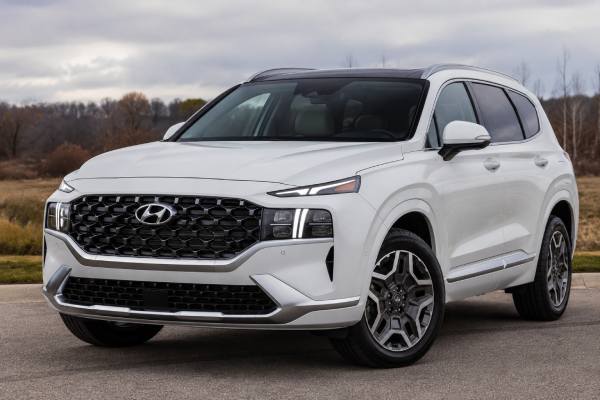
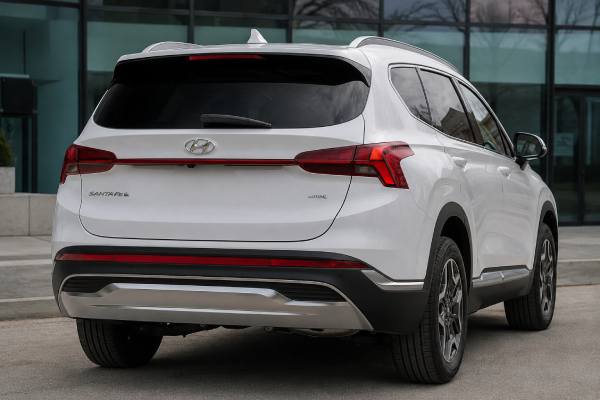

The facelifted TM-generation Hyundai Santa Fe Hybrid brought a meaningful change to the fourth-generation Santa Fe: a downsized turbo petrol engine, a conventional 6-speed automatic gearbox, and a compact self-charging hybrid system. In front-wheel-drive form, it is aimed less at off-road ability and more at family use, long-distance comfort, lower fuel use than the diesel or large petrol alternatives, and strong equipment value.
For used buyers, the important point is that this is not a plug-in hybrid. There is no external charging port, no large traction battery to charge overnight, and no quoted EV-only range. Instead, the 1.49 kWh lithium-ion polymer battery supports low-speed electric running, engine-off coasting, regenerative braking, and stronger torque response in traffic. The result is a large, seven-seat SUV that feels smoother and more efficient in normal use than its size suggests, while still requiring regular petrol-engine maintenance.
Fast Facts
- 230 PS system output and 350 Nm of combined torque give the FWD Santa Fe Hybrid relaxed real-world performance.
- The 6-speed automatic is smoother and less fussy than many dual-clutch systems in family-SUV use.
- Practical strengths include seven seats in many European/UK specifications, a large 67 L fuel tank, and braked towing up to 1,650 kg.
- Check recall completion, hybrid coolant condition, brake corrosion, 12 V battery health, and software update history before buying.
- A sensible ownership interval is engine oil and filter every 10,000 miles / 16,000 km or 12 months, with shorter intervals for severe use.
Table of Contents
- Santa Fe TM Hybrid Profile
- Santa Fe TM Technical Specs
- Santa Fe TM Trims and Safety
- Reliability and Service Actions
- Maintenance and Used Buying
- Driving, Performance and Efficiency
- Comparison With Key Rivals
Santa Fe TM Hybrid Profile
The 2021–2023 Hyundai Santa Fe FWD 1.6 T-GDi HEV belongs to the facelifted fourth-generation Santa Fe, known by the TM platform code. Although it looks like a mid-cycle facelift, the update was more substantial than a typical bumper-and-light revision. Hyundai moved the Santa Fe onto a newer platform architecture, added hybrid and plug-in hybrid drivetrains, updated the cabin, expanded driver-assistance technology, and gave the car a more upscale front-end design with T-shaped lighting signatures.
The version covered here is the full hybrid, not the plug-in hybrid. It uses Hyundai’s Smartstream 1.6-litre turbocharged direct-injection petrol engine paired with a transmission-mounted electric motor. The combined system output is 230 PS, marketed in many listings as 230 hp, with 350 Nm of system torque. Power goes to the front wheels through a 6-speed automatic transmission. That detail matters because this hybrid avoids the rubber-band feel of some eCVT hybrids and the low-speed hesitation sometimes found in dry dual-clutch gearboxes.
In Europe and the UK, this model commonly appeared in Premium and Ultimate specifications, with 2WD and HTRAC 4WD versions offered depending on market. The FWD model is the lighter and more economical choice. It does not have the extra traction of the AWD version, but it also avoids extra driveline weight and complexity. For most family use—school runs, commuting, motorway travel, and holiday trips—the FWD layout is adequate, provided the tyres are good and the vehicle is not expected to cope regularly with steep, snowy, or muddy roads.
The Santa Fe Hybrid’s biggest appeal is its mix of size and refinement. It is quieter in urban driving than the diesel, smoother at low speeds than older petrol automatics, and more efficient around town than a conventional turbo petrol SUV of similar size. It is not a performance SUV, but the electric motor helps mask turbo lag and gives the car a confident step-off from junctions.
Its main caveat is complexity. Compared with the older diesel Santa Fe, there are more electronic systems, a high-voltage battery, inverter cooling, hybrid control modules, regenerative braking, and ADAS sensors to maintain. That does not make it fragile, but it does make service history more important. A well-maintained Santa Fe Hybrid with dealer campaign records and regular fluid services is a much safer purchase than a cheaper one with missing maintenance evidence.
Santa Fe TM Technical Specs
Figures below focus on the facelifted TM Santa Fe 1.6 T-GDi Hybrid FWD sold in 2021–2023 European/UK-style specification. Some values vary by market, trim, seating layout, wheels, production date, and homologation method, so VIN-level confirmation is still important.
| Item | Hyundai Santa Fe FWD 1.6 T-GDi HEV |
|---|---|
| Engine code | Smartstream G1.6 T-GDi HEV; commonly listed as G4FP in European catalogues, with market documentation varying |
| Engine layout and cylinders | Front transverse inline-4 petrol, DOHC, 16 valves, 4 valves per cylinder |
| Bore × stroke | 75.6 × 89.0 mm (2.98 × 3.50 in) |
| Displacement | 1.6 L (1,598 cc) |
| Induction | Turbocharged, intercooled |
| Fuel system | Turbo gasoline direct injection |
| Compression ratio | 10.5:1 |
| ICE output | 180 PS / 132.2 kW @ 5,500 rpm |
| ICE torque | 265 Nm (195.5 lb-ft) @ 1,500–4,500 rpm |
| Electric motor | Permanent magnet synchronous motor, one front transmission-mounted motor |
| Motor output | 60.1 PS / 44.2 kW |
| Motor torque | 264 Nm (194 lb-ft) |
| System voltage | 270 V |
| Battery | 1.49 kWh lithium-ion polymer high-voltage battery |
| Combined system output | 230 PS / 169.2 kW @ 5,500 rpm |
| Combined system torque | 350 Nm (258 lb-ft) @ 1,500–4,500 rpm |
| Timing drive | Chain-driven camshaft system; inspect for noise, timing faults, or tensioner/guide wear rather than replacing by a fixed belt interval |
| Rated efficiency | About 6.4–6.9 L/100 km combined WLTP, depending on wheels and trim; about 34–37 mpg US / 41–44 mpg UK |
| Real-world highway at 120 km/h | Typically about 7.0–8.5 L/100 km, depending on tyres, temperature, load, wind, and terrain |
| Item | Specification |
|---|---|
| Transmission | Smartstream 6-speed automatic hybrid transmission; A6MF2H-family in later Hyundai technical data |
| Drive type | Front-wheel drive |
| Differential | Open front differential with ABS/ESC-based traction management |
| Front suspension | MacPherson strut |
| Rear suspension | Multi-link |
| Steering | Motor-driven power steering, approximately 2.62 turns lock-to-lock |
| Turning circle | 11.4 m (37.4 ft) |
| Front brakes | 325 mm (12.8 in) ventilated discs |
| Rear brakes | 325 mm (12.8 in) ventilated discs |
| Popular tyre sizes | 235/65 R17 on Premium-type trims; 235/55 R19 on higher trims |
| Ground clearance | Approximately 176 mm (6.9 in), market and tyre dependent |
| Length / width / height | 4,785 / 1,900 / about 1,710 mm (188.4 / 74.8 / 67.3 in) |
| Wheelbase | 2,765 mm (108.9 in) |
| Kerb weight | Approximately 1,780–1,906 kg (3,924–4,202 lb), depending on trim and equipment |
| GVWR | Approximately 2,580 kg (5,688 lb) |
| Fuel tank | 67 L (17.7 US gal / 14.7 UK gal) |
| Cargo volume | About 571 L seats up / 1,649 L seats down, VDA method, for common seven-seat European specification |
| Item | Specification or guidance |
|---|---|
| 0–100 km/h / 0–62 mph | 8.9 seconds |
| Top speed | 187 km/h (116 mph) |
| Braking distance | Independent 100–0 km/h figures vary by tyre and test conditions; no single official public value should be treated as universal |
| Towing capacity | 1,650 kg (3,638 lb) braked; 750 kg (1,653 lb) unbraked |
| Payload | Approximately 674–800 kg (1,486–1,764 lb), depending on kerb weight and equipment |
| Engine oil | SAE 0W-20, API SN PLUS/SP or ILSAC GF-6 full synthetic; about 4.8 L (5.1 US qt) drain and refill |
| Coolant | Phosphate-based ethylene glycol coolant for aluminium engines; commonly mixed 50:50 with deionized/distilled/soft water unless climate requires otherwise |
| Engine coolant capacity | About 7.31 L (7.72 US qt) in North American HEV documentation; verify by market |
| Inverter coolant capacity | About 1.71 L (1.8 US qt) for HEV in North American documentation |
| Transmission fluid | Hyundai Genuine ATF SP4M-1 or equivalent; about 6.0 L (6.3 US qt) total service reference, method dependent |
| Differential / transfer case | Not applicable to FWD model; AWD versions use separate rear and transfer oils |
| Brake fluid | DOT 4 LV / SAE J1704 / ISO 4925 Class 6, as required |
| A/C refrigerant | R1234yf; about 625 g front-only or 800 g front + rear system in HEV documentation |
| A/C compressor oil | POE oil; about 150 g front-only or 230 g front + rear system in HEV documentation |
| Key torque values | Wheel nuts commonly 107–127 Nm (79–94 lb-ft); oil drain plug commonly about 39–44 Nm (29–32 lb-ft), but verify by VIN service data |
| Euro NCAP | TM Santa Fe rated 5 stars in 2018: 94% adult, 88% child, 67% vulnerable road users, 76% safety assist under that test protocol |
| IIHS | 2021 Santa Fe achieved strong crashworthiness results; headlight ratings vary by trim and build date |
| ADAS | AEB with car/pedestrian/cyclist/junction support, lane keeping, blind-spot systems, rear cross-traffic systems, adaptive cruise, highway assist on higher trims, and speed-limit warning depending on trim and market |
Santa Fe TM Trims and Safety
In the UK-style launch specification, the facelifted Santa Fe Hybrid FWD was offered mainly as Premium and Ultimate, with both trims already well equipped. Premium typically included 17-inch alloy wheels, seven seats, leather seat facings, heated front and outer rear seats, dual-zone climate control, a 10.25-inch navigation system, Bluelink connected services, a KRELL audio system, smart key, electric tailgate, rear camera, front and rear parking sensors, and a strong standard safety package.
Ultimate added more of the “large family flagship” equipment: 19-inch wheels, ventilated front seats, driver memory, panoramic sunroof, 12.3-inch digital cluster, head-up display, surround-view monitor, blind-spot view monitor, remote smart parking assist, highway drive assist, and additional parking collision avoidance features. A Luxury Pack was available in some markets, bringing Nappa leather, suede headlining, and upgraded cabin trim. These features are easy to identify on a used car: look for the digital cluster, head-up display projection area, surround-view camera button, ventilated-seat controls, panoramic roof, and blind-spot camera feed in the instrument panel.
Mechanically, the main differences are not dramatic. The 2WD hybrid uses the same 230 PS hybrid powertrain and 6-speed automatic whether in Premium or Ultimate form. The more important practical differences are weight, wheels, equipment load, and fuel consumption. A Premium on 17-inch wheels is usually the better comfort-and-economy choice. An Ultimate feels more premium but rides slightly firmer on 19-inch tyres and can be more expensive to recondition because cameras, parking sensors, roof equipment, and electronic comfort systems add inspection points.
Safety equipment is a major strength. Common systems include Forward Collision-Avoidance Assist with car, pedestrian, cyclist and junction-turning support, Lane Keep Assist, Lane Departure Warning, Driver Attention Alert, Blind Spot Collision Avoidance Assist, Rear Cross Traffic Alert, electronic stability control, hill-start assist, trailer stability assist, eCall, parking distance warning, tyre-pressure monitoring, and ISOFIX/i-Size child-seat points. Higher trims may add Highway Drive Assist, blind-spot view cameras, surround-view monitoring, and reverse parking collision avoidance.
The Euro NCAP rating commonly cited for this generation is the 2018 five-star TM Santa Fe result. It remains useful as a structural and safety-package reference, but test protocols evolve, and exact applicability can vary with facelift equipment and market specification. IIHS results for the 2021 Santa Fe are also strong, but the headlight result is trim-sensitive. Projector LED systems on higher trims performed better than some reflector LED systems, and build date mattered in the US ratings. For a buyer, this means a “five-star” or “Top Safety Pick” label is not the whole story; check the actual lighting hardware and ADAS equipment fitted to the car in front of you.
ADAS calibration is another ownership point. Windscreen replacement, front bumper repair, radar removal, wheel alignment changes, or suspension work can require camera/radar calibration. A car that has had front-end accident repair should be scanned for ADAS faults, checked for correct warning-light behaviour, and road-tested to confirm lane support, adaptive cruise, blind-spot monitoring, and parking systems operate normally.
Reliability and Service Actions
The Santa Fe 1.6 T-GDi HEV is generally viewed as a solid large hybrid SUV when serviced properly, but it is too modern and too electronically complex to judge purely by old-school engine durability. The best examples are those with regular oil services, correct coolant, documented recall completion, clean hybrid-system scans, and no neglected brake or suspension wear.
Common or more likely ownership issues are usually low-to-medium severity. Brake-disc corrosion is one of the most predictable. Because regenerative braking handles part of normal deceleration, the friction brakes may work lightly in town driving. Cars used for short trips or parked outside in wet climates can develop rusty rear discs, uneven pad contact, or brake noise. The remedy is not complicated: inspect pad sweep, service the sliders, replace worn discs and pads, and occasionally use firmer brake applications where safe to keep the discs clean.
Occasional issues include 12 V battery weakness, keyless-entry faults, infotainment glitches, Bluelink connectivity problems, parking sensor warnings, camera faults, and ADAS warning messages. Many of these are solved with battery testing, software updates, sensor cleaning, wiring checks, or dealer calibration. A weak 12 V battery can create misleading hybrid or driver-assistance warnings, so it should be tested before replacing expensive modules.
Powertrain problems appear less common, but they deserve careful inspection. The 1.6 T-GDi is a direct-injection turbo engine, so oil quality, warm-up habits, and short-trip use matter. Watch for rough cold starts, misfires, oil leaks, coolant smell, poor boost response, timing-chain noise at start-up, or engine-management lights. Direct-injection carbon build-up is not usually an early-life concern, but at higher mileage it can contribute to rough running or loss of response, especially on cars driven mostly on short trips.
The hybrid battery is small and works within a controlled state-of-charge window, so severe degradation is less of a concern than on high-mileage EVs or neglected plug-in hybrids. Still, a pre-purchase scan should check battery module voltage spread, cooling-system faults, contactor errors, inverter codes, and DC–DC converter behaviour. The HEV has no onboard charger, DC fast charging hardware, or charge port, so those plug-in-specific checks do not apply. The key electrified-system checks are high-voltage battery health, inverter coolant condition, DC–DC operation, hybrid starter-generator belt condition, and absence of warning lights.
The 6-speed automatic is usually smooth and well suited to the hybrid system. Harsh engagement, delayed Drive/Reverse selection, flaring, shuddering, or repeated hunting can point to fluid condition, software adaptation, mounts, sensors, or internal wear. The transmission fluid is often treated as low-maintenance under normal use, but for long-term ownership, fluid replacement around 60,000 miles / 96,000 km is a sensible preventive step, especially for heavy urban use, hot climates, towing, or high-load operation.
Service actions and recalls are VIN-specific. In the US, notable campaign examples affecting some Santa Fe Hybrid vehicles include the seat-belt pretensioner recall for certain 2021–2022 vehicles, the trailer tow hitch harness fire-risk recall for certain 2021–2023 vehicles equipped with affected harnesses, and later camera-related recalls for certain related Santa Fe HEV production ranges. These campaigns do not automatically apply to every market or every VIN. Before buying, ask for dealer printouts showing all open and completed recalls, service campaigns, software updates, and warranty actions.
A strong pre-purchase inspection should include:
- Full dealer or specialist service history with oil grade and dates, not just mileage.
- VIN recall check and proof of completed campaigns.
- Hybrid-system diagnostic scan, including battery, inverter, DC–DC converter, and cooling codes.
- ADAS scan and calibration history if the windscreen, bumper, suspension, or front radar area has been repaired.
- Brake-disc condition check, especially rear discs and inner pad faces.
- Coolant inspection for correct type, level stability, and signs of mixing or contamination.
- Road test from cold, including EV-to-ICE transitions, gearbox shifts, hard acceleration, regenerative braking, and parking manoeuvres.
Maintenance and Used Buying
The Santa Fe Hybrid rewards preventive maintenance. It is not enough to treat it as a simple petrol SUV, because the hybrid cooling loop, DC–DC charging system, brake regeneration, ADAS hardware, and 12 V electrical condition all affect reliability. It is also not an EV, so oil, spark plugs, filters, belts, coolant, brake fluid, and transmission fluid remain important.
| Item | Suggested interval | Notes |
|---|---|---|
| Engine oil and filter | Every 10,000 miles / 16,000 km or 12 months; shorter under severe use | Use 0W-20 full synthetic meeting the correct API/ILSAC specification |
| Engine oil level | Monthly and before long trips | Small turbo engines can consume oil; do not wait for a warning light |
| Cabin air filter | 12 months or 10,000–15,000 miles | Replace sooner in dusty or polluted areas |
| Engine air filter | 20,000–30,000 miles / 32,000–48,000 km | Inspect more often on dusty roads |
| Spark plugs | About 50,000 miles / 80,000 km in many HEV schedules | Use the correct heat range and torque; misfires can damage the catalyst |
| Fuel filter / fuel system | Inspect by schedule; replacement is market dependent | Use quality petrol; some markets specify injector cleaner if detergent fuel is unavailable |
| HSG / auxiliary belts | Inspect at every service; replace when worn or by market schedule | Noise, cracking, oil saturation, or charging faults need prompt attention |
| Timing chain | No routine belt-style replacement | Investigate chain rattle, cam/crank correlation faults, or tensioner/guide wear |
| Brake fluid | Every 2 years is a sensible rule | Use DOT 4 LV / ISO 4925 Class 6 specification |
| Brake pads and rotors | Inspect at every service | Look for corrosion and uneven sweep from light regenerative-braking use |
| Automatic transmission fluid | Consider around 60,000 miles / 96,000 km | Use Hyundai ATF SP4M-1 equivalent; method and level setting are temperature-sensitive |
| Engine coolant | Follow official schedule; long-life coolant often has extended first interval | Use phosphate-based ethylene glycol coolant compatible with aluminium engines |
| Inverter coolant | Follow official hybrid schedule | Wrong coolant can damage hybrid-system components |
| Tyre rotation and alignment | Every 6,000–10,000 miles / 10,000–16,000 km | Heavy front axle load can wear front tyres quickly on FWD models |
| 12 V battery | Test annually after year three | Weak voltage can trigger confusing electrical and ADAS faults |
| ADAS calibration | After windscreen, radar, bumper, suspension, or alignment work | Confirm with scan data and road-test behaviour |
For a used buyer, the best FWD Santa Fe Hybrid is not always the highest trim. A Premium on 17-inch wheels can be the sweet spot because it keeps the hybrid’s comfort and economy advantages while reducing tyre cost and ride harshness. Ultimate models are more luxurious and desirable, but every added camera, seat motor, roof mechanism, and driver-assistance feature should work perfectly.
Check the body carefully. The Santa Fe is large, often family-used, and commonly parked in tight spaces. Look for repaired bumpers, misaligned parking sensors, scratched camera lenses, cracked lower trims, kerbed wheels, and tailgate damage. Underneath, inspect rear suspension arms, subframe surfaces, brake lines, exhaust hangers, jacking points, and underbody trays. Normal surface corrosion is not unusual in wet climates, but heavy scaling on structural areas or poorly repaired accident damage should lower the price or end the deal.
Inside, test every seat function, folding mechanism, climate zone, USB port, infotainment feature, tailgate function, camera view, and safety warning light. Third-row seat belts and latches should retract cleanly. Water leaks around the panoramic roof, tailgate seals, or rear quarter areas are uncommon but worth checking because moisture can create electrical faults.
Long-term durability should be good if the car is maintained correctly. The biggest mistake is buying only on mileage. A 70,000-mile car with annual oil services, brake work, recall completion, and clean diagnostics is usually a better prospect than a low-mileage car used only for short trips, serviced late, and parked with rusty brakes and a weak battery.
Driving, Performance and Efficiency
The Santa Fe Hybrid FWD is at its best when driven as a refined family SUV rather than a sporty crossover. The driving position is high, visibility is good, and the cabin feels calm at urban speeds. The electric motor gives the car a smooth initial step-off, while the petrol engine joins in with less fuss than many older hybrid systems. The changeover between electric assistance and petrol power is usually subtle, although cold starts, low battery state, steep hills, or heavy throttle can make the engine more noticeable.
The 6-speed automatic gives the Santa Fe a familiar feel. It shifts like a conventional automatic rather than holding constant revs like many eCVT hybrids. In gentle driving, the gearbox changes early and smoothly. Under harder throttle, it can pause briefly before selecting a lower gear, but the electric motor fills some of that gap. Sport mode sharpens response and holds gears longer, while Eco mode favours earlier shifts and more relaxed accelerator mapping.
Performance is adequate for the size. The official 0–100 km/h time of 8.9 seconds is quick enough for safe motorway merging and overtaking. The 350 Nm system torque matters more than the headline power because it arrives in the rev range where family SUVs spend most of their time. Fully loaded with passengers and luggage, it still feels composed, but it is not effortless in the way a larger six-cylinder or stronger diesel can be on long mountain climbs.
Ride comfort depends heavily on wheels. Cars on 17-inch wheels tend to absorb broken surfaces better and create less tyre noise. Cars on 19-inch wheels look sharper and may feel more controlled in quick direction changes, but they can thump more over potholes and cost more to re-tyre. Steering is light and accurate enough for a large SUV. It does not offer much road feel, but straight-line stability is good and the car settles nicely on motorways.
The braking feel is generally well managed for a hybrid. The system blends regenerative and friction braking, so the pedal can feel slightly different from a pure petrol or diesel Santa Fe. A good car should stop smoothly without pulsing, grinding, grabbing, or pulling. Rusty rear discs, uneven pad deposits, or sticky caliper hardware can spoil the feel and should be checked on cars used mostly in town.
Real-world fuel economy depends on use. In city and suburban driving, the hybrid system can be effective, with many drivers seeing roughly 5.5–7.0 L/100 km. Mixed use is more often around 6.5–7.5 L/100 km. At 120 km/h / 75 mph, the hybrid advantage falls because aerodynamic drag dominates and the petrol engine runs more continuously; 7.0–8.5 L/100 km is a realistic expectation. Cold weather, short trips, winter tyres, roof boxes, heavy loads, and motorway headwinds can raise consumption noticeably.
Towing is a useful advantage over some hybrids. The FWD Santa Fe HEV is rated up to 1,650 kg braked, but buyers should be realistic. A moderate caravan or trailer is within its capability, yet heavy towing increases fuel consumption, puts more heat into the powertrain, and reduces traction reserves on wet grass or steep ramps. For frequent towing, the AWD version is worth considering even though it uses more fuel.
Comparison With Key Rivals
The Santa Fe Hybrid sits between smaller five-seat hybrids and larger seven-seat SUVs. Its strongest case is not class-leading fuel economy alone, but the balance of space, comfort, equipment, towing ability, and purchase value.
| Model | Strengths versus Santa Fe HEV | Where Santa Fe HEV can be better |
|---|---|---|
| Kia Sorento Hybrid | Closely related powertrain, strong practicality, polished cabin, available AWD | Santa Fe may offer better used value, softer styling, and different equipment mixes by market |
| Toyota Highlander Hybrid | Larger, very proven hybrid reputation, smooth eCVT system, strong family practicality | Santa Fe is easier to place on narrower roads, often cheaper used, and has a conventional-shift feel |
| Toyota RAV4 Hybrid | More efficient, lighter, strong reliability reputation | Santa Fe is roomier, more comfortable for seven-seat needs, and better suited to larger-family luggage loads |
| Honda CR-V Hybrid | Smooth hybrid drive, good cabin packaging, strong economy | Santa Fe offers greater towing capacity and more large-SUV presence |
| Skoda Kodiaq | Very practical cabin, efficient diesel options, sharp packaging | Santa Fe Hybrid is quieter in town, more electrified, and often better equipped in high trims |
| Peugeot 5008 | Lighter feel, flexible seating, efficient diesel/petrol options depending on year | Santa Fe feels more substantial, more refined on long trips, and stronger as a towing family SUV |
Against the Kia Sorento Hybrid, the decision often comes down to price, design, trim availability, and warranty condition. The Kia is the closest mechanical rival and may feel slightly more upright and practical inside. The Santa Fe counters with a more rounded ride and a cabin layout that some drivers find more conventional.
Against Toyota hybrids, Hyundai’s advantage is value and towing rather than ultimate fuel economy. Toyota’s hybrid system has a long reliability record, but the Santa Fe feels more like a traditional automatic SUV and may be more pleasant for drivers who dislike eCVT engine flare. Against diesel seven-seaters, the Santa Fe is smoother in town and cleaner in low-speed operation, but a diesel can still be more economical for constant high-speed motorway use or heavy towing.
The best reason to choose the Santa Fe FWD Hybrid is simple: it gives large-SUV comfort and seven-seat flexibility without the fuel consumption of a conventional petrol SUV and without the charging routine of a plug-in hybrid. It is a strong used buy when the price reflects condition, the service history is complete, and the hybrid and safety systems check out cleanly.
References
- Hyundai announces New SANTA FE prices and specifications 2021 (Manufacturer Specifications)
- 2. Vehicle Information and Reporting Safety Defects 2023 (Owner’s Manual)
- Euro NCAP | Hyundai SANTA FE 2018 (Safety Rating)
- 2021 Hyundai Santa Fe 2021 (Safety Rating)
- Vehicle Detail Search – 2021 HYUNDAI SANTA FE SUV FWD | NHTSA 2021 (Recall Database)
Disclaimer
This article is for informational purposes only and is not a substitute for professional diagnosis, repair, or inspection. Specifications, torque values, service intervals, software updates, recall eligibility, fluid capacities, and procedures can vary by VIN, market, production date, trim, and equipment. Always verify critical information against official Hyundai service documentation, dealer records, and the vehicle’s own identification data before purchase or repair.
If you found this useful, please consider sharing it on Facebook, X/Twitter, or your preferred automotive community to support our work.