
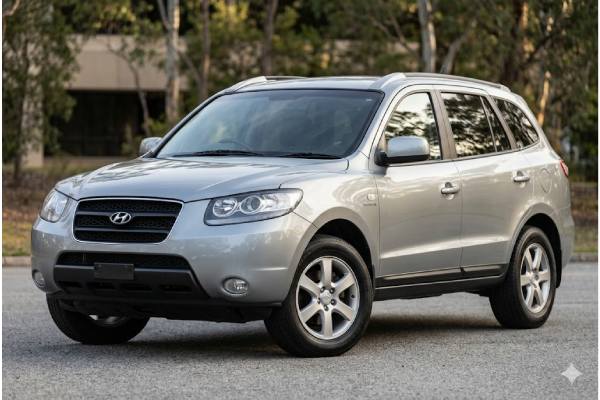
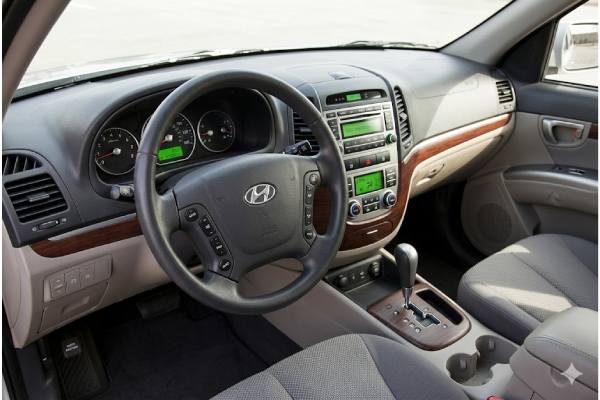
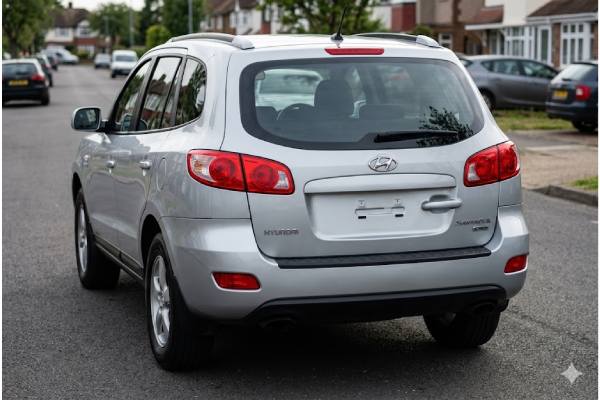
The 2007–2009 Hyundai Santa Fe FWD with the 2.7-liter V6 sits in a useful middle ground: larger and more comfortable than compact crossovers of the same era, simpler than many newer turbocharged SUVs, and generally affordable on the used market. In CM-generation form, this Santa Fe is a five-door, five-seat crossover aimed at family use, commuting, light towing, and long-distance road trips rather than serious off-road work.
The 2.7 V6 is not the quickest engine offered in the second-generation Santa Fe, but it is smooth, conventional, and relatively easy to understand from a maintenance perspective. Its biggest ownership factors are age, service history, timing-belt care, automatic-transmission condition, corrosion exposure, and recall completion.
Quick Specs and Notes
- Spacious five-seat cabin with about 34.2 ft³ cargo space behind the rear seats and up to 78.2 ft³ with them folded.
- Standard stability control, ABS, traction control, and side-curtain airbags gave this generation a strong safety baseline for its era.
- The 2.7 V6 is smooth and naturally aspirated, but acceleration is modest and fuel economy trails many four-cylinder rivals.
- Timing-belt replacement is a major service item: normally around 75,000 miles / 120,000 km or 60 months, sooner in severe use.
- Normal engine oil service is typically 7,500 miles / 12,000 km or 12 months; severe use can shorten this to 3,000 miles / 4,800 km or 3 months.
Table of Contents
- Santa Fe CM 2.7 V6 Profile
- Santa Fe CM Technical Specs
- Santa Fe CM Trims and Safety
- Reliability, Issues and Recalls
- Maintenance and Used Buying
- Road Feel and Performance
- Rivals Worth Comparing
Santa Fe CM 2.7 V6 Profile
The CM-generation Hyundai Santa Fe arrived as a more mature crossover than the original Santa Fe. It moved away from the first generation’s softer, rounded styling and became wider, more stable, more refined, and better suited to mainstream family-SUV use. In front-wheel-drive 2.7 V6 form, the 2007–2009 Santa Fe was usually positioned as the value-oriented version of the range, especially in the North American GLS trim.
The vehicle covered here is the second-generation Hyundai Santa Fe, internal code CM, with the naturally aspirated 2.7-liter V6 rated at 185 hp. It is a transverse-engine, front-wheel-drive crossover with unibody construction, independent suspension, and either a five-speed manual transmission or a four-speed automatic, depending on year, trim, and market. The focus is the FWD version, not the AWD model and not the stronger 3.3-liter V6 versions sold alongside it.
The 2.7-liter engine is part of Hyundai’s Mu V6 family. It uses aluminum construction, double overhead camshafts, four valves per cylinder, port fuel injection, and a timing belt. Compared with later direct-injected engines, it is mechanically straightforward. There is no turbocharger, no gasoline direct-injection carbon buildup issue in the usual sense, and no hybrid or high-voltage system to evaluate. That simplicity is one of its advantages as a used vehicle.
The trade-off is performance. With 185 hp and 183 lb-ft of torque moving a crossover weighing roughly 3,700–3,800 lb depending on equipment, the FWD 2.7 Santa Fe feels adequate rather than energetic. It is comfortable in normal traffic, steady at highway speeds, and acceptable for family use, but passing power requires planning, especially with the four-speed automatic, passengers, cargo, or hills.
Its strongest qualities are space, comfort, safety equipment for its period, and used-market value. The cabin has a high seating position, wide door openings, and a practical second row. Cargo capacity is generous for a two-row crossover, and the vehicle’s ride tuning favors comfort over sharp handling. For owners who want a simple, roomy, low-drama SUV and are willing to maintain an older timing-belt V6 properly, it can still make sense.
Its weakest points are mostly age-related. Fuel economy is only fair, the automatic transmission can feel dated, and neglected examples may need a stack of catch-up maintenance. Rust, suspension wear, worn engine mounts, old fluids, tire age, weak batteries, air-conditioning issues, and incomplete recalls matter more than mileage alone. A well-kept 120,000-mile Santa Fe can be a better buy than a neglected 80,000-mile one.
Santa Fe CM Technical Specs
Specifications vary by market, trim, production date, transmission, wheel package, and local homologation rules. The data below reflects the most relevant figures for the 2007–2009 Hyundai Santa Fe CM FWD 2.7 V6, with North American GLS-style equipment as the practical baseline.
| Item | Hyundai Santa Fe FWD 2.7 V6 |
|---|---|
| Engine code / family | 2.7-liter Mu V6, commonly associated with the G6EA family; verify by VIN and market |
| Engine layout | Transverse 60-degree V6, 6 cylinders, DOHC, 4 valves per cylinder, 24 valves total |
| Bore × stroke | 86.7 × 75.0 mm / 3.41 × 2.95 in |
| Displacement | 2.7 L / 2,656 cc |
| Induction | Naturally aspirated |
| Fuel system | Multi-point port fuel injection |
| Compression ratio | Approximately 10.4:1 |
| Maximum power | 185 hp / 138 kW @ 6,000 rpm |
| Maximum torque | 248 Nm / 183 lb-ft @ 4,000 rpm |
| Timing drive | Timing belt |
| Recommended fuel | Regular unleaded gasoline, minimum 87 AKI / 91 RON; premium may be recommended in some literature for best performance |
| Rated efficiency, automatic FWD | 18 city / 24 highway / 21 combined mpg US; about 13.1 / 9.8 / 11.2 L/100 km; about 21.6 / 28.8 / 25.2 mpg UK |
| Rated efficiency, manual FWD | 18 city / 23 highway / 20 combined mpg US; about 13.1 / 10.2 / 11.8 L/100 km; about 21.6 / 27.6 / 24.0 mpg UK |
| Real-world highway at 120 km/h / 75 mph | Typically around 10.5–12.0 L/100 km / 20–22 mpg US / 24–26 mpg UK, depending on tyres, load, wind, terrain, and vehicle condition |
| Item | Specification |
|---|---|
| Manual transmission | 5-speed manual, market and trim dependent |
| Automatic transmission | 4-speed automatic with SHIFTRONIC manual shift gate; exact unit should be verified by VIN/service data |
| Drive type | Front-wheel drive |
| Differential | Open front differential |
| AWD hardware | Not applicable to this FWD variant |
| Item | Specification |
|---|---|
| Body style | Five-door midsize crossover SUV, unibody |
| Front suspension | MacPherson strut independent suspension |
| Rear suspension | Independent multi-link suspension |
| Steering | Hydraulic power-assisted rack-and-pinion; ratio varies by market data source |
| Brakes | Ventilated front discs, rear discs, ABS with electronic brake-force distribution on most markets |
| Common tyre sizes | 235/70R16 or 235/60R18, depending on trim and package |
| Ground clearance | About 205–206 mm / 8.1 in |
| Length | 4,650–4,675 mm / 183.1–184.1 in, depending on bumper/market data |
| Width | 1,890 mm / 74.4 in |
| Height | About 1,725 mm / 67.9 in without roof rack; about 1,795 mm / 70.7 in with roof rack |
| Wheelbase | 2,700 mm / 106.3 in |
| Turning circle | About 10.9 m / 35.8 ft kerb-to-kerb |
| Curb weight | Approximately 1,690–1,725 kg / 3,727–3,803 lb, depending on transmission and equipment |
| GVWR | Approximately 2,240 kg / 4,938 lb on many FWD 2.7 examples; verify the door label |
| Fuel tank | 75 L / 19.8 US gal / 16.5 UK gal |
| Cargo volume | About 968 L / 34.2 ft³ behind second row; about 2,214 L / 78.2 ft³ with rear seats folded, using typical North American cargo measurement |
| Metric | Typical figure |
|---|---|
| 0–100 km/h / 0–62 mph | Approximately 10–11 seconds, depending on transmission, load, tyres, altitude, and condition |
| Top speed | Approximately 190 km/h / 118 mph where conditions and gearing allow |
| 100–0 km/h braking distance | Typical independent-test range around 41–45 m / 135–148 ft, tyre and surface dependent |
| Towing capacity, braked | Up to 1,270 kg / 2,800 lb for the 2.7 V6, where properly equipped |
| Towing capacity, unbraked | Up to 748 kg / 1,650 lb |
| Payload | Typically around 515–570 kg / 1,135–1,257 lb, depending on exact curb weight and door-label GVWR |
| System | Specification / capacity |
|---|---|
| Engine oil | API SJ/SL or later, ILSAC GF-3 or later; commonly SAE 5W-20 or 5W-30 depending on climate; about 4.5 L / 4.75 US qt with filter |
| Coolant | Ethylene-glycol coolant suitable for aluminum engines/radiators; about 7.0 L / 7.39 US qt; mixture commonly 50:50 unless climate requires otherwise |
| Automatic transmission fluid | Hyundai-approved ATF SP-III type; total capacity about 8.5 L / 8.98 US qt, with drain-and-fill quantity lower |
| Manual transmission fluid | 75W-85 API GL-4 manual transaxle fluid; about 1.9 L / 2.0 US qt |
| Brake fluid | DOT 3 or DOT 4 |
| Power steering fluid | PSF-4 type fluid where specified |
| Differential / transfer case | Not applicable to FWD models as a separate rear-drive service item |
| A/C refrigerant | R-134a; exact charge should be verified from the under-hood label or VIN-specific service data |
| A/C compressor oil | PAG oil type and charge are compressor/VIN specific; verify before service |
| Wheel lug nuts | Typically 88–107 Nm / 65–79 lb-ft |
| Engine oil drain plug | Typically around 39 Nm / 29 lb-ft; verify by service manual and plug condition |
| System | Status on 2007–2009 Santa Fe CM 2.7 FWD |
|---|---|
| Crash ratings | IIHS rated the 2007 Santa Fe a Top Safety Pick under the test criteria of the period; NHTSA ratings should be checked by exact model year |
| Euro NCAP | No directly equivalent Euro NCAP percentage-style result should be assumed for this exact US-market 2.7 FWD variant |
| Headlights | No modern IIHS headlight rating applies to this generation under later headlight-test protocols |
| Airbags | Dual front airbags, front-seat side airbags, and side-curtain airbags for outboard seating rows on typical North American models |
| Stability and braking | Electronic Stability Control, traction control, ABS, brake assist, and electronic brake-force distribution on most North American models |
| ADAS | No modern AEB, adaptive cruise control, lane keeping, blind-spot monitoring, rear cross-traffic alert, or traffic-sign assist on this variant |
Santa Fe CM Trims and Safety
For 2007–2009, the 2.7 V6 was most closely tied to the value side of the Santa Fe lineup. In the United States, that generally means GLS trim, while SE and Limited models were more commonly associated with the stronger 3.3-liter V6. Other markets used different grade names, so badges alone should not be treated as proof of engine, transmission, or safety equipment.
A typical North American Santa Fe GLS 2.7 FWD came with the basic mechanical package that defines this article: front-wheel drive, the 2.7 V6, independent suspension, four-wheel disc brakes, and either a manual or automatic transmission depending on model year and equipment. Alloy wheels, roof rails, air conditioning, power accessories, keyless entry, and a multi-speaker audio system were common. Later 2009 models added more contemporary audio features, including USB/iPod-style connectivity on many versions.
Options and packages could change the feel of the vehicle more than the engine specification suggests. Larger 18-inch wheels sharpen the look and can improve steering response slightly, but they usually ride more firmly and cost more to re-tyre than the common 16-inch package. A sunroof, heated seats, upgraded audio, and interior convenience features may add comfort, but they also add age-related inspection points.
Mechanical differences to watch are straightforward. The FWD 2.7 does not have a rear differential, transfer case, rear driveshaft, or AWD coupling, so it avoids some AWD service costs. It also has less traction on snow, mud, wet grass, and steep loose surfaces than an AWD Santa Fe. For buyers in warm climates or mostly urban use, FWD can be the simpler and cheaper layout. In snowy regions, tyre quality matters more than the badge; a FWD Santa Fe on proper winter tyres can be more secure than an AWD example on worn all-seasons.
Quick identifiers include the engine label under the hood, emissions label, VIN decoding, transmission shifter, wheel package, and trim badging. The 2.7 V6 should not be confused with the 3.3 V6: the larger engine delivers stronger acceleration and usually comes with a different equipment mix. A pre-purchase inspection should verify engine displacement through the VIN or under-hood labels, especially if the vehicle has been rebadged, imported, or repaired after collision damage.
Safety was one of this generation’s stronger selling points. Standard stability control was a major advantage in the late 2000s, when some rivals still made it optional or unavailable on lower trims. ABS, traction control, front airbags, front side airbags, side-curtain airbags, active front head restraints, child-seat anchors, and tyre-pressure monitoring were key features.
The IIHS results are best understood in period context. The Santa Fe performed strongly in the main crash tests used at the time and earned Top Safety Pick recognition for 2007 under that program’s criteria. However, later small-overlap, pedestrian-prevention, and headlight standards did not exist for this vehicle in the same way. It is a safe design for its era, not a substitute for a modern crossover with current crash structure and advanced driver-assistance systems.
There are no factory AEB, lane-keeping assist, adaptive cruise control, blind-spot monitoring, or rear cross-traffic systems on this model. After windshield replacement, suspension work, brake repair, or collision repair, there are no radar/camera calibrations typical of modern ADAS vehicles, but standard ABS, ESC, steering-angle, wheel-speed, and airbag systems still require proper diagnosis if warning lights appear.
Reliability, Issues and Recalls
The FWD 2.7 V6 Santa Fe can be durable when serviced on time, but age is now the main reliability filter. Most examples are old enough that rubber parts, electrical connectors, seals, coolant hoses, brake lines, suspension joints, mounts, and interior electronics deserve as much attention as the engine itself. A clean service history is more valuable than a low odometer reading without documentation.
The 2.7 V6’s most important engine maintenance item is the timing belt. This is not a “lifetime” chain engine. A neglected belt, seized idler, failing tensioner, or old water pump can turn a routine maintenance delay into major engine damage. On a used Santa Fe with uncertain history, assume the belt service is due unless there is a dated invoice showing the belt, tensioner, idlers, and usually the water pump were replaced.
Oil leaks are not unusual on older examples. Valve-cover gaskets, front engine seals, cam/crank seals, oil-pan seepage, and power-steering hose sweating should be checked. Minor seepage is common with age, but active dripping onto exhaust components or accessory belts needs repair. Cooling-system condition is also important because overheating can shorten gasket life and accelerate plastic tank, hose, and radiator problems.
The four-speed automatic is generally understandable and serviceable, but it is not modern. It may shift firmly at times, kick down slowly compared with newer six-speed units, and feel busy on hills. Harsh engagement, delayed reverse, flare between gears, burnt fluid, or repeated shift shock points to a vehicle that needs careful diagnosis before purchase. Many problems are worsened by old ATF, incorrect fluid, neglected mounts, failing sensors, or software/calibration issues.
| Issue | Prevalence / cost | Symptoms | Likely remedy |
|---|---|---|---|
| Timing belt overdue | Common risk on cars with poor records / high cost if it fails | No proof of service, belt noise, oil contamination near belt area | Replace belt, tensioner, idlers, and usually water pump; inspect seals |
| Valve-cover or front seal leaks | Common with age / low to medium cost | Burning-oil smell, damp engine, oil on lower covers | Replace gaskets or seals; clean and recheck |
| Automatic shift flare or harsh shift | Occasional / medium to high cost | Delayed engagement, slipping feel, harsh 2–3 or 3–4 shift | Check fluid level/condition, use correct SP-III type fluid, scan TCM, inspect mounts and solenoids |
| Suspension links and bushings | Common / low to medium cost | Clunks over bumps, wandering, uneven tyre wear | Replace sway-bar links, control-arm bushings, ball joints, or strut parts as needed; align afterward |
| Wheel bearings | Occasional / medium cost | Growling that changes with road speed or cornering load | Replace affected hub/bearing assembly |
| Airbag or passenger-seat warning | Occasional / medium cost | SRS light, passenger airbag classification warning | Check recalls, occupant-classification system, connectors, and seat sensors |
| Stop-lamp switch failure | Known recall-related issue / low cost if not covered | Brake lights inoperative, shifter stuck in Park, ESC light, cruise-control issue | Verify recall completion; replace switch if needed |
| ABS module electrical risk | Recall-specific / safety critical | May have no obvious symptom before failure | Check VIN for campaign completion and dealer remedy |
| Rust and underbody corrosion | Common in salt climates / medium to high cost | Crusty brake lines, subframe rust, rocker corrosion, seized fasteners | Inspect lift points, subframes, brake/fuel lines, rear suspension mounts, exhaust and seams before purchase |
Known recall themes include occupant-classification recalibration on some early CM Santa Fe models, stop-lamp switch replacement on affected vehicles, and ABS module fire-risk campaigns on certain production ranges. The exact applicability depends on VIN, build date, market, and previous completion. A seller’s claim that “all recalls were done” is not enough; ask for dealer records or run the VIN through the official recall database.
Software and calibration work is less central than on newer vehicles, but it still matters. Engine and transmission control updates may address drivability or diagnostic behavior on some vehicles. Airbag, ABS, ESC, and occupant-classification systems should not be repaired with guesswork. Warning lights require a scan tool that can read Hyundai-specific modules, not just generic engine codes.
A strong pre-purchase inspection should include a cold start, full warm-up, underbody lift inspection, OBD scan of all modules, test drive at city and highway speeds, transmission engagement check, brake inspection, tyre and alignment check, and confirmation that the timing belt and recalls are current. For a vehicle this old, budget for immediate baseline maintenance unless the records are unusually complete.
Maintenance and Used Buying
Maintenance on the 2.7 V6 Santa Fe is not exotic, but it must be consistent. The vehicle rewards routine fluid changes, cooling-system care, good tyres, and early attention to leaks or noises. It punishes neglect in predictable ways: old timing belts, dirty transmission fluid, weak batteries, worn suspension, and rust can quickly turn a cheap SUV into an expensive one.
| Item | Typical interval | Notes |
|---|---|---|
| Engine oil and filter | 7,500 miles / 12,000 km / 12 months normal; 3,000 miles / 4,800 km / 3 months severe | Use correct viscosity for climate and API/ILSAC specification; severe use includes short trips, dust, towing, hot weather, and heavy traffic |
| Engine air filter | Inspect regularly; replace about every 30,000 miles / 48,000 km or sooner in dusty use | A dirty filter can hurt throttle response and economy |
| Cabin air filter | About every 15,000–30,000 miles / 24,000–48,000 km depending on dust and climate | Weak airflow or musty smell usually means it is overdue |
| Timing belt | Replace around 75,000 miles / 120,000 km / 60 months normal; 50,000 miles / 80,000 km / 48 months severe | Replace tensioner, idlers, and usually water pump at the same time |
| Spark plugs | Long-life iridium plugs may be listed up to 150,000 miles / 240,000 km / 120 months under normal conditions | Older vehicles may need earlier service due to misfires, coil issues, or age |
| Coolant | First major change around 60,000 miles / 96,000 km / 60 months, then about every 30,000 miles / 48,000 km / 24 months | Use coolant compatible with aluminum engine and radiator components |
| Automatic transmission fluid | Often about every 60,000 miles / 96,000 km under severe use; many owners service proactively | Use Hyundai-approved SP-III type fluid; avoid universal fluid unless explicitly approved |
| Manual transmission fluid | About every 60,000 miles / 96,000 km in severe use | Use correct GL-4 75W-85 type fluid |
| Brake fluid | Every 2–3 years is prudent | Moisture-contaminated fluid can corrode components and reduce boiling margin |
| Brake pads, rotors and parking brake | Inspect at every tyre rotation or oil service | Check rear calipers and parking-brake operation, especially in rust climates |
| Tyre rotation and alignment | Rotate about every 5,000–7,500 miles / 8,000–12,000 km; align when wear or steering pull appears | Uneven tyre wear often points to worn bushings, weak struts, or alignment error |
| Serpentine belt, hoses and mounts | Inspect annually on older vehicles | Cracking, swelling, oil saturation, vibration, or clunking calls for repair |
| 12 V battery | Test yearly after 3 years; many last 3–5 years | Weak batteries can trigger misleading electrical symptoms |
For used buyers, the best Santa Fe is not necessarily the cleanest-looking one. The right one has evidence: timing belt invoice, coolant history, transmission-fluid service, recall completion, matching tyres, recent brakes, clean underbody, working air conditioning, no airbag or ABS warning lights, and no signs of overheating.
On a test drive, start with the engine cold. It should fire quickly, settle into a steady idle, and not produce heavy smoke or loud belt-area noise. The transmission should engage Drive and Reverse without long delays. Under moderate throttle, shifts should be clear but not violent. During highway driving, listen for wheel-bearing hum, suspension knock, wind noise from damaged seals, and vibration from worn mounts or imbalanced tyres.
Inspect the underside carefully. Rust around subframes, suspension mounting points, brake lines, fuel lines, rocker seams, rear wheel arches, exhaust hangers, and lift points can be more important than engine mileage. Surface rust is expected in some regions; flaking structural corrosion is different. A cheap vehicle with severe underside rust may not be economical to repair.
Recommended versions depend on priorities. A well-maintained FWD 2.7 GLS can be the sensible low-cost choice because it avoids AWD hardware and has simpler equipment. Buyers who tow more often, drive heavily loaded, or want stronger acceleration may prefer the 3.3 V6, but that is outside this exact variant. For the 2.7, seek complete records, a recent timing-belt service, good tyres, and no warning lights. Avoid examples with unknown belt history, slipping transmission, active coolant loss, serious rust, or unresolved airbag/ABS faults.
Long-term durability is reasonable when maintenance is current. The engine itself is not fragile, but it is not immune to neglected belts, overheating, old fluids, or leaks. At this age, the ownership verdict is vehicle-specific. A documented, rust-free Santa Fe can be a practical used family SUV; a neglected one can cost more than its purchase price to put right.
Road Feel and Performance
The 2.7 V6 Santa Fe drives like a comfort-focused crossover from the late 2000s. Its controls are easy, visibility is good, and the ride is generally settled on normal roads. The suspension is tuned more for compliance than sharp response, which suits family use but gives the vehicle a softer, heavier feel than smaller crossovers such as a RAV4 or CR-V.
At city speeds, the V6 is smooth and quiet when maintained well. It does not have the low-rpm shove of a modern turbo engine, so throttle input needs to be more deliberate. The automatic transmission’s four ratios are widely spaced by modern standards. Around town, that is usually acceptable; on hills or when merging, it may hold a gear longer or kick down more noticeably than a newer six-speed automatic.
The manual version, where available, gives the driver more control and can make the 2.7 feel slightly more alert. However, most used buyers will encounter automatics. A healthy automatic should shift predictably and not flare, bang, or hesitate sharply. Some firmness is normal for age and design; repeated harshness is not.
Highway stability is one of the vehicle’s better qualities. The wheelbase and width help it feel planted at 100–120 km/h / 60–75 mph. Wind and tyre noise are present, especially on older tyres or worn suspension, but the cabin remains comfortable for long trips. The V6 can cruise smoothly, although passing from 80–120 km/h / 50–75 mph is not effortless when loaded.
Steering is hydraulic, so it has a more natural weight build-up than some later electric systems, but feedback is muted. The Santa Fe is not eager to change direction quickly, and body roll is noticeable if pushed. That said, predictable handling and standard stability control are more important in this vehicle than sportiness. Good tyres make a significant difference in braking, wet-weather confidence, and highway tracking.
Braking feel is generally progressive, but brake performance depends heavily on tyre quality, rotor condition, caliper health, and fluid age. Rear brakes and parking-brake hardware should be checked on vehicles from wet or salty climates. A soft pedal, vibration under braking, pulling, or a burning smell after a test drive needs diagnosis before purchase.
Real-world efficiency is acceptable for a V6 crossover of the period, but not impressive by modern standards. In mixed use, many automatic FWD examples return roughly 11–13 L/100 km / 18–21 mpg US / 22–25 mpg UK. Steady highway driving may improve to around 9.8–11.5 L/100 km / 20–24 mpg US / 24–29 mpg UK, while short winter trips can fall well below that. Cold starts, old oxygen sensors, dragging brakes, underinflated tyres, roof accessories, and worn spark plugs all hurt fuel economy.
For towing, the 2.7 Santa Fe is best kept within moderate limits. It can tow a small trailer when properly equipped, but it is not a heavy-duty tow vehicle. Use the correct hitch, trailer brakes where required, proper tongue weight, fresh cooling-system components, healthy ATF, and conservative speeds. Expect fuel consumption to rise sharply under load, often by 25–50 percent depending on trailer shape, terrain, and speed.
Rivals Worth Comparing
The FWD 2.7 Santa Fe competes with a wide mix of late-2000s crossovers and SUVs. Its strongest case is value: it often costs less than a similar Toyota or Honda while offering generous space, a smooth V6, and strong safety equipment for its time. Its main disadvantages are fuel economy, aging four-speed automatic behavior, and the timing-belt service burden.
| Rival | Where it can beat the Santa Fe | Where the Santa Fe can make more sense |
|---|---|---|
| Toyota Highlander | Strong reputation, refined V6 options, excellent resale value | The Santa Fe is often cheaper to buy and may offer similar everyday space for less money |
| Honda CR-V | Better fuel economy, compact size, strong practicality, durable four-cylinder powertrain | The Santa Fe feels larger, smoother, and more relaxed on highways |
| Toyota RAV4 V6 | Much quicker acceleration and strong efficiency for its power | The Santa Fe has a more substantial cabin feel and often lower used pricing |
| Ford Edge | Roomy cabin, stronger standard V6 performance, comfortable ride | The Santa Fe may be simpler in lower trims and can be cheaper to maintain if bought well |
| Kia Sorento | More truck-like character in older body-on-frame versions, useful for some towing needs | The Santa Fe is more crossover-like, smoother, and easier to live with daily |
| Chevrolet Equinox / Pontiac Torrent | Often inexpensive and roomy | The Santa Fe generally has a stronger safety-equipment story and a more refined cabin feel |
Against compact four-cylinder crossovers, the Santa Fe offers more relaxed V6 smoothness and a larger cabin, but it uses more fuel. Against larger V6 crossovers, it may feel less powerful, but the FWD 2.7 version keeps mechanical complexity down. That balance is the main appeal: it is not the most efficient, fastest, or most prestigious option, but it can be a practical used SUV when condition and records are right.
The best reason to choose it is not raw specification. It is the combination of space, comfort, safety equipment, conventional engineering, and affordability. The best reason to walk away is also clear: a neglected example can need a timing belt, tyres, brakes, suspension work, transmission service, battery, air-conditioning repair, rust repair, and recall work all at once.
For buyers comparing several vehicles, prioritize evidence over brand reputation. A documented Santa Fe with a recent belt service, clean underside, healthy transmission, and working safety systems is worth considering. A more famous rival with poor records may not be the safer buy. In this age group, individual condition decides more than brochure claims.
References
- Hyundai Owners manuals | Hyundai Motor UK 2007–2011 (Owner’s Manual)
- Manuals & Warranties | Hyundai Resources | MyHyundai 2026 (Owner Resources)
- Gas Mileage of 2007 Hyundai Santa Fe 2007 (Fuel Economy)
- 2007 Hyundai Santa Fe 2007 (Safety Rating)
- Vehicle Detail Search – 2007 HYUNDAI SANTA_FE | NHTSA 2007 (Recall Database)
Disclaimer
This article is for informational purposes only and is not a substitute for professional diagnosis, repair advice, or official service procedures. Specifications, torque values, capacities, intervals, equipment, recall status, and repair methods can vary by VIN, market, production date, transmission, trim, and installed options. Always verify critical information against the official service documentation, owner’s manual, under-hood labels, door labels, and dealer VIN records before buying, servicing, towing, or repairing the vehicle.
If you found this useful, consider sharing it on Facebook, X/Twitter, or another platform to help other owners and used-car shoppers make better-informed decisions.