


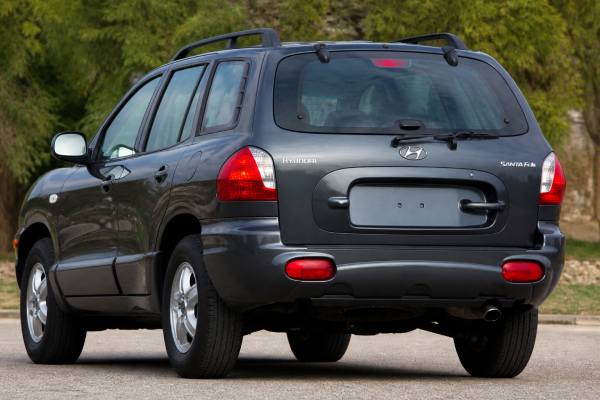
The 2003–2004 Hyundai Santa Fe FWD with the 2.4-liter MPI four-cylinder is the simpler, lighter version of Hyundai’s first-generation SM crossover. It is not quick, luxurious, or especially modern by current standards, but it has a clear appeal as an inexpensive used SUV: a roomy five-seat body, straightforward mechanicals, standard front-wheel drive, and a naturally aspirated engine that is easier to service than many later turbocharged or direct-injected units.
This specific 138 hp version is best understood as the North American 2.4L front-wheel-drive model. Other markets and trims used different power figures, diesel engines, V6 engines, all-wheel-drive systems, and equipment packages, so specification checks should always be tied to the VIN, market, and transmission.
Owner Snapshot
- Practical cabin and cargo space for a compact early-2000s SUV, with a comfortable ride and simple controls.
- Naturally aspirated 2.4 MPI engine avoids turbocharger and direct-injection carbon issues.
- Timing-belt service history is critical; unknown belt age should be treated as overdue.
- Common older-vehicle checks include corrosion, suspension wear, oil leaks, cooling-system age, and automatic-transmission shift quality.
- A useful baseline service rhythm is oil every 7,500 miles / 12,000 km or 12 months under normal use, with shorter intervals for severe driving.
Table of Contents
- Santa Fe SM 2.4 Context
- Santa Fe SM 2.4 Specs
- Santa Fe SM Trims and Safety
- Reliability, Issues and Recalls
- Maintenance and Used Buying
- Driving Feel and Performance
- Comparison With Period Rivals
Santa Fe SM 2.4 Context
The first-generation Hyundai Santa Fe, known by the SM platform code, was one of Hyundai’s early serious entries into the crossover SUV market. Instead of using a body-on-frame truck layout, it was based on a car-derived platform related to Hyundai’s midsize passenger-car architecture. That gave it a softer ride, easier step-in height, and more car-like controls than traditional compact SUVs of the same period.
The 2003–2004 FWD 2.4 MPI model sits at the practical end of the range. It uses a 2.4-liter inline-four gasoline engine, multipoint fuel injection, front-wheel drive, and either a 5-speed manual transmission or an optional 4-speed automatic. In North American trim, the engine is rated at 138 hp and 147 lb-ft of torque. Some European and export-market listings show different outputs, often in PS, so the 138 hp figure should not be mixed with the 146 PS or 150 PS variants found in other markets.
The main advantage of this version is simplicity. Compared with the V6 Santa Fe models, the 2.4 FWD has less weight over the front axle, lower fuel use in typical driving, and better access around the engine bay. It also avoids the extra service points of the full-time 4WD system. For owners who need light-duty family transport, snow-free commuting, or a basic utility vehicle, that simplicity can be more useful than extra power.
There are trade-offs. The 2.4 has enough power for city use and steady highway cruising, but loaded acceleration is modest. The automatic transmission further softens response, especially on grades or with passengers aboard. It is also an older timing-belt engine, so deferred maintenance can turn an affordable vehicle into an expensive repair quickly.
As a used buy today, condition matters far more than trim gloss. A clean underbody, documented timing-belt replacement, smooth transmission behavior, working air conditioning, and a cooling system in good shape are more important than cosmetic extras. The best examples feel honest and low-stress; neglected ones often show their age through leaks, tired suspension parts, rust, and intermittent electrical faults.
Santa Fe SM 2.4 Specs
The following figures focus on the 2003–2004 Hyundai Santa Fe SM FWD 2.4 MPI, primarily in North American specification. Some dimensions, capacities, and service values vary slightly by market, transmission, equipment, and published source.
| Category | Specification |
|---|---|
| Model | Hyundai Santa Fe FWD, SM generation |
| Model years | 2003–2004 |
| Body style | 5-door, 5-seat compact/midsize crossover SUV |
| Engine code | Sirius II / G4JS family |
| Engine type | 2.4L naturally aspirated gasoline inline-four |
| Fuel system | Multipoint fuel injection / MPI |
| Displacement | 2.4 L / 2,351 cc |
| Bore × stroke | 86.5 × 100.0 mm / 3.41 × 3.94 in |
| Valvetrain | DOHC, 4 valves per cylinder |
| Compression ratio | About 10.0:1 |
| Max power | 138 hp / 103 kW @ 5,500 rpm |
| Max torque | 199 Nm / 147 lb-ft @ 3,000 rpm |
| Timing drive | Timing belt, with balance-shaft belt system |
| Induction | Naturally aspirated |
| Recommended fuel | Regular unleaded gasoline |
| Transmission and driveline | Specification |
|---|---|
| Standard transmission | 5-speed manual |
| Optional transmission | 4-speed automatic with Shiftronic-style manual gate on automatic models |
| Drive type | Front-wheel drive |
| Differential | Open front differential |
| AWD / transfer case | Not fitted on this FWD variant |
| Efficiency and range | Specification |
|---|---|
| EPA rating, 2.4 FWD automatic | 18 mpg city / 25 mpg highway / 20 mpg combined US |
| EPA rating, 2.4 FWD manual | 18 mpg city / 25 mpg highway / 20 mpg combined US |
| Metric equivalent | About 13.1 L/100 km city / 9.4 L/100 km highway / 11.8 L/100 km combined |
| UK mpg equivalent | About 22 mpg city / 30 mpg highway / 24 mpg combined |
| Real-world mixed use | Commonly about 19–23 mpg US / 12.4–10.2 L/100 km |
| Highway at 120 km/h / 75 mph | Often about 22–25 mpg US / 10.7–9.4 L/100 km when healthy and lightly loaded |
| Chassis and dimensions | Specification |
|---|---|
| Front suspension | MacPherson struts, coil springs, anti-roll bar |
| Rear suspension | Independent trailing-arm / multi-link layout with coil springs |
| Steering | Hydraulic power rack-and-pinion |
| Steering ratio | About 19:1 |
| Front brakes | Ventilated discs |
| Rear brakes | Solid discs |
| Typical tyre size | 225/70R16 |
| Wheel size | 16 in alloy wheel |
| Length | About 4,500 mm / 177.2 in |
| Width | About 1,845 mm / 72.6–72.7 in |
| Height | About 1,675–1,730 mm / 66.0–68.1 in, depending on market and roof equipment |
| Wheelbase | 2,620 mm / 103.1 in |
| Turning circle | About 11.3 m / 37.1 ft |
| Ground clearance | About 188–207 mm / 7.4–8.1 in, depending on published specification |
| Curb weight | About 1,585–1,621 kg / 3,494–3,574 lb |
| GVWR | About 2,245 kg / 4,950 lb for common FWD listings |
| Fuel tank | About 72 L / 19.0 US gal / 15.8 UK gal |
| Cargo volume, seats up | About 864 L / 30.5 ft³ |
| Cargo volume, rear seats folded | About 2,200 L / 77.7 ft³ |
| Performance and capability | Specification |
|---|---|
| 0–100 km/h / 0–62 mph | Roughly 11.5–13.0 seconds, depending on transmission and load |
| Top speed | About 170–175 km/h / 106–109 mph |
| 100–0 km/h braking | Typically mid-40 m range when tyres and brakes are fresh |
| Braked towing, 2.4 FWD | Common North American figure: about 544 kg / 1,200 lb |
| Unbraked towing | Often about 454 kg / 1,000 lb, market dependent |
| Payload | About 460 kg / 1,016 lb in common FWD automatic listings |
| Fluids and service capacities | Typical specification |
|---|---|
| Engine oil | API SG/SJ or later; commonly 5W-30 or 10W-30 depending on climate |
| Engine oil capacity | About 4.3 L / 4.5 US qt with filter |
| Coolant | Ethylene-glycol coolant suitable for aluminum engines, 50/50 mix |
| Coolant capacity | About 7–8 L / 7.4–8.5 US qt, verify by VIN |
| Automatic transmission fluid | Hyundai / Diamond / SK ATF SP-III equivalent |
| Automatic transaxle capacity | About 3.8–4.5 L / 4.0–4.8 US qt drain-and-fill; total fill higher |
| Manual transaxle oil | GL-4 manual transaxle oil, commonly 75W-90 where specified |
| Brake fluid | DOT 3 or DOT 4 |
| Power steering fluid | Hyundai PSF-3 or specified equivalent |
| A/C refrigerant | R-134a |
| A/C refrigerant charge | About 600 g / 21 oz for single evaporator systems; verify under-hood label |
| A/C compressor oil | PAG 46 / Hyundai-specified oil, commonly around 150 mL / 5.1 fl oz system amount |
| Key torque values | Typical value |
|---|---|
| Engine oil drain plug | About 35–45 Nm / 26–33 lb-ft |
| Wheel lug nuts | About 90–110 Nm / 66–81 lb-ft |
| Spark plugs | About 20–30 Nm / 15–22 lb-ft, depending on plug type and manual |
| Front coil spring protector recall bolts | Hyundai campaign procedure lists specific fastener ranges; use campaign instructions exactly |
Santa Fe SM Trims and Safety
For 2003–2004, Hyundai sold the Santa Fe in several trim levels, but the 2.4-liter four-cylinder was primarily associated with the base front-wheel-drive model in the United States. GLS and LX trims commonly used V6 engines, with higher equipment levels and available or standard features that were not always paired with the 2.4.
The base 2.4 FWD model still had useful standard equipment for its era. Typical equipment included air conditioning, power windows and locks, roof rails, privacy glass, 16-inch alloy wheels, front and rear disc brakes, cloth seating, and an AM/FM/CD audio system. The basic cabin is plain but easy to use, with large controls and good outward visibility.
Higher trims added features such as the Monsoon audio system, leather seating surfaces, heated front seats, automatic climate control, electrochromic mirror, HomeLink, ABS with traction control depending on year and trim, and a power sunroof on some vehicles. A quick way to identify a base 2.4 is to look for the four-cylinder engine, FWD layout, simpler cloth interior, 5-speed manual availability, and the absence of V6-specific trim badging or 4WD hardware.
Year-to-year changes for this exact 2.4 FWD version were modest. Hyundai had already introduced many cabin and equipment updates around the 2002–2003 period, including revised interior details and front-seat side-impact airbags. The 2004 model continued with similar mechanical hardware while the broader Santa Fe range added or carried over larger V6 options.
Safety equipment is typical of early-2000s crossovers, not modern SUVs. Dual front airbags were fitted, and front-seat side-impact airbags for head and torso protection were an important improvement for 2003–2004 vehicles. Front seat-belt pretensioners were included. Rear child-seat anchors were provided, though ease of use and labeling are not as modern as in current vehicles.
IIHS ratings are mixed but respectable for the age. The 2003 Santa Fe received a Good rating in the original moderate-overlap front test, an Acceptable rating in the original side test, and a Poor rating for head restraints and seats. That means the basic crash structure performed well in the frontal test, but whiplash protection and some side-impact details are weak by today’s standards.
Do not expect modern driver assistance. There is no factory AEB, adaptive cruise control, lane-keeping assist, blind-spot monitoring, rear cross-traffic alert, traffic-sign recognition, or camera-based safety suite. ABS and traction control availability depends on trim and market, so a used vehicle should be checked physically rather than assumed from the model year.
After collision repair, front-end work, steering work, or airbag-related service, proper inspection matters. This generation does not have complex radar and camera calibration requirements, but it does rely on correct sensor, seat-belt, airbag, and ABS system function. Warning lights should illuminate during key-on self-check and go out after startup.
Reliability, Issues and Recalls
A well-maintained Santa Fe SM 2.4 can be durable, but age is now the main enemy. These vehicles are old enough that corrosion, neglected fluids, brittle rubber, previous accident damage, and low-quality repairs often matter more than the original design.
The most important engine item is the timing belt system. The G4JS/Sirius II 2.4 uses a belt-driven valvetrain and balance-shaft belt arrangement. A missed belt interval can lead to severe engine damage if the belt or related components fail. Common symptoms of timing-system neglect include rattling from covers, visible belt cracking, oil contamination around the belt area, poor running after a slipped belt, and unknown service history. The remedy is not inspection alone on an unknown vehicle: replace the belt, balance-shaft belt, tensioners, idlers, and often the water pump at the same time.
Oil leaks are occasional to common with age. Valve-cover gasket seepage, cam and crank seal leaks, oil-pan seepage, and front-cover contamination can appear after many heat cycles. Minor sweating is a low-cost issue if monitored, but oil leaking onto belts or exhaust components should be repaired promptly.
Cooling-system age deserves attention. Radiators, hoses, thermostat housings, water pumps, caps, and expansion tanks can become weak after decades of use. Watch for temperature creep in traffic, coolant smell, low coolant level, white residue around hose joints, and heater output changes. Overheating can turn a modest repair into a head-gasket or cylinder-head problem.
The 4-speed automatic is generally serviceable when maintained, but harsh shifts, delayed engagement, flare between gears, burnt-smelling fluid, and shudder under light throttle are warning signs. Many problems come from old fluid, incorrect fluid, solenoid wear, or internal clutch wear. The correct SP-III-type fluid is important; a generic fluid choice can create shift problems.
Manual-transmission cars are simpler but still need checks for clutch slip, release-bearing noise, second-gear synchro wear, and axle-seal leaks. A high clutch bite point under load suggests clutch wear.
Common chassis and driveline wear points include front control-arm bushings, ball joints, sway-bar links, strut mounts, rear trailing-arm bushings, wheel bearings, and outer CV boots. Symptoms include knocking over bumps, vague steering, uneven tyre wear, humming at speed, clicking on turns, and brake pulsation.
Corrosion is a major inspection item, especially in salt-belt regions. Known recall and service-action areas include front coil springs and rear suspension/subframe-related corrosion on some vehicles. Check the front spring seats, lower spring ends, strut assemblies, rear trailing arms, subframes, brake lines, fuel lines, rocker panels, rear wheel arches, and liftgate seams. Rust that looks cosmetic at the wheel arch may be less concerning than hidden rust near suspension mounting points or brake lines.
Recall history should be verified by VIN. Not every campaign applies to every vehicle, and previous completion depends on location, production date, ownership history, and dealer records. Important recall themes for this generation include front coil spring corrosion in salt-belt areas, rear trailing-arm and subframe corrosion on certain earlier Santa Fe vehicles, ABS-related actions on certain 2003–2004 3.5L 4WD ABS vehicles, and tire-pressure label compliance on some 2004 vehicles. Some of those do not apply to the 2.4 FWD, which is why VIN checking is essential.
A practical issue map looks like this:
| Issue | Prevalence | Severity | Typical signs | Best response |
|---|---|---|---|---|
| Unknown timing-belt age | Common | High | No records, belt noise, oil contamination | Replace complete belt system |
| Front coil spring corrosion | Common in salt areas | High | Broken spring, tyre contact risk, uneven ride height | Verify recall, inspect springs and protectors |
| Rear suspension / subframe corrosion | Occasional to common in salt areas | High | Rust near trailing arms, poor alignment, clunks | Professional underbody inspection |
| Oil leaks | Common with age | Low to medium | Burning smell, oil spots, wet front cover | Repair seals/gaskets, protect belts |
| Cooling-system wear | Occasional | Medium to high | Overheating, coolant smell, low level | Pressure test, replace aged parts |
| Automatic shift issues | Occasional | Medium to high | Flare, harsh shift, delayed engagement | Fluid check, scan, service or repair |
| Suspension wear | Common | Low to medium | Clunks, wandering, uneven tyres | Replace worn joints/bushings |
| Electrical aging | Occasional | Low to medium | Window, lock, radio, sensor faults | Diagnose circuits, avoid parts guessing |
Maintenance and Used Buying
Maintenance on the Santa Fe 2.4 is straightforward, but it must be done on time. The vehicle is forgiving in daily use, yet the timing belt, cooling system, transmission fluid, and corrosion checks are not areas to ignore.
A sensible schedule for a used 2003–2004 2.4 FWD is:
| Item | Practical interval |
|---|---|
| Engine oil and filter | 7,500 miles / 12,000 km or 12 months normal; 3,000–5,000 miles / 5,000–8,000 km in severe use |
| Tyre rotation | 7,500 miles / 12,000 km |
| Brake inspection | Every oil service; more often in salted climates |
| Engine air filter | Inspect every 15,000 miles / 24,000 km; replace as needed |
| Cabin air filter | Inspect yearly if fitted; replace every 12–24 months |
| Spark plugs | About 30,000 miles / 48,000 km for standard plugs unless upgraded and specified differently |
| Timing belt system | About 60,000 miles / 96,000 km or 5 years; replace immediately if age is unknown |
| Accessory belts and hoses | Inspect yearly; replace if cracked, swollen, glazed, or noisy |
| Coolant | About 60,000 miles / 96,000 km or 5 years initially, then shorter repeat intervals |
| Automatic transmission fluid | 30,000 miles / 48,000 km in severe use; 30,000–45,000 miles is prudent on an older vehicle |
| Manual transaxle oil | About 60,000 miles / 96,000 km, or sooner if shifting quality declines |
| Brake fluid | Every 2 years |
| Power steering fluid | Inspect yearly; exchange if dark, contaminated, or noisy |
| Wheel alignment | Check after suspension work or uneven tyre wear |
| 12 V battery | Test yearly after 3 years; typical replacement window is 4–6 years |
The best buyer’s-guide approach is to inspect the expensive age-related items first. Start underneath. A rusty body panel can often be repaired or ignored, but structural corrosion around suspension pickup points, brake lines, rear trailing arms, front subframes, and spring seats can make the vehicle unsafe or uneconomical.
Next, check the engine cold. It should start cleanly, settle into a steady idle, and avoid blue smoke, knocking, or belt squeal. Look for oil around the valve cover and timing-belt cover. A clean engine bay is not proof of good care; fresh cleaning can hide leaks. Ask for receipts showing timing belt, water pump, tensioners, idlers, coolant, spark plugs, and transmission fluid.
During the test drive, the 2.4 should pull smoothly if not quickly. The automatic should engage Drive and Reverse without a long delay and shift without flare. A hard 2–3 shift, slipping sensation, or burnt fluid smell is a reason to pause. Manual cars should not grind on shifts or slip under full throttle in a higher gear.
The cooling system should hold temperature in traffic and on the highway. Let the vehicle idle after the drive, check that the fans cycle correctly, and inspect for coolant smell or bubbling. Heater output should be strong and consistent.
Inside, check every window, lock, mirror, fan speed, A/C mode, instrument warning light, remote key, rear wiper, and audio function. Electrical faults are usually manageable, but many small faults can make a cheap vehicle frustrating.
Recommended examples are usually the least modified, cleanest, and best documented. The 2.4 FWD is a good choice for low-cost ownership when towing and mountain performance are not priorities. Avoid examples with heavy rust, overheating history, missing timing-belt records, slipping transmission, persistent airbag or ABS warning lights, or evidence of neglected collision repair.
Driving Feel and Performance
The Santa Fe SM 2.4 FWD drives like an early crossover rather than a modern SUV. It has a soft, compliant ride, light controls, and a higher seating position than a sedan. Around town, it feels easy to place and relaxed. The body is not especially rigid by today’s standards, but the suspension tuning suits broken pavement and moderate speeds well.
The 2.4 MPI engine is smooth enough when maintained, but it does not have strong low-rpm torque for the vehicle’s weight. In city driving, throttle response is predictable and simple. The engine prefers gradual inputs rather than sudden demands. With the automatic, kickdown is frequent when climbing grades or merging with passengers aboard. With the manual, the driver can keep the engine in a more useful part of the rev range, but the vehicle still feels modest rather than lively.
Highway cruising is acceptable. At 100–120 km/h / 60–75 mph, the Santa Fe tracks steadily if the tyres, alignment, bushings, and struts are in good condition. Wind and road noise are more noticeable than in newer crossovers, and coarse tyres can make the cabin sound older than it is. A fresh set of quality touring tyres often improves the vehicle more than many owners expect.
Steering is light and somewhat isolated. It is not a sharp-handling SUV, but it is easy to drive in parking lots and urban traffic. Body roll appears in faster bends, and the front tyres give up first if pushed. That is normal for the model and not a problem if expectations are realistic. Worn struts, tired rear bushings, or mismatched tyres can make it feel far less stable than a good example.
Braking feel is adequate when the system is healthy. Four-wheel disc brakes are a plus for the period, but age, rust, cheap pads, old fluid, and seized caliper slide pins can hurt performance. A firm pedal, straight stops, and no steering-wheel shake are good signs. Brake pulsation usually points to rotor issues or hub/installation problems.
Fuel use is acceptable for an older gasoline SUV but not impressive by modern standards. Expect around 18–20 mpg US / 13.1–11.8 L/100 km in city-heavy use, 22–25 mpg US / 10.7–9.4 L/100 km on steady highway trips, and about 19–23 mpg US / 12.4–10.2 L/100 km mixed. Cold weather, short trips, roof racks, soft tyres, old oxygen sensors, dragging brakes, and neglected spark plugs can worsen those figures quickly.
Towing is not a strength of the 2.4 FWD. The common North American braked rating is around 1,200 lb / 544 kg, far below some V6 or export-market ratings. For small utility trailers it can work if the vehicle is healthy, the trailer is correctly loaded, and brakes are maintained, but it is not the right Santa Fe for regular towing. Extra load also increases braking distance, transmission heat, and fuel consumption.
The best description of the driving experience is calm and functional. It rewards mechanical freshness more than aggressive driving. A well-kept example feels comfortable, practical, and honest; a neglected one feels slow, loose, noisy, and old.
Comparison With Period Rivals
Against early-2000s rivals, the Santa Fe 2.4 FWD sits between compact car-based crossovers and more rugged small SUVs. It is roomier and softer than many compact SUVs, but less powerful than V6 versions of the Toyota Highlander, Ford Escape, Mazda Tribute, Honda CR-V, and Subaru Forester.
Compared with a 2003–2004 Honda CR-V, the Santa Fe offers a more substantial cabin feel and a larger cargo area, but the CR-V usually has better fuel economy, sharper packaging, and a stronger reputation for long-term resale value. The Hyundai can be the better value if it is much cheaper and has clear maintenance records.
Compared with a Toyota RAV4 of the same period, the Santa Fe is larger and more comfortable, but the RAV4 is lighter, easier on fuel, and often simpler to park. The Santa Fe feels more like a family crossover, while the RAV4 feels more compact and economical.
Compared with a Ford Escape or Mazda Tribute 2.0/2.3/3.0, the Hyundai’s ride comfort is competitive, and its cabin is straightforward. The Ford/Mazda V6 models are quicker and tow better, but fuel use and age-related transmission or rust concerns can be comparable. Condition should decide more than the badge.
Compared with a Toyota Highlander, the Santa Fe is usually cheaper to buy. The Highlander has a more polished driving feel, stronger V6 options, and better resale strength, but clean Highlanders often cost more. A properly maintained Santa Fe 2.4 FWD can make sense when purchase price and service history are the priorities.
Compared with a Subaru Forester, the Hyundai has more cargo space and a softer ride, while the Subaru offers standard all-wheel drive and better poor-weather traction. The FWD Santa Fe is simpler and avoids AWD service items, but it cannot match Subaru traction on snow-covered roads.
The Santa Fe’s main advantages are value, cabin usefulness, simple naturally aspirated mechanicals, and comfortable ride quality. Its main disadvantages are modest acceleration, aging safety technology, rust sensitivity in salt climates, and the need for disciplined timing-belt maintenance. For a low-cost used SUV, it is worth considering only when the individual vehicle is clean, documented, and mechanically sound.
References
- 2003 HYUNDAI SANTA FE 2002 (Manufacturer Publication)
- 2004 HYUNDAI SANTA FE 2003 (Manufacturer Publication)
- Gas Mileage of 2004 Hyundai Santa Fe 2004 (Official Fuel Economy Database)
- 2003 Hyundai Santa Fe 2003 (Safety Rating)
- Part 573 Safety Recall Report 14V-435 2015 (Recall Database)
Disclaimer
This information is for general informational purposes only and is not a substitute for professional diagnosis, inspection, or repair. Specifications, torque values, service intervals, fluids, recalls, and procedures can vary by VIN, market, production date, transmission, and installed equipment. Always verify against the official owner’s manual, workshop manual, under-hood labels, dealer records, and current VIN-based recall information before servicing or buying a vehicle.
If this helped, please consider sharing it on Facebook, X/Twitter, or your preferred platform to support our work.