
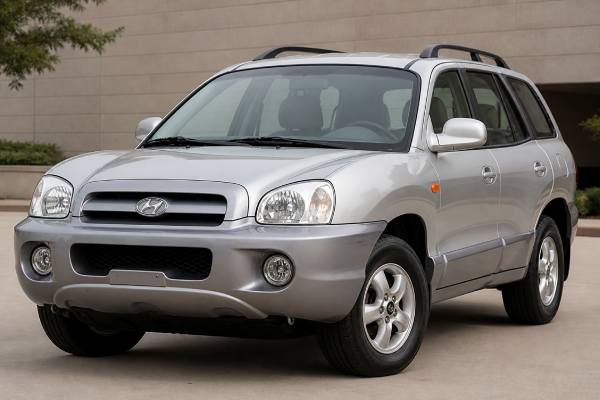

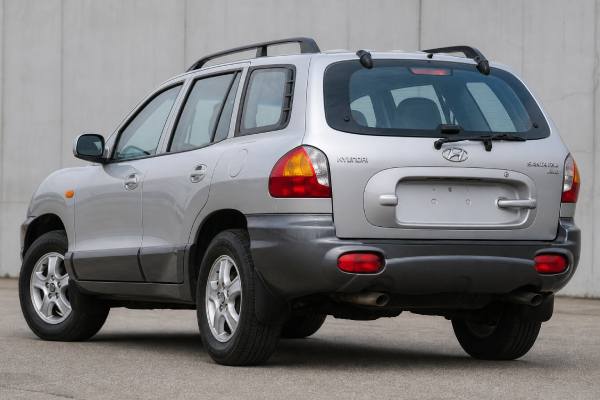
The 2003–2004 Hyundai Santa Fe FWD with the 2.7-liter V6 sits in an interesting place in Hyundai’s early SUV history. It is a first-generation SM Santa Fe: a unibody, five-seat crossover with a transverse V6, front-wheel drive, and a four-speed Shiftronic automatic. It was designed more for daily use, family duty, poor-weather confidence, and light utility than for serious off-road work.
For used buyers today, its appeal is simple. It offers a roomy cabin, a smooth naturally aspirated V6, straightforward mechanical layout, and usually modest purchase prices. The tradeoff is age. Any example is now old enough that maintenance history, rust condition, timing-belt service, cooling-system health, and transmission behavior matter more than mileage alone.
Quick Overview
- The 2.7 V6 is smoother and more relaxed than the four-cylinder, with adequate highway passing power.
- Front-wheel drive keeps the driveline simpler than the full-time 4WD version and avoids transfer-case and rear-axle service.
- Cabin space, cargo flexibility, soft ride quality, and low used prices are the strongest ownership advantages.
- The key ownership caveat is age-related maintenance: timing belt, coolant leaks, suspension corrosion, and transmission fluid history need proof.
- Plan oil and filter service about every 7,500 miles or 12,000 km under normal use, sooner for severe short-trip or hot-climate driving.
Table of Contents
- Hyundai Santa Fe SM Used Overview
- Hyundai Santa Fe SM Technical Specs
- Hyundai Santa Fe SM Trims and Safety
- Reliability Issues and Service Actions
- Maintenance and Buying Advice
- Real-World Driving and Performance
- Rivals and Final Verdict
Hyundai Santa Fe SM Used Overview
The first-generation Hyundai Santa Fe, known by the SM generation code, was Hyundai’s first in-house sport-utility vehicle for the North American market. Rather than using a body-on-frame truck platform, it used a heavily revised midsize-car platform. That choice shaped the whole vehicle: the Santa Fe feels more like a tall wagon than an old-school SUV, with independent suspension, rack-and-pinion steering, a low cargo floor, and a softer ride.
The 2003–2004 FWD 2.7 V6 version is one of the simpler and more balanced configurations. It avoids the heavier 4WD hardware and the larger 3.5-liter V6, while still giving noticeably better refinement than the 2.4-liter four-cylinder. In U.S.-market form, the 2.7-liter Delta V6 was fitted mainly to GLS and LX trims and paired with a four-speed automatic with manual shift override. The covered vehicle is a five-door, five-seat crossover with front-wheel drive, not the full-time 4WD variant.
In practical ownership terms, the Santa Fe SM is best viewed as an affordable used family vehicle or utility runabout. It is not quick by modern standards, and it does not have modern driver-assistance technology, but it has a comfortable seating position, a broad rear bench, a useful cargo area, and mechanical systems that most independent shops can understand. The 2.7 V6 is naturally aspirated and port-injected, so there are no turbochargers, high-pressure direct-injection pumps, particulate filters, hybrid batteries, or complex drive modes to manage.
The strongest advantages are comfort, visibility, simplicity, and value. The ride is forgiving on rough roads, the steering is light enough for urban use, and the V6 gives the car a relaxed character. Many examples also came with useful equipment for the era, such as alloy wheels, roof rails, power accessories, air conditioning, front side airbags, and available ABS with traction control.
The main drawback is that condition varies widely. A well-maintained 2003–2004 Santa Fe can still be a dependable low-cost vehicle, but a neglected one can quickly become uneconomical. Timing-belt age, oil leaks, cooling-system neglect, transmission shift quality, rust in suspension areas, broken springs in salt regions, and old rubber components are the issues that separate a sensible buy from a money pit. At this age, a clean underbody and a folder of maintenance records are worth more than cosmetic shine.
Market differences also matter. U.S., Canadian, European, Australian, and other regional Santa Fe models used different trim names, tow ratings, equipment packages, lighting, emissions systems, and sometimes power ratings. The figures below focus mainly on the North American-style 2003–2004 Santa Fe SM FWD 2.7 V6 automatic rated at 173 hp.
Hyundai Santa Fe SM Technical Specs
The 2.7-liter Santa Fe uses Hyundai’s Delta-family V6, installed transversely and driving the front wheels through a four-speed automatic transaxle. Specification details can vary by market and trim, so the table should be read as a practical baseline for the 2003–2004 FWD 2.7 V6 automatic.
| Item | 2003–2004 Santa Fe FWD 2.7 V6 |
|---|---|
| Engine code | Delta G6BA family, 2.7 V6 |
| Engine layout | Front transverse V6, 6 cylinders, DOHC, 4 valves/cylinder, 24 valves total |
| Bore × stroke | 86.7 × 75.0 mm (3.41 × 2.95 in) |
| Displacement | 2.7 L (2,656 cc) |
| Induction | Naturally aspirated |
| Fuel system | Multi-point port fuel injection |
| Compression ratio | About 10.0:1 |
| Max power | 173 hp (129 kW) @ 6,000 rpm |
| Max torque | About 247 Nm (182 lb-ft) @ 4,000 rpm |
| Timing drive | Timing belt |
| EPA-rated efficiency | About 11.8 L/100 km combined (20 mpg US / 24 mpg UK); 13.1 L/100 km city and 9.8 L/100 km highway |
| Real-world highway at 120 km/h | Typically about 10.5–12.5 L/100 km (19–22 mpg US / 23–26 mpg UK), depending on tyres, load, wind, and engine condition |
| Item | Specification |
|---|---|
| Transmission | 4-speed electronically controlled Shiftronic automatic transaxle, commonly associated with the F4A51 family |
| Drive type | Front-wheel drive |
| Differential | Open front differential |
| Front suspension | MacPherson struts, coil springs, anti-roll bar |
| Rear suspension | Independent trailing-arm/multi-link arrangement with coil springs |
| Steering | Hydraulic power-assisted rack and pinion |
| Brakes | Four-wheel disc brakes; ABS availability depends on trim/equipment |
| Popular tyre size | 225/70 R16 on 16-inch alloy wheels |
| Ground clearance | About 205 mm (8.1 in) |
| Length / width / height | About 4,500 / 1,845 / 1,675 mm (177.2 / 72.7 / 66.0 in), market dependent |
| Wheelbase | 2,620 mm (103.1 in) |
| Turning circle | About 11.3 m (37 ft) |
| Curb weight | About 1,610 kg (3,549 lb) for U.S.-market GLS FWD automatic |
| GVWR | About 2,375 kg (5,240 lb), depending on certification label |
| Fuel tank | 72 L (19.0 US gal / 15.8 UK gal) |
| Cargo volume | About 850 L (30 cu ft) seats up; about 2,200 L (78 cu ft) seats folded, SAE-style U.S. reporting |
| Item | Typical figure or specification |
|---|---|
| 0–100 km/h (0–62 mph) | Roughly 11–12 seconds when healthy |
| Top speed | About 180 km/h (112 mph), market dependent |
| 100–0 km/h braking | Varies heavily with tyres and brake condition; no single reliable factory figure |
| Towing capacity | Market dependent; North American 2.7 FWD listings are often around 1,225 kg (2,700 lb), while some non-U.S. ratings are higher with braked trailers |
| Payload | About 695 kg (1,535 lb), depending on certification label and trim |
| Engine oil | API SH/SG or later; common grades include 5W-30, 10W-30, 10W-40 depending on climate; 4.5 L (4.76 US qt) with filter |
| Coolant | Ethylene-glycol coolant suitable for aluminum engines; typical 50/50 mix; about 8.5 L (8.98 US qt) |
| Automatic transmission fluid | Hyundai Genuine ATF / Diamond ATF SP-III / SK ATF SP-III; drain-and-fill quantity varies by service method |
| Power steering fluid | PSF-3 type fluid |
| Brake fluid | DOT 3, DOT 4, or equivalent |
| Critical torque values | Wheel lug nuts are commonly serviced around 88–108 Nm (65–80 lb-ft); verify all fasteners by VIN-specific service data |
| IIHS ratings | Moderate overlap front: Good; original side test: Acceptable; head restraints/seats: Poor for the tested era configuration |
| ADAS | No modern AEB, ACC, lane keeping, blind-spot monitoring, or traffic-sign recognition; equipment is mainly passive safety plus ABS/traction control where fitted |
The key point is that the FWD 2.7 V6 is mechanically simpler than the 4WD version. There is no transfer case, rear differential, driveshaft, or viscous-coupling system to maintain. That simplicity is valuable on a 20-year-old vehicle, especially when shopping for a low-cost used example.
Hyundai Santa Fe SM Trims and Safety
For 2003–2004 North American models, the 2.7 V6 was most closely associated with GLS and LX trim levels, while the base Santa Fe commonly used the 2.4-liter four-cylinder. Hyundai’s trim strategy varied by market, but the basic hierarchy was clear: GLS offered the V6 and useful comfort equipment, while LX added more luxury-oriented features.
Typical GLS equipment could include 16-inch alloy wheels, roof rack, air conditioning, power windows and locks, keyless entry, cruise control, upgraded audio, privacy glass, and cloth seating. LX models often added leather seating surfaces, heated front seats, automatic climate control, upgraded Monsoon audio, an electrochromic mirror, and additional convenience features. Exact equipment should always be checked on the vehicle itself, because option packages and dealer-installed accessories varied.
Mechanically, the most important distinction is not just trim but drivetrain and engine. The FWD 2.7 V6 uses the simpler front-drive layout. The 4WD 2.7 version adds Hyundai’s full-time mechanical system with torque normally biased to the front and a rear drive connection through the additional driveline hardware. The 3.5-liter V6, introduced around this period, brought more power and a five-speed automatic, but it also adds different service considerations.
Quick identifiers for a 2.7 FWD car include the GLS or LX badge, the 2.7-liter V6 under the hood, the four-speed automatic selector with Shiftronic manual gate, absence of rear differential and rear driveshaft underneath, and the VIN/underhood emissions labels. The most reliable confirmation is the VIN decoded against Hyundai records or a build sheet.
Safety equipment was respectable for its era but limited by modern standards. Dual front airbags and front seat-mounted side-impact airbags were important features, and 2002-and-later models built after the relevant changeover generally benefited from standard front seat-mounted combination head-and-torso side airbags in the U.S. context. Front seatbelt pretensioners were also fitted. LATCH/ISOFIX child-seat anchors became part of the equipment set during this generation, though exact anchor positions and tether points should be verified in the owner’s manual.
Crash-test results need context. The IIHS moderate-overlap frontal test rated the first-generation Santa Fe Good, which was a strong result for the time. The original side-impact test was Acceptable, with weaker structural performance than modern side-impact standards would demand. Head-restraint and seat performance was rated Poor in the IIHS evaluation, so front-seat whiplash protection is not a strength by modern comparison.
Driver-assistance technology is minimal. There is no automatic emergency braking, adaptive cruise control, lane keeping, blind-spot monitoring, rear cross-traffic alert, or camera-based safety suite. ABS and traction control availability depends on trim and market. If ABS is fitted, a warning light that stays on should be treated as a repair item, not just an old-car quirk. Wheel-speed sensors, wiring, tone rings, hydraulic modules, and stored fault codes should be checked before purchase.
After suspension, steering, brake, or body repair, there are no modern camera/radar calibrations to perform. However, basic alignment and brake-system checks matter. Poor alignment, mismatched tyres, uneven brake rotors, weak struts, and loose suspension joints can make the Santa Fe feel far worse than it should.
Reliability Issues and Service Actions
The 2.7 V6 Santa Fe can be durable, but it is not a maintenance-free old SUV. Most serious problems today are age related, neglected-service related, or corrosion related. A good example should start easily, idle smoothly, shift without flare or harsh engagement, hold temperature in traffic, track straight, and show no warning lights.
Common engine-related concerns start with the timing belt. The 2.7 V6 is a belt-driven engine, and skipped timing can cause major damage. A seller should be able to prove belt service with a dated invoice, not just a verbal claim. A proper timing-belt job normally includes the belt, tensioner, idlers, water pump where practical, accessory belts, and fresh coolant if the cooling system is opened.
Oil leaks are another frequent age issue. Valve-cover gaskets, camshaft seals, crankshaft seals, and oil-pan areas can seep as rubber hardens. Light sweating is not unusual on an old vehicle, but active dripping onto exhaust components or suspension parts should be priced into the deal. Misfires may come from old spark plugs, plug wires, coils, intake leaks, or failing sensors. Because the rear bank is harder to access, deferred spark-plug service is common.
Cooling-system problems deserve careful attention. Radiators, hoses, thermostat housings, caps, water pumps, and coolant reservoirs can all age out. A healthy 2.7 should warm up predictably and hold temperature without pushing coolant out. Brown coolant, oily residue, a sweet smell after shutdown, or repeated low-coolant warnings suggest more investigation.
The automatic transmission is generally serviceable when fluid has been changed with the correct SP-III-type fluid. Harsh engagement, delayed reverse, slipping, flare between shifts, or shudder under light throttle are warning signs. Some issues come from old fluid, solenoids, sensors, mounts, or adaptive behavior; others indicate internal wear. A short test drive is not enough. Drive the vehicle cold, warm, in traffic, and during moderate throttle acceleration.
Suspension and corrosion are major inspection areas. Front coil springs are a known safety concern in salt-belt regions because corrosion can cause fracture and possible tyre contact. Struts, strut mounts, lower control arms, ball joints, sway-bar links, trailing arms, rear links, and wheel bearings also wear with age. A clunk over small bumps is often not one part but a collection of worn rubber and joints.
Service actions and recalls should be checked by VIN. The headline recall for many 2001–2006 Santa Fe models in road-salt states involved front coil spring corrosion, with inspection and replacement or protective measures where required. Some 2003–2004 Santa Fe 3.5-liter 4WD models with ABS were also subject to an ABS ECU reprogramming campaign; that campaign is not the same as the FWD 2.7 vehicle covered here, but it illustrates why VIN-specific checking matters. Label-related campaigns and regional actions may also apply.
A practical issue map looks like this:
| System | Prevalence | Typical symptom | Likely remedy | Cost tier |
|---|---|---|---|---|
| Timing belt | Common maintenance risk | No proof of recent belt service | Replace belt, tensioner, idlers, and related parts | Medium to high |
| Cooling system | Common with age | Coolant smell, overheating, low coolant | Pressure test, replace leaking radiator, hose, thermostat, or water pump | Low to high |
| Automatic transmission | Occasional | Shift flare, harsh engagement, shudder | Fluid service, diagnosis, solenoid/sensor repair, or rebuild if worn | Medium to high |
| Front suspension | Common in rust areas | Clunks, broken spring, uneven tyre wear | Inspect springs, struts, arms, joints, alignment | Medium |
| Electrical accessories | Occasional | Window, lock, audio, warning-light issues | Trace wiring, switches, modules, grounds, fuses | Low to medium |
Before purchase, request a full service history, proof of recall completion, timing-belt invoice, transmission-fluid history, coolant-service records, and any recent suspension work. On a car this old, a professional pre-purchase inspection is not excessive; it is often the difference between a bargain and a false economy.
Maintenance and Buying Advice
A sensible maintenance plan for the 2.7 V6 Santa Fe should be more conservative than the minimum schedule if the vehicle is used for short trips, hot climates, dusty roads, towing, steep terrain, or stop-and-go traffic. Age also changes the calculation. Rubber hoses, seals, belts, brake lines, bushings, and electrical connectors degrade even when mileage is low.
| Interval | Service items |
|---|---|
| Every 5,000–7,500 miles / 8,000–12,000 km | Engine oil and filter, tyre rotation, tyre pressure check, brake inspection, fluid-level check, lights and wipers |
| Every 15,000 miles / 24,000 km | Inspect engine air filter, cabin filter if equipped, belts, hoses, steering and suspension joints, exhaust, CV boots |
| Every 30,000 miles / 48,000 km | Automatic transmission drain-and-fill under severe use, brake-fluid condition check, cooling-system inspection, fuel and vapor hoses |
| Every 60,000 miles / 96,000 km or about 4–5 years | Timing belt service, accessory belts, coolant service, spark plugs if due, detailed suspension and brake inspection |
| Every 2–3 years | Brake fluid replacement, battery test, A/C performance check, rust inspection in salt regions |
| As symptoms require | Wheel alignment, struts, control-arm bushings, engine mounts, transmission mounts, oxygen sensors, ignition components |
Use fluids that match the original requirements. For the engine, 5W-30 or 10W-30 is commonly appropriate depending on climate, but the manual’s temperature chart should guide final choice. Automatic transmission fluid should meet the Hyundai SP-III requirement; using a generic fluid without the correct specification can make shift quality worse. Brake fluid should be DOT 3 or DOT 4. Coolant should be an ethylene-glycol type suitable for aluminum components, normally mixed 50/50 with distilled water unless a premix is used.
For buyers, the inspection should begin before the test drive. Look underneath for rust at the front springs, strut seats, subframe areas, rear suspension mounting points, brake lines, fuel tank straps, rocker seams, and rear wheel arches. Surface rust is expected in many climates; flaking structural rust, swollen seams, or recently undercoated areas that hide corrosion are not reassuring.
Under the hood, check coolant color, oil level, oil leaks, cracked hoses, belt condition, engine mounts, and the timing-belt service sticker if present. Start the engine cold. Listen for belt noise, ticking, misfire, exhaust leaks, and power-steering pump whine. The idle should settle smoothly. A check-engine light may be minor or costly; scan it before buying.
On the road, the Santa Fe should shift cleanly, brake straight, and track without wandering. A vibration under acceleration may point to CV axles or mounts. A rumble that changes with speed can be a wheel bearing. Steering play, clunks over bumps, and uneven tyre wear suggest suspension work. Confirm that the heater gets hot, the A/C gets cold, and all windows, locks, lights, and gauges work.
The best versions to seek are clean, rust-free FWD 2.7 V6 examples with documented timing-belt replacement, regular oil service, fresh coolant, correct ATF history, and matching quality tyres. Avoid vehicles with overheating history, slipping transmission, severe rust, missing title history, multiple warning lights, or “just needs a sensor” explanations without diagnostic proof.
Long-term durability is fair to good when maintained, but economic reality matters. Because market values are low, one major repair can exceed the vehicle’s worth. The smartest purchase is not the cheapest Santa Fe available; it is the one that has already had the expensive age-related maintenance done properly.
Real-World Driving and Performance
The FWD 2.7 V6 Santa Fe is not a performance SUV, but it has an easygoing character that suits daily driving. The V6 is the main reason to choose this version over the four-cylinder. It starts smoothly, pulls more comfortably from low and midrange speeds, and feels less strained with passengers or cargo aboard.
Throttle response is soft rather than sharp. That works well in town because the vehicle is easy to drive smoothly, but it does mean the Santa Fe can feel lazy if the transmission is in a higher gear and the driver asks for quick acceleration. Kickdown is noticeable, and the four-speed automatic has wider ratio gaps than modern six-, eight-, or ten-speed units. A healthy transmission should not bang into gear or flare between shifts, but it will not feel modern.
At city speeds, the Santa Fe’s strengths are visibility, seat height, and ride compliance. The suspension absorbs broken pavement well, and the cabin has a relaxed, upright feel. Steering is light and not especially communicative, but it is easy to manage in parking lots and narrow streets. The turning circle is acceptable for a vehicle of this size, though not as compact-feeling as a small hatchback or modern subcompact crossover.
On the highway, the V6 settles into a steady cruise. Wind and tyre noise are more noticeable than in newer SUVs, and engine revs are higher than they would be with a modern overdrive-heavy transmission. Still, the Santa Fe feels stable when the suspension is in good shape and the tyres match. Passing performance is adequate, not urgent. A loaded vehicle, steep grade, or hot day will make the transmission downshift more often.
Fuel economy is ordinary. The official 2004 U.S. rating for the FWD 2.7 automatic is around 18 mpg city, 24 mpg highway, and 20 mpg combined. In metric terms, that is about 13.1 L/100 km city, 9.8 L/100 km highway, and 11.8 L/100 km combined. Real-world mixed use often lands in the high teens to low twenties in mpg US, depending heavily on maintenance, tyre pressure, speed, and trip length. Short winter trips can be significantly worse.
Braking feel is typical for the era: adequate when maintained, but sensitive to pad quality, rotor condition, old brake fluid, and tyre grip. Because these vehicles are now old, a soft pedal, pulsing pedal, pull under braking, or ABS warning light should be repaired before relying on the vehicle for family use or towing.
The FWD layout is predictable on dry and wet pavement, but it does not provide the poor-weather traction of the full-time 4WD model. Good tyres matter more than the badge. A FWD Santa Fe on quality all-season or winter tyres will usually feel safer than an old 4WD version on worn mismatched tyres. For snow-belt buyers, inspect underbody rust carefully before valuing 4WD capability.
For light towing or full-load use, the V6 is acceptable if the vehicle is in excellent mechanical condition and the trailer is within the specific market rating. Cooling-system health, brake condition, tyre load rating, transmission fluid condition, and trailer brakes become critical. Expect fuel consumption to rise sharply when towing, especially at highway speeds or on grades.
Rivals and Final Verdict
The 2003–2004 Santa Fe FWD 2.7 V6 competed with compact and midsize crossovers such as the Honda CR-V, Toyota RAV4, Ford Escape, Mazda Tribute, Subaru Forester, and Kia Sorento. Each rival has a different personality. The Santa Fe’s advantage is value, comfort, V6 smoothness, and standard-feature content. Its weakness is that Hyundai’s early-2000s resale value and perceived durability never matched Toyota or Honda, and some examples have suffered from deferred maintenance.
Compared with the Honda CR-V of the same period, the Santa Fe feels heavier and smoother but less efficient and less nimble. The CR-V’s four-cylinder packaging and cargo cleverness are excellent, and its reputation remains stronger, but used prices often reflect that. The Hyundai gives more engine refinement for less money if condition is good.
Compared with the Toyota RAV4, the Santa Fe is roomier and more relaxed but not as light or economical. The RAV4 has a stronger reputation for durability and lower running costs, while the Santa Fe offers more traditional SUV comfort and a more substantial cabin feel. Buyers who prioritize simplicity and fuel economy may prefer the Toyota; buyers wanting a softer, larger-feeling vehicle may prefer the Hyundai.
The Ford Escape and Mazda Tribute are closer in spirit. They also offered V6 power and practical packaging, and they can feel livelier than the Santa Fe. However, rust, transmission condition, and prior maintenance are just as important on those models. The Subaru Forester offers standard AWD and better bad-weather balance, but older Foresters bring their own concerns, including head-gasket history on some engines.
The Kia Sorento of the era is a different kind of vehicle: more truck-like, with rear-wheel-drive-based construction and stronger towing potential in some versions. It is less car-like and usually thirstier. For daily commuting and family use, the Santa Fe’s unibody layout is often easier to live with.
The final verdict is condition-led. A clean, documented, rust-free 2003–2004 Hyundai Santa Fe FWD 2.7 V6 can still make sense as a low-cost utility vehicle. Its best qualities are comfort, space, mechanical familiarity, and a smooth V6. It is not the best choice for maximum fuel economy, modern safety tech, or high resale value, and it should not be bought without checking timing-belt history, underbody corrosion, transmission behavior, and recall completion.
For buyers who understand those limits, the FWD 2.7 V6 is arguably one of the more sensible first-generation Santa Fe configurations. It has enough power, fewer driveline parts than 4WD versions, useful cargo capacity, and a practical ownership profile when maintained properly.
References
- 2004 HYUNDAI SANTA FE 2004 (Manufacturer Publication)
- Manuals & Warranties | Hyundai Resources 2026 (Owner’s Manual Resource)
- Gas Mileage of 2004 Hyundai Santa Fe 2026 (Fuel Economy Database)
- 2004 Hyundai Santa Fe 2026 (Safety Rating)
- Part 573 Safety Recall Report 14V-435 2015 (Recall Database)
Disclaimer
This article is for informational purposes only and is not a substitute for professional diagnosis, inspection, or repair. Specifications, torque values, fluid capacities, service intervals, recall applicability, and repair procedures can vary by VIN, market, production date, trim, and installed equipment. Always verify critical information against official Hyundai service documentation and a qualified technician before making maintenance or purchase decisions.
If this helped you evaluate the 2003–2004 Hyundai Santa Fe FWD 2.7 V6, consider sharing it on Facebook, X/Twitter, or your preferred platform to support our work.