

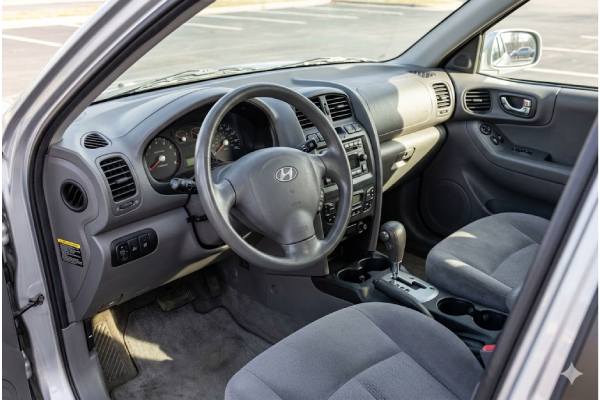
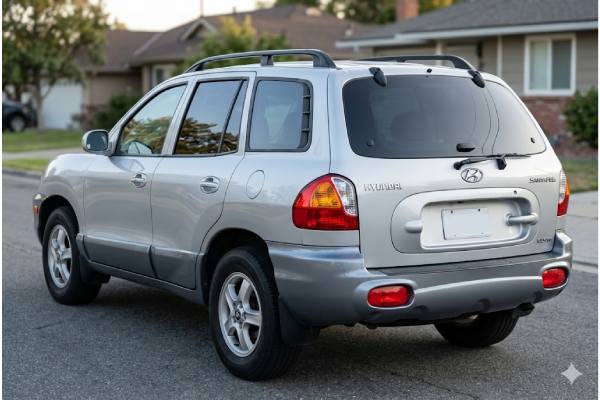
The first-generation Hyundai Santa Fe arrived when compact and midsize crossovers were still finding their shape. In front-wheel-drive SM form with the 2.7-liter V6, it was not a hardcore SUV, but a practical five-seat crossover with a roomy cabin, simple mechanicals, and enough power for daily driving. For buyers looking at an early-2000s Santa Fe today, the key questions are less about image and more about condition: timing belt history, rust exposure, automatic transmission care, suspension wear, and whether safety equipment matches the build date.
The 2001–2002 Santa Fe FWD 2.7 V6 sits in an interesting spot. It offers more relaxed performance than the 2.4 four-cylinder, avoids the added complexity of the AWD driveline, and keeps maintenance relatively straightforward. At the same time, it is now an older vehicle, so its value depends heavily on documented servicing and corrosion control.
Owner Snapshot
- Strong V6 smoothness, useful cabin space, and simple FWD packaging make it a practical older crossover.
- The 2.7-liter Delta V6 is durable when the timing belt, coolant, ignition parts, and oil service are kept current.
- Rust-prone suspension areas and recalled corrosion-related components need careful inspection, especially in road-salt regions.
- Timing belt service is commonly treated as a 60,000-mile / 96,000-km maintenance priority on this engine.
- Engine oil capacity is about 4.5 L / 4.8 US qt with filter; verify viscosity and specification by market and climate.
Table of Contents
- Santa Fe SM FWD Used Overview
- Santa Fe SM V6 Technical Specs
- Santa Fe SM Trims and Safety
- Reliability Issues and Service Actions
- Maintenance Schedule and Buying Checks
- Road Performance and Fuel Use
- Comparison With Period Rivals
Santa Fe SM FWD Used Overview
The SM-generation Hyundai Santa Fe was Hyundai’s first SUV-style crossover for many export markets, and the 2001–2002 2.7 V6 FWD version is one of the more sensible early configurations. It uses a transverse-mounted gasoline V6, a four-speed automatic transaxle, independent suspension, and front-wheel drive. That makes it closer in character to a tall wagon than to a ladder-frame off-roader.
The 2.7-liter V6 is the main reason to consider this version over the four-cylinder. It does not make the Santa Fe fast by modern standards, but it gives the vehicle smoother acceleration, better highway passing, and less effort when carrying passengers or cargo. The V6 also came paired with an automatic transmission, which suited the Santa Fe’s relaxed character.
The FWD layout has advantages for used buyers. It avoids rear differential, transfer case, and prop-shaft maintenance found on AWD versions. It is lighter, simpler, and usually slightly better on fuel. The trade-off is traction: on wet grass, snow, steep gravel, or muddy tracks, a FWD Santa Fe depends heavily on tires and careful throttle use. With quality all-season or winter tires, it is still a reasonable road-focused family crossover.
In market terms, the exact equipment varies. North American 2002 models were commonly sold in GLS and LX grades with the V6, while some international markets used different trim names and power ratings. Some sources list the engine near 173 hp in certain markets, while the U.S. manufacturer rating for the 2.7-liter V6 was 181 hp. This article focuses on the 181 hp FWD 2.7 V6 specification stated in the title, with notes where market differences matter.
As a used purchase, condition is far more important than trim. A clean, well-maintained Santa Fe with documented timing belt replacement, healthy cooling system, smooth automatic shifts, and solid underbody structure is worth far more than a higher-trim example with rust, vague service records, or neglected fluids.
The main advantages are practical: a spacious five-seat cabin, a large rear hatch, decent ride comfort, simple controls, affordable parts availability, and a powertrain that many independent workshops understand. The main limitations are age, fuel economy, early-2000s safety technology, and the need to inspect corrosion-prone areas carefully.
Santa Fe SM V6 Technical Specs
The following data reflects the 2001–2002 Hyundai Santa Fe SM FWD with the 2.7-liter Delta V6 and four-speed automatic, using U.S.-market figures where available. Always verify final values by VIN, market, emissions calibration, and trim.
| Item | Specification |
|---|---|
| Engine code | G6BA / Delta V6 family |
| Engine layout | Transverse V6, 6 cylinders, DOHC, 24 valves, 4 valves/cyl |
| Bore × stroke | 86.7 × 75.0 mm / 3.41 × 2.95 in |
| Displacement | 2.7 L / 2,656 cc |
| Induction | Naturally aspirated |
| Fuel system | Multi-point fuel injection |
| Compression ratio | About 10.0:1 |
| Max power | 181 hp / 135 kW @ 6,000 rpm |
| Max torque | 240 Nm / 177 lb-ft @ 4,000 rpm |
| Timing drive | Timing belt |
| EPA rating | About 17 city / 23 highway / 19 combined mpg US; about 13.8 / 10.2 / 12.4 L/100 km |
| Real-world highway at 120 km/h / 75 mph | Typically about 10.5–12.5 L/100 km / 19–22 mpg US when healthy |
| Item | Specification |
|---|---|
| Transmission | 4-speed automatic transaxle, commonly listed as F4A51-family Shiftronic automatic |
| Drive type | Front-wheel drive |
| Differential | Open front differential |
| Item | Specification |
|---|---|
| Front suspension | MacPherson strut with stabilizer bar |
| Rear suspension | Independent rear suspension; commonly listed as double-wishbone/multi-link type |
| Steering | Power-assisted rack-and-pinion |
| Brakes | Ventilated front discs, solid rear discs on V6 models; ABS availability varies by trim |
| Popular tire size | P225/70R16 on 16 × 6.5 in wheels |
| Ground clearance | About 188 mm / 7.4 in |
| Length / width / height | About 4,500 mm / 1,845 mm / 1,675 mm; 177.2 in / 72.6 in / 65.9 in |
| Wheelbase | 2,620 mm / 103.1 in |
| Turning circle | About 11.3 m / 37.1 ft |
| Curb weight | About 1,685–1,700 kg / 3,720–3,750 lb, depending on trim and equipment |
| GVWR | About 2,300 kg / 5,070 lb; verify door label |
| Fuel tank | 65 L / 17.2 US gal / 14.3 UK gal |
| Cargo volume | Market data varies; roughly 30+ ft³ seats up and about 70+ ft³ seats folded by SAE-style figures |
| Item | Specification |
|---|---|
| 0–100 km/h / 0–62 mph | Approximately 11–12 seconds, depending on market and test conditions |
| Top speed | Approximately 180–185 km/h / 112–115 mph |
| 100–0 km/h braking | Period test data varies; tire and brake condition dominate on used examples |
| Towing capacity | Up to about 1,225 kg / 2,700 lb when properly equipped |
| Payload | About 680–700 kg / 1,500–1,540 lb, depending on trim; verify certification label |
| System | Specification / Capacity |
|---|---|
| Engine oil | API SG or later; 5W-30, 10W-30, or climate-appropriate grade; about 4.5 L / 4.8 US qt with filter |
| Coolant | Ethylene-glycol coolant mixed about 50/50 with distilled water; capacity varies by market, verify manual |
| Automatic transmission fluid | Hyundai/Kia SPIII-type ATF; total fill commonly around 7.8–8.5 L / 8.2–9.0 US qt, drain-and-fill less |
| Brake fluid | DOT 3 or DOT 4, according to cap/manual specification |
| A/C refrigerant | R134a; commonly about 575–625 g / 20–22 oz depending on market label |
| A/C compressor oil | PAG-type oil; verify compressor label and service manual |
| Oil drain plug torque | About 39 Nm / 29 lb-ft |
| Wheel lug nut torque | Commonly around 90–110 Nm / 66–81 lb-ft; verify wheel and service data |
| Item | Availability / Rating |
|---|---|
| IIHS moderate overlap front | Good for applicable 2001–2006 models built after March 2001 |
| IIHS side test | Acceptable for applicable 2002–2006 models built after March 2002 with side airbags |
| IIHS head restraints/seats | Poor |
| Euro NCAP | Older test regime; some European-market data lists four stars, but equipment and protocols differ |
| ADAS | No modern AEB, ACC, lane keeping, blind-spot monitoring, or traffic sign assist |
Santa Fe SM Trims and Safety
For the 2001–2002 period, the Santa Fe range differed by country. In the U.S., the V6 FWD model was commonly offered as GLS and LX. The GLS provided the main V6 equipment package, while the LX added more comfort and convenience features. In other markets, trim names such as GL, GLS, or locally defined grades may apply, and power output can be listed differently due to measurement standards or emissions tuning.
The easiest identifiers are mechanical rather than cosmetic. A 2.7 V6 Santa Fe has the V6 badging, the wider power delivery of the Delta engine, and the four-speed automatic. On a used vehicle, the VIN, emissions label, and under-hood engine label are more reliable than badges, which may have been moved, removed, or replaced.
Typical V6 FWD equipment included five seats, a split-folding rear bench, roof rails on many examples, 16-inch wheels, power accessories, cruise control, air conditioning, and upgraded audio depending on trim. LX models often added features such as leather upholstery, heated front seats, automatic climate control, or a sunroof, though availability varied. Functionally, the FWD V6 trims share the same basic engine and transmission package.
Safety equipment is where build date matters. Early Santa Fe models had dual front airbags and basic structural protection for the period, but modern driver-assistance systems were not part of this generation. IIHS data gives the applicable SM Santa Fe a Good rating in the original moderate-overlap front test for models built after March 2001. Side-impact performance was rated Acceptable for 2002–2006 models built after March 2002 with standard front seat-mounted combination head-and-torso airbags. Head restraints and seats were rated Poor, which is important for whiplash protection expectations.
ABS and traction control availability can vary by trim and market. Some V6 models had ABS with electronic brake-force distribution, while others may not. Stability control was not a defining feature of these early examples, and there is no factory AEB, adaptive cruise control, lane assistance, or blind-spot monitoring.
For child seats, check for LATCH/ISOFIX provisions according to market and build date, and inspect rear seat belts carefully. On older vehicles, belt retractors, buckles, and anchor points deserve close attention because age, moisture, and previous repairs can affect function.
After collision repair, alignment of airbags, sensors, seat belts, and crash structure should be verified by a qualified repairer. Unlike newer vehicles, there are no camera or radar calibrations to manage, but basic restraint-system integrity is still critical.
Reliability Issues and Service Actions
The Santa Fe SM 2.7 V6 can be a long-lived vehicle, but it does not tolerate neglect. Its most important reliability item is the timing belt system. The belt, tensioner, idlers, and water pump area should be serviced on schedule. A seller who cannot document timing belt replacement should be treated as if the job is due now. On an interference-style V6, a failed belt can turn an affordable service into major engine damage.
Common and moderate-cost issues include oil leaks from valve covers, front seals, or oil pan areas; ignition misfires from worn plugs, leads, or coils; oxygen-sensor faults; aged vacuum hoses; thermostat problems; and radiator or coolant-hose deterioration. Symptoms are usually straightforward: oil smell, visible seepage, rough idle, check-engine light, overheating, or poor fuel economy. The remedy is usually replacement of aged rubber, gaskets, sensors, or cooling components rather than complex diagnostics, but access around the V6 can add labor.
Automatic transmission condition matters. The four-speed automatic should shift smoothly when cold and warm, without flare, harsh engagement, delayed reverse, or shudder under light throttle. Dirty, burned, or incorrect ATF is a warning sign. These transmissions were designed around SPIII-type fluid, so generic “universal” fluid should be treated cautiously unless it clearly meets the correct specification.
Corrosion is the major chassis concern. Road-salt vehicles require detailed inspection of rear trailing arms, front subframe areas, coil spring seats, brake lines, fuel lines, rocker seams, rear wheel arches, and suspension mounting points. Corrosion-related recalls and campaigns have affected early Santa Fe models in salt-belt regions, including rear trailing-arm corrosion and front coil-spring corrosion. A broken coil spring can damage a tire, and severe trailing-arm corrosion can affect vehicle control.
Typical issue mapping:
| Prevalence | Issue | Symptoms | Likely Remedy | Cost Tier |
|---|---|---|---|---|
| Common | Timing belt overdue | No records, belt noise, age/mileage uncertainty | Replace belt, tensioner, idlers, water pump as a set | Medium |
| Common | Valve cover and seal leaks | Oil smell, smoke on hot engine, wet engine surfaces | Replace gaskets and inspect PCV system | Low–medium |
| Occasional | Automatic shift problems | Flare, shudder, delayed engagement | Fluid inspection, correct ATF service, diagnosis before purchase | Medium–high |
| Common in salt areas | Suspension and underbody corrosion | Rust flakes, cracked spring, uneven rear alignment, clunks | Recall check, structural inspection, replacement of affected parts | Medium–high |
| Occasional | Cooling system aging | Overheating, coolant smell, brown coolant, seepage | Radiator, hoses, thermostat, coolant flush, pressure test | Medium |
Software updates are less central than on modern vehicles. There are no hybrid battery, ADAS, or infotainment software ecosystems to manage. However, dealer campaign completion should still be checked by VIN, especially for safety recalls. Ask for proof that any applicable recalls were completed, and use an official VIN lookup before purchase.
Maintenance Schedule and Buying Checks
A good maintenance plan for the Santa Fe 2.7 V6 should be age-based as much as mileage-based. Many remaining examples are driven lightly, but rubber belts, coolant hoses, seals, brake components, and tires still age.
| Interval | Service Items |
|---|---|
| Every 5,000–7,500 miles / 8,000–12,000 km or 6–12 months | Engine oil and filter; inspect belts, hoses, tires, lights, leaks, and fluid levels |
| Every 12 months | Brake inspection, suspension check, steering inspection, underbody corrosion check, battery test |
| Every 15,000–30,000 miles / 24,000–48,000 km | Engine air filter, cabin filter if equipped, throttle body inspection, fuel and vacuum hose inspection |
| Every 30,000–40,000 miles / 48,000–64,000 km | Automatic transmission drain-and-fill with correct SPIII-type ATF, especially for city use or towing |
| Every 2 years | Brake fluid replacement; coolant condition test; inspect brake lines and fuel lines |
| Every 60,000 miles / 96,000 km or about 5 years | Timing belt service; include tensioner, idlers, water pump inspection/replacement, drive belts, and coolant if disturbed |
| Every 60,000–100,000 miles / 96,000–160,000 km | Spark plugs, ignition wires, PCV valve, coolant service, accessory belts, engine mounts, oxygen sensors as needed |
| Every 4–6 years | 12 V battery replacement window; load-test sooner in hot or cold climates |
Before buying, inspect the vehicle cold. A warm engine can hide starting issues, lifter noise, misfires, and transmission engagement delays. Check for blue smoke, coolant smell, uneven idle, check-engine lights, and oil leaks. During the test drive, include low-speed parking maneuvers, stop-and-go driving, a steady 80–100 km/h cruise, and a firm but safe acceleration run.
A strong buyer’s checklist includes:
- Timing belt invoice with date, mileage, and parts list.
- Correct ATF service history, not just “transmission flushed” with unknown fluid.
- Rust inspection on a lift, especially rear suspension arms, front subframe, brake lines, and spring seats.
- Cooling system pressure test if coolant is discolored or the temperature gauge is unstable.
- Scan-tool check for stored and pending codes.
- Tire age check, not just tread depth.
- Confirmation of recall completion through official records.
- Verification that ABS, airbag, and check-engine lamps illuminate at key-on and go out normally.
The best examples are usually not the cheapest. Paying more for a clean underbody, fresh timing belt, smooth transmission, and complete service history is often cheaper than repairing a neglected vehicle later. Avoid examples with structural rust, overheating history, slipping transmission, missing title history, or evidence of poorly repaired collision damage.
Road Performance and Fuel Use
The Santa Fe FWD 2.7 V6 drives like an early crossover: soft-edged, stable, and more comfort-focused than sporty. The seating position is high enough to feel SUV-like, but the unibody structure and independent suspension make it more car-like than body-on-frame SUVs of the same era.
The V6 is smooth at low and medium rpm, with useful torque for normal traffic. It responds better than the four-cylinder when the cabin is loaded, and it does not need to be worked as hard on hills. Still, the vehicle’s weight and four-speed automatic limit urgency. Passing at highway speed requires planning, and kickdown can be noticeable because there are only four forward gears.
Ride comfort is one of the better traits. The Santa Fe absorbs broken pavement reasonably well on 16-inch tires, and the taller tire sidewalls help it feel less brittle than many modern crossovers on large wheels. Steering is light rather than communicative. Body roll is present in quick corners, but the vehicle feels predictable when suspension bushings, shocks, tires, and alignment are in good condition.
Cabin noise is moderate by early-2000s standards. Wind noise around mirrors and roof rails, tire noise from all-terrain or older tires, and engine noise during kickdown are normal. Excessive humming, clunking, or vibration usually points to wheel bearings, tire wear, engine mounts, exhaust leaks, or driveline issues.
Fuel economy is acceptable for its age but not impressive now. Expect roughly:
| Use Case | Likely Consumption |
|---|---|
| City driving | 13.5–16.0 L/100 km / 15–17 mpg US / 18–20 mpg UK |
| Mixed driving | 11.5–13.5 L/100 km / 17–20 mpg US / 21–25 mpg UK |
| Highway at 100 km/h / 62 mph | 9.5–11.0 L/100 km / 21–25 mpg US / 26–30 mpg UK |
| Highway at 120 km/h / 75 mph | 10.5–12.5 L/100 km / 19–22 mpg US / 23–26 mpg UK |
Cold weather, short trips, roof racks, low tire pressure, dragging brakes, tired oxygen sensors, and old spark plugs can worsen economy. A sudden drop in mileage usually deserves diagnosis rather than acceptance.
For towing, the 2.7 V6 can manage light trailers when the vehicle is healthy and properly equipped, but it is not a heavy-duty tow platform. Transmission temperature, brake condition, tire rating, and trailer tongue weight matter. Moderate towing can increase fuel use by 20–40 percent or more, especially at highway speeds or on grades.
Comparison With Period Rivals
Against period rivals, the 2001–2002 Santa Fe FWD 2.7 V6 offered strong value, a long warranty when new, distinctive styling, and generous equipment. It was not the most refined or most efficient crossover, but it gave buyers a lot of space and V6 power for the money.
Compared with the first-generation Ford Escape and Mazda Tribute V6, the Santa Fe feels more relaxed and less sharp. The Escape/Tribute twins offered lively V6 performance and a more compact feel, but their interiors were simpler and road noise could be higher. The Hyundai’s advantage is comfort and perceived solidity; the Ford/Mazda advantage is agility.
Compared with a Toyota RAV4 of the same era, the Santa Fe is larger and more powerful, but less fuel-efficient and less nimble. The RAV4 has a stronger reputation for long-term durability, yet prices often reflect that. A clean Santa Fe may be better value than a rough RAV4.
Compared with a Honda CR-V, the Santa Fe again brings more V6 torque and a roomier feel, while the CR-V counters with excellent packaging, lighter running costs, and strong reliability. For drivers who prioritize fuel economy and simplicity, the CR-V is usually easier to justify. For those wanting a smoother V6 and more relaxed highway character, the Santa Fe has appeal.
Compared with a Subaru Forester, the Santa Fe FWD lacks standard AWD traction and the more wagon-like handling of the Subaru. However, it avoids some Subaru-specific engine and AWD maintenance concerns. In dry or mild climates, the FWD Hyundai can be simpler to own.
The Santa Fe’s strongest case today is not that it beats all rivals on paper. Its case is condition, price, and practicality. A rust-free, well-maintained FWD V6 with documented timing belt service can still be a useful budget crossover. A neglected one is rarely worth rescuing unless it is extremely cheap and the buyer can do repairs personally.
References
- 2002 HYUNDAI SANTA FE 2002 (Manufacturer Press Kit)
- Gas Mileage of 2002 Hyundai Santa Fe 2002 (Official Fuel Economy)
- 2002 Hyundai Santa Fe 2002 (Safety Rating)
- Check for Recalls: Vehicle, Car Seat, Tire, Equipment | NHTSA 2026 (Recall Database)
- Manuals & Warranties | Hyundai Resources 2026 (Owner’s Manual Portal)
Disclaimer
This article is for informational purposes only and is not a substitute for professional diagnosis, repair, or inspection. Specifications, torque values, service intervals, equipment, safety ratings, and procedures can vary by VIN, market, build date, trim, and installed options. Always verify maintenance, repair, and safety information against official service documentation and qualified professional advice.
If this helped, consider sharing it on Facebook, X/Twitter, or another platform to support our work.