
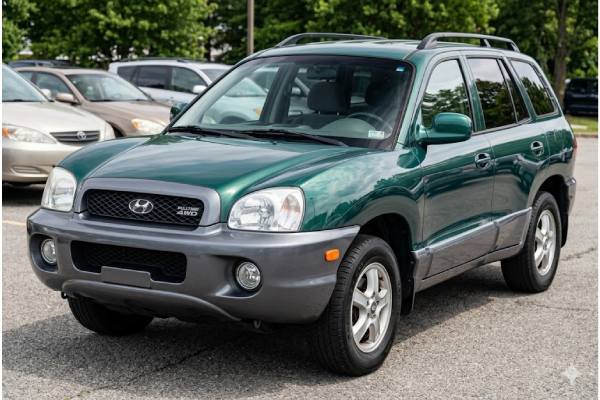
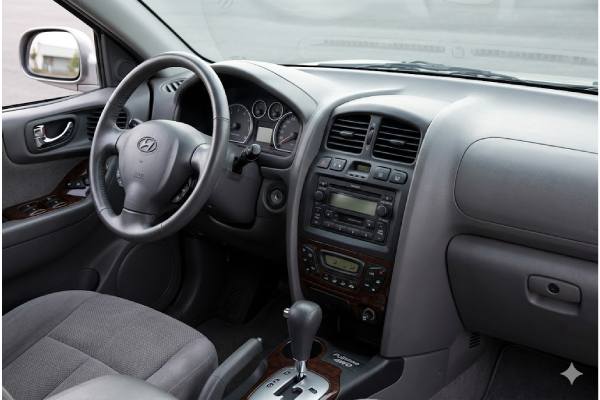

The 2004 Hyundai Santa Fe FWD with the 3.5-liter V6 is a narrow but useful slice of the first-generation SM Santa Fe lineup. It pairs Hyundai’s larger Sigma V6 with a 5-speed Shiftronic automatic and front-wheel drive, giving it better passing power than the 2.4-liter and 2.7-liter versions without the added weight and driveline complexity of 4WD.
As a used vehicle, its appeal depends less on showroom equipment and more on condition, maintenance history, rust exposure, and whether age-related service has been handled. The engine is strong enough for family use, light towing, and highway driving, but the timing belt, cooling system, suspension corrosion, and transmission-fluid history deserve careful attention before purchase.
Quick Overview
- Stronger 3.5 V6 gives the Santa Fe better highway passing and towing confidence than smaller-engine SM models.
- Comfortable ride, generous cargo space, simple controls, and 5-passenger practicality remain key strengths.
- Fuel economy is modest, and rust-prone suspension components are a serious inspection point in salt-belt climates.
- Replace the timing belt about every 60,000 miles / 96,000 km or 4 years, whichever comes first.
- Use Hyundai/Kia SP-III automatic transmission fluid specification and verify capacities by VIN and service manual.
Table of Contents
- Santa Fe SM 3.5 Used Context
- Santa Fe SM 3.5 Technical Data
- Santa Fe SM 3.5 Trim and Safety
- Reliability Issues and Service Actions
- Maintenance Schedule and Buyer Checks
- Driving Performance and Economy
- How the Santa Fe Compares
Santa Fe SM 3.5 Used Context
The 2004 Santa Fe belongs to the first-generation SM platform, a unibody SUV built with a clear road-biased focus. It was not a ladder-frame off-roader, and the FWD 3.5 V6 version is best understood as a roomy compact-to-midsize crossover with a stronger engine, not as a rugged trail vehicle. The body style is a 5-door SUV/wagon with two rows of seating and a rear hatch.
For North America, the 3.5-liter V6 was a major upgrade over the 2.7-liter V6. The engine was shared with larger Hyundai models of the period and brought the Santa Fe to 200 hp for 2004, paired with a 5-speed automatic instead of the 4-speed used with the 2.7. In FWD form, it avoided rear differential and transfer hardware, which helps simplify long-term ownership, although it also means less traction in snow or loose surfaces than the 4WD model.
The 3.5 FWD Santa Fe suits buyers who want inexpensive used-SUV utility with a softer ride, simple cabin layout, and adequate V6 power. Its strongest ownership case is a well-maintained, rust-free example with proof of timing-belt service, coolant service, brake work, and clean automatic-transmission fluid. A cheap example without these records can quickly become expensive because the 3.5 V6 timing belt service is not optional maintenance.
The model’s biggest advantage is its balance of space, comfort, and low purchase cost. Cargo room is useful, the rear seat is adult-friendly for the vehicle’s size, and visibility is better than in many later crossovers. The controls are straightforward, and there is less electronic complexity than in modern SUVs.
The trade-off is age. Every 2004 Santa Fe is now old enough that rubber parts, seals, bushings, mounts, hoses, cooling components, and wiring connectors matter as much as mileage. Even a low-mileage car may need catch-up maintenance if it has sat outside or skipped time-based services. A high-mileage car can still be viable if it has been serviced consistently and kept away from severe corrosion.
For this exact FWD 3.5 V6 configuration, the main purchase questions are clear: has the timing belt been replaced on time, does the transmission shift cleanly, is the front suspension free of rust and broken spring history, are there oil or coolant leaks, and do the brakes, ABS, air conditioning, and electrical accessories work without warning lights? A car that passes those checks can still make sense as a low-cost utility vehicle. One that fails several of them is often not worth rescuing unless the price leaves room for immediate repairs.
Santa Fe SM 3.5 Technical Data
The figures below describe the 2004 North American-style Santa Fe FWD 3.5 V6 where data is available. Some values vary by market, trim, tire package, production date, and certification method, so the VIN plate, under-hood labels, and official service information remain the final authority.
| Item | 2004 Santa Fe FWD 3.5 V6 |
|---|---|
| Engine code | G6CU, Sigma family |
| Engine layout and cylinders | 60-degree V6, 6 cylinders, DOHC, 4 valves/cyl, 24 valves total |
| Bore x stroke | 93.0 x 85.8 mm / 3.66 x 3.38 in |
| Displacement | 3.5 L / 3,497 cc |
| Induction | Naturally aspirated |
| Fuel system | Multi-point fuel injection |
| Compression ratio | 10.0:1 |
| Max power | 200 hp / 149 kW @ 5,500 rpm |
| Max torque | 297 Nm / 219 lb-ft @ 3,500 rpm |
| Timing drive | Timing belt |
| Fuel | Regular unleaded gasoline |
| EPA rated efficiency | 15 city / 20 highway / 17 combined mpg US; approx. 15.7 / 11.8 / 13.8 L/100 km; 18.0 / 24.0 / 20.4 mpg UK |
| Real-world highway at 120 km/h / 75 mph | Typically about 11.5–13.5 L/100 km / 17–20 mpg US, depending on tires, terrain, load, wind, and maintenance condition |
| Item | Specification |
|---|---|
| Transmission | 5-speed Shiftronic automatic, F5A51-family; verify exact tag by VIN |
| Drive type | Front-wheel drive |
| Differential | Open front differential integrated with transaxle |
| AWD transfer case | Not fitted to FWD model |
| Item | Specification |
|---|---|
| Front suspension | MacPherson strut, coil springs, anti-roll bar |
| Rear suspension | Independent trailing-arm / multi-link layout with coil springs |
| Steering | Hydraulic power rack-and-pinion; approx. 18.9:1 overall ratio |
| Brakes | Front vented discs approx. 277 mm / 10.9 in; rear discs approx. 284 mm / 11.2 in |
| Popular tire size | 225/70R16 on 16-inch wheels |
| Ground clearance | Approx. 188 mm / 7.4 in for FWD listings; some market listings vary |
| Approach / departure angles | Approx. 28° / 26° |
| Length / width / height | 4,501 / 1,847 / 1,676 mm; 177.2 / 72.7 / 66.0 in |
| Wheelbase | 2,619 mm / 103.1 in |
| Turning circle | Approx. 11.3 m / 37.1 ft kerb-to-kerb |
| Curb weight | Approx. 1,695 kg / 3,737 lb |
| GVWR | Approx. 2,307 kg / 5,086 lb |
| Fuel tank | Approx. 72 L / 19.0 US gal / 15.8 UK gal |
| Cargo volume | Approx. 864 L / 30.5 ft³ seats up; 2,200 L / 77.7 ft³ seats folded, SAE-style published figures |
| Metric | Typical figure |
|---|---|
| 0–100 km/h / 0–62 mph | Approx. 9.5–10.5 seconds depending on test conditions; 4WD road tests were often slower than FWD |
| 0–60 mph | About 9.0–10.0 seconds in period testing and estimates |
| Top speed | Approx. 190–200 km/h / 118–124 mph, where conditions and gearing permit |
| 60–0 mph braking | Period 4WD testing recorded about 132 ft / 40 m; tire condition strongly affects results |
| Towing capacity | Approx. 1,270 kg / 2,800 lb for this FWD 3.5 listing; some sources list higher by package, so verify hitch and manual |
| Payload | Approx. 612 kg / 1,349 lb |
| System | Specification and capacity |
|---|---|
| Engine oil | API gasoline oil meeting Hyundai period spec; commonly 5W-30 or 10W-30 depending on climate. Capacity with filter approx. 4.3 L / 4.5 US qt |
| Coolant | Ethylene-glycol coolant suitable for aluminum engines; 50/50 mix in most climates. System capacity approx. 8.2 L / 8.7 US qt |
| Automatic transmission fluid | Hyundai/Kia Diamond ATF SP-III specification. Drain-and-fill commonly about 3.8–4.0 L / 4.0–4.2 US qt; total fill roughly 7.7–8.0 L / 8.1–8.5 US qt |
| Differential / transfer case | Not separate on FWD; front final drive is part of the automatic transaxle |
| A/C refrigerant | R134a; many service charts list about 600 g / 21 oz for front A/C, but use the under-hood label |
| A/C compressor oil | PAG oil; charge varies by compressor and service operation, commonly around 150 mL / 5 fl oz for system quantity |
| Key torque values | Wheel nuts approx. 88–108 Nm / 65–80 lb-ft; oil drain plug commonly about 39 Nm / 29 lb-ft. Verify fasteners by service manual |
| Area | 2004 Santa Fe SM notes |
|---|---|
| IIHS | Moderate overlap front: Good; original side test: Acceptable for models with side airbags; head restraints and seats: Poor |
| NHTSA | Published 5-star-era summaries vary by configuration; check the official vehicle record and VIN for exact applicability |
| Euro NCAP | No directly applicable 2004 North American FWD 3.5 result; European-market equipment differed |
| Airbags | Dual front airbags plus front seat-mounted side-impact airbags on later SM models |
| Braking and stability systems | Four-wheel discs; ABS and traction control were associated with 3.5 models in North American equipment |
| ADAS | No AEB, ACC, lane keeping, blind-spot monitoring, rear cross-traffic alert, or traffic-sign assist |
| Headlight rating | No modern IIHS headlight rating for this model generation |
Santa Fe SM 3.5 Trim and Safety
For the 2004 North American lineup, the Santa Fe was generally offered in base, GLS, and LX forms, with the 3.5-liter V6 positioned above the standard 2.4-liter four-cylinder and 2.7-liter V6. The 3.5 V6 was available on GLS and was standard on LX in many listings. The exact trim mix depends on market and build date, but a FWD 3.5 is typically a better-equipped example than a base four-cylinder Santa Fe.
The mechanical identifier is the combination of the 3.5-liter V6, 5-speed Shiftronic automatic, and FWD transaxle. The shift gate with manual override is a quick cabin clue. Under the hood, the emissions label and engine layout confirm the V6, while the VIN and build plate are the best way to confirm drivetrain and trim. Exterior badging may show GLS or LX, but badges alone should not be trusted on a 20-year-old vehicle because liftgates and trim pieces can be replaced.
Feature differences were more about comfort and convenience than hard mechanical upgrades. GLS and LX versions commonly brought alloy wheels, roof rails, better audio, power accessories, cruise control, and upgraded interior materials. LX models often added leather seating surfaces, automatic climate control, heated front seats, an auto-dimming mirror, and higher audio equipment. Wheel and tire size was commonly 225/70R16, which is a useful size for ride comfort and replacement cost.
Safety equipment is period-appropriate rather than modern. Dual front airbags were expected, and later SM Santa Fe models gained front seat-mounted side-impact airbags for the driver and front passenger. Hyundai also used seatbelt pretensioners, child door locks, and child-seat anchors. The 3.5 models had four-wheel disc brakes, and ABS with traction control was part of the key equipment story for the larger-engine versions.
Crash-test performance was respectable for its era but must be understood in context. The IIHS moderate-overlap front result was Good, which was a strong result at the time. The original IIHS side-impact rating was Acceptable for applicable models, with good injury measures for several body regions but structural and rear head-protection concerns. The head restraint and seat evaluation was Poor, which matters for whiplash protection in rear impacts.
There were no modern driver-assistance systems. No automatic emergency braking, adaptive cruise control, active lane support, blind-spot monitoring, parking sensors, or rear camera should be expected as factory equipment. Aftermarket cameras or head units may be fitted, but their quality depends entirely on the installation.
Service work after body repairs is simpler than on modern vehicles because there are no radar or camera calibrations. However, ABS wheel-speed sensors, tone rings, airbag wiring, and seatbelt pretensioner circuits still need proper diagnosis. Any airbag or ABS warning light should be treated as a safety issue, not as a cosmetic fault.
Reliability Issues and Service Actions
The 3.5 V6 Santa Fe can be durable, but it is not a low-maintenance vehicle at this age. The key is separating ordinary age wear from expensive neglected-service problems. The engine itself is generally robust when oil, coolant, and timing-belt services are kept current. The most costly failures usually come from deferred timing-belt service, cooling-system neglect, corrosion, or automatic-transmission fluid that was never changed.
| Issue | Prevalence | Cost tier | Symptoms and remedy |
|---|---|---|---|
| Overdue timing belt | Common on neglected cars | High if it fails | No warning before failure; replace belt, tensioner, idlers, water pump, and seals as a package |
| Oil leaks | Common with age | Low to medium | Burning smell, wet valve covers, oil on exhaust; reseal valve covers and inspect cam/crank seals |
| Cooling-system aging | Common | Medium to high | Temperature creep, coolant smell, stained radiator tanks; inspect radiator, hoses, thermostat, cap, and water pump |
| Transmission shift flare or harsh shifts | Occasional | Medium to high | Delayed engagement, slipping, harsh downshifts; check SP-III fluid condition, mounts, codes, and TCU adaptation |
| Front coil spring corrosion | Common in salt areas | Medium, safety-related | Broken spring, tire rub, uneven stance; inspect recall/campaign completion and replace damaged springs |
| Wheel bearings and suspension bushings | Occasional to common | Medium | Growling, clunking, wandering; replace worn bearings, ball joints, struts, arms, and alignment afterward |
| ABS sensor or tone-ring faults | Occasional | Low to medium | ABS light, low-speed pulsing, wheel-speed codes; inspect sensors, wiring, rings, and hub condition |
| A/C weak cooling | Common with age | Medium | Warm air, compressor cycling, oily residue; leak-test before recharge and verify charge by weight |
The timing belt is the most important engine-specific item. The 3.5 V6 is not a casual “run it until it breaks” engine. A belt failure can cause internal engine damage, so a buyer should treat missing documentation as if the belt is due now. A proper service should include the belt, hydraulic tensioner or tensioner assembly where applicable, idler pulleys, water pump, thermostat if accessible, front seals if leaking, and fresh coolant.
Oil leaks are usually manageable but should not be ignored. Valve cover gaskets, spark plug tube seals, cam seals, and crank seals are common age-related leak points. Oil in spark plug wells can cause misfires. Oil dripping onto hot exhaust parts can create smell and smoke. A pre-purchase inspection should include a look behind the upper timing covers and around the rear bank of the V6, where leaks may be harder to see.
The automatic transmission is smoother when serviced correctly. Harsh or lazy shifts may come from degraded fluid, worn mounts, sensor faults, or internal wear. Because the unit was designed around SP-III-type fluid, using a generic fluid without the correct friction behavior can worsen shift quality. A single drain-and-fill will not replace all fluid, so repeated drain-and-fill service is often safer on an older transmission than an aggressive flush.
Corrosion is one of the largest make-or-break issues. The front coil spring recall/campaign was tied to corrosion in salt-belt regions because a broken spring could contact the tire. On any used example, inspect the lower spring seats, front struts, control arms, subframe mounting areas, brake lines, fuel lines, rocker panels, rear suspension arms, and spare tire area. Surface rust is expected; perforation, swelling seams, cracked spring ends, or crusty brake lines are not.
Service actions and recalls should be checked by VIN. The front coil spring campaign is especially relevant in rust-prone regions. The ABS ECU reprogram recall applied to certain 2003 and 2004 Santa Fe vehicles equipped with the 3.5 V6, 4WD, and ABS, so it is not usually the headline concern for the FWD version, but VIN verification is still essential. Some vehicles also had label-related recall actions. Dealer records, recall-completion printouts, and a current VIN check are better than relying on general model-year lists.
Maintenance Schedule and Buyer Checks
A 2004 Santa Fe 3.5 should be maintained by both mileage and time. Age matters because belts, hoses, seals, brake fluid, coolant, and tires degrade even when the odometer moves slowly. For a used purchase, the first service plan should assume that undocumented work has not been done.
| Item | Practical interval | Notes |
|---|---|---|
| Engine oil and filter | 3,750–7,500 miles / 6,000–12,000 km or 6–12 months | Use the shorter interval for short trips, heat, cold starts, towing, or old engines with leaks |
| Engine air filter | Inspect every 15,000 miles / 24,000 km; replace around 30,000 miles / 48,000 km | Dusty use shortens the interval |
| Cabin air filter | 12,000–15,000 miles / 19,000–24,000 km or yearly | Helps airflow and defogging |
| Timing belt system | About 60,000 miles / 96,000 km or 4 years | Replace belt, tensioner, idlers, water pump, and seals as needed |
| Spark plugs | About 60,000 miles / 96,000 km | Rear bank access adds labor; replace plug wires or boots if aged |
| Coolant | About 30,000 miles / 48,000 km or 2 years for traditional coolant service | Use correct coolant type and 50/50 mix unless climate requires otherwise |
| Automatic transmission fluid | 30,000–60,000 miles / 48,000–96,000 km in practical used-vehicle service | Use SP-III specification; inspect for burnt smell or debris |
| Brake fluid | Every 2 years | Moisture-contaminated fluid harms ABS parts and calipers |
| Brake pads, rotors, hoses | Inspect every service | Check rear caliper slide pins and parking brake function |
| Serpentine belts and hoses | Inspect every oil service; replace if cracked, swollen, noisy, or glazed | Age is as important as mileage |
| Tire rotation and alignment | Rotate every 5,000–7,500 miles / 8,000–12,000 km | Align after strut, control arm, or tire replacement |
| 12 V battery | Test yearly after 3 years; typical replacement 4–6 years | Weak voltage can trigger false electrical symptoms |
| Fuel filter | Market-specific; inspect fuel-pressure symptoms | Some service information treats it as long-life/in-tank; verify by VIN |
A buyer’s inspection should start underneath. Look at the front springs and struts, control arms, subframe, rear suspension arms, rocker seams, fuel tank straps, brake lines, and exhaust hangers. A Santa Fe that looks clean on top but is heavily corroded underneath can become unsafe or uneconomical to repair.
Next, check the engine cold. It should start cleanly without extended cranking, heavy ticking, blue smoke, or coolant smell. Idle should settle smoothly. During the road test, the temperature gauge should stay stable, the heater should blow hot air, and the radiator fans should cycle as expected. Any overheating history is a major warning sign because old aluminum heads, gaskets, and plastic cooling parts do not tolerate repeated heat events.
Transmission behavior matters. From cold and warm, engagement into Drive and Reverse should be prompt but not violent. Upshifts should be clean, and kickdown should happen without flare. A light bump on one shift may be mount-related, but slipping, delayed engagement, or burnt fluid suggests risk.
Inside, test every power window, door lock, mirror, wiper speed, blower speed, A/C mode, radio, gauge, and warning lamp. Old Hyundai electrical problems are often simple, but diagnosing multiple small faults can consume time. Confirm the airbag light turns on at startup and then goes out. A bulb that never illuminates may have been tampered with.
Recommended examples are rust-free, stock, documented, and recently serviced. The best buy is not always the lowest-mile car; it is the one with timing-belt proof, clean fluids, good tires, no structural rust, and no warning lights. Avoid cars with missing timing-belt history, milky oil, coolant loss, slipping transmission, severe suspension corrosion, patched brake lines, or multiple unrelated electrical faults.
Driving Performance and Economy
The 3.5 V6 gives the SM Santa Fe a noticeably more relaxed character than the smaller engines. It is not quick by modern turbo-SUV standards, but it has enough torque for normal merging, two-lane passing, and climbing grades without constant high-rpm effort. The engine’s best work happens in the midrange, where the 219 lb-ft torque peak helps the vehicle feel less strained than a 2.4 or 2.7 Santa Fe with passengers aboard.
Throttle response is traditional and predictable. There is no turbo lag, no hybrid handoff, and no drive-mode complexity. The 5-speed automatic is one of the main advantages of the 3.5 package because it gives the engine better gearing than the older 4-speed. When healthy, it shifts smoothly and responds reasonably to kickdown. It is not a sporty transmission, and it may hold gears conservatively on hills, but it fits the Santa Fe’s comfort-focused personality.
Ride quality is soft and compliant. On 225/70R16 tires, the vehicle absorbs broken pavement well, and the taller sidewalls help protect wheels from potholes. Body roll is noticeable in faster corners, and the steering is not especially communicative, but the Santa Fe feels stable at normal road speeds. It is happier on urban streets, suburban roads, and highways than on twisty back roads.
Braking feel is adequate when the system is fresh. Because most examples are old, real braking confidence depends heavily on rotor condition, tire age, caliper slide lubrication, brake hoses, and ABS sensor health. A pulsing pedal, pulling, grinding, or long pedal travel should be fixed before regular use.
Cabin noise is moderate. The V6 is smoother than the four-cylinder, and highway cruising is comfortable enough for long trips, but wind noise, tire roar, aging door seals, and interior rattles become more apparent with age. Engine mounts and exhaust flex sections also influence perceived refinement.
Real-world fuel economy is the main operating-cost drawback. The official 2WD 3.5 automatic rating is 15 mpg city, 20 mpg highway, and 17 mpg combined. In practical use, city driving often lands around 14–17 mpg US / 16.8–13.8 L/100 km. Mixed driving often sits near 17–19 mpg US / 13.8–12.4 L/100 km. Steady highway cruising at moderate speeds can reach about 20–22 mpg US / 11.8–10.7 L/100 km, but 75 mph, roof racks, worn tires, hills, winter fuel, and A/C use can pull that down.
Towing should be treated conservatively. The 3.5 V6 has enough torque for a small trailer, but this is still an older unibody SUV with modest brakes by modern standards. Trailer brakes, proper tongue weight, fresh cooling system parts, good tires, and clean ATF matter more than the headline tow number. For frequent towing, a thorough inspection and auxiliary transmission temperature awareness are sensible.
The FWD layout has one practical benefit and one limitation. It is simpler and lighter than 4WD, with fewer driveline parts to service. But in snow, gravel, mud, or steep wet driveways, it relies on front-tire grip. Good all-season or winter tires transform the vehicle more than any traction-control system of the era.
How the Santa Fe Compares
The 2004 Santa Fe 3.5 FWD sits among early-2000s crossovers and compact SUVs such as the Toyota Highlander, Honda CR-V, Ford Escape, Mazda Tribute, Subaru Forester, Kia Sorento, and Mitsubishi Outlander. Its strongest comparison points are price, V6 torque, comfort, and equipment. Its weaker points are fuel economy, aging safety technology, and long-term rust exposure.
| Rival | Where the Santa Fe 3.5 is stronger | Where the rival may be stronger |
|---|---|---|
| Toyota Highlander V6 | Usually cheaper to buy with similar family utility | Better reputation for long-term durability and resale value |
| Honda CR-V | More V6 power and higher tow confidence | Better fuel economy, simpler four-cylinder maintenance, stronger parts ecosystem |
| Ford Escape / Mazda Tribute V6 | Softer ride and often roomier cabin feel | More compact feel and generally easier parking |
| Subaru Forester | More cargo volume and stronger V6 highway torque | Standard AWD traction and more car-like handling |
| Kia Sorento | More road-biased comfort and lighter-duty simplicity in FWD form | Body-on-frame strength and more traditional SUV capability |
Compared with the Toyota Highlander, the Santa Fe usually wins on used purchase price. A Highlander of the same era often commands more money because of Toyota’s reputation. The Santa Fe can be a better value if its service records are strong, but it has less tolerance for neglect and typically lower resale confidence.
Against the Honda CR-V, the Santa Fe 3.5 feels stronger and more relaxed on the highway. The CR-V counters with better economy, simpler mechanical packaging, and easier maintenance. Buyers who prioritize fuel cost and simplicity may prefer the Honda. Buyers who want V6 torque and more traditional SUV feel may prefer the Hyundai.
The Ford Escape and Mazda Tribute are closer in size and era. Their V6 versions are lively, but their cabins can feel narrower and less substantial. The Santa Fe’s ride comfort and equipment value are strong here, though the Ford/Mazda pair may feel a little more nimble.
The Subaru Forester offers better all-weather traction as a core advantage. A FWD Santa Fe cannot match that on slippery roads. The Hyundai responds with a bigger-cabin feel, more cargo space, and stronger naturally aspirated V6 output.
The final verdict is condition-led. A clean, serviced, rust-free 2004 Santa Fe FWD 3.5 V6 is a practical, comfortable, inexpensive used SUV with useful power and simple controls. It is not the most economical, safest by modern standards, or easiest engine to service, but it can be a sensible buy when the maintenance history is complete and the underbody is solid. The best examples are worth considering; neglected ones should be avoided, even at a tempting price.
References
- 2004 HYUNDAI SANTA FE 2003 (Manufacturer Publication) ([Hyundai News][1])
- Gas Mileage of 2004 Hyundai Santa Fe 2026 (EPA Fuel Economy Listing) ([Fuel Economy][2])
- 2004 Hyundai Santa Fe 2004 (Safety Rating) ([IIHS HLDI][3])
- Used 2004 Hyundai Santa Fe LX Specs & Features | Edmunds 2026 (Specifications) ([Edmunds][4])
- 2004 Hyundai SANTA FE Recalls | Cars.com 2026 (Recall Database) ([Cars.com][5])
Disclaimer
This article is for informational purposes only and is not a substitute for professional diagnosis, repair, or inspection. Specifications, torque values, fluid capacities, service intervals, procedures, and safety equipment can vary by VIN, market, production date, trim, and installed equipment. Always verify details against the official owner’s manual, service manual, under-hood labels, recall records, and qualified technician guidance before servicing or purchasing a vehicle.
If you found this useful, please consider sharing it on Facebook, X/Twitter, or another platform to support our work.