
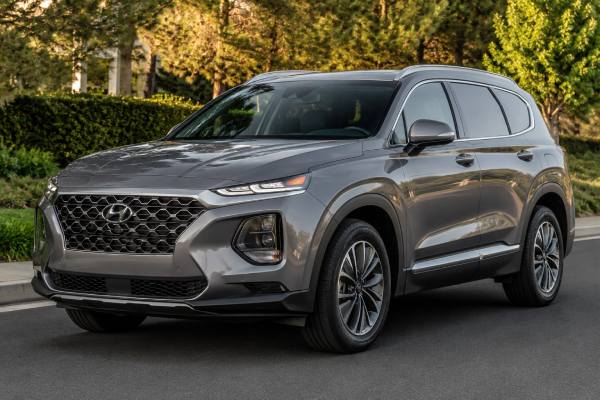

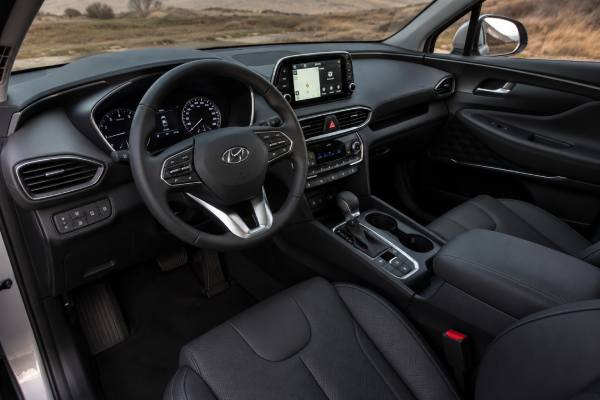
The 2019–2020 Hyundai Santa Fe FWD with the 2.4 GDi engine is a practical two-row midsize crossover aimed at comfort, space, safety, and daily usability rather than outright speed. In the North American market, this TM-generation Santa Fe replaced the earlier Santa Fe Sport nameplate and kept the larger three-row Santa Fe XL separate for a short time.
This version pairs Hyundai’s naturally aspirated 2.4-liter Theta II GDI four-cylinder with an 8-speed automatic transmission and front-wheel drive. It is not the quickest Santa Fe of its generation, but it is one of the simpler versions mechanically, with no turbocharger, no all-wheel-drive transfer hardware, and no hybrid system. For used buyers, the key questions are straightforward: whether the 2.4 has been maintained carefully, whether recalls and service actions are complete, and whether the equipment level matches the asking price.
At a Glance
- Roomy two-row cabin, strong cargo space, and a lighter, simpler FWD driveline than HTRAC AWD models.
- EPA-rated at 22 mpg city, 29 mpg highway, and 25 mpg combined for both 2019 and 2020 FWD 2.4 versions.
- Strong safety record, with IIHS Top Safety Pick recognition depending on model year and headlight equipment.
- The 2.4 GDi engine rewards frequent oil checks, clean oil, and attention to oil consumption, misfires, and carbon buildup symptoms.
- Typical U.S. oil service is about every 7,500 miles or 12 months in normal use, shortened to about 3,750 miles or 6 months in severe use.
Table of Contents
- Santa Fe TM Used Context
- Santa Fe TM Core Specs
- Santa Fe TM Trims and Safety
- Reliability, Issues and Recalls
- Maintenance and Buyer Checks
- Driving Feel and Economy
- Comparison With Key Rivals
Santa Fe TM Used Context
The TM-generation Santa Fe arrived for 2019 as a cleaner, more mature replacement for the previous Santa Fe Sport. In this specification, it is a five-seat crossover with front-wheel drive, a naturally aspirated 2.4-liter gasoline direct-injection engine, and a conventional 8-speed automatic transmission. That combination makes it less complex than the turbocharged and all-wheel-drive versions, while still providing enough space and equipment for family use.
The 2.4 GDi engine produces 185 hp and 178 lb-ft of torque. Those numbers are adequate rather than energetic, especially because the Santa Fe is a relatively large two-row SUV. The engine needs revs for quick merging or hill climbing, and the transmission often downshifts decisively when the vehicle is loaded. The upside is predictable throttle response, no turbo lag, and lower mechanical complexity than the 2.0T version.
Front-wheel drive is also important to the ownership picture. FWD Santa Fe models are lighter, slightly more efficient, and simpler underneath because they do not have the HTRAC rear driveline components. That reduces the number of fluids, couplings, seals, and mounts to inspect. The tradeoff is traction: in snow, mud, steep gravel, or wet boat ramps, the FWD model depends heavily on tire quality and stability-control calibration. With good tires it is a confident road vehicle, but it is not the Santa Fe to choose for regular slippery-climate towing or rural winter use.
The cabin is one of the main reasons this Santa Fe remains appealing as a used vehicle. It has a wide second row, a useful cargo floor, good outward visibility, and controls that are easier to operate than many newer touch-heavy interiors. Cargo capacity is strong for a two-row SUV, and the rear seat folds nearly flat for bulky loads. Families will also appreciate the easy child-seat access and available safety systems, though exact features vary between 2019 and 2020 trims.
As a used purchase, this Santa Fe is strongest when it has clear service records, matching quality tires, no accident-related sensor problems, and proof that open recalls or campaigns have been completed. It is less attractive if oil changes were stretched, if the engine is already consuming oil, if there are repeated misfire codes, or if a tow hitch harness recall applies but has not been remedied.
The 2019–2020 FWD 2.4 is best viewed as a comfortable, value-oriented crossover rather than a performance SUV. It suits buyers who want space, safety, a conventional automatic, and reasonable ownership costs, while accepting moderate acceleration and the usual direct-injection maintenance concerns.
Santa Fe TM Core Specs
The following specifications apply to the North American 2019–2020 Hyundai Santa Fe FWD 2.4 GDi unless noted. Exact values can vary by trim, tire package, market, equipment, build date, and VIN.
| Item | Specification |
|---|---|
| Engine family / code | Theta II 2.4 GDi, commonly identified as G4KJ in many service references |
| Layout | Inline-4, aluminum block and head, DOHC, 4 valves per cylinder |
| Bore × stroke | 88.0 × 97.0 mm (3.46 × 3.82 in) |
| Displacement | 2.4 L (2,359 cc) |
| Induction | Naturally aspirated |
| Fuel system | Gasoline direct injection |
| Compression ratio | 11.3:1 |
| Maximum power | 185 hp (138 kW) at 6,000 rpm |
| Maximum torque | 241 Nm (178 lb-ft) at 4,000 rpm |
| Timing drive | Timing chain, no routine belt replacement interval |
| Transmission | 8-speed automatic with SHIFTRONIC manual mode, A8MF1 family |
| Drive type | Front-wheel drive |
| Differential | Open front differential with electronic traction control |
| EPA fuel economy | 10.7 / 8.1 / 9.4 L/100 km city/highway/combined (22 / 29 / 25 mpg US; 26 / 35 / 30 mpg UK) |
| Real-world highway at 120 km/h | Typically about 8.1–9.0 L/100 km (26–29 mpg US; 31–35 mpg UK) when lightly loaded and mechanically healthy |
| Item | Specification |
|---|---|
| Front suspension | MacPherson strut |
| Rear suspension | Independent multi-link |
| Steering | Motor-driven power steering, rack-and-pinion, 13.8:1 ratio |
| Brakes | Front ventilated discs 320 mm (12.6 in); rear solid discs 305 mm (12.0 in) |
| Common tire sizes | 235/65 R17, 235/60 R18, or 235/55 R19 depending on trim and package |
| Ground clearance | 185 mm (7.3 in) |
| Length / width / height | 4,770 / 1,890 / 1,679–1,704 mm (187.8 / 74.4 / 66.1–67.1 in) |
| Wheelbase | 2,766 mm (108.9 in) |
| Turning circle | 11.4 m (37.5 ft), curb-to-curb |
| Curb weight | 1,629–1,725 kg (3,591–3,803 lb), depending on trim and equipment |
| GVWR | 2,145 kg (4,729 lb) |
| Estimated payload | About 420–516 kg (926–1,138 lb), depending on curb weight and equipment |
| Fuel tank | 71.2 L (18.8 US gal; 15.6 UK gal) |
| Cargo volume | 1,017 L (35.9 ft³) behind second row; 2,019 L (71.3 ft³) behind first row, SAE method |
| Towing capacity | 907 kg (2,000 lb) braked; 748 kg (1,650 lb) unbraked |
| Item | Specification or guidance |
|---|---|
| 0–100 km/h | Approximately 9.4–10.0 seconds depending on trim, tires, load, and conditions |
| 0–60 mph | About 8.6–9.0 seconds in independent testing of the 2.4-liter version |
| Top speed | Not a major U.S. published figure; global estimates are around 190–195 km/h (118–121 mph) |
| Braking | Independent 60–0 mph testing has been around 36 m (118 ft), with tire condition and trim affecting results |
| Engine oil | Use the viscosity and specification listed for the VIN and climate; many 2.4 GDi service references list about 4.8 L (5.1 US qt) with filter |
| Coolant | Ethylene-glycol long-life coolant mixed to the service-manual ratio, commonly 50:50 unless climate requires otherwise |
| Automatic transmission fluid | Hyundai/Kia SP-IV family ATF or exact approved equivalent; service quantity depends on procedure, while total fill is higher than a drain-and-fill amount |
| Brake fluid | DOT 3 or DOT 4 as specified on the reservoir cap and service documentation |
| A/C refrigerant | Use the under-hood label and VIN-specific service data; refrigerant type and charge can vary by market and production details |
| Key torque examples | Oil drain plug commonly about 39 Nm (29 lb-ft); wheel lug nuts commonly about 107–127 Nm (79–94 lb-ft), verified by service data before work |
| Area | 2019–2020 Santa Fe FWD 2.4 notes |
|---|---|
| IIHS crash ratings | Strong crash-test performance, with Top Safety Pick recognition depending on model year and headlight equipment |
| Headlights | Higher-trim LED projector headlights performed better than lower-trim halogen headlights in IIHS evaluations |
| Airbags | Front, front side, and side-curtain airbags |
| Child-seat anchors | LATCH/ISOFIX-style lower anchors and tether provisions for rear seating positions, with usability varying by position |
| Driver assistance | Forward collision avoidance, lane keeping, driver attention warning, blind-spot monitoring, rear cross-traffic alert, adaptive cruise, and related systems vary by year and trim |
Santa Fe TM Trims and Safety
The 2019 Santa Fe lineup used SE, SEL, SEL Plus, Limited, and Ultimate trims in the U.S. market. The 2.4 GDi engine was standard across the range, while the 2.0T was offered on upper trims. Front-wheel drive was standard, and HTRAC AWD was optional. That means a used 2.4 FWD Santa Fe can appear in basic cloth-seat form or in a much more premium configuration with leather, panoramic roof, larger wheels, navigation, upgraded audio, and additional parking aids.
For 2020, Hyundai simplified the trim structure to SE, SEL, and Limited. This makes shopping easier, but it also means equipment differences are more concentrated. A 2020 SE is the price-leader version; a 2020 SEL adds a useful middle ground of convenience and available packages; a 2020 Limited is the better-equipped version with more comfort and technology features. The 2.4 remained the standard engine, while the turbocharged engine was offered on selected higher configurations.
Quick identifiers help when inspecting a listing. Base SE models usually have smaller wheels, simpler seat trim, and fewer convenience features. SEL models often add more daily-use equipment, and upper trims are more likely to have leather seating, larger infotainment screens, upgraded audio, a power liftgate, parking sensors, panoramic roof equipment, or premium lighting. Wheel size is not just cosmetic: 17-inch tires usually ride more softly and cost less to replace, while 18- and 19-inch packages can sharpen responses slightly but may increase tire noise and replacement cost.
The safety equipment story is one of the Santa Fe’s strengths, but trim and year matter. Many active-safety features were widely available or standard during these model years, including forward collision-avoidance assistance, lane keeping assistance, driver attention warning, blind-spot monitoring, and rear cross-traffic systems. However, the exact combination differs between 2019 and 2020 trims. In particular, some 2020 lower-trim configurations do not carry the same blind-spot or rear cross-traffic equipment as better-equipped versions.
Crash-test performance is generally a strong point. The TM Santa Fe structure performed well in IIHS crashworthiness testing, and the model received high recognition when fitted with qualifying headlights. The headlight detail is important because safety awards often depend not only on crash structure and automatic emergency braking, but also on headlight performance. A buyer comparing two otherwise similar vehicles should check whether the car has halogen or LED projector headlights and whether those lights are functioning correctly.
Airbag coverage includes front airbags, front side airbags, and side-curtain airbags. Rear-seat child restraint support is practical, though the middle rear position may not be as convenient as the outboard positions. Families using child seats should physically test seat fit, buckle access, and front-seat clearance before purchase.
ADAS calibration is another used-car consideration. Forward-camera and radar-based systems can require calibration after windshield replacement, collision repair, suspension work, bumper replacement, wheel alignment, or sensor removal. Warning lights, intermittent lane-keeping faults, poor adaptive-cruise behavior, or unexplained collision-warning messages should not be dismissed as minor annoyances. They can indicate improper repair, incorrect glass installation, damaged brackets, or outdated software.
Reliability, Issues and Recalls
The 2019–2020 Santa Fe 2.4 FWD can be a durable used crossover when maintained correctly, but it should not be bought casually without checking its history. The engine belongs to Hyundai’s Theta II family, a name associated with well-known problems in some earlier Hyundai and Kia applications. The TM-generation 2.4 is not automatically a bad engine, but oil condition, oil level, service records, and cold-start behavior matter more than they would on a less sensitive powertrain.
| Issue area | Prevalence / cost tier | Symptoms | Likely remedy |
|---|---|---|---|
| Oil consumption or low oil level | Occasional / medium to high | Low dipstick reading between services, ticking, warning light, blue smoke, catalyst codes | Document consumption, inspect leaks and PCV system, perform dealer oil-consumption test, repair before engine damage occurs |
| GDI intake carbon buildup | Occasional / medium | Rough idle, misfires, hesitation, reduced fuel economy | Diagnosis with scan data and inspection; intake valve cleaning if buildup is confirmed |
| Ignition coils or spark plugs | Occasional / low to medium | Misfire under load, flashing check-engine light, poor starting | Replace plugs at the correct interval; test coils and replace failed components |
| 8-speed automatic shift quality | Occasional / medium | Harsh cold shifts, flare, delayed engagement, hunting on grades | Check fluid level and condition, scan for TCU updates, reset adaptations when appropriate, service with correct ATF |
| Brake pulsation or corrosion | Common wear item / low to medium | Steering shake under braking, scraping after parking, uneven pad wear | Inspect pads, rotors, caliper slides, and parking brake operation; replace or service as needed |
| Suspension and steering wear | Normal with age / low to medium | Clunks, wandering, uneven tire wear, vibration | Inspect struts, bushings, ball joints, tie rods, wheel bearings, and alignment |
| Tow-hitch harness recall | VIN and accessory dependent / safety-critical | May have no warning before an electrical short or fire risk | Verify recall status by VIN; dealer inspection and harness/fuse remedy where applicable |
Oil level deserves special attention. A direct-injected 2.4-liter engine that is run low on oil can suffer accelerated timing-chain, bearing, cam phaser, and cylinder wear. A pre-purchase inspection should include a cold dipstick check, a look under the oil cap, a scan for misfire and cam-crank correlation codes, and a road test after the engine is fully warm. A seller who says the engine “just needs topping off sometimes” should be taken seriously, not reassured away.
Carbon buildup is another direct-injection concern. Because fuel is injected directly into the combustion chamber, it does not wash over the intake valves the way port injection does. Over time, oil vapor and exhaust-gas residue can form deposits. This is more likely on vehicles used for short trips, extended idling, and low-speed city driving. Symptoms can mimic ignition problems, so proper diagnosis is important before replacing parts randomly.
The A8MF1 8-speed automatic is generally smoother and more conventional in feel than a dual-clutch transmission or CVT, but it still needs correct fluid, software, and adaptation behavior. Shift complaints may be caused by old fluid, incorrect service procedure, worn mounts, software calibration, or unrelated engine hesitation. A road test should include cold engagement, gentle acceleration, moderate kickdown, hill climbing, and low-speed stop-and-go driving.
Recalls and service actions must be verified by VIN rather than assumed by model year. The major headline item for many Hyundai SUVs of this period is the tow-hitch harness recall, which concerns certain vehicles equipped with a genuine Hyundai accessory tow hitch or wiring harness. The risk involves a possible electrical short and fire, including while parked. Any Santa Fe with hitch wiring should be checked carefully, and recall completion should be documented.
A separate windshield bonding recall affected certain Santa Fe vehicles by production range. The issue concerns windshield adhesion and crash retention. Because VIN range and build date determine applicability, a vehicle should be checked through the official recall system and dealer records.
Theft-deterrent equipment is another practical ownership concern. Some lower-trim Hyundai models from this era were affected by the broader immobilizer and theft-vulnerability issue. On the Santa Fe, equipment can vary by trim and year, so buyers should confirm whether the vehicle has an immobilizer, whether any anti-theft software or hardware campaign applies, and whether insurance terms are affected in their area.
Maintenance and Buyer Checks
A Santa Fe 2.4 FWD is not difficult to maintain, but it is not a vehicle to neglect. The engine oil, ignition system, cooling system, transmission behavior, brake condition, and ADAS status should all be treated as part of the buying decision.
| Item | Typical interval or guidance |
|---|---|
| Engine oil and filter | About every 7,500 miles or 12 months in normal use; about every 3,750 miles or 6 months in severe use |
| Oil level check | Monthly and before long trips; more often if consumption is suspected |
| Tire rotation | About every 7,500 miles, with pressure checks at least monthly |
| Wheel alignment | Check when tires wear unevenly, after impacts, or when steering pull appears |
| Engine air filter | Inspect regularly; replace around 30,000 miles or sooner in dusty conditions |
| Cabin air filter | Usually every 12 months or 15,000 miles, sooner in dusty or polluted areas |
| Spark plugs | Common schedule reference is around 97,500 miles in normal use, shortened substantially in severe use |
| Valve clearance | Inspect at the specified high-mileage interval or if valve noise, rough running, or compression issues appear |
| Timing chain | No routine replacement interval; inspect for rattle, stretch, guide wear, tensioner faults, and timing-correlation codes |
| Coolant | Often first replacement at about 120,000 miles or 10 years, then about every 30,000 miles or 2 years, depending on market schedule |
| Brake fluid | Test moisture content regularly; replacement every 2–3 years is a sensible ownership practice |
| Brake pads and rotors | Inspect at every service, especially in salted-road climates or after long parking periods |
| Automatic transmission fluid | Normal-use schedules may not call for routine replacement, but severe use, towing, heat, or mileage can justify correct-fluid service |
| Serpentine belt and hoses | Inspect yearly for cracking, glazing, swelling, seepage, and age hardening |
| 12 V battery | Test from about year three onward; many batteries need replacement in the 3–5 year range |
Severe use is common in real life. Short trips, long idling, repeated city driving, dusty roads, hot climates, cold starts, mountain driving, and towing all qualify as harder service than a gentle highway commute. A used Santa Fe with mostly urban miles should be judged by the severe schedule, not by the most optimistic interval.
Before buying, ask for service records rather than verbal reassurance. Good records show regular oil changes with the correct specification, coolant service when due, tire rotations, brake work, and any transmission service performed with the right fluid. A vehicle with clean cosmetic presentation but no maintenance history should be priced accordingly.
A proper inspection should include:
- Cold start after sitting overnight, listening for chain rattle, piston slap-like noise, or rough idle.
- Dipstick check before the seller starts the engine.
- Scan for stored, pending, and permanent fault codes, not just an illuminated warning lamp.
- Road test through city speeds, highway speeds, hills, and stop-and-go traffic.
- Check for transmission flare, delayed engagement, harsh downshifts, or shudder.
- Inspect coolant color, oil leaks, valve-cover seepage, and underbody corrosion.
- Confirm recall completion, especially if a tow hitch or accessory wiring is installed.
- Test all ADAS warnings, cameras, parking sensors, blind-spot indicators, and adaptive cruise functions where equipped.
- Check tire brand, age, size match, tread depth, and alignment wear.
The best used examples are not necessarily the newest or highest trim. A well-maintained SEL or Limited with complete records is often a better purchase than an Ultimate with neglected service or unresolved warning lights. For 2020, SEL and Limited trims are generally more attractive than a basic SE if blind-spot monitoring, rear cross-traffic alert, immobilizer equipment, and convenience features are priorities. For 2019, higher trims can offer better lighting and comfort features, but buyers should still avoid any example with oil consumption, incomplete recalls, or poor repair history.
Long-term durability depends heavily on maintenance discipline. With regular oil service, a clean cooling system, good tires, and prompt attention to warning signs, the FWD 2.4 Santa Fe can be a sensible family vehicle. Neglected examples can become expensive quickly because engine, transmission, ADAS, and emissions repairs are not cheap.
Driving Feel and Economy
The Santa Fe 2.4 FWD drives like a comfort-focused family crossover. It is stable at highway speeds, easy to place in traffic, and generally quiet enough for long-distance use. The suspension favors compliance over sharp response, especially on 17- and 18-inch tires. Models with 19-inch wheels can feel slightly more responsive but may transmit sharper impacts and more tire noise.
Steering effort is light, which suits parking lots and everyday commuting. Feedback is limited, but the vehicle tracks predictably when the tires and alignment are in good condition. Body roll is present in faster corners, though not excessive for the class. This is not a sporty SUV, and it does not try to be. Its strengths are comfort, visibility, seating position, and relaxed road manners.
The 2.4 GDi engine is smooth enough in normal use but not especially muscular. Around town, the 8-speed automatic helps keep the engine in a useful range. On highways, the transmission’s wide ratio spread allows relaxed cruising, but passing often requires a downshift and higher revs. When the vehicle is full of passengers or cargo, the engine feels noticeably busier. Drivers coming from a V6 or turbocharged SUV may find it modest; drivers coming from older compact crossovers will likely find it acceptable.
There is no turbo lag because the engine is naturally aspirated. Instead, the main characteristic is that meaningful power arrives higher in the rev range. Sport mode can make the transmission more eager to hold gears, but it does not transform the vehicle. Normal mode is usually the best match for daily driving.
Real-world fuel economy depends strongly on speed, terrain, tire type, temperature, and trip length. In mixed driving, many owners should expect figures close to the low-to-mid 20s mpg US range, or roughly 9.4–10.7 L/100 km. City-heavy use can fall to about 10.5–12.5 L/100 km (19–22 mpg US; 23–26 mpg UK), especially in winter or with short trips. Gentle highway driving can approach the official highway rating, around 8.1 L/100 km (29 mpg US; 35 mpg UK), while faster 120 km/h cruising, roof racks, headwinds, or cargo can push consumption closer to 9.0 L/100 km.
Braking performance is adequate for family use, with a firm enough pedal when the system is healthy. As with most crossovers, tire quality has a major effect on emergency stopping distance. Worn all-season tires, cheap replacements, or mismatched tires can make the Santa Fe feel much less composed than it did when new.
Towing is possible but should be kept realistic. The 2.4 FWD rating is suitable for small utility trailers, light personal watercraft, or modest loads within the stated limit. It is not the ideal version for frequent towing in mountains, hot weather, or slippery conditions. Towing also increases fuel consumption sharply, often by 15–35 percent or more depending on trailer shape, speed, and terrain. Brake condition, tire pressure, cooling-system health, and hitch wiring recall status should all be confirmed before towing.
Comparison With Key Rivals
The Santa Fe 2.4 FWD competes with compact and midsize-leaning two-row SUVs. Its position is slightly unusual: it is larger and more comfortable than many compact crossovers, but usually less powerful than some similarly sized midsize models. That can make it a strong value on the used market.
| Rival | Where the rival is stronger | Where the Santa Fe 2.4 FWD has an edge |
|---|---|---|
| Toyota RAV4 2.5 FWD | Fuel economy, resale value, broad reliability reputation | More relaxed midsize feel, strong equipment value, comfortable cabin |
| Honda CR-V 1.5T FWD | Efficiency, cargo packaging, lively turbo torque | Conventional automatic feel, wider cabin character, no turbocharger |
| Nissan Rogue 2.5 FWD | Often lower purchase price, easy urban manners | More substantial road feel, stronger safety and cabin refinement in many trims, no CVT |
| Ford Edge 2.0 EcoBoost FWD | Power, highway passing, larger-vehicle feel | Lower running-cost potential, simpler naturally aspirated engine, better fuel economy in many conditions |
| Kia Sorento 2.4 FWD | Available third row in some versions, similar mechanical familiarity | Newer-feeling TM platform, strong two-row space, modern safety presentation |
Against the RAV4 and CR-V, the Santa Fe’s main appeal is value and comfort. It feels more substantial than many compact SUVs, and used pricing can be attractive for the equipment offered. The Toyota and Honda are often easier choices for buyers who prioritize resale value and fuel economy above all else. The Hyundai makes more sense for those who want a quieter, roomier, more comfort-biased vehicle at a lower purchase price.
Against the Nissan Rogue, the Santa Fe has a stronger argument for buyers who dislike CVTs or want a more solid highway feel. The Rogue can be economical and affordable, but transmission history and overall refinement should be inspected carefully.
Against the Ford Edge, the Santa Fe gives up power but may cost less to fuel and maintain. The Edge is better for drivers who want stronger acceleration, while the Santa Fe is better for those who value simplicity and efficiency.
The closest in-house alternative is the Kia Sorento. The Sorento can be useful for buyers who occasionally need a small third row, but the Santa Fe TM feels more focused as a two-row family SUV. For most buyers who do not need seven seats, the Santa Fe is the cleaner package.
Overall, the 2019–2020 Hyundai Santa Fe FWD 2.4 GDi is worth considering when the price, records, trim, and condition line up. Its best qualities are comfort, space, safety equipment, practical cargo capacity, and a conventional driving feel. Its main weaknesses are average acceleration, front-drive traction limits, and the need to treat the 2.4 GDi engine with disciplined maintenance. A clean, documented example is a sensible used crossover; a neglected one is not a bargain.
References
- 2020 Santa Fe Product Guide 2020 (Manufacturer Specifications)
- 2019 Santa Fe Specifications 2019 (Manufacturer Specifications)
- 2019 Hyundai Santa Fe 2019 (Safety Rating)
- 2020 Hyundai Santa Fe 2020 (Safety Rating)
- Recall 244: Trailer Tow Hitch Harness Inspection and 4 Pins Pigtail Extension Wire & Harness/Fuse Replacement – Dealer Best Practice 2023 (Recall / Service Action)
Disclaimer
This article is for informational purposes only and is not a substitute for professional diagnosis, repair, or inspection. Specifications, torque values, service intervals, fluids, procedures, recalls, and equipment can vary by VIN, market, production date, and trim. Always verify critical information against the official owner’s manual, service documentation, recall database, and a qualified Hyundai technician before maintenance or repair.
If you found this useful, please consider sharing it on Facebook, X/Twitter, or another platform to help support our work.