
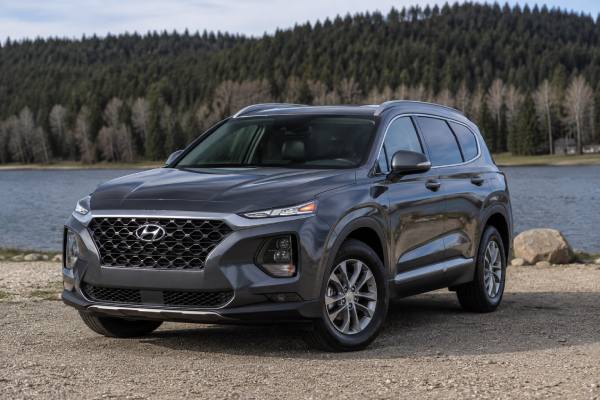
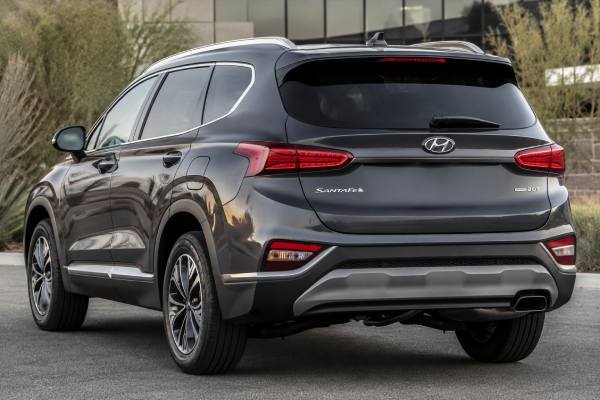
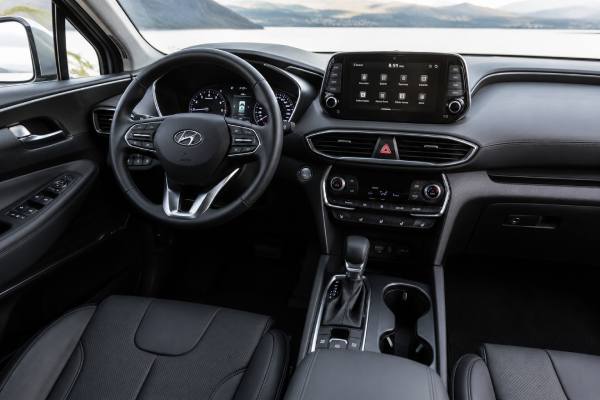
The TM-generation Hyundai Santa Fe in front-wheel-drive 2.0 T-GDi form is a practical two-row midsize SUV with a stronger-than-base turbocharged engine, generous cabin space, and a broad safety-equipment package for its time. For 2019–2020, the 2.0-liter turbo version sat above the naturally aspirated 2.4-liter engine in performance and towing confidence, while FWD kept weight and driveline complexity lower than AWD.
For used buyers, the main questions are not only horsepower and cargo volume. Service history, recall completion, turbo-system behavior, direct-injection maintenance, transmission feel, and safety-equipment differences by trim all matter. A well-kept example can be a comfortable, useful family SUV, but neglected oil changes, unresolved recalls, or warning lights related to boost control or intake components should be treated seriously before purchase.
Quick Overview
- Strong 235 hp turbo engine gives the Santa Fe FWD better passing power than the base 2.4-liter model.
- Spacious two-row cabin, large cargo area, and mature ride quality make it well suited to family and highway use.
- FWD versions are lighter and simpler than AWD models, but give up traction advantages in snow, wet grass, steep driveways, and towing launches.
- Watch for incomplete recalls, GDI/turbo service neglect, turbo wastegate actuator faults, intake-manifold actuator issues, and rough 8-speed shift behavior.
- Typical normal-use oil and filter service is about every 10,000 km or 12 months; severe use is closer to 5,000 km or 6 months.
Table of Contents
- Santa Fe TM FWD Used Focus
- Santa Fe TM 2.0T Technical Data
- Santa Fe TM Trims and Safety
- Reliability Issues and Service Actions
- Maintenance Schedule and Buying Checks
- Driving Feel and Real Economy
- Rivals and Ownership Verdict
Santa Fe TM FWD Used Focus
The 2019–2020 Hyundai Santa Fe TM replaced the previous Santa Fe Sport naming in several markets and became Hyundai’s mainstream five-seat midsize SUV. The FWD 2.0 T-GDi version uses a transverse turbocharged four-cylinder engine, an 8-speed torque-converter automatic transmission, and front-wheel drive. It is not a seven-seat Santa Fe XL and should not be confused with later hybrid, plug-in hybrid, or larger-market variants.
The engine is the Theta II 2.0-liter turbocharged gasoline direct-injection unit, rated at 235 hp and 260 lb-ft in North American specification. In practical terms, this is the more relaxed and muscular Santa Fe of these model years. It has noticeably more low-rpm pull than the 2.4-liter naturally aspirated engine and feels more confident when merging, climbing long grades, or carrying passengers and luggage.
The FWD layout suits buyers who mostly drive on paved roads and value lower weight, slightly better fuel economy, and fewer driveline components than AWD. It is also easier to inspect underneath because it lacks a rear differential and transfer case. The trade-off is traction. On wet hills, snowy roads, gravel, or when towing from a slippery surface, the front tires have to handle steering, acceleration, and most of the vehicle’s weight transfer. Good tires matter more on the FWD Santa Fe than the spec sheet may suggest.
The 2019 model year positioned the 2.0T mainly in higher trims, while 2020 availability became somewhat broader depending on market and trim structure. Equipment can vary heavily, so two cars with the same engine may not have the same headlights, wheels, driver-assistance features, upholstery, audio system, or towing preparation. Used buyers should identify the exact trim from the window sticker, VIN build data, or original sales documentation rather than relying only on badges.
This Santa Fe’s appeal is strongest when it has a clear maintenance history and no unresolved safety actions. The engine is not unusually complex by modern turbo-SUV standards, but it is more service-sensitive than the base engine. Clean oil, correct spark plugs, healthy cooling, intact intake plumbing, and good fuel-system practice are important. A short test drive around town is not enough; the vehicle should be driven from cold, on the highway, under moderate boost, and through repeated low-speed shifts before purchase.
Overall, the FWD 2.0T Santa Fe TM is best viewed as a comfort-oriented, feature-rich two-row SUV with useful turbo torque rather than a sporty crossover. Its strengths are space, equipment, safety structure, highway manners, and value. Its main ownership risks are not exotic; they are the familiar modern-SUV concerns of missed maintenance, software updates, turbo-control faults, direct-injection deposits, aging suspension parts, and incomplete recall work.
Santa Fe TM 2.0T Technical Data
The Santa Fe 2.0T FWD combines a direct-injected turbo engine with Hyundai’s 8-speed automatic. Some specifications differ slightly by market, trim, tire package, and model year, but the following figures reflect the 2019–2020 North American-style TM Santa Fe FWD 2.0T configuration.
| Item | Hyundai Santa Fe TM FWD 2.0T |
|---|---|
| Engine code/family | Theta II 2.0T GDI; commonly catalogued in the G4KH-family depending on market |
| Engine layout | Inline-4, 4 cylinders, DOHC, continuously variable valve timing, 4 valves per cylinder |
| Bore × stroke | 86.0 × 86.0 mm (3.39 × 3.39 in) |
| Displacement | 2.0 L (1,998 cc) |
| Induction | Twin-scroll turbocharger |
| Fuel system | Gasoline direct injection |
| Compression ratio | 10.0:1 |
| Maximum power | 235 hp (175 kW) @ 6,000 rpm |
| Maximum torque | 353 Nm (260 lb-ft) @ 1,450–3,500 rpm |
| Timing drive | Timing chain |
| Transmission | 8-speed torque-converter automatic, Hyundai A8LF1 on 2.0T applications |
| Drive type | Front-wheel drive |
| Differential | Open front differential with electronic traction and stability control |
| Official rated efficiency | About 20–23 mpg US combined depending on model year and certification; roughly 10.2–11.8 L/100 km combined |
| Real-world highway at 120 km/h | Typically about 9.0–10.2 L/100 km (23–26 mpg US / 28–31 mpg UK), depending on tires, load, wind, fuel, and temperature |
| Item | Specification |
|---|---|
| Front suspension | MacPherson strut with coil springs, gas dampers, and stabilizer bar |
| Rear suspension | Independent multi-link with coil springs, gas dampers, and stabilizer bar |
| Steering | Column-mounted motor-driven power steering, rack-and-pinion, 13.8:1 ratio |
| Front brakes | Ventilated discs, 320 × 28 mm (12.6 × 1.1 in) |
| Rear brakes | Solid discs, 305 × 11 mm (12.0 × 0.43 in) |
| Common tire sizes | 235/65 R17, 235/60 R18, and 235/55 R19; 235/60 R18 is a common balanced fitment |
| Ground clearance | About 185 mm (7.3 in) |
| Length / width / height | 4,770 / 1,890 / about 1,680–1,705 mm (187.8 / 74.4 / 66.1–67.1 in) |
| Wheelbase | 2,766 mm (108.9 in) |
| Turning circle | About 11.4 m (37.5 ft), curb-to-curb |
| Curb weight | About 1,778–1,789 kg (3,920–3,942 lb), depending on trim and equipment |
| GVWR | About 2,190 kg (4,828 lb) for FWD 2.0T versions |
| Fuel tank | 71 L (18.8 US gal / 15.6 UK gal) |
| Cargo volume | About 1,017 L (35.9 ft³) behind second row; about 2,019 L (71.3 ft³) with rear seats folded, SAE method |
| Measure | Typical figure or note |
|---|---|
| 0–100 km/h / 0–62 mph | Generally in the high-7 to low-8 second range in independent-style testing conditions |
| Top speed | Not consistently published in North American factory data; market and tire-rating limits apply |
| 100–0 km/h braking | Not factory-listed; good tires and brake condition matter more than trim in used examples |
| Braked towing capacity | Up to 1,588 kg (3,500 lb) where properly equipped |
| Unbraked towing capacity | About 748 kg (1,650 lb) |
| Approximate payload | Roughly 400 kg (880 lb) before equipment variation; use the door-jamb payload label for the exact vehicle |
| System | Specification or capacity |
|---|---|
| Engine oil | About 4.8 L (5.1 US qt); commonly 5W-30 meeting current API/ILSAC or ACEA A5/B5-type guidance, with climate-specific alternatives in the owner’s manual |
| Engine coolant | About 7.5 L (7.9 US qt); phosphate-based ethylene-glycol coolant suitable for aluminum components, typically mixed 50/50 unless climate requires adjustment |
| Automatic transmission fluid | About 7.0 L (7.4 US qt) system capacity; Hyundai/Kia SP-IV-type fluid family as specified for the transmission |
| Brake fluid | DOT 3 or DOT 4; approximately 0.44–0.48 L (0.46–0.51 US qt) |
| A/C refrigerant | R-1234yf, about 625 ± 25 g (22.1 ± 0.9 oz) |
| A/C compressor oil | PAG oil, about 120 ± 10 mL (4.2 ± 0.35 fl oz) |
| Wheel lug nut torque | 107–127 Nm (79–94 lb-ft) |
| GDI fuel-pipe service torque | High-pressure fuel-pipe flare nuts are typically around 29.5 Nm (21.8 lb-ft); single-use pipe guidance applies when removed |
Santa Fe TM Trims and Safety
The 2019–2020 Santa Fe 2.0T was not a single fixed specification. Trim, market, package selection, and production date affect headlights, driver-assistance features, upholstery, wheel size, infotainment, audio equipment, and towing preparation.
In broad North American terms, 2019 2.0T availability was concentrated in higher trims such as Limited and Ultimate, while 2020 made the turbo engine available in a more revised trim structure, including SEL and Limited-type configurations depending on region. Base SE models were generally tied to the 2.4-liter engine, so a 2.0T Santa Fe is usually not the lowest-equipment version.
The easiest identifiers are the engine label, original window sticker, VIN build data, and underhood emissions label. Badges alone are not enough because trim names and equipment packages shifted. Inside, higher turbo models commonly show larger infotainment screens, upgraded upholstery, advanced driver-assistance controls on the steering wheel, power seat functions, and sometimes premium audio or panoramic-roof equipment. Exterior tells may include larger wheels, LED lighting elements, roof rails, and trim-specific fascia or chrome details, but these are not reliable after repairs or owner modifications.
Mechanically, the biggest distinction is not suspension tuning but drivetrain and towing preparation. FWD 2.0T models avoid the AWD rear driveline and transfer components. When properly equipped, the 2.0T can carry a higher tow rating than the base engine, but the presence of trailer pre-wiring or a heavy-duty transmission oil cooler should be confirmed on the actual vehicle. Never assume maximum tow capacity from engine size alone.
| Area | 2019–2020 Santa Fe TM notes |
|---|---|
| Euro NCAP | Five-star overall rating for the Santa Fe generation tested, with strong adult and child occupant scores |
| IIHS | Strong crash-test performance; award status depends on model year and specific headlight equipment |
| NHTSA/U.S. NCAP | Commonly listed with a five-star overall rating for these model years, but the exact listing should be checked by year, drivetrain, and VIN |
| Airbags | Front, side-impact, and curtain-airbag coverage; early 2019 curtain-airbag recall status should be checked |
| Child seats | Rear-seat LATCH/ISOFIX provisions; inspect anchors for damage and confirm seat fit before purchase |
| Braking and stability | ABS, electronic brake-force distribution, traction control, stability control, and brake-assist functions |
| ADAS availability | AEB/forward collision avoidance, lane support, blind-spot monitoring, rear cross-traffic alert, adaptive cruise, and driver-attention features vary by trim and package |
| Calibration concerns | Windshield replacement, front-end collision repair, radar work, steering-angle service, or camera replacement may require ADAS calibration |
Headlights are especially important. On many vehicles of this era, safety-award status is linked not just to crashworthiness but also to the lighting package. A Santa Fe with higher-grade LED projector headlights may score differently from one with lower-output lamps. Used buyers who drive often at night should test the headlights on an unlit road and verify that both aim and output are correct.
The driver-assistance systems are useful but should not be treated as proof of careful ownership. During inspection, confirm that warning lights clear after startup, lane and radar functions activate correctly, the windshield camera area is clean and original-looking, and the front bumper radar area has not been poorly repaired. Misaligned sensors can create false warnings, disabled functions, or uneven adaptive-cruise behavior.
Reliability Issues and Service Actions
The Santa Fe 2.0T’s reliability picture is best understood by system. A maintained example can be durable, but the combination of turbocharging, gasoline direct injection, emissions controls, and a modern 8-speed automatic makes maintenance quality more important than with older naturally aspirated SUVs.
| System | Prevalence | Severity/cost tier | Typical symptoms and checks |
|---|---|---|---|
| Oil and GDI/turbo maintenance neglect | Common as a used-vehicle risk | Medium to high | Dark oil, low oil level, sludge under cap, turbo noise, poor service records, hesitation under boost |
| Turbo electronic wastegate actuator | Occasional | Medium | Check-engine light, low boost, overboost codes, reduced power, abnormal turbo response |
| Intake manifold variable-control actuator | Occasional | Medium | Unstable idle, reduced power, intake noise, warning light, intake-control fault codes |
| 8-speed automatic shift quality | Occasional | Medium | Delayed engagement, harsh 2–3 or 3–4 shifts, flare, shudder, hunting on hills |
| Direct-injection carbon buildup | Occasional with age/mileage | Medium | Rough idle, cold-start stumble, misfires, reduced economy, intake-valve deposits |
| Suspension and wheel bearings | Occasional | Low to medium | Clunks over bumps, humming with speed, uneven tire wear, looseness in links or bushings |
| Brake corrosion in salt climates | Climate-dependent | Low to medium | Rotor rust, caliper slider drag, parking-brake noise, pulsing, uneven pad wear |
For the engine, the first priority is oil history. The turbocharger, timing chain tensioning, cam phasers, and high-pressure fuel system all depend on clean oil and correct viscosity. A car used mostly for short trips, cold starts, and city driving should follow the severe-service oil interval. A long factory-style interval may be acceptable for gentle highway use, but it is not ideal for a used turbo SUV with unknown history.
The direct-injection system operates at very high pressure. Any service around the high-pressure pump, fuel rail, or fuel pipes should use correct procedures and replacement parts where specified. Fuel leaks, fuel odor, poor cold starts, or repeated fuel-pressure codes should not be dismissed as minor. This is not an area for improvised repair.
Turbo wastegate actuator issues can show up as a check-engine light, limited power, boost-related diagnostic codes, or inconsistent acceleration. The correct repair is diagnosis, adjustment or replacement according to the fault pattern, not simply replacing random sensors. Intake manifold variable-control faults can create similar drivability complaints, including unstable rpm or reduced power, so code reading and live-data checks matter.
The 8-speed automatic is generally smooth when healthy. During a test drive, it should engage Drive and Reverse promptly, shift cleanly from cold and warm, and avoid repeated hunting at steady throttle. Some shift adaptation behavior can improve with software or relearn procedures, but harsh flares, burnt-smelling fluid, or persistent shudder under light acceleration deserve deeper inspection.
Known service actions and recalls should be checked by VIN. Early 2019 TM Santa Fe vehicles had a curtain-airbag-related recall involving protective covers at mounting points. Some 2020-era vehicles may also fall under windshield-bonding or trailer-hitch wiring campaigns depending on build range and installed equipment. A completed recall should appear in dealer records, not only in a seller’s verbal assurance.
Pre-purchase checks should include:
- VIN recall lookup and dealer service history.
- Cold start, idle quality, and full scan for stored and pending fault codes.
- Oil level, coolant condition, and signs of turbo or cam-cover leaks.
- Smooth boost delivery from low rpm to highway merging speed.
- Transmission behavior during light throttle, moderate kickdown, and parking maneuvers.
- ADAS function check after any windshield, bumper, or front-end repair.
- Undercarriage inspection for salt corrosion, crash repair, fluid seepage, and tire wear patterns.
Maintenance Schedule and Buying Checks
The Santa Fe 2.0T rewards conservative maintenance. Because it is turbocharged and direct injected, a buyer should treat missing records as a negotiation point, not a minor paperwork gap. If the vehicle is otherwise clean but history is incomplete, budget for baseline service soon after purchase.
| Item | Typical interval or guidance | Why it matters |
|---|---|---|
| Engine oil and filter | About 10,000 km or 12 months in normal use; about 5,000 km or 6 months in severe use | Protects turbocharger, timing chain components, cam phasers, and bearings |
| Engine air filter | Inspect periodically; commonly replace around 40,000 km or sooner in dust | Maintains airflow, fuel economy, and turbo efficiency |
| Cabin air filter | Often around 20,000 km or 12 months | Improves HVAC airflow and reduces odors |
| Spark plugs | About 70,000 km on the turbo engine | Weak plugs can cause misfires under boost and damage the catalyst over time |
| Fuel system | Use quality fuel; add fuel-system additive where official guidance calls for it and suitable fuel is unavailable | Supports injector cleanliness and high-pressure fuel-system performance |
| Timing chain | No routine replacement interval; inspect for rattle, correlation faults, guide wear, or tensioner problems | Chain stretch or tensioner issues can lead to poor running or engine damage if ignored |
| Accessory belts and hoses | Inspect from about 96,000 km or 72 months, then regularly | Prevents overheating, charging issues, and roadside breakdowns |
| Coolant | First major replacement around 192,000 km or 10 years, then about every 48,000 km or 24 months; earlier if contaminated | Protects aluminum engine parts, turbo cooling passages, radiator, and heater core |
| Automatic transmission fluid | No routine normal-use service in some schedules; severe use may call for service around 96,000 km | Fresh correct fluid can help long-term shift quality under heat, towing, and city use |
| Brake fluid | Inspect regularly; many owners replace every 2–3 years as preventive maintenance | Reduces moisture-related corrosion and maintains pedal feel |
| Brake pads, rotors, sliders | Inspect at tire rotations and before winter | FWD SUVs can develop uneven wear, rotor corrosion, or caliper drag |
| Tire rotation | About every 10,000 km | Controls front-tire wear and helps preserve steering and braking balance |
| Wheel alignment | Check after impacts, uneven wear, or suspension work | Protects tires and helps straight-line stability |
| 12 V battery | Test annually after about 3 years; replacement often falls in the 4–6 year window | Weak voltage can create electronic faults, starting issues, and module warnings |
The most valuable buyer’s-guide step is a baseline inspection by someone familiar with Hyundai/Kia GDI turbo systems. The inspection should include a scan-tool report, cold-start observation, underbody check, road test, and verification that the vehicle has the correct tire size and load rating. A quick visual inspection in a parking lot is not enough for this engine and transmission combination.
Pay attention to the cooling system. The 2.0T produces more heat than the base engine, and heat is the enemy of turbochargers, transmission fluid, plastic fittings, and rubber hoses. Coolant level should be stable, the reservoir should not show oily contamination, and the radiator fans should operate correctly in traffic. Any overheating history should be treated as a major concern.
For tires, the 18-inch package is often the best balance. The 17-inch setup usually gives a slightly softer ride and cheaper replacements. The 19-inch package can sharpen appearance and steering response, but tire cost, impact harshness, and wheel damage risk rise. Uneven front wear can point to alignment issues, aggressive driving, worn bushings, or underinflation.
Recommended used examples are those with complete service records, matching quality tires, original or well-documented glass and body repairs, completed recalls, no dashboard warning lights, smooth transmission behavior, and clean underbody condition. Higher trims can be attractive because they include more comfort and safety equipment, but added electronics also increase inspection points.
Be more cautious with vehicles that have aftermarket engine tuning, poor-quality trailer wiring, unresolved boost codes, inconsistent idle, missing undertrays, evidence of front-end collision repair, or repeated cheap tires. The Santa Fe 2.0T is not a poor used choice, but it is not the ideal vehicle to buy blind from an auction listing or without a proper diagnostic scan.
Driving Feel and Real Economy
On the road, the FWD Santa Fe 2.0T feels more relaxed than its horsepower number suggests. The turbo engine’s main advantage is torque, not high-rpm excitement. With 260 lb-ft arriving from low rpm, the SUV moves away from traffic lights without needing dramatic revs, and it has enough reserve for passing slower vehicles on two-lane roads.
Throttle response is generally smooth, though there can be a brief pause while the transmission decides whether to downshift and the turbo builds boost. In gentle driving, the 8-speed automatic shifts early to save fuel. In hilly terrain, it may hunt between higher gears if the driver is holding a steady but modest throttle. Sport-style drive modes can make the powertrain more alert, but they also hold gears longer and may reduce economy.
Ride quality is one of the Santa Fe’s better traits. It is tuned more for comfort and stability than sharp handling. The body stays composed on highways, and the suspension absorbs expansion joints and broken city pavement well, especially on 17- or 18-inch wheels. The 19-inch setup can look better but may send more impact harshness into the cabin over potholes.
Steering is light and predictable rather than communicative. That suits daily use, parking, and family driving, but it will not feel as precise as a Mazda CX-9 or some European-market SUVs. Cornering balance is safe and front-biased. Push hard into a bend and the Santa Fe will understeer progressively; it is not designed to rotate or feel sporty.
Braking feel is generally easy to modulate. Used examples should stop straight, with no pulsing, scraping, or steering-wheel shake. A soft pedal may indicate old brake fluid or air in the system. A rhythmic vibration at highway braking speeds often points to rotor thickness variation or pad deposits rather than the engine or driveline.
Real-world fuel economy depends heavily on speed and trip length. The 2.0T is efficient enough on steady highways but can become thirsty in short-trip city driving because the turbo engine, vehicle weight, and automatic transmission all work against stop-start use.
| Driving condition | Typical consumption | Approximate mpg US / mpg UK |
|---|---|---|
| Dense city, short trips | 11.5–13.5 L/100 km | 17–20 mpg US / 21–25 mpg UK |
| Suburban mixed use | 9.8–11.2 L/100 km | 21–24 mpg US / 25–29 mpg UK |
| Highway at 100–110 km/h | 8.0–9.0 L/100 km | 26–29 mpg US / 31–35 mpg UK |
| Highway at 120 km/h | 9.0–10.2 L/100 km | 23–26 mpg US / 28–31 mpg UK |
| Cold weather or heavy traffic | Often 10–20% worse | Varies by trip length, tires, warm-up time, and HVAC load |
Towing is possible, but the FWD version needs realistic expectations. With the proper equipment, the 2.0T rating is useful for a small trailer, light camper, utility trailer, or modest personal-watercraft load. Still, front-wheel drive can struggle for traction on wet ramps or loose surfaces. A moderate trailer also increases fuel consumption sharply and adds heat to the transmission, so fluid condition and cooling health are important.
Noise control is good for the class. Wind noise is moderate, tire noise depends strongly on tire brand and tread wear, and the engine stays quiet under light load. Under hard acceleration, the turbo four sounds less refined than a V6 rival, but it is not harsh when maintained. Rattles from the rear cargo area, sunroof shade, or loose trim should be investigated because they may indicate prior disassembly or accident repair.
Rivals and Ownership Verdict
The 2019–2020 Santa Fe 2.0T FWD competes against a wide group of two-row and near-three-row midsize SUVs. Its strongest case is value: it offers good space, strong equipment levels, solid crash-test performance, and better low-rpm torque than many naturally aspirated four-cylinder rivals.
Against the Mazda CX-9 2.5T, the Santa Fe is less engaging to drive but easier to live with if comfort and features are the priorities. The Mazda feels more premium from behind the wheel and has sharper steering, but its cargo packaging is less generous for some families. The Hyundai’s simpler two-row layout can be an advantage for buyers who do not need a third row.
Compared with a Toyota Highlander V6, the Santa Fe 2.0T usually costs less on the used market and feels strong at low rpm. The Highlander counters with a stronger long-term reputation, broader three-row usefulness, and typically higher resale value. Buyers planning very long ownership with minimal risk may still prefer the Toyota, while value-focused buyers may find the Hyundai more appealing.
The Honda Passport and Pilot are larger-feeling, V6-powered alternatives with more cargo usefulness in some configurations. They are better suited to buyers who need space and occasional light adventure use, but they can cost more and may feel bulkier in city driving. The Santa Fe is easier to park and more efficient in many everyday conditions.
The Ford Edge 2.0 EcoBoost is one of the closest conceptual rivals: a two-row midsize crossover with turbocharged four-cylinder power. The Ford can feel substantial and comfortable, while the Hyundai often wins on feature value and warranty-era appeal. Condition matters more than badge here; a carefully maintained Edge is better than a neglected Santa Fe, and vice versa.
The Nissan Murano offers a smooth V6 and comfort-oriented cabin, but its CVT and different driving character make it a less direct match for buyers who like the Hyundai’s turbo torque and conventional automatic. The Kia Sorento of the same period is also worth cross-shopping, especially where three-row packaging is useful, though powertrain and trim details vary.
The best reason to choose the Santa Fe 2.0T FWD is that it delivers a comfortable, roomy, well-equipped SUV experience without the complexity of AWD and with more useful torque than the base engine. It is especially attractive for drivers who spend most of their time on paved roads, want modern safety systems, and value cabin practicality over sporty handling.
The main reasons to walk away are poor maintenance history, unresolved recalls, boost-control warning lights, rough transmission behavior, obvious collision repair around ADAS sensors, serious corrosion, or signs of towing abuse. A clean FWD 2.0T with records, completed campaigns, good tires, and smooth drivability is a strong used-SUV candidate. A cheap one with missing history can quickly become expensive.
References
- 2019 Santa Fe Specifications 2019 (Manufacturer Specifications)
- 2020 Santa Fe Product Guide 2020 (Manufacturer Specifications)
- TMa CAN-E 8.qxp 2019 (Owner’s Manual Specifications)
- Euro NCAP | Hyundai SANTA FE 2018 (Safety Rating)
- 2019 Hyundai Santa Fe 2019 (Safety Rating)
Disclaimer
This article is for informational purposes only and is not a substitute for professional diagnosis, repair, inspection, or service advice. Specifications, torque values, service intervals, fluid requirements, recalls, procedures, and equipment can vary by VIN, market, production date, trim, and installed options. Always verify details against the official owner’s manual, service information, dealer records, and the vehicle’s VIN-specific documentation before maintenance, repair, purchase, or towing decisions.
If this helped, sharing it on Facebook, X/Twitter, or with other Hyundai Santa Fe owners is a simple way to support our work.