
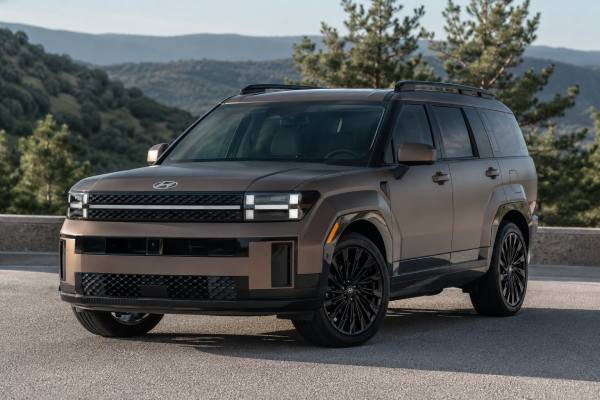
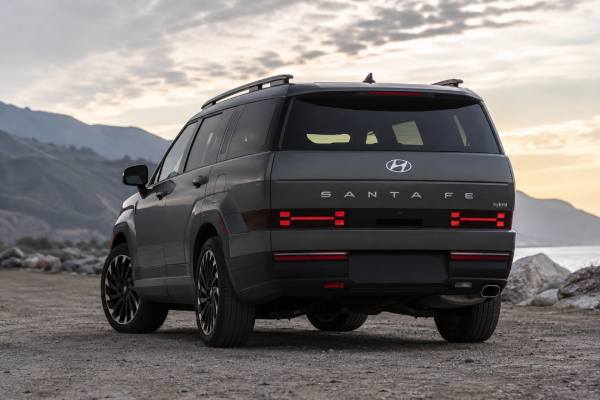
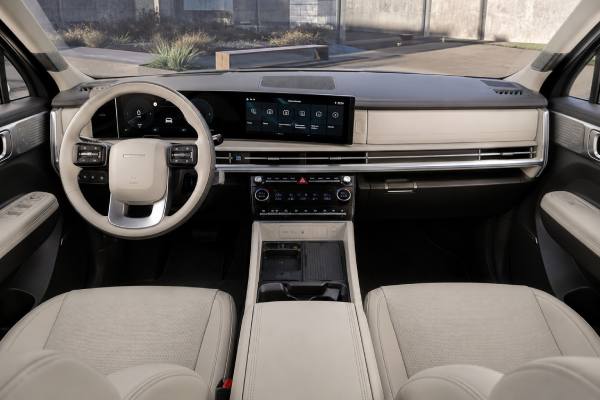
The fifth-generation Hyundai Santa Fe is a large, squared-off family SUV with a strong focus on space, comfort, hybrid efficiency, and long-distance usefulness. In 1.6 T-GDi HEV 4WD form, it pairs a turbocharged petrol engine with an electric motor, a small high-voltage battery, and a 6-speed automatic transmission rather than a continuously variable transmission.
The 239 hp version is especially important because it represents the later, higher-output European/German-market HEV tune introduced from late 2025 model-year availability. Earlier MX5 hybrid versions in some markets were rated lower, so VIN, market, and build date matter when comparing figures. In this 4WD specification, the Santa Fe is best understood as a practical, refined three-row hybrid SUV with useful towing capacity, not as a sporty crossover.
Quick Overview
- The 239 hp HEV 4WD offers stronger performance than the earlier 215 PS tune while keeping a conventional 6-speed automatic.
- Key strengths are cabin space, a large cargo area, generous safety equipment, and a useful 2,000 kg braked tow rating in the later HEV 4WD specification.
- The main ownership caveat is complexity: turbocharging, direct injection, hybrid cooling, AWD hardware, sensors, and ADAS calibration all require correct servicing.
- Typical oil-service planning is about 15,000 km / 12 months in normal European use, with shorter intervals sensible for repeated short trips, towing, or cold-city driving.
- The hybrid battery is small at 1.49 kWh, so there is no external charging or EV-range planning; efficiency depends heavily on speed, load, temperature, and tyre size.
Table of Contents
- Santa Fe MX5 Hybrid Positioning
- Santa Fe MX5 Technical Specs
- Santa Fe MX5 Trims and Safety
- Reliability, Issues and Service Actions
- Maintenance and Buyer’s Checks
- Driving Performance and Efficiency
- Santa Fe Against Hybrid SUV Rivals
Santa Fe MX5 Hybrid Positioning
The Hyundai Santa Fe MX5 is a major change from the rounded fourth-generation model. Its upright tailgate, long roof, broad glasshouse, and squared body make it feel closer to a family utility vehicle than a soft, coupe-like crossover. That shape is not only a design statement. It helps create a more useful cargo bay, easier third-row access, and a cabin that feels open in all three rows.
The 1.6 T-GDi HEV 4WD version uses Hyundai’s Smartstream turbocharged four-cylinder petrol engine with an integrated electric motor and a compact lithium-ion battery. It is a self-charging hybrid, so the battery is charged by regenerative braking and by the petrol engine when needed. Unlike the Santa Fe Plug-in Hybrid, it does not have a charge port and does not offer a meaningful EV-only range for daily commuting.
The 239 hp version sits above the earlier 215 PS HEV tune seen in some launch-market technical documents. For buyers, the distinction matters. Both are MX5 Santa Fe hybrids, both use a 1.6-litre turbo-hybrid layout, and both use a 6-speed automatic, but the later 176 kW / 239 PS specification has stronger combined output, a higher stated top speed, improved acceleration, and, in some European data, a much higher braked towing capacity than the earlier 215 PS HEV.
In 4WD form, the Santa Fe is not a body-on-frame off-roader. The system is intended for all-weather traction, wet-road stability, snow, gravel tracks, campsites, and towing confidence. Ground clearance of 177 mm is useful for rough lanes, but the long wheelbase and road-biased tyres limit serious off-road work. Terrain modes can help with throttle and traction control behavior, yet tyre choice is still the biggest factor in winter and mild off-pavement use.
The strongest case for this model is family ownership. It offers five-, six-, and seven-seat configurations depending on market and trim. The six-seat version, where available, uses second-row captain’s chairs and gives the cabin a more premium, easier-access feel. The seven-seat layout is more flexible for children and occasional adult use. The five-seat version gives the largest luggage volume with the second row in use.
The powertrain also suits the vehicle’s role. A diesel may still be more economical for constant high-speed towing, but the Santa Fe HEV is smoother in town, quieter in stop-start traffic, and less dependent on long journeys for emissions-system health. Compared with many plug-in hybrids, it is simpler for owners who cannot charge at home. Compared with a non-hybrid petrol SUV, it is usually more efficient in urban and suburban use.
Santa Fe MX5 Technical Specs
The figures below focus on the 1.6 T-GDi HEV 4WD / Allrad version rated at 176 kW / 239 PS. Data can vary by country, seating layout, wheel package, emissions classification, and model-year update. Earlier 215 PS HEV data should not be mixed with the later 239 PS specification without checking the VIN and market brochure.
| Item | Hyundai Santa Fe 1.6 T-GDi HEV 4WD |
|---|---|
| Platform / generation | Santa Fe MX5, fifth generation |
| Engine code | G4FZ in listed German-market 239 PS data; related Smartstream G1.6 T-GDi hybrid codes vary by market |
| Engine layout | Inline-4, DOHC, 16 valves, turbocharged petrol |
| Bore × stroke | 75.6 × 89.0 mm / 2.98 × 3.50 in |
| Displacement | 1.6 L / 1,598 cc |
| Fuel system | Turbo gasoline direct injection, petrol particulate filter in European data |
| Compression ratio | 10.5:1 in published European technical data for the same engine family |
| Petrol engine output | 132 kW / 180 PS at 6,000 rpm |
| Petrol engine torque | 265 Nm / 195 lb-ft from about 1,500–4,500 rpm |
| Electric motor | Permanent-magnet synchronous motor integrated with the transmission |
| Motor output | 48 kW / 65 PS and 250 Nm / 184 lb-ft |
| System voltage | 270 V in earlier European HEV technical data |
| Battery | 1.49 kWh lithium-ion / lithium-ion polymer traction battery |
| Combined output | 176 kW / 239 PS and 380 Nm / 280 lb-ft |
| Timing drive | Timing chain |
| WLTP combined fuel use | About 7.1–7.2 L/100 km / 33.1–32.7 mpg US / 39.8–39.2 mpg UK for 4WD |
| Real highway at 120 km/h | Typically about 8.3–9.3 L/100 km / 28–25 mpg US, depending on load, tyres, wind, and temperature |
| Item | Specification |
|---|---|
| Transmission | 6-speed automatic hybrid transaxle; public brochures do not consistently list a service code |
| Drive type | 4WD / AWD, electronically controlled on-demand all-wheel drive |
| Differentials | Open axle differentials with electronic traction control; no locking differential |
| Final-drive behavior | Calibrated for smooth hybrid torque blending rather than aggressive launch response |
| Item | Specification |
|---|---|
| Front suspension | MacPherson strut |
| Rear suspension | Multi-link |
| Steering | Rack-mounted motor-driven power steering; about 2.53 turns lock-to-lock in European data |
| Brakes | Ventilated discs front and rear, 325 mm / 12.8 in in published European data |
| Common tyre size | 255/45 R20 on 20-inch wheels for higher European trims |
| Ground clearance | 177 mm / 7.0 in |
| Approach / departure / breakover | About 17.4° / 20.9° / 15.3° in listed 4WD data |
| Length / width / height | 4,830 / 1,900 / 1,720 mm — 190.2 / 74.8 / 67.7 in |
| Wheelbase | 2,815 mm / 110.8 in |
| Turning circle | About 11.6 m / 38.1 ft kerb-to-kerb |
| Kerb weight | About 1,985–2,115 kg / 4,376–4,663 lb for 5-seat 4WD, equipment-dependent |
| GVWR | About 2,650 kg / 5,842 lb for 5-seat 4WD; 6- and 7-seat versions differ slightly |
| Fuel tank | 67 L / 17.7 US gal / 14.7 UK gal |
| Cargo volume | 5-seat: 711–2,032 L / 25.1–71.8 ft³; 6/7-seat: 628–1,949 L / 22.2–68.8 ft³, VDA-style EU figures |
| Metric | Figure |
|---|---|
| 0–100 km/h | 9.2 seconds for 4WD |
| Top speed | 196 km/h / 122 mph |
| 100–0 km/h braking | No single official open figure; expect tyre- and test-dependent results |
| Towing capacity | 2,000 kg / 4,409 lb braked; 750 kg / 1,653 lb unbraked in later 239 PS HEV data |
| Payload | Roughly 535–665 kg / 1,179–1,466 lb depending on seating and equipment |
| Roof load | 100 kg / 220 lb |
| Maximum towball load | 100 kg / 220 lb |
| Item | Practical reference |
|---|---|
| Engine oil | Typically SAE 0W-20 full synthetic meeting current Hyundai/API/ILSAC requirements; about 4.8 L / 5.1 US qt with filter in North American lookup data, but verify by VIN and dipstick |
| Coolant | Hyundai long-life ethylene-glycol coolant; hybrid vehicles may have more than one cooling loop, so use service data by VIN |
| Transmission fluid | Hyundai 6-speed hybrid automatic fluid specification varies by service market; capacity and refill method should be taken from dealer service documentation |
| AWD transfer / rear drive oils | Verify exact oil grade and capacity by VIN; do not assume older Santa Fe values |
| A/C refrigerant and compressor oil | Use the under-bonnet refrigerant label; charge values vary by market and equipment |
| Oil drain plug torque | About 39 Nm / 29 lb-ft in aftermarket service lookup data; replace the washer |
| Wheel nut torque | Common Hyundai range is about 107–127 Nm / 79–94 lb-ft; confirm in the owner’s manual |
Santa Fe MX5 Trims and Safety
European-market trim naming varies, but the German MY26 Santa Fe Hybrid range is a useful baseline because it matches the 239 PS HEV. The two main grades are Signature and Blackline. Both can be paired with the 1.6 T-GDi HEV, and the 4WD version is available in five-, six-, and seven-seat forms depending on configuration.
Signature is already a high-equipment trim. It typically includes 20-inch alloy wheels, dual 12.3-inch displays, navigation, Hyundai Bluelink, heated and ventilated front seats, heated outer second-row seats, wireless phone charging, Bose audio, 360-degree camera, blind-view monitor, blind-spot collision assistance, exit assist, remote smart parking assistance, Highway Driving Assist 2.0, and the 2.0 version of the autonomous emergency braking system.
Blackline adds visual and comfort upgrades rather than a different engine tune. Key identifiers include black-themed exterior elements, 20-inch Blackline-design wheels, Nappa leather upholstery, relaxation front seats, driver memory, a head-up display, a digital rear-view mirror, dual wireless phone charging, an electrically adjustable steering column, and some distinctive interior details. Mechanically, the important checks are still engine output, drivetrain, seating layout, tow rating, wheel size, and tyre specification.
| Area | Signature | Blackline |
|---|---|---|
| Powertrain | 239 PS HEV, FWD or 4WD depending on configuration | 239 PS HEV 4WD available; PHEV also available in some markets |
| Wheels and tyres | 20-inch wheels, commonly 255/45 R20 | 20-inch Blackline wheels, commonly 255/45 R20 |
| Seating | 5- or 7-seat layouts depending on market | 5-, 6-, or 7-seat layouts depending on market |
| Interior identifiers | Leather upholstery, twin-screen cockpit, Bose audio | Nappa leather, head-up display, digital mirror, relaxation seating features |
| Mechanical differences | No major output difference by trim | No major output difference by trim; added equipment can increase kerb weight |
Safety equipment is a major strength of the MX5 Santa Fe. The body structure is supported by multiple airbags, including front airbags, front side airbags, side airbags for the second row in some markets, curtain airbags extending rearward, a front center airbag, and a driver knee airbag in listed German equipment. ISOFIX and top-tether points are provided for the second row, and some six- and seven-seat versions include third-row ISOFIX and top-tether provisions.
Euro NCAP tested the Santa Fe HEV AWD in 2024 and gave it a dual result: four stars with standard safety equipment and five stars when fitted with the relevant safety pack. The published category percentages include 84% adult occupant protection, 88% child occupant protection, 70% vulnerable road-user protection, and 69% safety assist. This is a good but nuanced result: adult and child protection are strong, while some pedestrian and cyclist-related subtests, plus safety-assist thresholds, prevent the standard car from being a simple class-leading result in every market.
In the United States, IIHS ratings for the 2025 Santa Fe are strong for vehicles built after the relevant production updates. The model achieved Good ratings in the small-overlap front, updated moderate-overlap front, and updated side tests, with Acceptable headlights and Good front crash-prevention ratings. IIHS Top Safety Pick+ applies to 2025–2026 Santa Fe vehicles built after November 2024, which makes build date important for used imports or nearly new stock.
ADAS calibration is not a minor detail on this vehicle. Cameras, radar sensors, steering-angle sensors, wheel alignment, windscreen replacement, bumper work, and suspension repairs can all affect driver-assistance accuracy. After a windscreen, front bumper, radar, camera, steering, or alignment repair, calibration should be confirmed with Hyundai-compatible diagnostic equipment.
Reliability, Issues and Service Actions
The MX5 Santa Fe HEV 239 PS is still a relatively new vehicle, so long-term reliability patterns are not as mature as they are for older Santa Fe diesel or petrol models. A fair assessment should separate known platform risks from proven high-mileage failures. At this stage, the most sensible view is cautiously positive, provided maintenance is correct and recall work is verified.
The hybrid powertrain avoids Hyundai’s 8-speed dual-clutch transmission used in some non-hybrid turbo-petrol Santa Fe variants. That is an important distinction. The HEV uses a 6-speed automatic hybrid transaxle, which generally gives smoother low-speed operation and avoids the clutch-pack heat and shudder concerns associated with some DCT applications. It is still a complex unit, however, because the electric motor, hydraulic control, transmission software, and petrol engine must work together cleanly.
| System | Prevalence | Severity | Symptoms | Likely remedy |
|---|---|---|---|---|
| Infotainment / connected services | Occasional | Low to medium | Glitches, delayed startup, phone connection issues | Software update, reset, module diagnosis |
| ADAS sensors | Occasional | Medium | Warnings after bumper, windscreen, or alignment work | Calibration and fault-code check |
| 12 V battery | Occasional | Low to medium | No-start, warning lights, low-voltage faults | Battery test, parasitic draw check, software update if applicable |
| Brake rotor corrosion | Common in low-use hybrids | Low to medium | Rust ridges, vibration, scraping after wet parking | Regular friction-brake use, inspection, pads/rotors if needed |
| Turbo GDI intake deposits | Possible over time | Medium | Rough idle, hesitation, misfire codes at higher mileage | Diagnosis, intake cleaning where required |
| AWD driveline | Occasional | Medium | Binding, vibration, leaks, rear coupling noise | Fluid inspection, tyre matching, coupling/differential diagnosis |
The high-voltage battery is small and cycles frequently, but it is not asked to deliver long EV-only range. That generally helps durability compared with a large plug-in battery that is deeply discharged and recharged daily. Watch for warning lights, cooling-system faults, unusual fan noise, poor electric assist, or a sudden drop in fuel economy. A buyer should request a diagnostic scan that includes battery state of health, isolation faults, hybrid-system codes, DC–DC converter status, and thermal-management data.
The petrol engine’s main long-term concerns are typical of a small turbocharged direct-injection unit in a heavy SUV. Short trips can dilute oil and increase condensation. Hard use with long oil intervals can stress the turbocharger and timing-chain system. Direct injection can lead to intake-valve deposits over time because fuel does not constantly wash the back of the valves. Good oil, warm-up mechanical sympathy, and shorter service intervals for harsh use are sensible.
Service actions and recalls must be checked by VIN. North American recall records for Santa Fe and Santa Fe Hybrid have included issues such as rearview camera installation, side-curtain airbag installation, seat-belt anchor concerns, and wiring-harness chafing on certain build ranges. These do not automatically apply to every European 239 PS HEV, and they do not necessarily apply to every production date. The correct process is simple: run the VIN through the official Hyundai recall portal for the country of registration and keep dealer completion records.
For a nearly new used example, request proof of software updates, recall completion, correct tyres on all four corners, documented oil changes, and any ADAS calibration after glass or body repairs. A clean test drive should have smooth petrol-electric transitions, no harsh engagement when selecting Drive or Reverse, no AWD binding on tight turns, and no warning lights after a cold start.
Maintenance and Buyer’s Checks
Maintenance for the Santa Fe HEV should be planned around both time and distance. The hybrid system reduces brake wear and engine idling, but it also adds cooling loops, power electronics, a high-voltage battery, and more diagnostic requirements. Owners who tow, drive in mountains, make frequent short trips, or use the vehicle mostly in cold city traffic should treat the normal schedule as the maximum, not the ideal.
| Interval | Items to service or inspect |
|---|---|
| Every 10,000–15,000 km / 6,000–9,000 miles or 12 months | Engine oil and filter, tyre rotation, brake inspection, fluid levels, lights, wipers, diagnostic scan if warnings appear |
| Every 15,000–20,000 km / 9,000–12,000 miles | Cabin filter, brake corrosion check, suspension and steering inspection, tyre wear and alignment check |
| Every 30,000 km / 18,000 miles | Engine air filter inspection or replacement, underbody inspection, AWD leak check, software update check |
| Every 2 years | Brake fluid replacement is a sensible planning interval in many markets; confirm local Hyundai schedule |
| Every 45,000–60,000 km / 28,000–37,000 miles | Spark plug and fuel-system checks by market schedule; inspect auxiliary belt, hoses, mounts, cooling system, and hybrid coolant condition |
| Every 60,000–90,000 km / 37,000–56,000 miles | Consider AWD transfer/rear drive fluid inspection or replacement under towing, mountain, or harsh-weather use if service data supports it |
| Every 4–6 years | 12 V battery testing or replacement planning, especially if the car shows low-voltage warnings |
| Ongoing | Hybrid battery health scan, inverter/cooling loop checks, recall status, ADAS calibration status after repairs |
For the timing chain, there is no routine belt-style replacement interval. The correct approach is inspection and diagnosis. Rattle at cold start, cam/crank correlation faults, rough running, metal debris in oil, or persistent timing-related codes should be investigated quickly. A chain engine still depends on clean oil and proper oil pressure; long oil intervals under harsh use are one of the simplest ways to shorten timing-system life.
Brake maintenance is more important on hybrids than many owners expect. Regenerative braking means the friction brakes may be used less often, especially in gentle urban driving. That reduces pad wear, but it can leave discs rusty and calipers under-exercised. During servicing, ask for pad movement, slide pins, rotor condition, parking brake operation, and rear brake wear to be checked rather than relying only on pad thickness.
Buyer checks should start with the VIN and build date. Confirm that the vehicle is the 176 kW / 239 PS HEV if that is the version advertised. Look at the registration document, market certificate, build sheet, or official Hyundai system rather than trusting an advert headline. Check whether it is five-, six-, or seven-seat, because cargo volume, resale appeal, and family usability differ.
A good pre-purchase inspection should include:
- Cold start from overnight, listening for timing-chain rattle, exhaust leaks, belt noise, and rough idle.
- Smooth shift quality in Drive and Reverse, plus gentle and full-throttle acceleration.
- Hybrid transitions with no clunk, flare, or hesitation when the petrol engine starts.
- Full ADAS warning-light check and camera/radar inspection.
- Tyre matching across all four corners, especially on 4WD versions.
- Underbody inspection for impact damage, corrosion, fluid seepage, and damaged aero panels.
- Evidence of oil changes, brake-fluid service, software updates, and completed recalls.
- High-voltage battery and hybrid-system diagnostic scan where available.
For long-term durability, the best-owned examples will be those serviced by time, not only mileage, and driven often enough to warm the engine fully. The Santa Fe HEV is a complex but fundamentally sensible family SUV when maintained correctly. Neglect, mismatched tyres, skipped brake servicing, and ignored software campaigns are bigger risks than the basic hybrid concept.
Driving Performance and Efficiency
The 239 PS Santa Fe HEV 4WD drives in a calm, heavy, comfort-biased way. Its squared body and large cabin do not encourage fast cornering, but the chassis feels secure and predictable. Steering is light at parking speeds and steady on the motorway. Feedback is limited, though that is normal for this class. The suspension is tuned more for family comfort than sharp response, and the long wheelbase helps the car settle well over undulating roads.
Performance is adequate rather than exciting. A 0–100 km/h time of 9.2 seconds is strong enough for a large three-row hybrid SUV, especially with passengers aboard, but the Santa Fe is not a performance model. The benefit of the hybrid system is more noticeable in the first few metres from rest, where electric torque smooths the response before the petrol engine takes over. In normal use, the powertrain feels more relaxed than the numbers suggest.
The 6-speed automatic is a major part of the driving character. It gives a more familiar stepped-gear feel than an eCVT-style hybrid. Under light throttle, shifts are smooth and the engine often stays quiet. Under heavier throttle, the gearbox will downshift and the turbocharged engine becomes more audible, but the calibration generally favors progressive acceleration over sudden kickdown. Drive modes can sharpen response, although they do not turn the Santa Fe into a sporty SUV.
At city speeds, the hybrid system is at its best. It can creep, coast, and assist the petrol engine in ways that reduce fuel use in stop-start driving. In mixed suburban use, realistic consumption is often around 6.8–7.8 L/100 km, equal to about 34.6–30.2 mpg US or 41.5–36.2 mpg UK. In dense cold-weather city use with short journeys, expect worse results because the petrol engine must warm itself and the cabin.
At steady high speed, the Santa Fe’s size and frontal area matter. Around 100–120 km/h, realistic consumption often falls in the 7.8–9.3 L/100 km range depending on weather, tyres, traffic, roof bars, passenger load, and terrain. The official WLTP high-speed figures are a useful reference, but real motorway driving with winter tyres or a full family load can add a noticeable penalty.
The 4WD system improves confidence in poor weather. It is not designed for rock crawling, but it helps when pulling away on wet grass, climbing snowy roads, or towing on loose surfaces. Stability control is generally conservative, which suits the vehicle’s family role. With 20-inch wheels and 255/45 tyres, grip is good on dry roads, but ride quality and winter traction can depend heavily on tyre brand and compound.
Towing is one of the most meaningful improvements in the later HEV data. A 2,000 kg braked rating makes the Santa Fe HEV 4WD far more useful for caravans, horse trailers, and heavy leisure trailers than earlier low-rated hybrid versions. Even so, towing should be approached realistically. A large trailer will increase fuel use sharply, extend braking distances, and raise thermal load on the engine, transmission, and cooling system. Keep nose weight within the 100 kg limit, use proper trailer brakes, and service the driveline more carefully if towing is frequent.
Santa Fe Against Hybrid SUV Rivals
The Santa Fe HEV 4WD competes with a broad set of large hybrid SUVs, but not all rivals serve the same buyer. The Kia Sorento Hybrid is the closest technical and practical alternative. It offers a similar general size class, similar hybrid logic, and available three-row seating. The Kia may appeal to buyers who prefer a less boxy shape, while the Hyundai has a more distinctive cargo-focused design and a very modern cabin layout.
The Toyota Highlander Hybrid, where available, is the conservative benchmark for hybrid durability and smoothness. It is usually more efficient for its size and has a strong reputation for long-term ownership. Against it, the Santa Fe feels newer inside and may offer more advanced display and convenience features, but Toyota’s hybrid history is hard to ignore for high-mileage buyers.
The Toyota RAV4 Hybrid is often cross-shopped on price and reliability, but it is smaller and does not offer the same three-row space in most markets. The RAV4 is easier to park, usually cheaper to run, and very efficient. The Santa Fe is the better choice when the priority is seating flexibility, luggage space, towing capacity, and long-trip comfort.
The Honda CR-V Hybrid is also smaller and more car-like. It has excellent packaging for a two-row SUV and a refined hybrid system, but it cannot match the Santa Fe for cargo volume or three-row family use. The Honda is a strong everyday choice for smaller households; the Hyundai is more useful for larger families and holiday travel.
Plug-in hybrid rivals, including the Santa Fe PHEV and Kia Sorento PHEV, are worth considering only if charging is available. A plug-in hybrid can be dramatically cheaper to run for short daily trips when charged at home, but it is heavier, more expensive, and more dependent on owner behavior. For drivers without charging access, the regular HEV is usually the cleaner, simpler decision.
The Santa Fe HEV 4WD’s best advantages are space, comfort, equipment, safety technology, a conventional automatic feel, and useful towing ability in the 239 PS version. Its disadvantages are size, complexity, real-world motorway fuel consumption, and the need to verify market-specific specification details. It is a strong choice for buyers who need a large hybrid family SUV and value practicality over sportiness.
References
- Hyundai SANTA FE Preisliste MY26 2026 (Specifications and Equipment)
- Der Hyundai SANTA FE Hybrid: Stilvoller Raumriese 2026 (Manufacturer Publication)
- Euro NCAP | Hyundai SANTA FE 2024 (Safety Rating)
- 2025 Hyundai Santa Fe 2025 (Safety Rating)
- Vehicle Detail Search – 2025 HYUNDAI SANTA FE HYBRID SUV AWD | NHTSA 2025 (Recall Database)
Disclaimer
This article is for informational purposes only and is not a substitute for professional diagnosis, repair, inspection, or official Hyundai service guidance. Specifications, torque values, service intervals, fluids, procedures, software campaigns, and safety equipment vary by VIN, market, build date, trim, and installed options. Always verify maintenance and repair information against the official owner’s manual, service documentation, recall database, and dealer records for the exact vehicle.
If you found this useful, please consider sharing it on Facebook, X/Twitter, or your preferred social platform to support our work.