
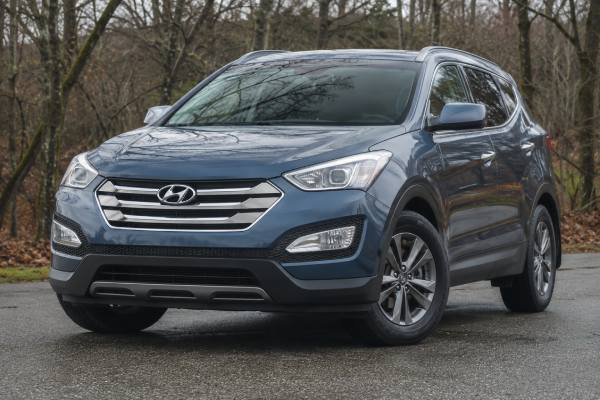
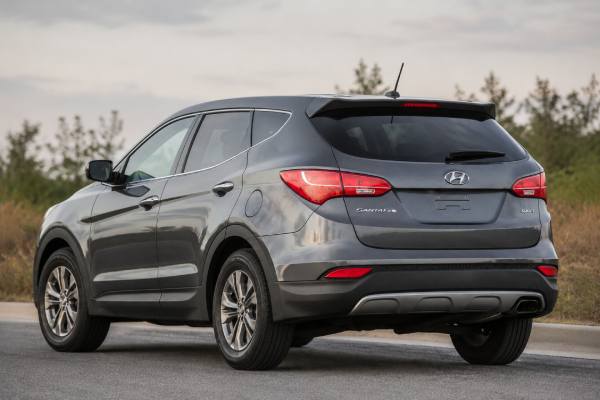
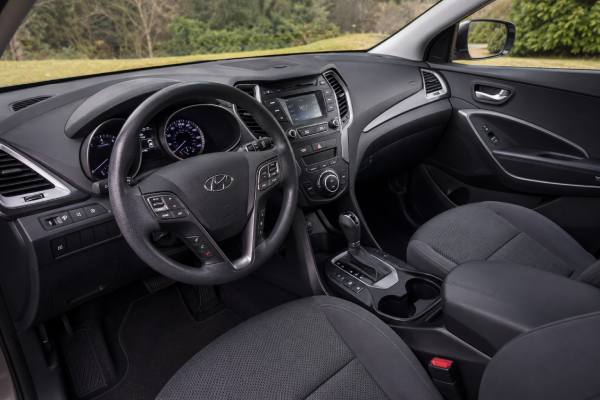
The Hyundai Santa Fe Sport AWD with the 2.4 GDI engine sits in a useful middle ground: larger and more comfortable than many compact crossovers, but less bulky and expensive to run than a three-row midsize SUV. In 2013–2016 form, it is a five-seat crossover with a naturally aspirated direct-injected four-cylinder engine, a six-speed automatic transmission, and an on-demand AWD system aimed at all-weather traction rather than serious off-road use.
As a used purchase, this version is appealing for its cabin space, equipment value, ride comfort, and practical cargo area. The main caution is the Theta II GDI engine family’s recall and extended-coverage history, especially on earlier 2013–2014 vehicles. A good Santa Fe Sport 2.4 AWD can still be a sensible buy, but the right one is the car with documented maintenance, completed recall work, clean oil history, and no signs of bearing noise or oil consumption.
Quick Overview
- Spacious two-row cabin with about 1,003 L cargo space behind the rear seats and about 2,025 L with them folded.
- The 190 hp 2.4 GDI engine is smooth and affordable to maintain, but it is not quick when fully loaded.
- AWD adds useful wet-road and winter traction, while remaining a road-biased system without low range.
- Engine recall history makes VIN checks, dealer records, and oil-level monitoring especially important.
- Normal-use oil service is typically around 12,000 km / 7,500 miles or 12 months; severe use deserves shorter intervals.
Table of Contents
- Santa Fe Sport DM Buyer View
- Santa Fe Sport DM Technical Data
- Santa Fe Sport DM Trims and Safety
- Reliability Issues and Service Actions
- Maintenance Schedule and Used Checks
- Driving Performance and Efficiency
- Rivals and Ownership Advantages
Santa Fe Sport DM Buyer View
The 2013–2016 Hyundai Santa Fe Sport AWD 2.4 GDI belongs to the DM-generation Santa Fe family. In North America, “Santa Fe Sport” identifies the shorter, two-row, five-seat body, while the longer three-row model was sold simply as Santa Fe. That distinction matters because dimensions, cargo packaging, trim availability, and some equipment differ between the two.
This article focuses on the AWD Santa Fe Sport with the 2.4-liter naturally aspirated GDI gasoline engine rated at 190 hp. It does not cover the 2.0T turbo engine, the 3.3-liter V6 long-wheelbase Santa Fe, diesel variants sold in some markets, or later refreshed 2017–2018 versions. The covered drivetrain uses a six-speed automatic transmission and an electronically controlled on-demand AWD system.
The strongest reason to consider this model is its blend of space and value. Compared with smaller crossovers such as the Honda CR-V or Toyota RAV4 of the same era, the Santa Fe Sport feels wider, quieter, and more substantial. Rear-seat space is generous, the cargo area is square and useful, and upper trims can include features such as leather upholstery, panoramic glass, larger infotainment screens, premium audio, proximity key access, heated seats, and larger wheels.
The 2.4 GDI engine suits calm driving. It has enough power for commuting, school runs, snow-belt use, and highway cruising, but it is not the version to choose if regular towing, mountain driving, or frequent full-passenger loads are expected. The six-speed automatic usually shifts smoothly, although downshifts are common on grades because the naturally aspirated four-cylinder makes its best power high in the rev range.
AWD is a practical advantage in bad weather. It can send torque rearward when slip is detected and, depending on trim and market, may include a driver-selectable lock mode for low-speed use. It does not turn the Santa Fe Sport into a trail vehicle. Ground clearance is crossover-typical, the tires are road-biased, and there is no two-speed transfer case.
The main ownership risk is not the cabin, chassis, or AWD system; it is the engine history. Hyundai’s Theta II GDI engines from this era are known for bearing-related recalls and inspection campaigns on certain VINs. A used 2013–2016 Santa Fe Sport 2.4 AWD should therefore be evaluated less like a generic crossover and more like a specific VIN with a specific maintenance and recall record. A clean, well-documented example can be a comfortable and practical family vehicle. A neglected one can become expensive quickly.
Santa Fe Sport DM Technical Data
The specifications below describe the 2013–2016 Hyundai Santa Fe Sport AWD 2.4 GDI as commonly sold in North America. Figures can vary by country, trim, wheel package, production date, and equipment, so service information should always be verified by VIN before repair or parts ordering.
| Item | Hyundai Santa Fe Sport AWD 2.4 GDI |
|---|---|
| Engine code | Theta II GDI, commonly G4KJ family |
| Engine layout | Inline-4, 4 cylinders, DOHC, 4 valves per cylinder, Dual CVVT |
| Bore × stroke | 88.0 × 97.0 mm / 3.46 × 3.81 in |
| Displacement | 2.4 L / 2,359 cc |
| Induction | Naturally aspirated |
| Fuel system | Gasoline direct injection |
| Compression ratio | About 11.3:1 |
| Maximum power | 190 hp / 142 kW at 6,300 rpm |
| Maximum torque | 181 lb-ft / 245 Nm at about 4,250 rpm |
| Timing drive | Chain |
| EPA-rated efficiency | About 20 city / 26 highway / 22 combined mpg US for early AWD 2.4 models, equal to about 11.8 / 9.0 / 10.7 L/100 km |
| Real-world highway at 120 km/h | Typically about 9.5–11.0 L/100 km, or 21–25 mpg US / 25–30 mpg UK, depending on tires, load, terrain, and weather |
| Item | Specification |
|---|---|
| Transmission | Six-speed automatic with manual shift mode; commonly A6MF-family depending on build |
| Drive type | Electronically controlled on-demand AWD |
| Differentials | Open differentials with electronic brake and stability control support; no low range |
| Front suspension | MacPherson strut |
| Rear suspension | Multi-link independent |
| Steering | Electric motor-driven rack-and-pinion; selectable steering modes on some trims |
| Brakes | Four-wheel disc brakes; commonly about 320 mm front and 302 mm rear, verify by VIN |
| Common tires | 235/65R17 or 235/55R19, depending on trim and package |
| Ground clearance | About 185 mm / 7.3 in |
| Length / width / height | 4,690 / 1,880 / about 1,680–1,690 mm; 184.6 / 74.0 / about 66.1–66.5 in |
| Wheelbase | 2,700 mm / 106.3 in |
| Turning circle | About 10.9 m / 35.8 ft kerb-to-kerb |
| Curb weight | About 1,640–1,782 kg / 3,616–3,929 lb, depending on trim and equipment |
| GVWR | About 2,300 kg / 5,071 lb for 2.4 AWD models in Canadian data |
| Fuel tank | 66 L / 17.4 US gal / 14.5 UK gal |
| Cargo volume | About 1,003 L / 35.4 ft³ seats up and 2,025 L / 71.5 ft³ seats folded, SAE method |
| Item | Specification or practical note |
|---|---|
| 0–100 km/h / 0–62 mph | Typically about 10.5–11.0 seconds, depending on market, load, tires, and test conditions |
| Top speed | About 190 km/h / 118 mph where published |
| 100–0 km/h braking distance | No single universal factory figure; expect roughly mid-40 m / 140–150 ft range with good all-season tires |
| Towing capacity | Commonly 907 kg / 2,000 lb for 2.4 AWD in North American use; verify hitch, cooling, local law, and VIN data |
| Payload | Roughly 520–660 kg / 1,145–1,455 lb depending on trim curb weight and equipment |
| Engine oil | API SM / ILSAC GF-4 or later, commonly SAE 5W-30 or market-approved grade; about 4.6 L / 4.9 US qt with filter |
| Coolant | Ethylene-glycol coolant suitable for aluminum engines, mixed with distilled or deionized water; about 7.1–7.4 L / 7.5–7.8 US qt |
| Automatic transmission fluid | Hyundai ATF SP-IV; total capacity about 7.1 L / 7.5 US qt |
| Transfer case fluid | API GL-5 SAE 75W-90 hypoid gear oil; about 0.6 L / 0.63 US qt |
| Rear differential fluid | API GL-5 SAE 75W-90 hypoid gear oil; about 0.53 L / 0.56 US qt |
| Brake fluid | FMVSS116 DOT 3 or DOT 4; about 0.7–0.8 L / 0.74–0.85 US qt |
| A/C refrigerant and oil | Verify the under-hood label and VIN-specific service data; charge quantity varies by market and production details |
| Wheel lug nut torque | 88–107 Nm / 65–79 lb-ft |
The important takeaway from the specification sheet is that this is a conventional gasoline crossover, not a high-output SUV. The engine is simple in concept but has direct injection and a known family history that makes oil quality, oil level, and recall compliance more important than they might appear from the brochure numbers alone.
Santa Fe Sport DM Trims and Safety
Trim names varied by country and model year. In the United States, the 2.4-liter Santa Fe Sport was commonly offered as the value-focused version below the 2.0T turbo. In Canada and some other markets, familiar names included grades such as Premium, Luxury, and Limited, with equipment differences changing year by year.
The 2.4 AWD model usually kept the same core mechanical layout across trims: the 2.4 GDI engine, six-speed automatic transmission, on-demand AWD, front strut suspension, rear multi-link suspension, and four-wheel disc brakes. Trim differences were more often about wheels, cabin materials, infotainment, roof options, lighting, convenience features, and driver-assistance equipment than about major changes to the drivetrain.
Common equipment and option differences include:
- 17-inch wheels on many lower and mid trims, with 19-inch wheels on higher trims or packages.
- Cloth or leather seating depending on grade.
- Heated front seats widely available, with heated rear seats and ventilated front seats on some higher trims and markets.
- Rearview camera, rear parking sensors, navigation, larger audio screens, and upgraded audio depending on package.
- Panoramic sunroof on many upper trims, which should be checked carefully for smooth movement, seal condition, and drain function.
- Proximity key, push-button start, dual-zone climate control, roof rails, and power liftgate availability depending on year and region.
Quick identifiers are useful when inspecting a used car. An AWD badge on the tailgate, an AWD lock button or downhill brake control switch in the cabin, and AWD warning-lamp self-check behavior can help confirm equipment, but the VIN and build sheet are more reliable than badges. The 2.0T turbo version usually carries different badging and has a different engine character. The 2.4 GDI version should be confirmed by the under-hood emissions label, VIN decoding, and service records.
For safety, the Santa Fe Sport was strong by early-2010s crossover standards, but it does not have the full modern active-safety suite now expected on newer SUVs. Standard safety equipment commonly included front airbags, front side airbags, side-curtain airbags, a driver knee airbag in many markets, anti-lock brakes, electronic stability control, traction control, brake assist, electronic brake-force distribution, tire-pressure monitoring, hill-start assist, and downhill brake control on AWD models.
The Insurance Institute for Highway Safety rated the 2013 Santa Fe Sport well in several crash categories, including good ratings in moderate-overlap front, side, roof-strength, and head-restraint evaluations. The more demanding small-overlap driver-side evaluation was a weaker point for this generation, with a marginal overall result for the tested structure. Headlight ratings were not published for the 2013–2016 pre-refresh model in the later IIHS headlight-test format, so it is better to treat lighting performance as equipment-dependent rather than assume a modern rating.
European crash-test information should be interpreted carefully because the North American Santa Fe Sport is not identical to every European-market Santa Fe configuration. Ratings for related DM-generation Santa Fe models are useful context, but they are not a direct substitute for the exact market, body, trim, and test protocol.
Advanced driver assistance was limited. Automatic emergency braking, adaptive cruise control, lane-keeping assist, and traffic-sign recognition were not core features of the 2013–2016 Santa Fe Sport 2.4 AWD in the way they are on newer Hyundai SUVs. Blind-spot monitoring and rear cross-traffic features were market, year, and trim dependent, and should not be assumed without seeing the vehicle’s switches, mirrors, cluster menus, or original window sticker. After windshield, bumper, steering, suspension, or collision work, any fitted sensors and camera-related systems should be checked and calibrated according to service procedures.
Reliability Issues and Service Actions
Reliability on the 2013–2016 Santa Fe Sport 2.4 AWD is mixed rather than simple. Many vehicles have covered high mileage with normal maintenance, but the Theta II GDI engine family gives this model a more serious inspection profile than some rivals. A buyer should not rely only on mileage or cosmetics. The service file, VIN recall status, cold-start sound, oil level, and engine behavior under load matter more.
| Area | Prevalence | Severity | Typical signs | Best response |
|---|---|---|---|---|
| Engine rod bearing wear | Common enough to be a major buying concern on affected VINs | High | Metallic knock, oil warning, loss of power, stalling, debris in oil | VIN recall check, dealer inspection, knock-sensor update where applicable, engine replacement if failed |
| Oil consumption | Occasional to common with age | Medium to high | Low oil between services, smoke, fouled plugs, catalyst stress | Document consumption test, inspect PCV and leaks, avoid extended oil intervals |
| GDI carbon buildup | Occasional | Medium | Rough idle, hesitation, misfires, reduced response | Proper diagnosis, intake cleaning, spark plug and injector checks |
| Six-speed automatic shift quality | Occasional | Medium | Delayed engagement, flare, harsh 2–3 or 3–4 shifts, hunting on grades | ATF condition check, SP-IV drain and fill, adaptation or TCU update, inspect mounts |
| AWD coupling and rear driveline | Occasional, higher with mismatched tires or neglected fluid | Medium | Binding, vibration, rear noise, leaks, warning lights | Match tires, service transfer case and rear differential, inspect coupler and propshaft |
| Suspension and wheel bearings | Common with mileage | Low to medium | Rumbling, clunks, uneven tire wear, vague steering | Inspect bearings, struts, sway links, control arms, bushings, alignment |
| Corrosion | Climate dependent | Medium | Rust on subframes, brake lines, fasteners, liftgate seams, rocker edges | Lift inspection, underbody cleaning, repair structural rust before purchase |
The headline service action is the engine recall affecting certain 2013–2014 Santa Fe Sport vehicles with 2.4 GDI and 2.0T GDI engines. The concern involved machining debris that could restrict oil flow to connecting rod bearings, leading to bearing wear, engine knock, loss of motive power, or engine failure. The remedy process has included inspection and engine replacement where required. On some vehicles and markets, knock-sensor detection software and extended warranty coverage may also be part of the ownership record.
A second related concern affects some vehicles that already received engine replacement work. The high-pressure fuel tube can be damaged, misaligned, or improperly installed during engine service, creating a fuel-leak risk. This is another reason dealer records matter. A car with a replaced engine is not automatically bad, but the replacement should be documented, the fuel line recall status should be clear, and the engine should run cleanly without fuel odor, warning lights, or drivability problems.
There are also fire-risk recalls involving ABS or hydraulic electronic control unit components on certain Hyundai and Kia vehicles, including specific Santa Fe Sport production groups. These are VIN-specific. Owners and buyers should use an official VIN check and dealer confirmation rather than relying on model year alone.
Beyond recalls, normal aging issues are familiar crossover problems. The six-speed automatic is generally durable when maintained, but neglected fluid, heat, towing, or repeated short-trip use can produce rough shifts. AWD components dislike mismatched tires; all four tires should be the same size, brand, model, and similar tread depth. Rear differential and transfer case fluids are small-capacity oils, so they are cheap to neglect but expensive to ignore.
A careful pre-purchase inspection should include a cold start, hot idle, road test under load, scan for stored and pending diagnostic codes, oil-level check, leak inspection, recall printout, and review of maintenance receipts. A compression test, borescope inspection, or used-oil analysis can be worthwhile on higher-mileage examples, especially if the seller cannot prove regular oil changes.
Maintenance Schedule and Used Checks
Maintenance for the Santa Fe Sport 2.4 AWD should be based on official schedules, but real-world use often justifies shorter intervals. Direct injection, known engine sensitivity, winter operation, city driving, towing, dusty conditions, and long idling all increase the value of conservative service.
| Item | Typical interval or inspection point | Practical note |
|---|---|---|
| Engine oil and filter | About 12,000 km / 7,500 miles or 12 months in normal use | Shorten to roughly 6,000–8,000 km / 3,750–5,000 miles for severe use, short trips, winter operation, or engine-risk management |
| Engine air filter | Inspect regularly; replace around 48,000 km / 30,000 miles in normal use | Replace sooner in dusty areas or if restricted |
| Cabin air filter | About 24,000 km / 15,000 miles or 12 months | A clogged filter reduces HVAC performance and can stress blower operation |
| Tire rotation | About 12,000 km / 7,500 miles | Important for AWD tire matching and even wear |
| Wheel alignment | Inspect annually or with uneven tire wear | Rear suspension wear can show up as cupping or inside-edge wear |
| Brake pads and rotors | Inspect at tire rotations | Check rear brake hardware carefully in salted climates |
| Brake fluid | Inspect regularly; replacement every 2–3 years is sensible | Use DOT 3 or DOT 4 fluid meeting the required standard |
| Coolant | First replacement around 96,000 km / 60,000 miles or 5 years, then about every 48,000 km / 30,000 miles or 2 years | Use correct aluminum-compatible coolant and proper mix ratio |
| Spark plugs | About 168,000 km / 105,000 miles under normal conditions | Replace earlier if misfire, oil consumption, or poor fuel quality is present |
| Timing chain | No normal scheduled replacement | Inspect for start-up rattle, chain stretch, guide wear, tensioner issues, and timing-correlation faults |
| Accessory belts and hoses | Inspect from about 96,000 km / 60,000 miles, then regularly | Replace cracked belts, swollen hoses, weak clamps, and noisy tensioners |
| Automatic transmission fluid | Often listed as long-life in light use; service is wise by about 60,000–100,000 km / 37,500–62,000 miles in harder use | Use Hyundai ATF SP-IV only; avoid universal fluids unless explicitly approved |
| Transfer case and rear differential | Inspect around 60,000 km / 37,500 miles; change sooner after water exposure or severe use | Small fluid capacities make clean gear oil important |
| Fuel system | Filter is not usually treated as routine external service | Diagnose fuel pressure, injectors, and high-pressure pump if hard starting or lean codes appear |
| Valve clearance | Inspect if excessive valve noise, roughness, or vibration appears | Not a casual service item; diagnosis should be symptom-led |
| 12 V battery | Test annually after about 3 years | Typical replacement window is 4–6 years depending on climate and use |
For a used buyer, the best Santa Fe Sport 2.4 AWD is not simply the newest or lowest-mileage one. It is the example with consistent oil changes, matching tires, clean coolant, documented recall completion, and no suspicious engine noise. A 2015–2016 vehicle with good records may be preferable to an earlier car with an unclear engine history, even if the early car looks cleaner in photos. A 2013–2014 vehicle can still be worth considering, but only if the VIN history is clear and the engine-related service actions have been completed or properly addressed.
Inspection should include the following:
- Start the engine cold and listen near the lower block for metallic knock that rises with rpm.
- Check oil level before the seller warms the car, and look for evidence of frequent top-ups.
- Scan the engine and transmission modules for stored, pending, and permanent codes.
- Road test from cold and fully warm, checking for shift flare, torque-converter shudder, hesitation, or misfires.
- Confirm that AWD engages without binding, vibration, or warning lights.
- Inspect transfer case, rear differential, axle seals, and the propshaft area for leaks.
- Check underbody rust, especially rear subframe areas, brake lines, rocker seams, suspension fasteners, and liftgate edges.
- Test the panoramic roof, backup camera, parking sensors, heated seats, climate control, infotainment, and keyless functions.
The long-term durability outlook is best for owners who treat the engine conservatively. Keep oil clean, check the dipstick frequently, use correct fluids, keep tires matched, and address warning lights quickly. This is not a vehicle where deferred maintenance is likely to stay cheap.
Driving Performance and Efficiency
The Santa Fe Sport 2.4 AWD drives like a comfortable family crossover rather than a sporty SUV. Its body is fairly wide, the seating position is relaxed, and the suspension is tuned more for daily comfort than sharp response. On 17-inch wheels it generally rides better over broken pavement; 19-inch wheels improve appearance and steering response slightly but can feel firmer and are more sensitive to tire quality.
Straight-line stability is good, and the vehicle feels settled on highways. Steering effort can vary through Hyundai’s selectable steering modes on some trims, but feedback remains light. Comfort mode is easy around town, while Sport adds weight without turning the Santa Fe Sport into a driver-focused crossover. Cornering balance is safe and predictable, with body roll typical of a tall, comfort-oriented SUV.
The 2.4 GDI engine is adequate rather than strong. Around town, throttle response is smooth enough, and the six-speed automatic keeps the engine quiet when the vehicle is lightly loaded. On highway merges, steep grades, or two-lane passing, the transmission needs to downshift and the engine becomes more audible. Drivers used to turbocharged crossovers or V6 SUVs may find the 2.4 AWD modest, especially with passengers, cargo, roof boxes, or trailer load.
The six-speed automatic is usually pleasant when healthy. It is less efficient than newer eight-speed or continuously variable transmissions, but it is also familiar and predictable. Hunting between gears can happen on rolling hills, and a delayed or harsh engagement during test drives should not be dismissed as normal without checking fluid condition, mounts, software adaptation, and stored transmission codes.
The AWD system is one of the model’s practical strengths. In normal dry driving, it behaves mostly like a front-biased crossover. When the front tires slip or the control system anticipates traction needs, torque can be sent rearward. This helps on wet roads, snow-covered streets, gravel driveways, and steep starts. Stability control and brake-based torque management help keep the vehicle tidy, but tire choice remains critical. A good set of winter tires will transform the vehicle more than AWD alone.
Real-world fuel economy depends heavily on speed and conditions. In urban use, 12–14 L/100 km is common, and short winter trips can be worse. At 100–110 km/h, careful drivers may see around 8.8–10.5 L/100 km. At 120 km/h, the higher body profile, AWD drag, and tire choice usually push consumption into the 9.5–11.0 L/100 km range. Mixed use often lands around 10–12.5 L/100 km, equal to about 19–24 mpg US or 23–29 mpg UK. Cold weather, winter tires, roof racks, low tire pressure, and city idling can add a noticeable penalty.
Towing should be approached conservatively. The 2.4 AWD can handle light utility trailers, small campers within rating, and modest loads, but it is not the ideal choice for frequent heavy towing. The engine works hard on grades, fuel consumption rises sharply, and transmission heat becomes more important. Correct tongue weight, trailer brakes where required, fresh fluids, and conservative speed are important. For regular towing near the limit, a stronger engine or larger vehicle is the better tool.
Rivals and Ownership Advantages
The Santa Fe Sport 2.4 AWD competes with both compact and midsize crossovers from the same era. Its advantage is that it feels roomier and more substantial than many compact SUVs while often costing less used than some Japanese-brand rivals. Its disadvantage is the engine-risk profile, which makes documentation more important than on a Toyota RAV4 or Honda CR-V.
| Rival | Where it is stronger | Where the Santa Fe Sport can appeal |
|---|---|---|
| Toyota RAV4 AWD 2.5 | Fuel economy, resale strength, simpler reliability reputation | Roomier feel, quieter cabin, stronger equipment value on many used examples |
| Honda CR-V AWD 2.4 | Packaging efficiency, economy, long-term ownership confidence | More substantial cabin feel, more upscale trims, broader comfort emphasis |
| Ford Edge AWD | Power, road presence, available V6 performance | Usually lower running costs, easier city size, better value when maintained |
| Kia Sorento AWD 2.4 | Similar mechanical layout, sometimes available with different seating and trim choices | Hyundai cabin layout and trim mix may suit buyers better; same need for engine-history checks |
| Subaru Outback or Forester | Standard AWD, winter confidence, often better efficiency | More conventional automatic feel, stronger crossover stance, generous cabin width |
Against these rivals, the Hyundai’s main advantage is value. A well-kept Santa Fe Sport AWD can deliver heated seats, good cargo space, a comfortable ride, confident winter traction, and a quiet cabin at a price that may undercut more sought-after competitors. It also has a straightforward layout for routine service: gasoline engine, conventional automatic, conventional brakes, and no hybrid battery or complex air suspension.
The value equation changes if maintenance history is weak. A cheap Santa Fe Sport with uncertain oil changes, mismatched tires, overdue AWD fluids, or incomplete recall work is not a bargain. The cost of engine, transmission, AWD, or corrosion repairs can exceed the price difference between it and a cleaner rival. Buyers should budget not only for purchase price, but also for immediate baseline service: oil and filter, brake inspection, tire assessment, alignment, ATF condition review, coolant age check, and AWD fluid inspection.
The best use case is a driver who wants a comfortable two-row SUV for commuting, family duty, winter roads, and occasional light towing, and who is willing to maintain it carefully. The least suitable use case is someone expecting sporty acceleration, heavy towing capacity, modern driver-assistance technology, or a completely hands-off ownership experience.
As a used vehicle, the Santa Fe Sport AWD 2.4 is neither an automatic pass nor an automatic recommendation. It is a condition-sensitive crossover. Buy the right VIN, verify the history, inspect the engine carefully, and keep up with fluids, and it can be a practical, comfortable, well-equipped SUV. Skip those checks, and the same model can become much more expensive than its used price suggests.
References
- AN (CAN) ENG 8.qxp 2013 (Owner’s Manual)
- AN (CAN) ENG 7.qxp 2013 (Owner’s Manual)
- Gas Mileage of 2013 Hyundai Santa Fe 2013 (Fuel Economy)
- 2013 Hyundai Santa Fe Sport 4-door SUV 2013 (Safety Rating)
- Part 573 Safety Recall Report 17V-226 2017 (Recall Database)
Disclaimer
This article is for informational purposes only and is not a substitute for professional diagnosis, repair, inspection, or official service procedures. Specifications, torque values, maintenance intervals, fluid capacities, recall applicability, and repair methods can vary by VIN, market, production date, trim, and installed equipment. Always verify details against the official service documentation, owner’s manual, under-hood labels, dealer records, and an official VIN-based recall check before making maintenance or purchase decisions.
If this helped, consider sharing it on Facebook, X/Twitter, or another platform to support our work.