
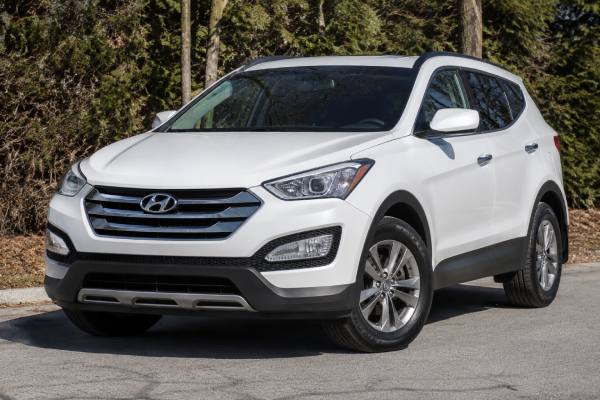

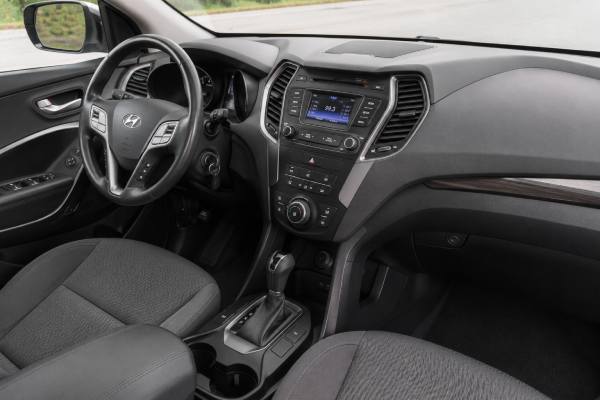
The 2013–2016 Hyundai Santa Fe Sport AWD 2.0T sits in an interesting place among used midsize crossovers. It is smaller and more agile than the three-row Santa Fe, but more powerful than many compact SUVs from the same period. With a turbocharged 2.0-liter direct-injection engine, a 6-speed automatic transmission, and available all-wheel drive, it offers strong everyday performance, useful cargo space, and a well-equipped cabin.
Its main appeal is also the area that needs the most careful inspection. The Theta II turbocharged GDI engine gives the Santa Fe Sport lively acceleration, but some vehicles are affected by major engine-related recalls, service campaigns, and extended warranty programs. A good example with complete maintenance records can be a practical and comfortable used SUV. A neglected one can become expensive quickly.
Owner Snapshot
- Strong low-rpm torque, roomy two-row packaging, and a useful 3,500 lb braked towing rating when properly equipped.
- AWD models add better wet-weather and winter traction, while still driving like a road-focused crossover.
- The main ownership caveat is the Theta II GDI engine history; recall completion, oil records, and knock-sensor campaign status matter.
- Plan engine oil service about every 5,000 miles / 8,000 km or 6 months for severe or mostly city use.
- Transfer case and rear differential fluid should be inspected regularly and serviced sooner if the vehicle tows, sees snow, or has high mileage.
Table of Contents
- Santa Fe Sport DM Basics
- Santa Fe Sport DM Specs
- Santa Fe Sport DM Equipment
- Reliability and Service Actions
- Maintenance and Used Buying
- Driving Feel and Performance
- How Santa Fe Sport Compares
Santa Fe Sport DM Basics
The 2013–2016 Santa Fe Sport belongs to Hyundai’s third-generation Santa Fe family, commonly associated with the DM generation. In North America, Hyundai separated the lineup into the shorter two-row Santa Fe Sport and the longer three-row Santa Fe. The model covered here is the two-row Santa Fe Sport AWD with the 2.0-liter turbocharged gasoline direct-injection engine.
This version is best understood as a road-biased family crossover rather than a rugged SUV. It uses unibody construction, independent suspension at all four corners, electrically assisted steering, and an on-demand AWD system. There is no low-range transfer case and no locking axle differential. Instead, the AWD system is designed to improve traction on wet roads, snow, gravel driveways, and slippery hills.
The 2.0T engine is the key reason to choose this version over the naturally aspirated 2.4-liter model. Official U.S. output is commonly listed at 264 hp and 269 lb-ft of torque, with the torque arriving low in the rev range. Canadian literature may list 265 hp because of market or rounding differences, but the mechanical character is the same. The engine is a Theta II turbocharged GDI four-cylinder with a twin-scroll turbocharger, direct injection, dual overhead cams, and a timing chain.
In daily use, the Santa Fe Sport 2.0T AWD feels stronger than its displacement suggests. It pulls well from low and mid-range speeds, does not need to rev hard in normal traffic, and has enough reserve power for highway merging with passengers aboard. The 6-speed automatic is conventional and usually smooth, though it can feel busy when climbing grades or when the driver asks for quick passing power.
The body size is one of the model’s strengths. At roughly 4.7 meters long, it is easier to park than many three-row crossovers, yet cargo room is generous for a five-seat SUV. The rear seat is spacious enough for adults, the cargo floor is broad, and the seating position gives the high view many crossover buyers want without the bulk of a full-size SUV.
The Santa Fe Sport AWD 2.0T is most attractive for buyers who want a comfortable, powerful, two-row crossover with good equipment for the money. It is less ideal for someone who wants class-leading fuel economy, serious off-road ability, or a low-risk engine history. The used-buying decision should depend less on trim badges and more on service records, recall status, oil consumption, engine noise, AWD maintenance, and evidence that the vehicle has not been overheated, neglected, or used hard without proper care.
Santa Fe Sport DM Specs
Specifications vary by market, model year, trim, wheel package, and homologation method. The figures below focus on the 2013–2016 North American-style Santa Fe Sport AWD 2.0T, with notes where values differ by source or equipment.
| Powertrain and efficiency item | Hyundai Santa Fe Sport AWD 2.0T |
|---|---|
| Engine family / code | Theta II 2.0 T-GDI; commonly associated with G4KH-family applications, verify by VIN |
| Engine layout | Inline-4, DOHC, 4 valves per cylinder, 16 valves total |
| Bore × stroke | 86.0 × 86.0 mm / 3.39 × 3.39 in |
| Displacement | 2.0 L / 1,998 cc |
| Induction | Twin-scroll turbocharger with intercooler |
| Fuel system | Gasoline direct injection |
| Compression ratio | 9.5:1 |
| Maximum power | 264 hp / 197 kW at about 6,000 rpm |
| Maximum torque | 365 Nm / 269 lb-ft at about 1,750–3,000 rpm |
| Timing drive | Timing chain |
| Fuel requirement | Regular unleaded accepted; use quality fuel and correct oil for turbo GDI durability |
| EPA-rated efficiency, AWD 2.0T | About 12.4 / 9.8 / 11.2 L/100 km city/highway/combined; 19 / 24 / 21 mpg US; 22.8 / 28.8 / 25.2 mpg UK |
| Real-world highway at 120 km/h / 75 mph | Commonly about 9.5–11.5 L/100 km, or 20–25 mpg US, depending on tires, load, weather, terrain, and engine condition |
| Transmission, driveline, chassis, and dimensions | Specification |
|---|---|
| Transmission | 6-speed torque-converter automatic with SHIFTRONIC manual mode; A6LF2-family code commonly used, verify by transmission tag |
| Drive type | On-demand AWD |
| Differential / AWD hardware | Open front and rear differentials with electronically controlled AWD coupling; no low range or mechanical locking differential |
| Front suspension | MacPherson strut with stabilizer bar |
| Rear suspension | Multi-link independent with stabilizer bar |
| Steering | Rack-mounted motor-driven power steering; about 15.0:1 ratio |
| Front brakes | Ventilated discs, about 320 mm / 12.6 in |
| Rear brakes | Solid discs, about 302 mm / 11.9 in |
| Common tire sizes | 235/65R17, 235/60R18, and 235/55R19 depending on trim and package |
| Ground clearance | About 185 mm / 7.3 in |
| Length / width / height | About 4,700 / 1,880 / 1,680–1,690 mm; 185.0 / 74.0 / 66.1–66.5 in |
| Wheelbase | About 2,700 mm / 106.3 in |
| Turning circle | About 10.9 m / 35.8 ft |
| Curb weight | About 1,681–1,823 kg / 3,706–4,019 lb depending on trim and equipment |
| GVWR | About 2,340–2,350 kg / 5,159–5,181 lb |
| Fuel tank | 66 L / 17.4 US gal / 14.5 UK gal |
| Cargo volume | About 1,003 L / 35.4 ft³ behind second row; about 2,025 L / 71.5 ft³ behind front seats, SAE-style measurement |
| Performance and capability | Specification |
|---|---|
| 0–100 km/h / 0–62 mph | Roughly 7.2–8.0 seconds depending on test conditions, tires, fuel, altitude, and load |
| Top speed | Around 200–210 km/h / 124–130 mph, market-dependent |
| 100–0 km/h braking distance | Commonly around 39–42 m / 128–138 ft with good tires and healthy brakes; no single universal official value |
| Braked towing capacity | Up to 1,588 kg / 3,500 lb when properly equipped |
| Unbraked towing capacity | Market-dependent; often around 750 kg / 1,650 lb where specified |
| Payload | Depends on curb weight and GVWR; commonly around 500–650 kg / 1,100–1,430 lb after trim and equipment differences |
| Fluids and service capacities | Typical value for 2.0T AWD |
|---|---|
| Engine oil | 5W-30 commonly preferred; 5W-40 may be suitable by climate/specification. Use oil meeting the applicable Hyundai/API/ILSAC or ACEA requirement. Capacity about 4.8 L / 5.07 US qt with filter |
| Coolant | Ethylene-glycol coolant suitable for aluminum engines, mixed with distilled water as specified; capacity about 9.7 L / 10.24 US qt |
| Automatic transmission fluid | Hyundai SP-IV specification; total capacity about 7.8 L / 8.24 US qt |
| Transfer case oil | API GL-5 SAE 75W-90 hypoid gear oil; about 0.6 L / 0.63 US qt |
| Rear differential oil | API GL-5 SAE 75W-90 hypoid gear oil; about 0.53 L / 0.56 US qt |
| Brake fluid | DOT 3 or DOT 4; system capacity about 0.7–0.8 L / 0.74–0.85 US qt |
| A/C refrigerant | R-134a; about 600 g / 21.2 oz for front A/C, higher on versions with rear A/C |
| A/C compressor oil | PAG oil such as FD46XG-type; charge varies by system, commonly about 120 mL for front A/C |
| Wheel lug nut torque | 88–107 Nm / 65–79 lb-ft |
| Timing chain | No routine replacement interval; inspect for rattle, correlation faults, tensioner/guide wear, or timing deviation |
| Safety and driver assistance | Summary |
|---|---|
| IIHS crash performance | Generally strong structure ratings, including Good moderate-overlap, side, roof-strength, and head-restraint results; small-overlap performance is weaker on 2013–2016 ratings |
| IIHS Top Safety Pick | 2013 Santa Fe Sport was listed as a Top Safety Pick under the applicable test criteria of that time |
| IIHS headlight rating | Not rated under the original 2013–2016 evaluation cycle |
| Euro NCAP | No directly equivalent Euro NCAP rating should be applied to the North American Santa Fe Sport 2.0T AWD without checking the exact European variant |
| ADAS | Stability control, traction control, ABS, brake assist, hill-start assist, and downhill brake control are typical; blind-spot features are trim/year-dependent; AEB, ACC, and lane keeping are generally not part of this generation’s main 2013–2016 equipment set |
Santa Fe Sport DM Equipment
The Santa Fe Sport DM lineup varies noticeably by country. In the United States, the Sport name usually identifies the shorter two-row body, while the 2.0T badge identifies the turbocharged engine. AWD was available rather than standard on every version. In Canada, AWD availability and trim naming differed, and the 2.0T was often positioned higher in the range.
Common trim and package names include Sport 2.0T, 2.0T Premium, 2.0T SE, 2.0T Limited, and later package names such as Ultimate depending on market and year. The exact badge is less important than the build sheet. A well-optioned 2.0T AWD can have 19-inch wheels, leather upholstery, panoramic sunroof, navigation, upgraded audio, power tailgate, heated rear seats, ventilated front seats, dual-zone climate control, rear camera, parking sensors, and blind-spot monitoring.
The easiest quick identifiers are the 2.0T exterior badge, larger alloy wheels on many upper trims, dual exhaust outlets on some versions, and a more upscale cabin equipment set. A VIN decode or original window sticker is still the best way to confirm AWD, trim, factory option packages, and towing equipment.
Mechanically, the main differences to check are wheel and tire package, AWD hardware, brake size, and towing preparation. The 19-inch wheel package looks sharper and can improve steering response, but it also makes the ride firmer and replacement tires more expensive. The 17- and 18-inch packages usually ride more comfortably and tolerate poor roads better. Tow ratings depend on the correct equipment, trailer brakes, and market rules, so do not assume every Santa Fe Sport 2.0T AWD is ready for the full rating without verifying the hitch, wiring, cooling condition, and documentation.
Safety equipment starts with the basics: multiple airbags, anti-lock brakes, electronic brake-force distribution, electronic stability control, traction control, brake assist, hill-start assist, and downhill brake control. The airbag setup commonly includes front airbags, front side airbags, side-curtain airbags, and a driver knee airbag. Rear child-seat anchors are provided, but families should still test their own seats because rear-seat contouring and front-seat position can affect fit.
Driver-assistance technology is modest by modern standards. A rear camera is common or available depending on year and trim. Blind Spot Detection with Lane Change Assist and Rear Cross-Traffic Alert appears on selected trims and later packages. Adaptive cruise control, automatic emergency braking, lane-keeping assist, and advanced traffic-sign systems are not typical factory features for this 2013–2016 Santa Fe Sport generation.
That matters for buyers comparing it with newer crossovers. The Santa Fe Sport can score well in older crash-test categories and has solid basic stability systems, but it does not provide the full active-safety layer expected on many newer SUVs. After windshield, bumper, mirror, suspension, or alignment work, any fitted camera, parking, or blind-spot sensors should be checked and calibrated according to service procedures. A warning light or disabled blind-spot system after body repair is not a cosmetic issue; it can mean the system is not reading correctly.
Year-to-year changes were mostly equipment and packaging updates rather than a full mechanical redesign. The bigger change arrived after this period with the refreshed 2017 model. For the 2013–2016 range, condition and history usually matter more than a small equipment difference. A clean 2015 or 2016 with verified maintenance is usually a better buy than a more heavily optioned earlier vehicle with missing engine recall records.
Reliability and Service Actions
Reliability is the most important part of evaluating a used Santa Fe Sport 2.0T AWD. The vehicle itself is comfortable, practical, and generally pleasant to drive, but the Theta II GDI engine history cannot be treated as a footnote. Some 2013 and 2014 Santa Fe Sport vehicles were included in engine recalls related to manufacturing debris and bearing wear. Hyundai also issued later service campaigns and warranty extensions covering certain 2013–2018 Santa Fe Sport models with 2.0T and 2.4 GDI engines.
The most serious concern is connecting-rod bearing wear or engine damage. Symptoms can include a knocking noise that rises with engine speed, oil-pressure warning, check-engine light, reduced power, hesitation, stalling, or diagnostic trouble code P1326 related to knock detection. The official remedy depends on VIN, campaign status, inspection result, and dealer procedure. It may involve engine inspection, software update, knock-sensor detection logic, or engine replacement.
| Issue area | Prevalence | Severity / cost tier | Typical clues | Recommended action |
|---|---|---|---|---|
| Theta II bearing wear / engine recall history | Common enough to be a major buying concern | High | Knock, low oil pressure, limp mode, P1326, unexplained engine replacement | Verify campaign completion by VIN, dealer history, and engine serial/service records |
| Oil consumption or low oil level | Occasional, more likely with poor service or high mileage | Medium to high | Low dipstick level between services, smoke, fouled plugs, catalyst stress | Monitor oil every 500–1,000 miles, document consumption, repair leaks or internal causes |
| Turbo and intake system faults | Occasional | Medium | Whine, smoke, boost loss, oil residue, underboost codes | Inspect turbo lines, intercooler hoses, PCV system, wastegate control, and intake tract |
| Direct-injection carbon build-up | Occasional at higher mileage | Medium | Rough idle, misfire, poor cold start, reduced response | Diagnose first; intake valve cleaning may be needed |
| 6-speed automatic harsh shifts | Occasional | Medium | Flare, bump shifts, delayed engagement, hunting | Check ATF condition, update software if applicable, perform proper service and adaptation |
| AWD coupling / transfer case / rear diff wear | Occasional, higher with mismatched tires or neglected fluid | Medium to high | Binding, humming, vibration, warning lights, driveline clunk | Inspect tires, fluid, mounts, coupling, transfer case, and rear differential |
| Suspension and wheel bearings | Common wear item | Low to medium | Clunks, uneven tire wear, humming, loose steering feel | Inspect strut mounts, control-arm bushings, links, bearings, alignment |
| Brake corrosion and rotor pulsation | Common in salted climates | Low to medium | Pulsation, dragging caliper, uneven pad wear | Service slide pins, replace worn pads/rotors, flush fluid |
| Camera, sunroof, and electrical accessories | Occasional | Low to medium | Failed camera, water leaks, slow roof, door-lock faults | Test all accessories; inspect drains and repair wiring or modules as needed |
Software and calibration history is also important. Hyundai’s knock-sensor detection software was designed to identify abnormal engine vibration patterns and trigger protective behavior before catastrophic failure. A vehicle that has not had the required update may be missing part of the official protection strategy. Conversely, a vehicle in limp mode with P1326 should not be cleared casually and driven as normal; it needs proper inspection.
The automatic transmission is usually less troublesome than the engine, but old fluid, heavy towing, and city heat can shorten its life. Harsh shifts may improve after fluid service, software updates, or adaptive relearn, but severe flare or slipping points to internal wear. The AWD hardware also deserves attention because some owners never service the transfer case or rear differential. Mismatched tires are especially harmful on AWD crossovers; all four tires should be the same size, close in tread depth, and properly inflated.
Body and chassis corrosion vary by climate. In snow-belt regions, inspect rear suspension arms, subframe areas, brake and fuel lines, lower door seams, rocker panels, tailgate edges, and fasteners around the rear suspension. Surface rust is normal on an older SUV, but flaking structural rust, swollen seams, and heavily corroded brake lines are serious warning signs.
A pre-purchase inspection should include a cold start, hot idle, full-throttle acceleration after warm-up, scan of all modules, oil-level check, underbody inspection, turbo and intercooler hose inspection, coolant-pressure check, AWD operation check, and review of dealer service history. The best used examples have proof of recall completion, frequent oil changes, no abnormal consumption, clean coolant, smooth transmission behavior, matched tires, and no unresolved warning lights.
Maintenance and Used Buying
The Santa Fe Sport 2.0T AWD rewards conservative maintenance. Because it uses a turbocharger, direct injection, timing chain, AWD hardware, and a 6-speed automatic, stretching service intervals is a poor way to save money. Oil quality, fluid condition, and cooling-system health matter more than cosmetic condition.
| Service item | Practical interval | Notes |
|---|---|---|
| Engine oil and filter | About every 5,000 miles / 8,000 km or 6 months for severe, city, short-trip, hot-climate, or turbo-heavy use | Use correct full-synthetic oil specification and check level between services |
| Engine air filter | Inspect every 15,000 miles / 24,000 km; replace around 30,000 miles / 48,000 km or sooner in dust | A dirty filter can affect turbo response and fuel economy |
| Cabin air filter | Every 12,000–15,000 miles / 20,000–24,000 km or yearly | Replace sooner in dusty or humid areas |
| Spark plugs | About every 45,000–60,000 miles / 72,000–96,000 km | Use correct turbo GDI plugs and gap; misfires are hard on the catalyst and turbo |
| Coolant | Inspect regularly; replace by official schedule or about every 5 years / 60,000 miles as a conservative used-car interval | Overheating can be very costly on the 2.0T |
| Automatic transmission fluid | Inspect for leaks and shift quality; service around 50,000–60,000 miles / 80,000–100,000 km in severe use | Use Hyundai SP-IV-compatible fluid only |
| Transfer case and rear differential oil | Inspect regularly; service around 60,000–75,000 miles / 100,000–120,000 km, sooner with towing or winter use | AWD driveline neglect is common |
| Brake fluid | Every 2–3 years | Use DOT 3 or DOT 4 as specified |
| Brake pads, rotors, and caliper slides | Inspect at least yearly | Salt corrosion can seize slide pins and cause uneven wear |
| Tires | Rotate every 5,000–7,500 miles / 8,000–12,000 km | Keep all four tires matched on AWD |
| Alignment | Check yearly or after impacts | Uneven wear is common on heavier AWD crossovers |
| Serpentine belt and hoses | Inspect each service; replace when cracked, swollen, noisy, or aged | Heat and age matter as much as mileage |
| Timing chain | No scheduled replacement | Investigate startup rattle, cam/crank correlation faults, or chain-guide noise |
| 12 V battery | Test yearly after 3 years; typical life 3–5 years | Weak voltage can create confusing electrical faults |
| Fuel system | No routine external fuel-filter service on many versions | Diagnose hard starts, misfires, or pressure faults before replacing parts |
The most important buying rule is simple: do not buy one on appearance alone. A shiny Santa Fe Sport with no oil-change history is a risk. A plainer one with dealer records, campaign completion, matching tires, clean fluids, and stable oil level is usually the better vehicle.
During inspection, start with paperwork. Ask for oil-change receipts, recall completion proof, warranty-extension notes, engine replacement records if applicable, transmission or AWD fluid service, and tire history. If the engine was replaced, confirm who performed the work, when it was done, whether it used a Hyundai-authorized repair path, and whether any follow-up software updates were completed.
Next, check the engine cold. A brief normal start-up noise is one thing; metallic knocking, long rattling, smoke, or rough idle is another. After the test drive, let it idle hot and listen again. Pull the dipstick if accessible, check oil level and condition, and look for sludge signs under the filler cap. Scan for stored and pending codes, not just active warning lights.
On the road, the transmission should engage Drive and Reverse promptly, shift without flaring, and kick down cleanly. The AWD system should not bind, grind, or chatter during tight low-speed turns. A humming rear end, vibration under load, or mismatched tire set can point to expensive driveline neglect. Brakes should stop straight without pulsation, and steering should return smoothly without clunks.
Recommended versions are usually later 2015–2016 examples with complete records, clean inspections, and verified campaign status. A 2013–2014 can still be worth considering if the engine history is clear and all recall work is documented, but the price should reflect the extra due diligence. Avoid vehicles with unexplained engine noise, repeated low-oil events, coolant loss, unresolved P1326 history, mismatched AWD tires, heavy rust, or recent auction history with no service trail.
Long-term durability can be acceptable when the vehicle is maintained conservatively and official campaigns are current. The weak link is not the body layout or cabin practicality; it is the risk profile of the turbo GDI engine and the cost of correcting neglect. Budgeting for fluids, plugs, brakes, tires, suspension wear, and inspection work is part of owning this model responsibly.
Driving Feel and Performance
The Santa Fe Sport 2.0T AWD drives with more urgency than many two-row crossovers from the same period. The turbo engine’s 269 lb-ft of torque arrives early, so the SUV feels responsive in the 30–70 mph range where family vehicles spend much of their time. It is not a performance SUV, but it has enough power that passing slower traffic or merging onto a fast highway rarely feels strained.
Throttle response is smooth rather than sharp. There can be a slight pause as the turbo builds boost and the transmission chooses a lower gear, but once the powertrain is awake it pulls strongly. The 6-speed automatic prefers relaxed upshifts in normal driving. Under load, it will downshift decisively, though it can hunt on rolling hills if the vehicle is heavily loaded or towing.
Ride comfort depends heavily on wheel size. Models on 17- or 18-inch wheels tend to feel calmer over broken pavement. The 19-inch tire package sharpens the look and steering response but sends more impact harshness into the cabin. The suspension is tuned more for stability and comfort than sporty handling. Body roll is present but controlled, and the vehicle feels secure during normal cornering.
Steering effort is light to moderate. Hyundai’s selectable steering modes, where fitted, change weight more than true feedback. Around town, the Santa Fe Sport is easy to place and not difficult to park. On the highway, it tracks well when the tires and alignment are in good condition. Worn rear suspension parts, uneven tires, or poor alignment can make it feel less settled than it should.
Cabin noise is reasonable for the class and age. At city speeds, the engine is usually subdued unless accelerating hard. At 100–120 km/h, tire and wind noise become more noticeable, especially on 19-inch tires or rough pavement. A healthy 2.0T should not drone, knock, whistle loudly, or smell of oil after a drive.
Fuel economy is the trade-off for the strong turbo engine and AWD. The official AWD 2.0T rating is around 19 mpg city, 24 mpg highway, and 21 mpg combined in U.S. EPA terms. In real use, many owners see roughly 13–15 L/100 km in city driving, 10.5–12.5 L/100 km mixed, and 9.5–11.5 L/100 km on faster highways. Cold weather, winter tires, roof boxes, short trips, and aggressive driving can push consumption higher. A weak thermostat, dragging brake, old plugs, carbon build-up, low tire pressure, or boost leak can also hurt economy.
The AWD system is most useful in rain, snow, and loose surfaces. It normally behaves like a front-biased system and sends torque rearward as needed. The driver-selectable lock function can help at low speeds, but this is still not a rock-crawling system. Ground clearance is useful for snow ruts and gravel roads, not for deep off-road use. Tires make a major difference: a Santa Fe Sport AWD on worn all-seasons will not perform like one on quality winter tires.
Towing is possible, but it should be approached sensibly. The 2.0T has enough torque for a small camper, utility trailer, or personal watercraft, and the rated braked capacity can reach 3,500 lb when properly equipped. Still, towing adds heat and load to the engine, transmission, brakes, and AWD system. Expect fuel use to rise sharply, often by 30–50% with a moderate trailer. Fresh fluids, good tires, trailer brakes, correct tongue weight, and careful speed control are essential.
How Santa Fe Sport Compares
Against period rivals, the Santa Fe Sport AWD 2.0T stands out for power, cabin equipment, cargo usefulness, and value. It often costs less used than a similarly equipped Toyota, Honda, or Subaru, while offering stronger acceleration than many naturally aspirated four-cylinder crossovers.
Compared with the Ford Edge, the Hyundai feels slightly smaller and easier to manage, while the Edge can feel wider, heavier, and more substantial. The Edge V6 is smoother, but the Hyundai 2.0T has strong mid-range torque and usually better packaging efficiency for buyers who want a two-row family SUV without extra bulk. Reliability depends heavily on engine history for both brands, so records matter.
Compared with the Kia Sorento of the same era, the Santa Fe Sport shares a broad corporate engineering background but has its own styling, equipment mix, and market positioning. The Sorento may offer different seating and engine combinations depending on year, while the Santa Fe Sport focuses clearly on the two-row layout. Buyers should compare actual VIN-level equipment rather than assuming the Hyundai and Kia are identical.
Compared with the Honda CR-V and Toyota RAV4, the Santa Fe Sport 2.0T feels more powerful and more substantial. The trade-off is higher fuel consumption and a more serious engine-risk profile. The Honda and Toyota are usually safer choices for buyers who prioritize long-term low-drama ownership over acceleration and equipment. The Hyundai can be the better value if its service history is excellent and the price accounts for the engine campaign background.
Compared with the Subaru Forester XT, the Santa Fe Sport is roomier and more relaxed, while the Subaru feels lighter and more responsive. The Forester’s AWD identity is stronger, but it has its own turbo maintenance needs. The Hyundai is better suited to someone who wants comfort, cargo space, and a quiet family cabin. The Subaru is better for someone who values traction feel, visibility, and a more compact footprint.
Compared with the Mazda CX-5, the Hyundai is stronger in a straight line and more spacious, while the Mazda is more enjoyable to steer and usually feels more precise on a winding road. The CX-5 is often the driver’s choice. The Santa Fe Sport is the more powerful and comfortable choice for families who value torque and equipment.
The Santa Fe Sport AWD 2.0T makes the most sense as a carefully chosen used vehicle, not as a blind bargain. Its advantages are real: strong torque, a roomy five-seat cabin, useful cargo space, good towing capability for the class, and strong feature content. Its disadvantages are also real: fuel economy is only average, advanced driver assistance is limited by modern standards, and the Theta II GDI engine history requires serious verification.
The best verdict is conditional. Buy one only after a proper inspection and a VIN-level campaign check. Favor documented oil service, clean engine behavior, matching tires, serviced AWD fluids, and a rust-free structure over cosmetic extras. When those conditions are met, the 2013–2016 Santa Fe Sport AWD 2.0T can be a comfortable, capable, and satisfying crossover. When they are not, safer rivals may be worth paying more for.
References
- Manuals & Warranties | Hyundai Resources | MyHyundai 2026 (Owner’s Manual)
- Gas Mileage of 2013 Hyundai Santa Fe 2013 (Fuel Economy)
- 2013 Hyundai Santa Fe Sport 2013 (Safety Rating)
- Part 573 Safety Recall Report 17V-226 2017 (Recall Database)
- HMA TSB 2020 (TSB)
Disclaimer
This article is for informational purposes only and is not a substitute for professional diagnosis, repair, inspection, or official service guidance. Specifications, torque values, fluid capacities, maintenance intervals, towing limits, safety equipment, recalls, and repair procedures can vary by VIN, market, model year, trim, production date, and installed equipment. Always verify details against the official owner’s manual, service documentation, dealer records, and the relevant VIN-based recall database before buying, servicing, or repairing the vehicle.
If this information helped you, please consider sharing it on Facebook, X/Twitter, or another platform to support our work.