

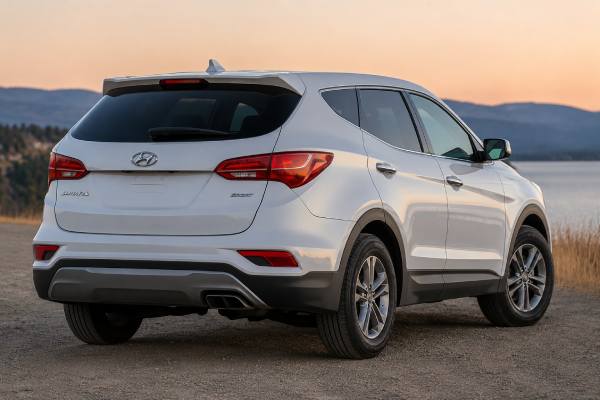
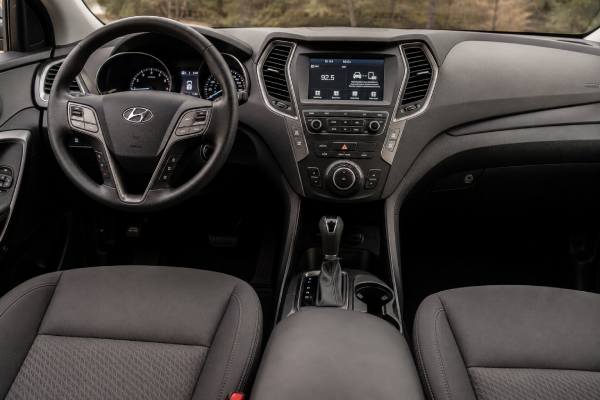
The facelifted 2017–2018 Hyundai Santa Fe Sport AWD with the 2.4-liter GDi engine is a practical five-seat crossover aimed at buyers who want useful space, winter traction, simple controls, and moderate running costs without moving up to the larger three-row Santa Fe. In North America, this version combines the naturally aspirated Theta II 2.4 GDi four-cylinder with a six-speed automatic transmission and on-demand all-wheel drive.
Its appeal is straightforward: it is roomy, comfortable, generally easy to live with, and well equipped for the price. The main caution is the engine family. The 2.4 GDi can be durable when serviced well, but buyers should treat oil consumption, bearing-noise history, recall completion, and knock-sensor software status as major inspection points before purchase.
Quick Specs and Notes
- Roomy five-seat cabin, large cargo area, comfortable ride, and useful AWD for snow and wet roads.
- 185 hp and 178 lb-ft make it adequate rather than quick, with best results when lightly loaded.
- The 2.4 GDi engine needs careful oil-level monitoring, clean service history, and recall/TSB verification.
- Typical normal-use oil service is around 7,500 miles or 12 months; severe use is best shortened to about 3,750–5,000 miles.
- Official EPA rating for the 2018 2.4 AWD is 20 mpg city, 26 mpg highway, and 22 mpg combined.
Table of Contents
- Santa Fe Sport DM AWD Context
- Santa Fe Sport 2.4 GDi Specs
- Santa Fe Sport Trims and Safety
- Reliability Issues and Recalls
- Maintenance and Used Buying
- Driving Performance and Economy
- Rivals and Ownership Verdict
Santa Fe Sport DM AWD Context
The 2017–2018 Santa Fe Sport sits in the facelifted part of Hyundai’s third-generation Santa Fe family. In the U.S. and Canada, “Santa Fe Sport” identified the shorter, two-row, five-passenger model, while the longer Santa Fe used three rows and a V6. The article scope here is the North American-style Santa Fe Sport AWD with the 2.4-liter gasoline direct-injection engine, six-speed automatic transmission, and 185 hp output.
The facelift brought revised exterior styling, improved cabin technology, updated safety availability, and structural changes that helped crash-test performance. The basic package remained familiar: a unibody crossover with MacPherson struts up front, a multi-link rear suspension, electric power steering, four-wheel disc brakes, and optional AWD across the range.
The 2.4 GDi is the base engine, but “base” should not be confused with inadequate for normal driving. It is a naturally aspirated inline-four, so it does not provide the low-rpm punch of the 2.0T turbo version. Instead, it delivers predictable throttle response, lower mechanical complexity, and acceptable performance for commuting, family errands, light road trips, and winter use. Drivers who often tow, climb steep grades with passengers, or expect strong passing performance will usually prefer the turbo model or a V6 rival.
The AWD system is an on-demand setup rather than a dedicated off-road 4×4 system. In normal steady driving, it behaves mostly like a front-drive crossover and sends torque rearward when slip or acceleration demand calls for it. A lock mode can help at low speeds in snow, mud, or loose surfaces, but the vehicle still depends heavily on tyre quality, ground clearance, and brake-based traction control. It has no low range and no mechanical locking differentials.
As a used purchase, the Santa Fe Sport 2.4 AWD is strongest for buyers who value comfort, equipment, cargo space, and purchase price. It is less ideal for buyers who want sharp handling, high fuel economy, strong towing ability, or a trouble-free engine record without careful inspection. The best examples are those with documented oil changes, completed Hyundai campaigns, no abnormal engine noise, no unresolved ABS recall, clean AWD driveline service, and no evidence of neglected maintenance.
Santa Fe Sport 2.4 GDi Specs
The following data focuses on the 2017–2018 Santa Fe Sport AWD 2.4 GDi in North American specification. Some values vary by production date, trim package, tyre size, country, and service documentation. Always verify fluid quantities, torque values, and equipment by VIN before servicing.
| Item | Santa Fe Sport AWD 2.4 GDi |
|---|---|
| Engine family / code | Theta II 2.4 GDi, commonly identified as G4KJ family; confirm by VIN |
| Layout | Inline-4, DOHC, 4 valves per cylinder, D-CVVT |
| Bore × stroke | 88.0 × 97.0 mm (3.46 × 3.82 in) |
| Displacement | 2.4 L (2,359 cc) |
| Induction | Naturally aspirated |
| Fuel system | Gasoline Direct Injection (GDi) |
| Compression ratio | 11.3:1 |
| Max power | 185 hp (138 kW) @ 6,000 rpm |
| Max torque | 241 Nm (178 lb-ft) @ 4,000 rpm |
| Timing drive | Timing chain |
| Rated efficiency | 9.0 L/100 km highway, 11.8 L/100 km city, 10.7 L/100 km combined; 26/20/22 mpg US; 31.2/24.0/26.4 mpg UK |
| Real-world highway at 120 km/h (75 mph) | Typically about 9.0–10.5 L/100 km (22–26 mpg US), depending on tyres, load, wind, roof rails, and terrain |
| Item | Specification |
|---|---|
| Transmission | 6-speed electronic automatic with SHIFTRONIC manual mode; Hyundai/Kia A6-series family, confirm exact code by VIN |
| Gear ratios | 1st 4.639, 2nd 2.826, 3rd 1.841, 4th 1.386, 5th 1.000, 6th 0.772, reverse 3.385 |
| Final drive | 3.648:1 for AWD 2.4 configuration |
| Drive type | On-demand AWD with electronically controlled coupling |
| Differentials | Open differentials with electronic traction control; no mechanical locker or LSD |
| Item | Specification |
|---|---|
| Front suspension | MacPherson strut, gas-filled damper, stabilizer bar |
| Rear suspension | Multi-link, gas shock absorbers, AWD rear stabilizer bar |
| Steering | Motor-driven power steering, 15.01:1 ratio, 2.95 turns lock-to-lock |
| Brakes | Front ventilated discs 320 mm (12.6 in); rear solid discs 302 mm (11.9 in) |
| Popular tyre size | 235/65 R17 on base 2.4; optional packages may use 235/60 R18 |
| Ground clearance | Approximately 180–185 mm (7.1–7.3 in), depending on tyre and market data |
| Length / width / height | 4,699 mm / 1,880 mm / 1,679 mm (185.0 in / 74.0 in / 66.1 in) |
| Wheelbase | 2,700 mm (106.3 in) |
| Turning circle | 10.9 m (35.8 ft), curb-to-curb |
| Curb weight | 1,721 kg (3,794 lb) |
| GVWR | 2,280 kg (5,027 lb) |
| Fuel tank | 65.9 L (17.4 US gal / 14.5 UK gal) |
| Cargo volume | 1,002 L (35.4 ft³) behind second row; 2,025 L (71.5 ft³) behind front seats, SAE method |
| Item | Specification or guidance |
|---|---|
| 0–100 km/h / 0–62 mph | Approximately 9–10 seconds in typical AWD 2.4 testing and estimates; not a Hyundai official rating |
| Top speed | Not officially emphasized; commonly estimated around 180–190 km/h (112–118 mph) |
| Braking distance | 100–0 km/h commonly around 38–42 m (125–138 ft from 62 mph), highly tyre-dependent |
| Towing capacity | 907 kg (2,000 lb) braked; 748 kg (1,650 lb) unbraked |
| Payload estimate | About 559 kg (1,233 lb), derived from GVWR minus listed AWD curb weight |
| Engine oil | API SM / ILSAC GF-4 or newer; SAE 5W-30 preferred, 5W-20 allowed in many markets; 4.8 L (5.1 US qt) with filter |
| Coolant | Ethylene-glycol long-life coolant, typically 50/50 premix; service refill varies by drain method |
| Automatic transmission fluid | Hyundai/Kia ATF SP-IV; total capacity commonly around 7.1 L (7.5 US qt), drain-and-fill amount lower |
| Transfer case / rear differential | Use Hyundai-specified hypoid gear oil by VIN; commonly 75W-90 GL-5 type in service practice |
| Key torque values | Oil drain plug about 39 Nm (29 lb-ft); wheel nuts commonly about 107–127 Nm (79–94 lb-ft), verify by official service data |
For safety data, the strongest public rating picture comes from U.S. agencies. IIHS rated the 2018 Santa Fe Sport as a Top Safety Pick+ only with optional front crash prevention and specific headlights built after June 2017. Base halogen headlights were rated Poor, which matters because many 2.4 AWD examples are base or package-equipped rather than Ultimate Tech models. NHTSA data for this generation is generally strong, with five-star overall ratings commonly listed for Santa Fe Sport, but exact sub-ratings should be checked for the specific model year and drivetrain.
Santa Fe Sport Trims and Safety
In the U.S. market, the 2018 Santa Fe Sport lineup centered on three main grades: base 2.4, 2.0T, and 2.0T Ultimate. The 2.4 AWD covered here is mechanically the entry powertrain but could be optioned with useful equipment packages. AWD itself was optional, so the simplest exterior identifier is the AWD badge and, inside, the presence of AWD-related controls and cold-weather equipment such as the windshield wiper de-icer on many AWD builds.
The base 2.4 normally used 17-inch alloy wheels with 235/65 R17 tyres. Higher trims used 18- or 19-inch packages, but wheel swaps on used vehicles are common, so wheels alone are not reliable proof of trim. The 2.4 has a single exhaust outlet treatment and no turbo badging, while 2.0T models are easier to identify by their engine badge, stronger tow rating, and different wheel/equipment combinations.
The most useful option path on the 2.4 was the Value Package, followed by Premium and Tech packages where fitted. These could add a larger display with Apple CarPlay and Android Auto, dual-zone automatic climate control, proximity key, heated front seats, Blue Link, blind-spot detection, rear cross-traffic alert, leather seating, power passenger seat, hands-free liftgate, panoramic sunroof, navigation, Infinity audio, ventilated front seats, heated steering wheel, and multi-view camera. A well-equipped 2.4 can therefore feel much more upscale than a basic cloth-seat example.
Safety equipment on all versions included stability control, traction control, ABS with brake assist and electronic brake-force distribution, downhill brake control, hill-start assist, tyre-pressure monitoring, front airbags, front side airbags, side-curtain airbags, and a driver’s knee airbag. LATCH anchors were provided in the second row.
Advanced driver assistance varied sharply by trim and package. A rearview camera was standard, but blind-spot detection and rear cross-traffic alert were optional on the 2.4 and standard on higher 2.0T trims. Smart cruise control, automatic emergency braking with pedestrian detection, lane-departure warning, high-beam assist, and dynamic bending lights were tied mainly to higher-level packages. That means two 2018 Santa Fe Sport AWD vehicles can have very different safety feature sets despite looking similar from outside.
Buyers should also understand calibration implications. Camera, radar, steering-angle, and wheel-speed related systems may require calibration or diagnostic checks after windshield replacement, collision repair, suspension work, alignment, steering rack service, or ABS-related repairs. Warning lamps that appear after body or chassis work should not be dismissed as minor electronic glitches.
Reliability Issues and Recalls
The Santa Fe Sport 2.4 AWD has a mixed reliability profile. The body, cabin, suspension layout, and six-speed automatic are generally conventional, but the Theta II GDi engine family needs more caution than many rival naturally aspirated engines. A clean example can be a good long-term vehicle; a neglected one can become expensive quickly.
Common to occasional engine concerns include oil consumption, low oil level between services, timing-chain noise, carbon buildup on intake valves, and, most importantly, connecting-rod bearing wear symptoms. Warning signs include a persistent knock from the lower engine, metallic debris in oil, oil-pressure warnings, check-engine light with knock-sensor-related codes, reduced-power “limp” operation, hard starting, or a no-start condition after noise develops. Any of these should be treated as high severity.
| Issue | Prevalence | Severity | Typical symptoms | Best response |
|---|---|---|---|---|
| Engine oil consumption | Occasional to common with age | Medium to high | Low dipstick level, exhaust smell, fouled plugs, owner topping up often | Document consumption test, inspect PCV, check leaks, avoid long intervals |
| Rod bearing wear / knock | Known concern in Theta II GDi family | High | Knocking, P1326, limp mode, no-start, metal in oil | Dealer diagnosis, KSDS status check, warranty/settlement review |
| GDi intake carbon buildup | Occasional | Medium | Rough idle, hesitation, reduced economy | Inspect intake valves, walnut blasting if needed |
| AWD coupling / driveline fluid neglect | Occasional | Medium | Binding, rear driveline noise, vibration under load | Inspect transfer case, rear differential, coupling operation and fluids |
| Suspension and wheel bearings | Age- and road-dependent | Low to medium | Clunks, humming, uneven tyre wear | Inspect control arms, links, bearings, alignment |
| ABS module fire-risk recalls | VIN-dependent | High | May show no symptoms before recall remedy | Run official VIN recall check and confirm dealer remedy completion |
The most important software-related item is Hyundai’s Knock Sensor Detection System update, often discussed in connection with Theta II GDi engine warranty extensions and settlement coverage. The system is designed to detect abnormal bearing-related vibration and trigger protective behavior before catastrophic failure. A used buyer should ask for printed dealer proof that the relevant campaign was completed, not simply rely on a seller’s statement.
ABS/HECU-related recalls are also essential. Certain 2017–2018 Santa Fe Sport vehicles were included in recall campaigns addressing an ABS module condition that could create an electrical short and engine-compartment fire risk. Remedies involved fuse-related repairs or updated campaign procedures, depending on VIN and recall phase. Because affected vehicles may have no obvious warning signs, the only responsible approach is to verify recall status through an official VIN check and dealer records.
Other inspection areas are more typical for a midsize crossover. Check for coolant seepage, oil leaks around the valve cover and timing cover area, cracked intake ducting, worn engine mounts, weak 12 V battery, corroded brake hardware in salt-belt states, rear parking camera issues, panoramic sunroof drain problems where equipped, and infotainment/navigation glitches. AWD versions should be inspected underneath for transfer-case seepage, rear differential leaks, damaged CV boots, and rust around suspension mounting points.
A pre-purchase inspection should include a cold start, hot idle, full scan for stored and pending codes, road test at city and highway speeds, oil-level check before and after the drive, inspection for recall labels or dealer records, and a review of maintenance receipts. A seller who cannot document oil changes on this engine deserves a lower offer or a walk-away decision.
Maintenance and Used Buying
Maintenance discipline matters more on the Santa Fe Sport 2.4 GDi than on many older port-injected crossovers. Direct injection, timing-chain operation, known engine-family concerns, and AWD hardware all reward shorter, consistent service intervals. The official maintenance schedule should remain the baseline, but many used buyers are better served by treating severe-use intervals as normal if the vehicle sees short trips, cold starts, urban traffic, heat, dust, mountain driving, or towing.
| Item | Practical interval | Notes |
|---|---|---|
| Engine oil and filter | 7,500 miles / 12 months normal; 3,750–5,000 miles for severe use | Use correct API/ILSAC oil; check dipstick every 1,000 miles on used examples |
| Engine air filter | Inspect every 15,000 miles; replace about every 30,000 miles or sooner | Dusty regions need shorter intervals |
| Cabin air filter | 12,000–15,000 miles or yearly | Replace sooner for weak airflow or odor |
| Spark plugs | About 60,000–100,000 miles depending on market schedule and plug type | Use OE-spec plugs; inspect earlier if oil consumption or misfire appears |
| Coolant | Inspect regularly; replace per official schedule or about 60,000–100,000 miles depending on coolant type | Use Hyundai-compatible long-life coolant and proper mix |
| Automatic transmission fluid | No routine service in some normal schedules; replace about 60,000 miles under severe use | Use ATF SP-IV only; avoid universal fluid unless it explicitly meets the specification |
| Transfer case and rear differential oil | Inspect about every 30,000 miles; service around 60,000 miles or after water exposure | Essential for AWD longevity, especially in snow-belt or towing use |
| Brake fluid | Every 2–3 years | Moisture contamination affects ABS and braking consistency |
| Tyre rotation and alignment | Rotate every 6,000–7,500 miles; align when wear appears | AWD needs matched tyre circumference across all four wheels |
| Timing chain | No fixed replacement interval | Inspect for rattle, correlation codes, tensioner/guide wear, or oil-starvation history |
| 12 V battery | Test yearly after 3 years; replacement often 4–6 years | Weak voltage can cause false electronic warnings |
For used buying, prioritize condition over trim. A lower-mile 2.4 AWD with full dealer history, completed recalls, clean oil records, and no engine noise is preferable to a loaded vehicle with missing receipts. During inspection, look underneath for salt corrosion at subframes, control arms, brake lines, exhaust hangers, and rear suspension hardware. Check the liftgate, rear camera, heated seats, climate control, steering-wheel buttons, parking sensors, blind-spot indicators, and infotainment functions.
A good road test should include light throttle, moderate kickdown, highway cruising, braking from speed, tight low-speed turns, and rough-road listening. The transmission should shift smoothly without flare, harsh engagement, or delayed reverse. The AWD system should not bind on dry pavement during parking maneuvers. Any humming that rises with vehicle speed may point to wheel bearings or tyres; clunks over bumps often come from sway-bar links, strut mounts, or bushings.
The best years within this narrow scope are both 2017 and 2018, provided recall and engine-campaign status is clean. The 2018 model may offer slightly better package availability and late-build headlight/safety advantages, but a well-maintained 2017 can be the smarter buy. Avoid examples with repeated low-oil history, unexplained engine replacement without paperwork, active recall warnings, rebuilt titles, mismatched tyres on AWD, overheating history, or sellers who resist a professional inspection.
Driving Performance and Economy
The Santa Fe Sport 2.4 AWD drives like a comfort-biased family crossover. Its ride quality is one of its better traits, especially on 17-inch wheels with taller sidewalls. The suspension absorbs broken pavement well and feels settled on highways. It is not sporty in the way its name may suggest, but it has enough composure for normal cornering and lane changes.
Steering effort is light to moderate, with more emphasis on ease than road feel. In city driving that makes the Santa Fe Sport simple to place and park, although the 10.9 m turning circle is average rather than tiny. On the highway, straight-line stability is good, and the cabin remains calm enough for long trips. Wind noise, tyre noise, and coarse-surface boom depend strongly on tyre brand and tread wear.
The 2.4 GDi’s power delivery is linear but not muscular. It makes peak torque at 4,000 rpm, so the six-speed automatic often needs to downshift for hills or passing. Around town, throttle response is predictable and smooth. At higher speeds with passengers, cargo, or a roof box, the engine works harder and becomes more audible. Drivers coming from a V6 or modern turbocharged crossover may find it modest; drivers coming from older compact SUVs will likely find it acceptable.
The six-speed automatic is generally smoother than many dual-clutch units and less complex than later multi-speed transmissions. It may hunt between gears on rolling grades, but harsh shifting is not normal. Drive Mode Select changes throttle and shift behavior, with Eco dulling response and Sport holding gears longer. Normal mode is usually the best match for the engine.
Real-world economy depends on use. In steady suburban and highway driving, 22–25 mpg US is realistic. Heavy urban use, winter fuel, idling, roof accessories, and short trips can bring consumption into the high teens. At 120 km/h, expect fuel use to rise noticeably because the Santa Fe Sport is broad, tall, and not especially light. Cold weather also reduces economy through denser air, longer warm-up, heated accessories, and winter tyres.
Towing should be approached conservatively. The official 2.4 rating is 2,000 lb with trailer brakes, which is suitable for small utility trailers, light campers, or compact recreational loads. It is not the best Santa Fe Sport variant for frequent towing. When loaded, leave extra braking distance, use fresh transmission fluid, keep cooling components healthy, and avoid sustained high-speed climbing in hot weather.
The AWD system is useful in rain, snow, and gravel, but tyres remain the deciding factor. A Santa Fe Sport AWD on worn all-seasons will not outperform a front-drive vehicle on good winter tyres in many conditions. With quality tyres, stable alignment, and functioning traction control, it is a confident winter vehicle for paved-road use.
Rivals and Ownership Verdict
Against rivals from the same period, the Santa Fe Sport 2.4 AWD makes its strongest case on cabin space, equipment value, comfort, warranty history for original owners, and used-market pricing. It is larger and roomier than many compact crossovers but easier to manage than three-row midsize SUVs.
The Toyota RAV4 of the era is usually more fuel-efficient and has a stronger reliability reputation, but it can feel less substantial and less refined inside. The Honda CR-V is more efficient and practical, especially in later turbocharged form, but used prices are often higher. The Mazda CX-5 handles better and feels more agile, but gives up cargo space and rear-seat room. The Ford Escape offers stronger turbo performance, yet its long-term ownership costs depend heavily on engine and transmission condition. The Kia Sorento shares some corporate engineering background and may offer three-row flexibility, but comparable engines and maintenance concerns should be checked just as carefully.
| Model | Strength versus Santa Fe Sport | Trade-off versus Santa Fe Sport |
|---|---|---|
| Toyota RAV4 AWD | Reliability reputation, resale value, fuel economy | Less cabin richness and often higher purchase price |
| Honda CR-V AWD | Efficiency, packaging, resale value | More expensive used; different engine concerns by year |
| Mazda CX-5 AWD | Handling, steering feel, cabin design | Less rear/cargo room and firmer ride |
| Ford Escape AWD | Turbo punch and compact size | Less spacious; condition-sensitive powertrains |
| Kia Sorento AWD | Available third row and similar value | Heavier; shared engine-family due diligence needed |
The Hyundai’s advantage is not that it beats every rival on one headline number. Instead, it combines a roomy body, comfortable ride, good safety structure, useful technology, and reasonable prices. The disadvantage is that buyers must be more careful about the engine than they would be with some naturally aspirated Japanese rivals.
A well-maintained 2017–2018 Santa Fe Sport AWD 2.4 GDi is worth considering for families, commuters in snowy regions, and buyers who want space without paying premium used-SUV prices. The smartest purchase is a clean, documented vehicle with completed Hyundai campaigns, no engine noise, stable oil level, matching tyres, smooth transmission behavior, and no corrosion surprises. The worst purchase is the cheap one with missing history and a seller who says “they all sound like that.”
References
- 2018 HYUNDAI SANTA FE SPORT SPECIFICATIONS 2018 (Manufacturer Specifications)
- 2018 HYUNDAI SANTA FE SPORT FEATURES & OPTIONS 2018 (Manufacturer Equipment Guide)
- Fuel Economy of 2018 Hyundai Santa Fe 2018 (Fuel Economy)
- 2018 Hyundai Santa Fe Sport 2018 (Safety Rating)
- Part 573 Safety Recall Report 22V-056 2022 (Recall Database)
Disclaimer
This article is for informational purposes only and is not a substitute for professional diagnosis, repair, or official service documentation. Specifications, torque values, service intervals, fluids, software campaigns, recalls, and procedures can vary by VIN, market, production date, equipment, and prior repairs. Always verify critical details against the official owner’s manual, service manual, recall database, and dealer records for the specific vehicle.
If you found this useful, please consider sharing it on Facebook, X/Twitter, or your preferred platform to support our work.