
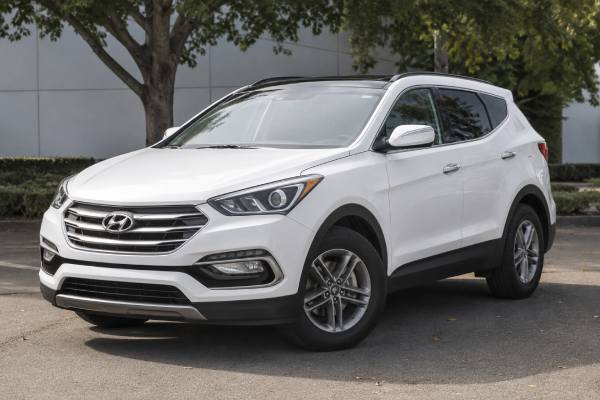
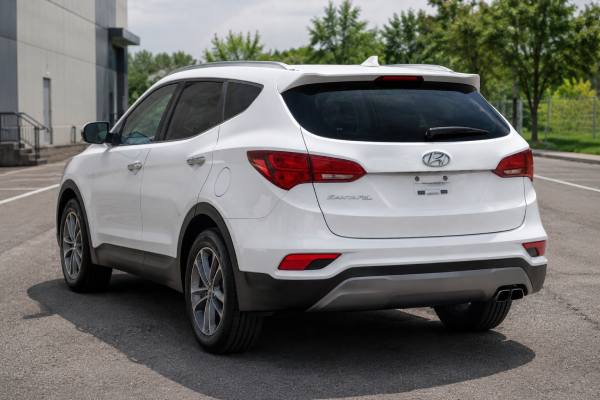

The facelifted Hyundai Santa Fe Sport AWD with the 2.0 T-GDi engine sits in a useful middle ground: larger and more substantial than many compact crossovers, but still easier to park and run than a full three-row SUV. In North American form, the 2017–2018 DM Santa Fe Sport is a two-row, five-seat crossover powered by Hyundai’s turbocharged 2.0-liter direct-injection four-cylinder engine, paired with a six-speed automatic transmission and available all-wheel drive.
As a used vehicle, its appeal is clear: strong mid-range torque, a comfortable cabin, generous equipment on 2.0T and Ultimate trims, and respectable safety credentials when fitted with the right driver-assistance package. The main caution is equally important: the Theta II turbo engine family needs careful service history, recall verification, oil-level monitoring, and attention to Hyundai engine-update campaigns.
What to Know
- The 2.0 T-GDi delivers 240 hp and 260 lb-ft, giving the Santa Fe Sport AWD confident passing power for its class.
- AWD versions add useful winter traction, and 2.0T models are rated to tow up to 3,500 lb when properly equipped.
- The best buys have complete oil-change records, matching tyres, documented recall completion, and no evidence of engine knock or oil consumption.
- Spark plugs on the turbo engine are typically due around 45,000 miles or 36 months; oil service should be no longer than 7,500 miles or 12 months, and shorter under severe use.
- Safety equipment varies sharply by trim, option package, and build date, especially headlights, AEB, smart cruise control, and lane-warning features.
Table of Contents
- Santa Fe Sport DM in Context
- Santa Fe Sport DM Technical Specs
- Santa Fe Sport DM Trims and Safety
- Reliability Issues and Service Actions
- Maintenance Schedule and Buying Checks
- Driving Feel and Real-World Pace
- Comparison Against Key Rivals
Santa Fe Sport DM in Context
The 2017–2018 Hyundai Santa Fe Sport AWD covered here is the facelifted version of the DM-generation two-row Santa Fe Sport, not the longer three-row Santa Fe sold in some markets as the Santa Fe XL or Grand Santa Fe. In the United States and Canada, the “Sport” name identified the shorter, five-passenger body. That distinction matters because dimensions, cargo space, safety results, trim names, and even equipment availability can differ from the longer three-row model.
The 2017 model year brought the major facelift. Hyundai revised the front and rear styling, lighting signatures, wheel designs, infotainment availability, and several driver-assistance options. The underlying formula stayed familiar: unibody construction, front MacPherson struts, rear multi-link suspension, electric power steering, four-wheel disc brakes, and a conventional torque-converter automatic transmission.
The 2.0 T-GDi is the more desirable engine for many used buyers. Compared with the naturally aspirated 2.4-liter base engine, it has much stronger torque at low and mid-range rpm, which suits the Santa Fe Sport’s weight. Official output is 240 hp at 6,000 rpm and 260 lb-ft from 1,450 to 3,500 rpm. That broad torque band is what makes the vehicle feel more relaxed on highway merges, steep grades, and loaded family trips.
All-wheel drive was optional rather than standard. The system uses an electronically controlled coupling to send torque rearward when needed, helped by brake-based traction control and Hyundai’s Active Cornering Control logic. It is not a locking off-road 4×4 system, but it is useful on snow, rain, gravel roads, and steep driveways. A low-speed AWD lock function can request a more even front-rear split in slippery conditions, though it is still meant for traction rather than serious trail work.
The Santa Fe Sport 2.0T AWD is best understood as a comfort-oriented crossover with useful power and good equipment value. It is not the sportiest SUV in its class, despite the “Sport” name, and its fuel economy is average rather than outstanding. Its strongest case is as a practical used family vehicle when the price is right and the service history is strong.
The main buying risk is the engine family. The Theta II turbocharged direct-injection engine has known campaigns and extended-coverage programs related to connecting-rod bearing wear, knock-sensor detection, and engine-protection software. Not every vehicle has a problem, but a clean inspection and verified campaign completion should be treated as essential, not optional.
Santa Fe Sport DM Technical Specs
The following data applies to the North American 2017–2018 Hyundai Santa Fe Sport AWD with the 2.0-liter turbocharged gasoline direct-injection engine. Some figures vary by trim, tyre size, market, production date, and equipment package.
| Category | Specification |
|---|---|
| Model | Hyundai Santa Fe Sport AWD, DM facelift |
| Model years | 2017–2018 |
| Body style | Five-door, two-row midsize crossover SUV |
| Seats | 5 |
| Engine family/code | Theta II 2.0 T-GDi, commonly identified as G4KH-family depending on market/VIN |
| Layout | Inline-4, aluminum block and head |
| Valvetrain | DOHC, 4 valves per cylinder, dual continuously variable valve timing |
| Bore × stroke | 86.0 × 86.0 mm / 3.39 × 3.39 in |
| Displacement | 2.0 L / 1,998 cc |
| Induction | Single turbocharger with intercooler |
| Fuel system | Gasoline direct injection |
| Compression ratio | 10.0:1 |
| Timing drive | Chain |
| Maximum power | 240 hp / 179 kW @ 6,000 rpm |
| Maximum torque | 353 Nm / 260 lb-ft @ 1,450–3,500 rpm |
| Transmission | 6-speed automatic with SHIFTRONIC manual mode |
| Drive type | Electronically controlled AWD |
| Differentials | Open front/rear differentials with brake-based traction control; no mechanical locking differential |
| Rated efficiency, 2.0T AWD | 12.4 city / 9.0 highway / 10.7 combined L/100 km; 19/26/22 mpg US; 22.8/31.2/26.4 mpg UK |
| Rated efficiency, 2.0T Ultimate AWD | 12.4 city / 9.8 highway / 11.2 combined L/100 km; 19/24/21 mpg US; 22.8/28.8/25.2 mpg UK |
| Real-world highway at 120 km/h / 75 mph | Commonly about 10.0–11.5 L/100 km, or 20–24 mpg US, depending on tyres, load, weather, and terrain |
| Chassis, dimensions, and capacity | Specification |
|---|---|
| Front suspension | MacPherson struts, coil springs, stabilizer bar |
| Rear suspension | Multi-link independent suspension, coil springs, stabilizer bar |
| Steering | Motor-driven power steering |
| Steering ratio | About 15.0:1 |
| Turning circle | 10.9 m / 35.8 ft |
| Front brakes | Ventilated discs, about 320 mm / 12.6 in |
| Rear brakes | Solid discs, about 302 mm / 11.9 in |
| Common 2.0T tyres | 235/60 R18 |
| Common 2.0T Ultimate tyres | 235/55 R19 |
| Ground clearance | About 185 mm / 7.3 in |
| Length | 4,699 mm / 185.0 in |
| Width | 1,880 mm / 74.0 in |
| Height | 1,679–1,689 mm / 66.1–66.5 in, depending on roof rails |
| Wheelbase | 2,700 mm / 106.3 in |
| Curb weight, 2.0T AWD | About 1,768 kg / 3,898 lb |
| Curb weight, 2.0T Ultimate AWD | About 1,863 kg / 4,107 lb |
| GVWR | About 2,340 kg / 5,159 lb |
| Estimated payload | About 477–572 kg / 1,052–1,261 lb, depending on trim and equipment |
| Fuel tank | 65.9 L / 17.4 US gal / 14.5 UK gal |
| Cargo volume, seats up | 1,002 L / 35.4 ft³, SAE method |
| Cargo volume, rear seats folded | 2,025 L / 71.5 ft³, SAE method |
| Braked towing capacity | Up to 1,588 kg / 3,500 lb |
| Unbraked towing capacity | About 748 kg / 1,650 lb |
| Performance and capability | Specification |
|---|---|
| 0–60 mph | About 7.6–8.4 seconds in instrumented testing, depending on trim and conditions |
| 0–100 km/h | About 8.0–8.8 seconds |
| Top speed | About 214 km/h / 133 mph where governed and conditions allow |
| 70–0 mph braking | High-180-ft range in independent testing |
| 100–0 km/h braking | Roughly 39–43 m depending on tyres, surface, and load |
| Tow rating | 3,500 lb braked on 2.0T models when properly equipped |
| Best use case | Family driving, winter commuting, highway travel, moderate towing |
| Fluids and service data | Specification |
|---|---|
| Engine oil | 5W-30 commonly preferred; use the API/ILSAC or ACEA specification required by the owner’s manual for the market |
| Engine oil capacity | About 4.8 L / 5.1 US qt with filter |
| Coolant | Ethylene-glycol coolant suitable for aluminum engines, normally mixed 50/50 with distilled water |
| Coolant capacity | Full-system service quantity varies by drain method and market; verify by VIN and service manual |
| Automatic transmission fluid | Hyundai/Kia ATF SP-IV specification |
| Automatic transmission capacity | Full fill about 7 L / 7.4 US qt; drain-and-fill amount is lower |
| Transfer case oil | SAE 75W-90 API GL-5 gear oil; about 0.6 L / 0.63 US qt |
| Rear differential oil | SAE 75W-90 API GL-5 gear oil; about 0.53 L / 0.56 US qt |
| Brake fluid | DOT 3 or DOT 4 brake fluid meeting the required standard |
| A/C refrigerant | R-134a; front system commonly about 600 ±25 g / 21.2 ±0.9 oz |
| A/C compressor oil | PAG-type oil, commonly FD46XG/PAG46 family; verify under-hood label |
| Wheel nut torque | 107–127 Nm / 79–94 lb-ft |
| Engine oil drain plug torque | About 39 Nm / 29 lb-ft with a new sealing washer |
| Safety and driver assistance | Specification |
|---|---|
| Airbags | Seven airbags, including front, front side, side curtain, and driver knee airbag |
| Child-seat provisions | LATCH/ISOFIX-style lower anchors for rear outboard seating positions and top tether anchors |
| Stability systems | ABS, EBD, brake assist, electronic stability control, traction control, hill-start assist, downhill brake control |
| IIHS 2017 | Top Safety Pick with optional front crash prevention; headlight rating limits overall result |
| IIHS 2018 | Top Safety Pick+ when equipped with optional front crash prevention and specific good-rated headlights after the relevant build date |
| NHTSA | Five-star overall safety rating for applicable U.S. Santa Fe Sport AWD configurations |
| AEB | Optional, mainly through Ultimate/technology packages; pedestrian detection available on equipped models |
| Smart cruise control | Optional on higher trims/packages |
| Lane support | Lane departure warning available; not a modern lane-centering system |
| Blind-spot monitoring | Standard or optional depending on year and trim; common on 2.0T and Ultimate |
| Rear cross-traffic alert | Standard or optional depending on trim |
| Traffic sign assist | Not a core feature of this model generation |
Santa Fe Sport DM Trims and Safety
For the 2017–2018 North American lineup, the relevant 2.0-liter turbo trims were generally the Santa Fe Sport 2.0T and Santa Fe Sport 2.0T Ultimate. AWD was available on these versions, while the base Santa Fe Sport used the naturally aspirated 2.4-liter engine. Trim naming and package content can vary between the United States, Canada, and other markets, so the original window sticker or VIN build sheet is valuable.
The regular 2.0T is the simpler used buy. It gives the stronger turbo engine, the six-speed automatic, the same basic body structure, and often the better-riding 18-inch wheel package. Many examples include blind-spot detection and rear cross-traffic alert, which are useful daily safety features because the rear pillars are fairly thick and urban parking visibility is not perfect.
The 2.0T Ultimate is the equipment-heavy version. It commonly brings larger 19-inch wheels, upgraded infotainment, navigation availability, premium audio, leather upholstery, panoramic sunroof availability, surround-view camera availability, rear parking sensors, and higher-grade lighting depending on package. The added equipment makes the cabin feel more upscale, but it also adds weight, tyre cost, sunroof complexity, and more electronics to inspect.
The 2017 facelift is easy to identify by its revised grille, front bumper, lighting details, and updated rear design. Inside, the facelifted models gained updated infotainment and a broader spread of active-safety technology. In practical terms, 2017 is the first year of the refreshed look, while 2018 is the final Santa Fe Sport model year before Hyundai changed the naming structure for the next generation.
The most important safety distinction is not simply 2017 versus 2018, but the exact lighting and driver-assistance package. In IIHS testing, the 2017 model achieved strong crashworthiness scores and qualified as a Top Safety Pick when equipped with optional front crash prevention, but its headlight performance held it back from the highest designation. For 2018, certain builds with the correct optional headlights and front crash-prevention system qualified for Top Safety Pick+.
That means two Santa Fe Sport 2.0T AWD vehicles can look similar but have meaningfully different safety equipment. A late-build 2018 Ultimate with the technology package, adaptive HID lighting, automatic high beams, automatic emergency braking, smart cruise control, and lane departure warning is a different safety proposition from a lower-spec 2.0T with halogen projector lamps and no AEB.
Airbag and structural safety are solid for the class. The vehicle includes seven airbags, stability control, traction control, anti-lock brakes, brake assist, hill-start assist, and downhill brake control. Rear child-seat installation is straightforward for most families, though the usual advice applies: test the exact child seats before purchase, especially if two seats and an adult must share the second row.
Driver-assistance service is one area buyers often overlook. Forward radar, camera-based systems, blind-spot sensors, and surround-view cameras can require calibration after windshield replacement, front-end repairs, bumper work, suspension alignment, or collision repair. If warning lights are present or a system has been disabled after bodywork, treat it as a repair item rather than a harmless dashboard message.
Reliability Issues and Service Actions
Reliability on the Santa Fe Sport 2.0T AWD depends heavily on maintenance quality, oil-change discipline, recall completion, and how the vehicle was used. A well-serviced example can be a comfortable long-term family SUV, but neglected turbocharged direct-injection engines are less forgiving than older naturally aspirated designs.
| Area | Prevalence and severity | Symptoms | Recommended action |
|---|---|---|---|
| Theta II bearing wear / knock detection | Occasional but high severity | Engine knock, flashing check-engine light, limp mode, DTC P1326 | Verify knock-sensor detection software campaign, inspect service records, perform diagnostic testing, and follow Hyundai repair procedure |
| Oil consumption | Occasional to common with age; medium to high severity | Low oil between services, smoke, fouled plugs, catalytic-converter stress | Document consumption, inspect PCV and leaks, perform official oil-consumption test where applicable |
| GDI carbon buildup | Occasional; medium severity | Rough idle, misfire, hesitation, reduced fuel economy | Inspect plugs/coils first, then intake valves if symptoms persist |
| Turbocharger and boost plumbing | Occasional; medium to high severity | Whine, smoke, oil seepage, underboost, loose intercooler hoses | Inspect turbo shaft play, oil feed/return lines, intercooler clamps, and boost-control components |
| Cooling system leaks | Occasional; medium severity | Coolant smell, overheating, low reservoir, crusted deposits | Pressure-test system, inspect radiator, water pump, hoses, thermostat housing |
| Six-speed automatic shift issues | Occasional; medium severity | Flare, harsh shifts, shudder, delayed engagement | Check fluid condition, use correct SP-IV fluid, scan TCU faults, update calibration if applicable |
| AWD coupler, transfer case, rear differential | Occasional; medium severity | Binding in tight turns, humming, clunks, uneven tyre wear | Replace fluids, inspect coupler operation, ensure four matching tyres |
| Suspension and wheel bearings | Common wear item; low to medium severity | Knocks, wandering, humming, uneven tyre wear | Inspect struts, bushings, ball joints, rear links, bearings, alignment bolts |
| Brakes and corrosion | Common in salt climates; low to medium severity | Pulsation, seized sliders, rusty rotors, weak parking brake | Service calipers, replace worn rotors/pads, inspect brake lines |
| Electronics, cameras, sunroof drains | Occasional; low to medium severity | Camera failure, water stains, warning messages, slow infotainment | Check drains, scan modules, inspect harnesses, update software where available |
The engine-related campaigns deserve special attention. Hyundai introduced knock-sensor detection software on many Theta II vehicles to detect abnormal bearing noise early and place the vehicle into a protective mode before catastrophic failure. If a Santa Fe Sport has not received the relevant update, or if its service history is incomplete, it carries more risk. Documentation matters: a receipt showing campaign completion is more useful than a seller’s verbal assurance.
The P1326 fault code is especially important. It can indicate the knock-sensor detection system has identified a potential bearing-wear condition. A seller who clears the code without proper diagnosis is a red flag. During a pre-purchase inspection, the vehicle should be scanned with a capable diagnostic tool, cold-started after sitting, driven under light and moderate load, and checked for stored, pending, and history codes.
Oil consumption is another key issue. Some engines may use oil as mileage rises, and low oil level is especially dangerous in a turbocharged engine. Buyers should check the dipstick before and after a test drive, inspect for service stickers or digital records showing short oil intervals, and look for blue smoke after extended idle or deceleration. A clean engine bay is not proof of health; consistent records are more valuable.
Recalls and service actions must be checked by VIN. Certain Santa Fe Sport vehicles were involved in ABS module fire-risk recalls requiring fuse or multi-fuse remedies. The core concern is an electrical short in the ABS module that could increase fire risk. Other recalls may apply to specific production ranges and components, including steering, airbags, or suspension parts. Because recall applicability is VIN-specific, the correct process is to check the official recall database and obtain dealer confirmation that every open campaign has been completed.
Driveline issues are less dramatic but still important. AWD versions are sensitive to tyre mismatch. Four tyres should be the same size, similar brand/model, and close in tread depth. Mismatched rolling diameters can overwork the AWD coupling and create binding or vibration. Transfer case and rear differential oil are often neglected because they are out of sight and not always emphasized during basic oil-change visits.
Corrosion depends strongly on climate. In snow-belt regions, inspect subframes, suspension arms, brake lines, fuel and evaporative lines, rear wheel arches, underbody seams, and fasteners around the rear suspension. Surface rust is expected on many older vehicles, but flaking structural corrosion, seized alignment bolts, or heavily corroded brake lines can turn a cheap SUV into an expensive one.
Maintenance Schedule and Buying Checks
The Santa Fe Sport 2.0T AWD responds well to conservative maintenance. Hyundai’s official schedule should always be followed for the vehicle’s market, but used buyers are better served by treating short trips, cold starts, turbo use, towing, dusty roads, and heavy city traffic as severe service.
| Item | Practical interval | Notes |
|---|---|---|
| Engine oil and filter | Up to 7,500 miles / 12 months normal; 3,750–5,000 miles / 6 months severe | Use correct 5W-30-grade oil meeting the required specification; capacity about 4.8 L / 5.1 US qt |
| Engine air filter | Inspect every 15,000 miles; replace around 30,000 miles or sooner if dirty | Dusty conditions shorten the interval |
| Cabin air filter | 12,000–15,000 miles or annually | Important for HVAC airflow and demisting |
| Spark plugs | About 45,000 miles / 36 months | Turbo GDI engines are sensitive to plug condition and gap |
| Coolant | First service around 60,000 miles / 60 months, then about 30,000 miles / 24 months | Use the correct coolant type and bleed procedure |
| Brake fluid | Test annually; replace every 2–3 years | Moisture contamination affects ABS and pedal feel |
| Brake pads, rotors, calipers | Inspect at every service | Check slider pins and rear brake corrosion in salt climates |
| Automatic transmission fluid | No casual “universal ATF”; severe service around 60,000 miles, often sooner for towing/city use | Use Hyundai/Kia SP-IV specification and correct temperature-level procedure |
| Transfer case and rear differential oil | 40,000–60,000 miles depending on use | Shorten interval for towing, snow, water exposure, or heavy loads |
| Tyre rotation | Every 7,500 miles or at each oil service | Keep tread depths closely matched on AWD models |
| Wheel alignment | Check annually or after impacts/uneven wear | Rear adjustment bolts can seize on rusty vehicles |
| Serpentine belt and hoses | Inspect from 60,000 miles, then regularly | Replace cracked, glazed, swollen, or noisy components |
| Timing chain | No routine replacement interval | Inspect for cold-start rattle, guide wear, tensioner issues, and cam/crank correlation faults |
| Fuel filter | Generally not a routine external service item | Inspect fuel pressure and in-tank components only when symptoms justify it |
| Valve clearance | No normal scheduled adjustment | Investigate only if noise, misfire, or compression symptoms appear |
| 12 V battery | Test annually after 3 years; replace commonly around 4–5 years | Weak voltage can cause misleading electronic faults |
| A/C system | Check cooling performance annually | Confirm refrigerant type and charge from the under-hood label |
| ADAS calibration | After windshield, bumper, steering, suspension, or collision repairs | Misalignment can disable or degrade driver-assistance systems |
For buyers, the first inspection should start before the test drive. Check the VIN against official recall data, ask for campaign completion records, and review oil-change history. A 2.0T with 5,000-mile oil intervals and documented Hyundai campaign work is more attractive than a cleaner-looking vehicle with vague service records.
A proper test drive should include a cold start, idle period, city-speed operation, highway acceleration, gentle cruising, full steering lock in a parking lot, and moderate braking. Listen for engine knock, timing-chain rattle, turbo whistle, suspension clunks, wheel-bearing hum, transmission flares, and AWD binding. Watch for smoke after idling and after a downhill coast followed by throttle.
The engine oil level should be checked before purchase. Very low oil, dark sludge under the oil cap, metallic noise, or a seller who says “these all burn oil” should slow the deal down immediately. Some oil use on an older turbo vehicle may be manageable, but unexplained consumption can lead to expensive repairs.
Undercar inspection is equally important. Look for oil around the turbo lines, front timing cover, valve cover, oil pan, transfer case, rear differential, and transmission case. Check the coolant reservoir, radiator seams, water pump area, and heater-hose connections. On AWD models, inspect the prop shaft, rear differential mounts, axle boots, and tyre matching.
Recommended versions depend on priorities. A 2018 2.0T Ultimate with the right technology package is the strongest choice for safety equipment, especially if it has the good-rated headlight setup. A regular 2.0T AWD on 18-inch wheels can be the better value for comfort, tyre cost, and reduced complexity. Vehicles to avoid include those with open recalls, unexplained engine noise, low oil, repeated P1326 or misfire codes, mismatched tyres, neglected AWD fluids, or signs of water intrusion from the panoramic roof.
Long-term durability is realistic but not automatic. The body, cabin, suspension layout, and automatic transmission can age well with routine care. The engine is the decisive factor. Conservative oil changes, correct fluids, prompt recall work, and regular level checks make a much larger difference on this vehicle than cosmetic condition alone.
Driving Feel and Real-World Pace
The Santa Fe Sport 2.0T AWD drives like a comfort-biased family crossover with a useful reserve of torque. It is not sharp in the way a smaller Mazda CX-5 or sport-tuned European SUV can be, but it feels stable, settled, and easy to place. The steering is light at low speed and gains some weight on the highway, though feedback through the wheel is limited.
Ride quality is one of the better points, especially on 18-inch tyres. The suspension absorbs broken pavement with reasonable compliance, and the longer wheelbase gives the vehicle a more substantial feel than many compact SUVs. The 19-inch Ultimate wheel package looks better and can sharpen initial response slightly, but it also transmits more impact harshness and increases tyre replacement cost.
The turbo engine suits the vehicle well. Peak torque arrives early, so the Santa Fe Sport does not need to be revved hard in normal traffic. There can be a small delay as the turbo builds boost, especially from a rolling start, but the response is generally smooth rather than abrupt. Once moving, the 2.0T has enough power for confident merging and passing.
The six-speed automatic is conventional and generally pleasant. It is not as quick as newer eight-speed or dual-clutch units, but its shift quality is predictable when healthy. In hilly terrain, it may hunt between gears if the vehicle is loaded or towing, and sport/manual mode can help hold a lower gear on grades. Harsh engagement, repeated flare, or shudder should not be dismissed as normal.
Measured performance depends on trim, tyres, weather, and test method. Independent tests have placed 0–60 mph acceleration in the high-seven to mid-eight-second range. That is quick enough to feel strong in daily use, although the Santa Fe Sport’s weight keeps it from feeling genuinely sporty. Passing performance is more impressive than the headline 0–60 number because the engine’s mid-range torque is broad.
Braking feel is secure but not especially athletic. The pedal is easy to modulate in daily driving, and the vehicle tracks straight when the brakes and tyres are in good condition. With a full load or trailer, stopping distances increase noticeably, so tyre quality, brake-fluid condition, and trailer-brake setup matter.
Real-world economy is the tradeoff for the stronger turbo engine and AWD. In mixed use, many owners should expect roughly 10.7–12.4 L/100 km, or about 19–22 mpg US and 23–26 mpg UK. Urban short-trip use can climb into the 13–15 L/100 km range, especially in winter. Steady highway driving at 100–110 km/h can be noticeably better, while 120 km/h / 75 mph cruising with roof rails, winter tyres, hills, or cargo often lands closer to 10.0–11.5 L/100 km.
Cold weather affects this vehicle in several ways. The turbo engine runs richer during warm-up, AWD adds drag, winter tyres increase rolling resistance, and heated accessories add load. A 10–20 percent winter economy penalty is realistic, and short trips can be worse because the engine may rarely reach full operating temperature.
The AWD system is most useful in poor weather rather than performance driving. It helps the Santa Fe Sport pull away on snow, climb slippery roads, and maintain stability when accelerating out of wet junctions. It cannot overcome poor tyres, and it does not turn the vehicle into an off-roader. With good winter tyres, however, the system gives the Santa Fe Sport a reassuring all-weather character.
For towing, the 3,500-lb rating is useful but should be treated sensibly. A small camper, utility trailer, personal watercraft, or light boat is within the vehicle’s intended range when properly equipped. On long grades or in hot weather, keep speeds moderate, use trailer brakes where required, avoid overloading the rear axle, and shorten transmission and AWD fluid intervals. Fuel use can worsen by 25–40 percent under moderate towing.
Comparison Against Key Rivals
The Santa Fe Sport 2.0T AWD competes with a mix of compact-plus and midsize two-row SUVs. Its closest rivals are vehicles such as the Ford Edge, Nissan Murano, Kia Sorento, Subaru Outback, Toyota RAV4, Honda CR-V, and Mazda CX-5, depending on what the buyer values most.
| Rival | Where the Santa Fe Sport 2.0T AWD is stronger | Where the rival may be better |
|---|---|---|
| Ford Edge 2.0 EcoBoost AWD | Often better value used, generous equipment, strong torque feel | Edge has a wider cabin and more polished road manners in some trims |
| Nissan Murano V6 AWD | Turbo torque and towing usefulness; more conventional SUV feel | Murano has a smoother V6 and more premium cruising character |
| Kia Sorento AWD | Santa Fe Sport is simpler as a two-row vehicle and often easier to shop | Sorento offers three-row availability and V6 options |
| Subaru Outback 3.6R | Stronger upright SUV feel, higher seating position, better turbo torque | Outback has better rough-road image, wagon practicality, and standard AWD |
| Honda CR-V 1.5T AWD | More power and higher tow rating | CR-V is more efficient, newer-feeling, and easier to run |
| Toyota RAV4 AWD | More substantial size and stronger engine output | RAV4 has stronger resale value and simpler long-term ownership reputation |
| Mazda CX-5 AWD | More cabin space and tow rating advantage | CX-5 has sharper steering and a more refined driver-focused feel |
The Santa Fe Sport’s strongest advantage is value. Compared with a Toyota or Honda of similar age and mileage, it can offer more equipment and power for the money. Heated features, panoramic roof availability, premium audio, navigation, blind-spot monitoring, and surround-view camera equipment are easier to find at reasonable prices.
Against the Ford Edge, the Hyundai feels slightly narrower and less lounge-like, but it is often cheaper to buy and can be well equipped. Against the Murano, the Hyundai’s turbo four-cylinder has a more purposeful low-rpm punch, while the Nissan’s V6 is smoother and quieter under load. Compared with the Sorento, the Santa Fe Sport is the more focused two-row choice; the Sorento makes more sense if a third row or V6 is a priority.
The Toyota RAV4 and Honda CR-V are the safer choices for buyers focused on fuel economy and resale value, but they do not match the Santa Fe Sport 2.0T’s torque, tow rating, or midsize feel from the same era. The Mazda CX-5 is better for enthusiastic drivers, though 2017–2018 CX-5 models did not yet offer the later turbo engine in many markets.
The final decision should come down to condition and documentation. A well-maintained Santa Fe Sport 2.0T AWD with completed recalls, strong oil-change history, matching tyres, clean diagnostics, and no engine noise can be a satisfying used crossover. A neglected one can erase its purchase-price advantage quickly. For buyers willing to inspect carefully, the 2017–2018 facelift model offers a strong blend of power, comfort, equipment, and winter usability.
References
- 2018 HYUNDAI SANTA FE SPORT SPECIFICATIONS 2018 (Manufacturer Specifications)
- 2018 HYUNDAI SANTA FE SPORT FEATURES & OPTIONS 2018 (Manufacturer Equipment Guide)
- 2018 Hyundai Santa Fe Sport 2018 (Safety Rating)
- Vehicle Detail Search – 2017 HYUNDAI SANTA FE SPORT SUV AWD | NHTSA 2017 (Safety Rating and Recall Database)
- Recall 218: ABS Module Multi-Fuse Installation 2023 (Recall Service Campaign)
Disclaimer
This information is provided for general informational purposes only and is not a substitute for professional diagnosis, repair, or inspection by a qualified technician. Specifications, torque values, fluid capacities, maintenance intervals, software campaigns, and procedures can vary by VIN, market, production date, trim, and installed equipment. Always verify critical data against the official owner’s manual, factory service information, recall database, and dealer records for the exact vehicle.
If this helped you evaluate the Hyundai Santa Fe Sport AWD, consider sharing it on Facebook, X/Twitter, or another platform to support our work.